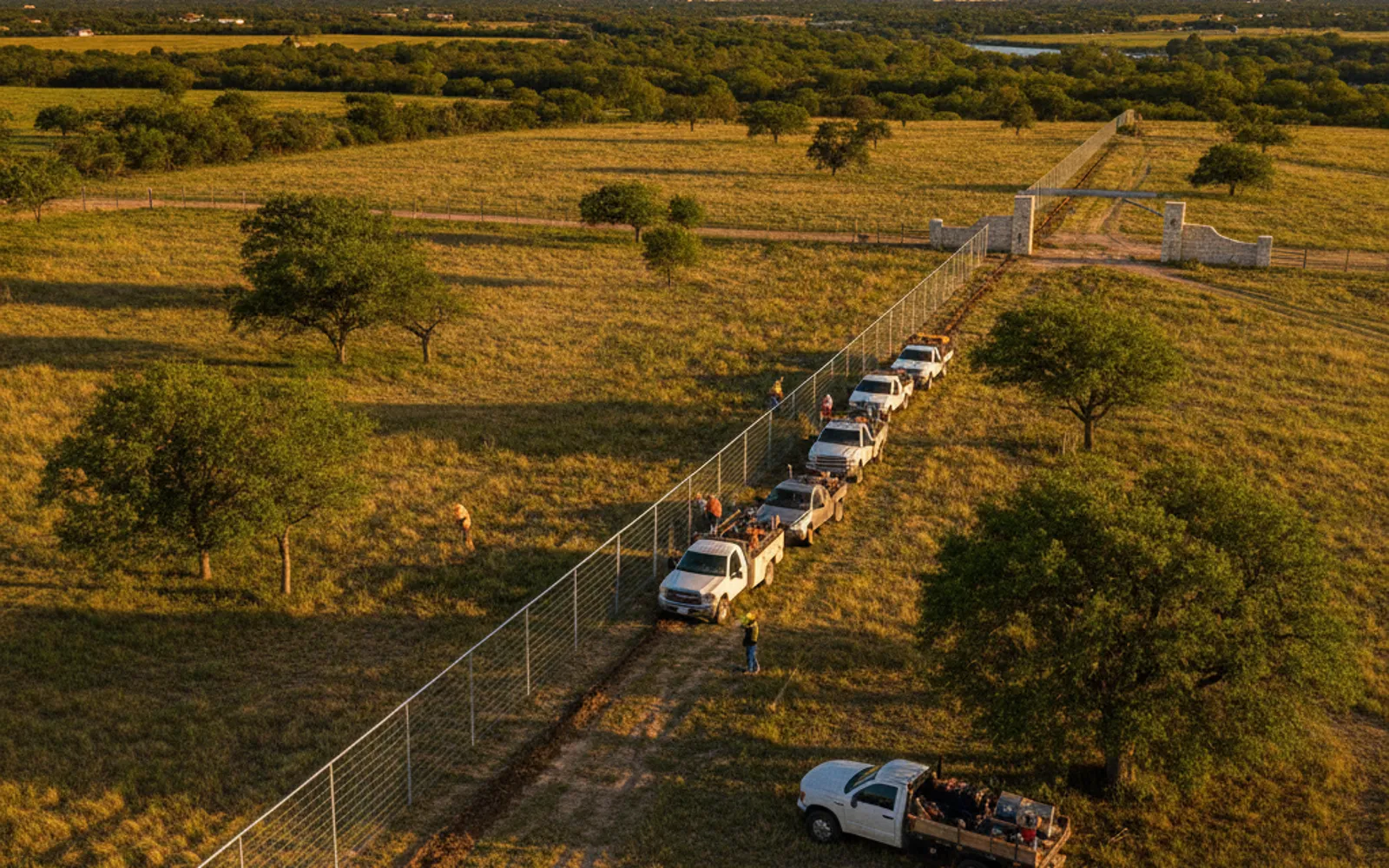
Woven field fence that holds what barbed wire lets through. Fixed-knot and hinge-joint in 32, 39, and 47 inch heights, stretched tight and braced to stay that way.
If barbed wire is not holding what you are running, net wire is usually the answer. Brazos Ridge Fence Co. installs woven field fence across McLennan, Bosque, and Falls counties, from a 32-inch cattle-tight perimeter to 47-inch fixed-knot that keeps goats in and coyotes out. Most net wire around Waco runs $3.50 to $8 per linear foot installed, depending on wire class, mesh spacing, and how rough the ground is.
Net wire is a different animal from barbed wire to build. It comes in 330-foot rolls that weigh a few hundred pounds, it has to be stretched evenly across the full height or the bottom goes slack first, and it pulls harder on a corner than five strands ever will. Our guide on barbed wire vs net wire covers which one fits your livestock. This page covers what we build, how we build it, and what it costs.
Fixed-knot wire holds tension for decades and shrugs off an animal hitting it at speed. Hinge-joint costs less and gives a little. We quote both so the difference shows up in dollars instead of adjectives.
Height comes from what you are keeping in. Thirty-two inches for a cattle-tight perimeter, 39 for calves and sheep, 47 where you have goats or predator pressure. Barbed strands on top add height cheaply.
Openings tight at the bottom and wider toward the top, so a calf or a kid cannot slip under while the fence stays affordable across the full height. Six-inch stays where the stock warrants it.
Class 3 coating carries roughly three times the zinc of Class 1. On a fence you intend to build once and leave alone, it is the cheapest real upgrade on the bid.
In-line strainers, dead-men on the long runs, and H-braces sized for the pull. Net wire that sags along the bottom was almost always stretched wrong rather than built wrong.
A barbed strand above keeps cattle from leaning the fence over, and one below keeps hogs from rooting under it. Both are cheap insurance on a woven fence.
Most net wire and field fence in Central Texas runs $3.50 to $8 per linear foot installed. That works out to roughly $18,000 to $42,000 per mile. Where you land depends on four things, in about this order of importance.
Corners, gates, and clearing are quoted as separate line items rather than smeared across the per-foot number, so you can see what the fence costs and what the site work costs. Our ranch fence cost guide puts net wire side by side with barbed wire, pipe, and game fence if you are still deciding.
Hinge-joint field fence is what most people picture when they hear "net wire." The vertical stays wrap around the horizontal line wires, and that joint is designed to flex. When a cow leans into it, the fence gives and springs back. When a cow leans into it every day for six years, the joint stops springing back and you get a permanent belly in the fence.
Fixed-knot wire uses a separate piece of wire tied at every intersection. Nothing hinges, so nothing works loose. It is high-tensile steel, which means it holds tension through heat and cold instead of going slack every August, and it takes an impact without deforming. It is the same construction we use on 8-foot game fence, for the same reason.
The practical rule: if the fence is a cross fence you might move in five years, hinge-joint is fine and the savings are real. If it is a perimeter, or it is going somewhere you do not want to walk again for twenty years, buy fixed-knot. The wire is maybe a third more; the labor to build it is identical, which is why the total difference is smaller than people expect.
Flat ground is easy. Almost nothing around here is flat. Net wire has to follow the contour of the land without leaving a gap at every low spot, and the way you get that is with more posts through the dips and rises, not with more tension.
We stretch in runs between braced ends, pulling the whole roll evenly with a stretcher bar rather than yanking on individual wires. Pulling one line wire tight and the rest loose is how you get a fence that is tight at the top and useless at the bottom, which is exactly where goats, calves, and hogs test it. On long runs we set in-line braces so no single stretch is carrying more than it should.
Where a line crosses a draw or a creek, we build a water gap that is meant to be rehung rather than a stretch of fence meant to hold. Anything else washes out the first real rain and takes a hundred feet of good fence with it. On the rocky ground west of Valley Mills and Meridian, post holes get drilled; our notes on setting posts in rocky ground and setting posts in clay explain why the same fence gets built two different ways depending on which side of the river you are on.
Barbed wire works by discomfort. An animal touches it, decides against it, and stays put. That works well on mature cattle and works poorly on anything smaller, faster, or more determined.
Net wire works by physically not having a hole. That matters for goats and sheep, which will walk through a five-strand fence without slowing down; for young calves, which slip under the bottom wire and then panic on the wrong side; for horses, where the safety argument runs the other direction and no-climb mesh is what you want instead of barbs; and for keeping things out, including coyotes and, with a tight bottom, feral hogs.
Plenty of places end up with both. A cattle perimeter in barbed wire, a net wire trap near the house for the smaller stock, and a hot wire offset where the bulls lean. We build all of it, and we would rather tell you which sections genuinely need woven wire than sell you woven wire around the whole place.
We build net wire and field fence within about an hour of Waco, across McLennan, Bosque, and Falls counties. That covers the small acreage and horse places around China Spring, Lorena, and Hewitt, the goat and sheep country around Clifton and Meridian, and the farm ground north and south toward West and Marlin.
Estimates are free and come in writing, with the wire class and mesh spacing spelled out so you can compare our bid against anyone else on the same terms. Call and we will come walk the line.
Most net wire and field fence runs $3.50 to $8 per linear foot installed, or roughly $18,000 to $42,000 per mile. Hinge-joint on T-posts sits at the low end; 47-inch fixed-knot on pipe posts sits at the high end. Clearing and gates are quoted separately. We give you an exact written number after we walk the line.
It depends on the animal. Thirty-two inches is a cattle-tight perimeter and will not hold much else. Thirty-nine inches handles calves and most sheep. Forty-seven inches is what you want for goats, for predator pressure, or anywhere you plan to add barbed strands on top for extra height. Deer and exotics need 8 feet, which is a game fence rather than field fence.
On a perimeter, yes. Fixed-knot holds tension through Texas heat and cold instead of going slack, and it takes an animal hitting it without permanently deforming. The wire costs about a third more but the labor is identical, so the difference on the total bid is smaller than people expect. On a temporary cross fence, hinge-joint is a reasonable way to save money.
Sometimes. If the posts are sound and spaced right, we can pull the old wire and hang net wire on them, which saves real money. What almost never carries over is the corners. Net wire pulls far harder than barbed wire, and old corner assemblies built for five strands will lean the first season. We look at the corners first and tell you honestly what can be reused.
It helps a great deal, but hogs go under rather than through. A tight bottom wire, a barbed strand run low, or a buried apron is what actually stops them. Our post on feral hog fence damage covers what works and what people waste money on.
Real prices and honest how-to advice from the same crew that will build your fence:
See the rest of what we build on the services page, or find your town on the service areas page.
Free written estimates. Emergency calls answered around the clock.
Most barbed wire fence around Waco runs $2.50 to $5.50 per foot installed, and game fence runs $4.50 to $10, so a written quote costs you nothing but a walk down the fence line. Call (254) 870-8898 or email info@brazosridgefence.com and we'll get you a free written estimate this week.
Call (254) 870-8898Around-the-clock line — a person answers, not a machine.