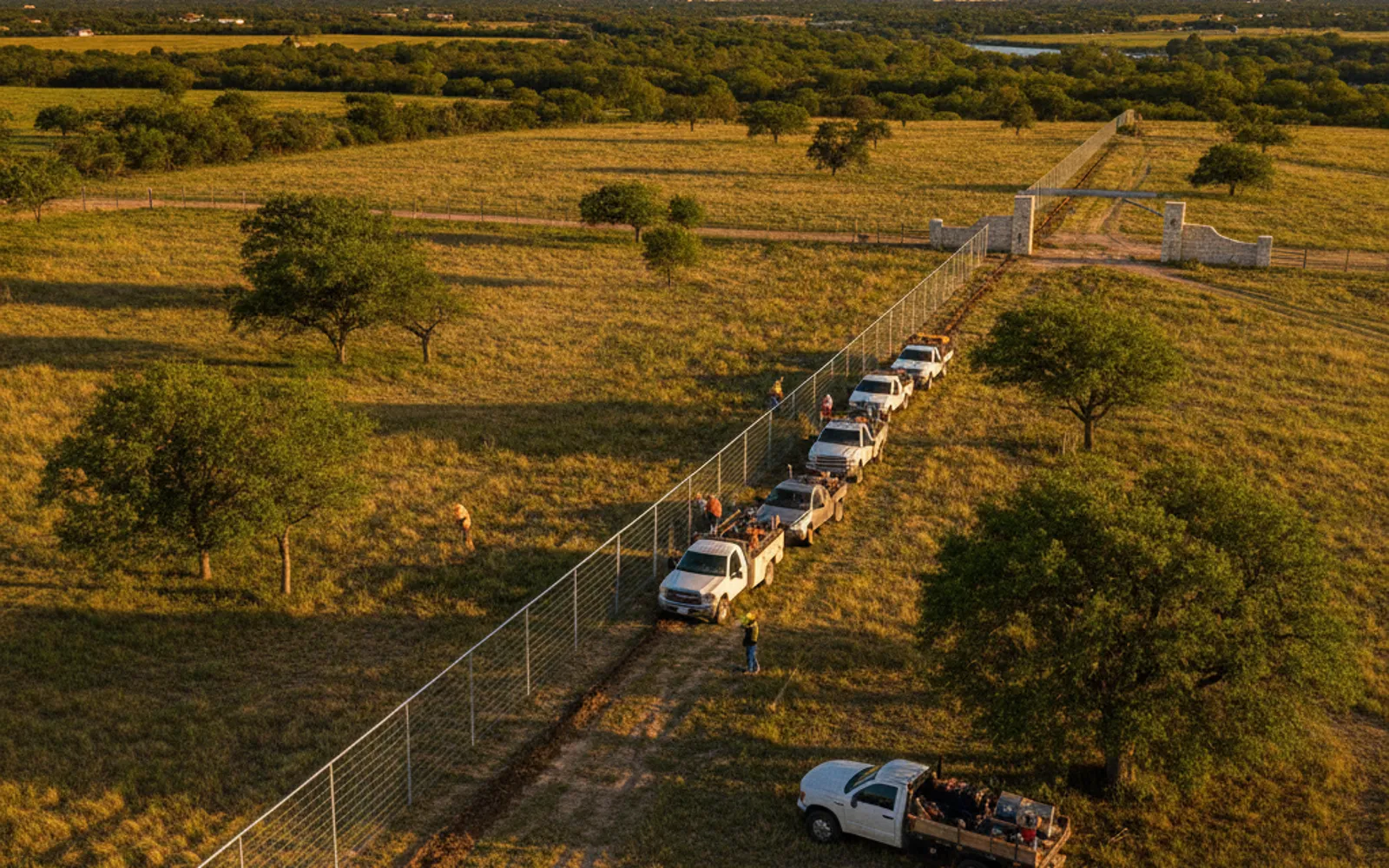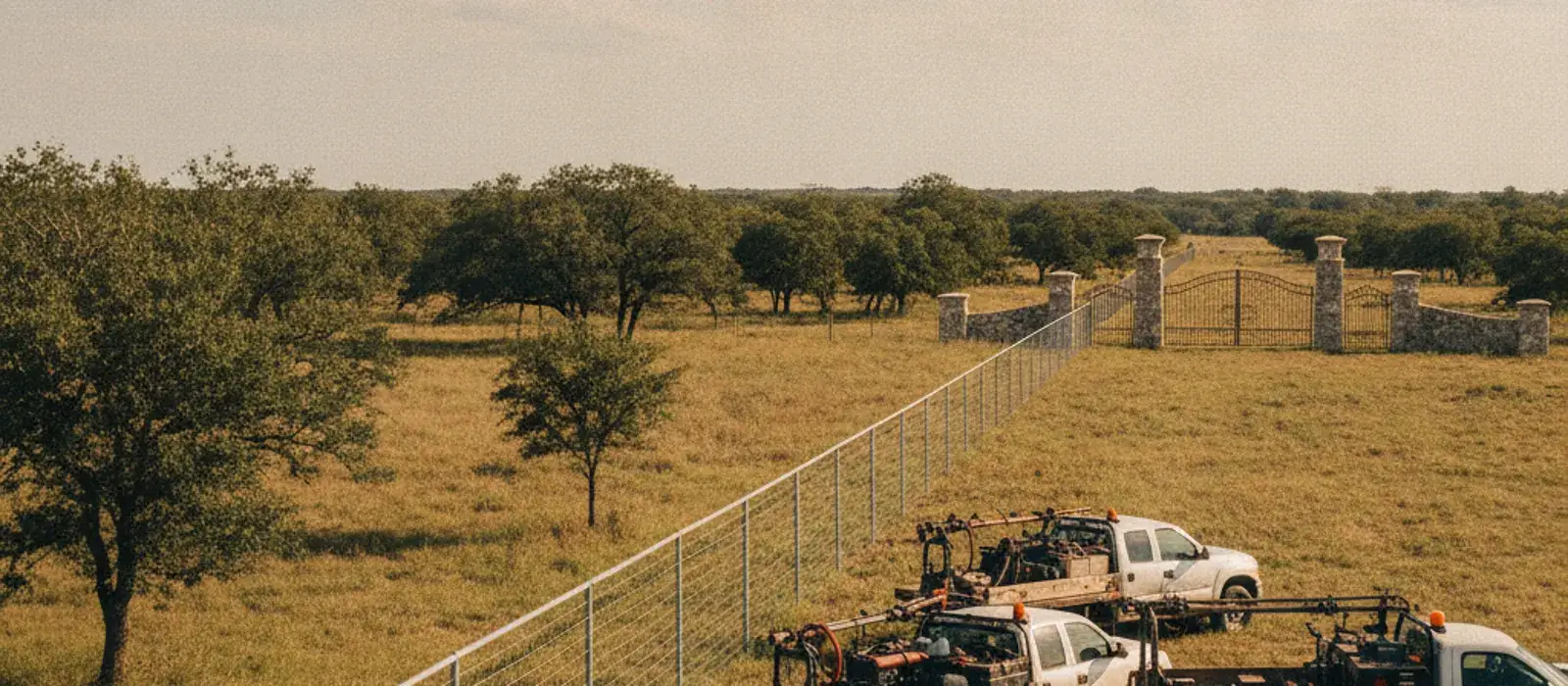
Here’s a number that surprises most landowners: stretching your post spacing from 12 feet to 20 feet on a mile of barbed wire fence cuts out about 175 posts. At $12 to $20 per T-post installed, that’s $2,100 to $3,500 back in your pocket per mile. So why doesn’t everybody run posts at 20 feet and call it a day?
Because fence post spacing isn’t one number. It changes with the wire you’re hanging, the animals you’re holding, the ground you’re driving into, and how hard the pressure hits the fence. Get it right and your fence stands tight for 25 years. Get it wrong and you’re walking the line every spring pushing leaning posts back up and splicing sagging wire.
We build barbed wire, net wire, and pipe fence all over McLennan, Bosque, and Falls counties, and post spacing questions come up on almost every estimate. This guide gives you the real numbers we use in the field, what they cost, and where cheap spacing turns expensive.
Not sure what spacing your place needs? Call us at (254) 870-8898 and we’ll walk your fence line with you. Written estimates are free.
Why Fence Post Spacing Matters More Than Most People Think
Posts do two jobs. They hold the wire at the right height, and they take the hit when something pushes on the fence. Wire does the actual stopping. That’s why a well-braced fence with good wire tension can run wider spacing than most folks expect, and why a fence with weak corners fails no matter how many posts you drive.
Wider spacing saves money up front. Tighter spacing spreads out impact, keeps wire heights honest over uneven ground, and gives cattle less room to work a gap. The right answer sits between those two pulls, and it’s different for each fence type.
One more thing before the numbers. Post spacing only works if your corners and ends are built right. A line post at 15 feet on centers means nothing if the H-brace at the corner is leaning. If your corners are suspect, read our guide on H-brace fence corners before you worry about anything between them.
Barbed Wire Fence Post Spacing: The 12 to 20 Foot Range
For a standard 5-strand barbed wire cattle fence in Central Texas, we set line posts at 12 to 15 feet for most jobs. On flat, open country with light cattle pressure, you can stretch to 16 or even 20 feet if the wire is high-tensile and the braces are stout. Texas A&M AgriLife Extension and most land-grant fencing guides put acceptable barbed wire spacing in that same 12 to 20 foot window, with tighter spacing where pressure is higher.
Here’s how we decide where to land in that range:
- 12 feet: Heavy cattle pressure, bulls, fence lines along roads, pens and traps, rolling ground.
- 15 feet: The workhorse spacing. Standard pasture fence for cow-calf operations on decent ground.
- 16 to 20 feet: Big open pastures, light stocking, straight flat runs, high-tensile wire, budget matters.
Most of our barbed wire jobs run a wood post every fourth or fifth post with T-posts between. The wood posts add stiffness to the line and give you something solid to tie into. On rocky ridges west of the Bosque River we sometimes flip that ratio because driving wood posts in rock gets expensive fast. If that’s your ground, our post on setting fence posts in rocky ground covers your options.
A quick story from Crawford. Dale runs about 60 cow-calf pairs on 300 acres, and the previous owner had built the perimeter with T-posts on 25-foot centers to save money. The wire heights wandered, the stays had slid, and his cows learned to push between strands. He lost two calves through the fence onto a county road before he called us. We added posts to bring the line to 12.5-foot centers and rebuilt six braces for $4,800. That’s real money, but one vet bill and one liability scare made the math easy for him.
Sagging wire between wide-set posts is the most common symptom we see. If your fence already droops, start with our guide on how to fix a sagging barbed wire fence, then decide if the spacing itself is the disease.
Net Wire Post Spacing for Sheep, Goats, and Horses
Net wire (field fence) needs tighter post spacing than barbed wire. The mesh carries more wind load, catches more weight when animals lean or climb, and shows every dip in the ground. We set net wire posts at 8 to 12 feet on most jobs.
Goats are the deciding factor more often than not. A goat treats a fence like playground equipment. They stand on it, rub it, and climb corners. For goat and sheep fence we hold spacing at 8 to 10 feet, run a barbed strand on top, and keep the bottom wire snug to the dirt. Horses do fine at 10 to 12 feet with fixed-knot net wire, which holds its shape better than hinge-joint when a hoof strikes it.
Terrain moves this number too. Net wire can’t bend over a hump or dip the way individual barbed strands can. Every grade change needs a post to hold the mesh at the right height, so hilly ground pulls your average spacing tighter whether you planned it or not.
The Hendersons in Valley Mills learned this the expensive way. They fenced 12 acres for Boer goats with hinge-joint net wire on 16-foot centers, a spacing the feed store had suggested for cattle. Within a year the mesh had bellied out between posts, the goats were flattening it at the low spots, and three got into a neighbor’s coastal field. We rebuilt 1,900 feet with fixed-knot wire on 10-foot centers for about $6.75 a foot, roughly $12,800 total. Their original fence had cost them close to $9,000 and lasted 14 months.
If you’re planning a small-acreage net wire job and want it done once, reach out for a free written estimate. We’ll spec the wire, the spacing, and the braces in writing so you can compare it against any other bid.
Pipe Fence Post Spacing and Why It Runs Tighter
Pipe fence flips the logic. With barbed and net wire, the wire does the stopping and posts just hold position. With pipe fence, the posts and rails ARE the fence. That’s why pipe fence posts run tighter, usually 8 to 10 feet on centers.
The spacing is really set by your top rail. Most pipe rail comes in lengths that work out clean at 8 or 10 foot spans, and a 2 3/8 inch top rail spanning much more than 10 feet will flex when a 1,400-pound cow leans on it. For horse pens, working pens, and arena fence we hold 8-foot centers. For pipe-and-cable or pipe top rail over net wire along a driveway, 10 feet is common.
Because pipe posts get set in concrete, each post costs a lot more than a driven T-post, so the temptation to stretch spacing is strong. Resist it. A pipe fence is a 40-year asset when it’s built right. Stretching spans to save four posts per hundred feet is how you end up with a wavy top rail that bugs you every time you drive in the gate.
Corner Posts, Braces, and Gates: Where Spacing Rules Change
Everything above covers line posts. Corners, ends, and gates play by different rules, and they matter more.
Every corner and every end of a wire fence needs a brace assembly, usually an H-brace with the horizontal rail at least twice the fence height in length. On long runs of barbed wire, we add an inline brace roughly every quarter mile so the wire can be tensioned in manageable pulls. Water gaps, big grade changes, and gate openings all get their own bracing regardless of what the line spacing is.
Gate posts carry the most load on the whole fence. A 16-foot pipe gate hanging on an undersized post will sag no matter how pretty the rest of the fence is. We set gate posts heavy, deep, and in concrete every time. If you’re planning an entrance, our ranch entrance gates page shows what proper gate post construction looks like.
Marcus outside Lorena had us diagnose a fence that kept going slack even though his line posts were fine at 15 feet. The problem was corners. His braces were single posts with a diagonal wire and no horizontal rail, and they’d pulled 6 inches out of plumb. Wire tension bled away every season. We rebuilt eight corner and end assemblies for $2,650 and re-tensioned his existing wire, and the fence has held tight for three years since. He didn’t need more posts. He needed better corners.
Fence Post Spacing Chart and Cost Comparison
Here’s the quick reference we hand landowners at estimates. Costs are typical installed ranges for our area in 2026 and include posts, labor, and hardware for the line itself.
| Fence type | Line post spacing | Typical post mix | Installed cost per foot |
|---|---|---|---|
| 5-strand barbed wire, standard | 12 to 15 ft | 1 wood per 4 to 5 T-posts | $2.50 to $4.50 |
| 5-strand barbed wire, wide spacing | 16 to 20 ft | High-tensile wire, stout braces | $2.00 to $3.50 |
| Net wire, cattle and horses | 10 to 12 ft | Wood corners, T-post lines | $4.00 to $7.00 |
| Net wire, goats and sheep | 8 to 10 ft | Fixed-knot wire preferred | $4.50 to $7.50 |
| Pipe fence, 4-rail | 8 ft | All pipe, set in concrete | $18 to $30 |
| Pipe top rail with net wire | 10 ft | Pipe posts, wire infill | $9 to $15 |
Two notes on that table. First, tighter spacing raises cost per foot but usually lowers cost per year of fence life, because the fence lasts longer and needs fewer repairs. Second, rocky or heavy clay ground can push these numbers up 15 to 25 percent because posts take longer to set. The USDA Natural Resources Conservation Service publishes fencing practice standards that follow the same logic if you want a second opinion from a neutral source: https://www.nrcs.usda.gov/.
Soil, Terrain, and Weather: When to Tighten Up
Central Texas ground doesn’t make fencing easy, and it should factor into your spacing decision.
Blackland clay swells when wet and shrinks hard in drought. That movement works posts loose over time, and loose posts plus wide spacing equals a leaning fence. In heavy clay we favor the tight end of every spacing range and set wood posts deeper. Limestone country west of Waco brings the opposite problem, shallow rock that stops a post driver cold. There we sometimes pin posts to rock or drill, which changes the cost math on every post.
Wind load matters on net wire. A long, exposed run of mesh fence catches gusts like a sail, and our spring storms will test it. Flood-prone creek crossings need water gaps built to break away and be rebuilt cheap, not tighter spacing.
And know when to stop doing this yourself. Driving T-posts on flat ground is honest DIY work. But corner braces, pipe welding, long wire stretches under high tension, and any post setting near buried utilities are where people get hurt and fences fail. Call 811 before you dig, every time. Stretched high-tensile wire stores real energy, and a snapped strand can cut you badly. If any of that gives you pause, that’s the moment to bring in a pro.
We build barbed wire fence, net wire, and pipe fence across Waco, China Spring, Crawford, McGregor, Valley Mills, Lorena, and West. If you’d rather get it right once, call (254) 870-8898 for a free written estimate, and remember we run a 24/7 emergency line for storm damage and cattle-out situations.
Frequently Asked Questions
How far apart should T-posts be for barbed wire fence?
For a typical 5-strand barbed wire cattle fence, set T-posts 12 to 15 feet apart, with a wood post every fourth or fifth post. You can stretch to 20 feet on flat ground with light cattle pressure and strong braces. Go tighter, around 12 feet, near roads, in pens, or anywhere cattle push hard.
Does closer fence post spacing make a fence stronger?
Up to a point, yes, because each post shares impact load and keeps wire heights consistent. But past a certain tightness you’re spending money without gaining much, since wire tension and corner bracing do most of the holding. A fence with 15-foot spacing and excellent H-braces will outlast a fence with 8-foot spacing and weak corners.
What spacing do pipe fence posts need?
Most pipe fence runs 8-foot centers for horse pens, working pens, and arenas, and up to 10 feet for pipe top rail over net wire. The span is limited by how much your top rail flexes under animal pressure. Pipe posts should be set in concrete, typically 2 to 3 feet deep depending on soil.
Can I just add posts to fix a sagging fence?
Sometimes, but diagnose first. If the wire sags because posts are too far apart, adding posts between the existing ones helps. If the sag comes from failed corner braces, rusted wire, or rotten posts, new line posts won’t cure it. We’re glad to look at it and tell you which problem you have before you spend anything.