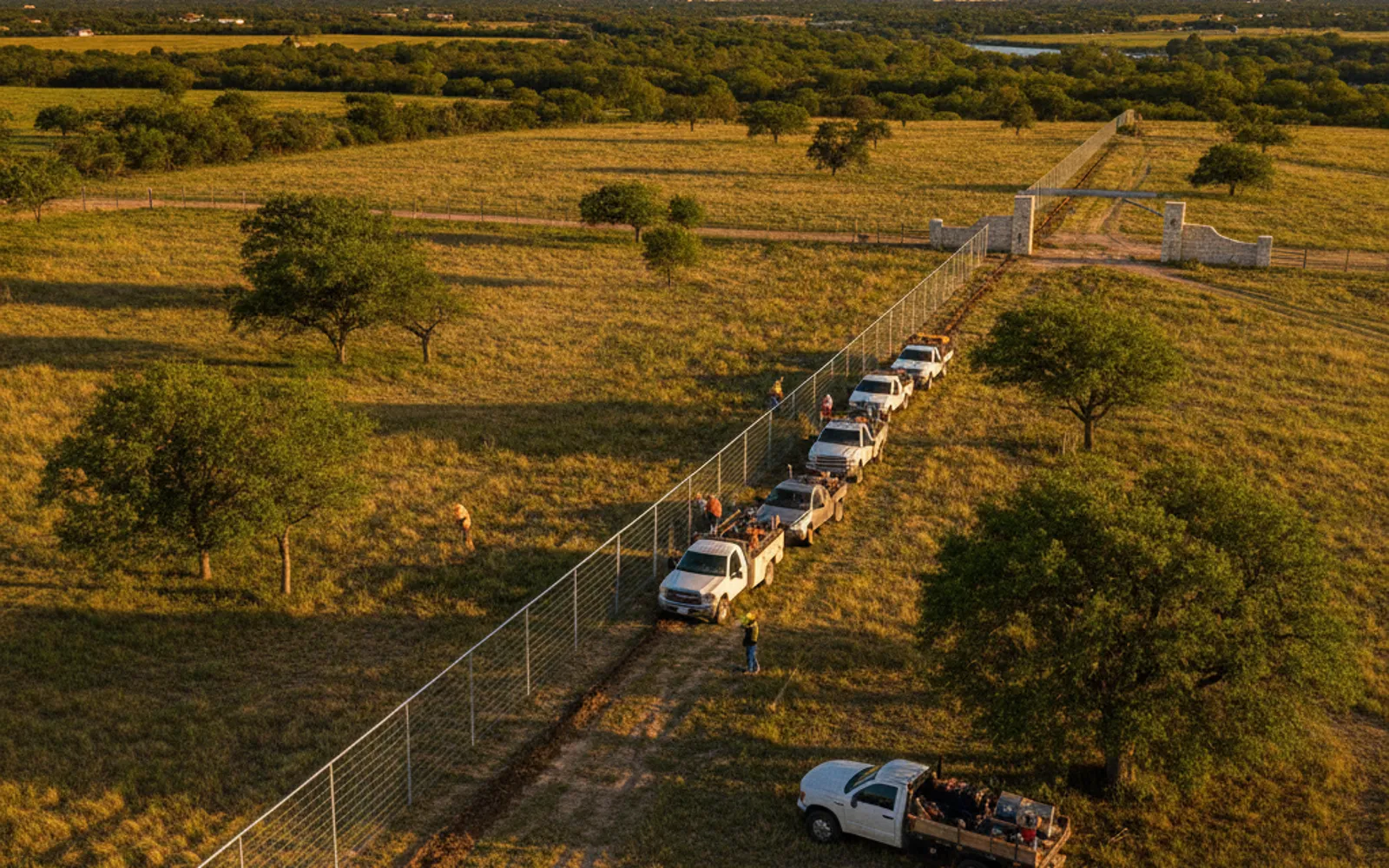
A 1,400 pound bull does not care what your fence cost. He cares whether it moves when he leans on it. That one fact settles most of the cattle panel versus net wire debate before we ever pull a tape measure.
We build both all over McLennan, Bosque, and Falls counties, and we get this question weekly. Should I run net wire down the whole property line, or should I spend more and put up a cattle panel fence? The honest answer is that they are different tools. Panels are rigid steel built for pressure and close quarters. Net wire is a stretched mesh built to cover distance for less money. Put each one where it belongs and you will spend less over ten years than the neighbor who picked one and used it everywhere.
Here is how we walk customers through it, with the numbers we actually quote in Waco.
What a cattle panel fence actually is
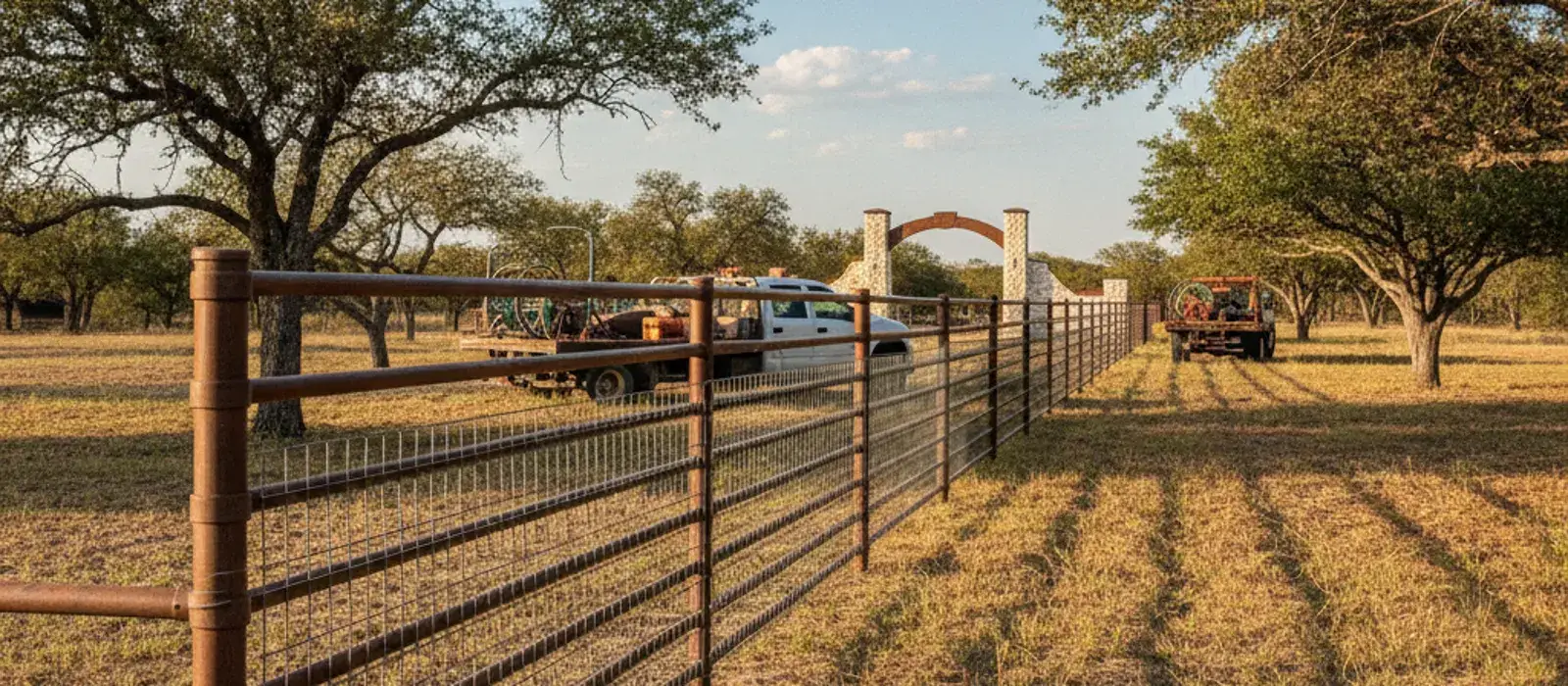
A cattle panel is a welded steel grid, usually 16 feet long and around 50 to 52 inches tall. The rods are welded at every crossing, so the panel holds its shape on its own. You do not stretch it. You stand it up against posts and clip or weld it in place.
Panels come in different rod thicknesses, and the gauge matters more than most folks realize. A light 6 gauge utility panel from the farm store runs $28 to $40 and will bend if a cow hits it hard. A true bull panel with 4 gauge rods runs $70 to $110 per panel and will take a real beating. When we build working pens, we use the heavy stuff, because a bent panel in an alley is worse than no panel at all.
Because each panel is rigid, a cattle panel fence shrugs off point pressure. An animal pushing on one spot loads the whole grid, and the grid pushes back. That is why panels dominate in corrals, sorting pens, bull traps, and anywhere animals get crowded and cranky.
The tradeoff is cost and labor. Every 16 feet needs solid post support, and the material price per foot is several times what net wire costs. Nobody fences a quarter section with panels. Nobody should.
If you are pricing a full property and want a gut check on your budget, look at our ranch fence cost guide or call us at (254) 870-8898 and we will talk through it. Written estimates are free and we do not play games with the numbers.
Net wire in plain terms
Net wire, also called field fence or woven wire, is a mesh of horizontal and vertical wires stretched between braced corners. Instead of welds, the wires are joined with knots. The two knot styles you will see are hinge joint and fixed knot, and the difference is bigger than the price gap suggests. We broke that down in detail in our fixed knot vs hinge joint post, but the short version is this: hinge joint is cheaper and folds under heavy impact, while fixed knot holds its grid and springs back.
A standard 330 foot roll of 12.5 gauge hinge joint field fence runs $180 to $260 around Waco right now. Fixed knot runs $280 to $420 for the same length, depending on height and wire class. Stretched properly on good posts with solid H braces at the corners, net wire makes a clean, tight fence that holds cattle, and it is the default choice for goats and sheep because the mesh stops the escape artists that walk right through barbed wire.
The catch is in that phrase “stretched properly.” Net wire is only as strong as its bracing. A beautiful stretch on weak corners will sag inside two years. If you have ever wondered why one neighbor’s field fence looks like a hammock and another’s still sings when you pluck it, the answer is almost always in the corner posts, not the wire.
Strength: cattle panels vs net wire when animals hit them
Strength is where these two products stop being comparable and start being different animals.
A heavy cattle panel resists bending because every joint is welded and every rod carries load. Hang a gate wrong, back a trailer into it, let a bull fight through it, and a 4 gauge panel usually survives with a scuff. Panels also hold their height forever. There is no stretch to lose, so there is no sag to fight.
Net wire works on tension. It is strong against steady pushing but weaker against sharp, concentrated impact. A hinge joint fence hit hard by a spooked cow will often kink and stay kinked. Fixed knot handles impact much better, which is why game fence builders use it, but even fixed knot will not match welded steel rod in a squeeze pen.
Then there are hogs. Feral hogs root under net wire and tear through the bottom courses, and Central Texas has no shortage of them. Texas A&M AgriLife Extension (agrilifeextension.tamu.edu) has good material on hog behavior and exclusion if you want the research side. From the fence side, we covered what hog damage looks like and how to fight it in our feral hog fence damage post. Panels resist hogs better at ground level, but hogs will still dig under anything if the bottom is not addressed.
Here is a real one. Dale Kubacak runs about 40 pairs outside Crawford. His working pens were 20 year old hinge joint net wire on cedar posts, and in March a bull went through the sorting pen side like it was a screen door. That wreck cost him a morning, a gate, and $340 in vet work on a heifer that got caught in the tangle. We rebuilt his pens with 4 gauge bull panels welded to pipe posts, about 280 feet of pen for $6,800. His words when we finished: “Should have done this ten years ago.” The perimeter of his place is still net wire, because out there it is doing exactly what net wire does well.
Cattle panel fence cost vs net wire cost
Numbers first, talk after. These are typical installed ranges we quote in McLennan, Bosque, and Falls counties as of mid 2026. Materials alone will run roughly a third to half of these figures.
| Fence type | Materials per foot | Installed per foot | Best lifespan on good posts |
|---|---|---|---|
| Hinge joint net wire (12.5 ga) | $0.90 - $1.60 | $3.25 - $5.50 | 15 - 20 years |
| Fixed knot net wire | $1.40 - $2.30 | $4.50 - $7.00 | 25 - 30 years |
| Utility cattle panels (6 ga) | $2.00 - $3.00 | $6.00 - $9.00 | 15 - 20 years |
| Bull panels (4 ga) on T-posts | $4.50 - $7.00 | $9.00 - $14.00 | 25 - 30 years |
| Bull panels welded to pipe posts | $6.00 - $9.00 | $16.00 - $28.00 | 30 - 40 years |
Read that table with acreage in mind. A mile of perimeter is 5,280 feet. At $4.50 a foot, net wire runs about $23,800 installed. The same mile in bull panels on pipe would top $90,000, which is why nobody does it. Flip it around for a set of pens: 300 feet of pen fence in panels might cost $4,000 to $7,000, and that is 300 feet that takes the hardest abuse on the whole ranch. Spending panel money there is not a splurge. It is insurance.
Post choice moves these numbers too. Panels on T-posts are fine for garden and horse paddock duty, but working pens want pipe. If you are already thinking about pipe, our pipe fence page covers what we build and why used oilfield pipe is the workhorse around here.
Marcy Villareal in Lorena had us quote both options for a 2 acre goat paddock last fall. Net wire came in at $4,100. Panels came in at $7,900. She went with fixed knot net wire and put the $3,800 difference into a better ranch entrance gate and a hog apron along the creek side. A year in, zero escapes. Right tool, right spot.
Want a number for your own place instead of a table? Request a free written estimate and we will walk the line with you.
Best uses: where each one earns its keep
After a few hundred fence jobs in Central Texas, the pattern is pretty clear.
Use cattle panels for working pens, corrals, alleys, and loading areas. Use them for bull pens and anywhere you crowd animals. Use them for round pens, hog traps, small horse paddocks with hot wire on top, and garden fence where deer pressure is moderate. Panels also shine for odd shaped small enclosures because you are not fighting a stretch around corners.
Use net wire for perimeter and cross fencing on acreage. Use it for goat and sheep pastures, for keeping dogs in and coyotes honest, and for any run longer than a few hundred feet where panel pricing stops making sense. On pure cattle perimeter, plenty of ranchers still choose 5 strand barbed wire over both, and that is a fair fight we covered in barbed wire vs net wire. Our barbed wire fence crew builds more miles of it than anything else we do.
The combination approach usually wins. A typical 50 acre place near us ends up with barbed or net wire on the perimeter, net wire cross fences, and a panel built pen complex near the barn. Each product sits where its strengths matter and its price makes sense.
One more note on rules and cost share. If you are fencing along a road, remember most of Texas is still legally open range at the county level with big exceptions, so your liability picture depends on local stock laws. And if you are improving grazing land, the USDA Natural Resources Conservation Service (nrcs.usda.gov) runs cost share programs through EQIP that sometimes help pay for livestock fencing. Worth a phone call to the Waco field office before you build.
Where DIY ends and a pro should take over
Plenty of our customers hang their own utility panels, and we will cheer you on. Setting a dozen panels around a garden with T-posts is a good Saturday project. Keep the bottom rod close to the ground, tie every panel at top, middle, and bottom, and do not skimp on post depth.
Stop and call somebody when the job involves stretching net wire past a couple hundred feet, building H braces, welding panels to pipe, or any fence that will hold bulls or sit along a public road. Corner bracing is the whole ballgame with net wire, and a failed brace lets the entire stretch go slack at once. Welding on pipe near dry grass in a Central Texas summer is its own hazard, and a pen that fails with cattle and people inside it is a genuinely dangerous failure, not just an expensive one.
Frank Novosad out in West learned that the hard way before he called us. He stretched 600 feet of field fence himself off corners set 18 inches deep in sand. It looked great in October. By June the corners had walked, the fence was on the ground in two spots, and his calves were grazing the county right of way. Redoing the corners and restretching cost him $1,150, most of which he would have avoided with proper braces the first time. If your fence is heading the same direction, our post on leaning fence posts explains what is happening underground.
We are licensed and insured, and we answer a 24/7 emergency line for cattle out and storm damage calls. If something just went through your fence tonight, call (254) 870-8898 and we will get you contained.
Frequently Asked Questions
Will cattle panels hold a bull?
Heavy 4 gauge bull panels on well set posts will hold most bulls, and panels welded to pipe posts will hold about anything that walks in Texas. Light 6 gauge utility panels will not, and a determined bull will fold them. If bulls are part of the plan, buy the heavy panel and put pipe behind it.
Is a cattle panel fence cheaper than net wire?
No, not per foot. Installed net wire typically runs $3.25 to $7.00 per foot in our area, while panel fencing runs $6.00 to $28.00 depending on panel gauge and post type. Panels win on cost only when you count the years, because a pen that never needs restretching or wreck repair costs less over a couple of decades of hard use.
How tall are cattle panels, and are they tall enough for horses?
Standard cattle panels are 50 to 52 inches tall, which is short for horses. For horse pens we recommend 60 inch panels or a top rail that brings the fence to at least 5 feet, since horses will reach over and lean on shorter panels. Smooth welded panels are safer for horses than barbed alternatives, but check for sharp clipped ends at eye height.
Can I combine cattle panels and net wire on the same place?
Yes, and most well fenced ranches around Waco do exactly that. Panels go on the pens, alleys, and high pressure spots near the barn, and net wire or barbed wire covers the perimeter and cross fences. You get panel strength where animals fight the fence and net wire economics across the long runs.