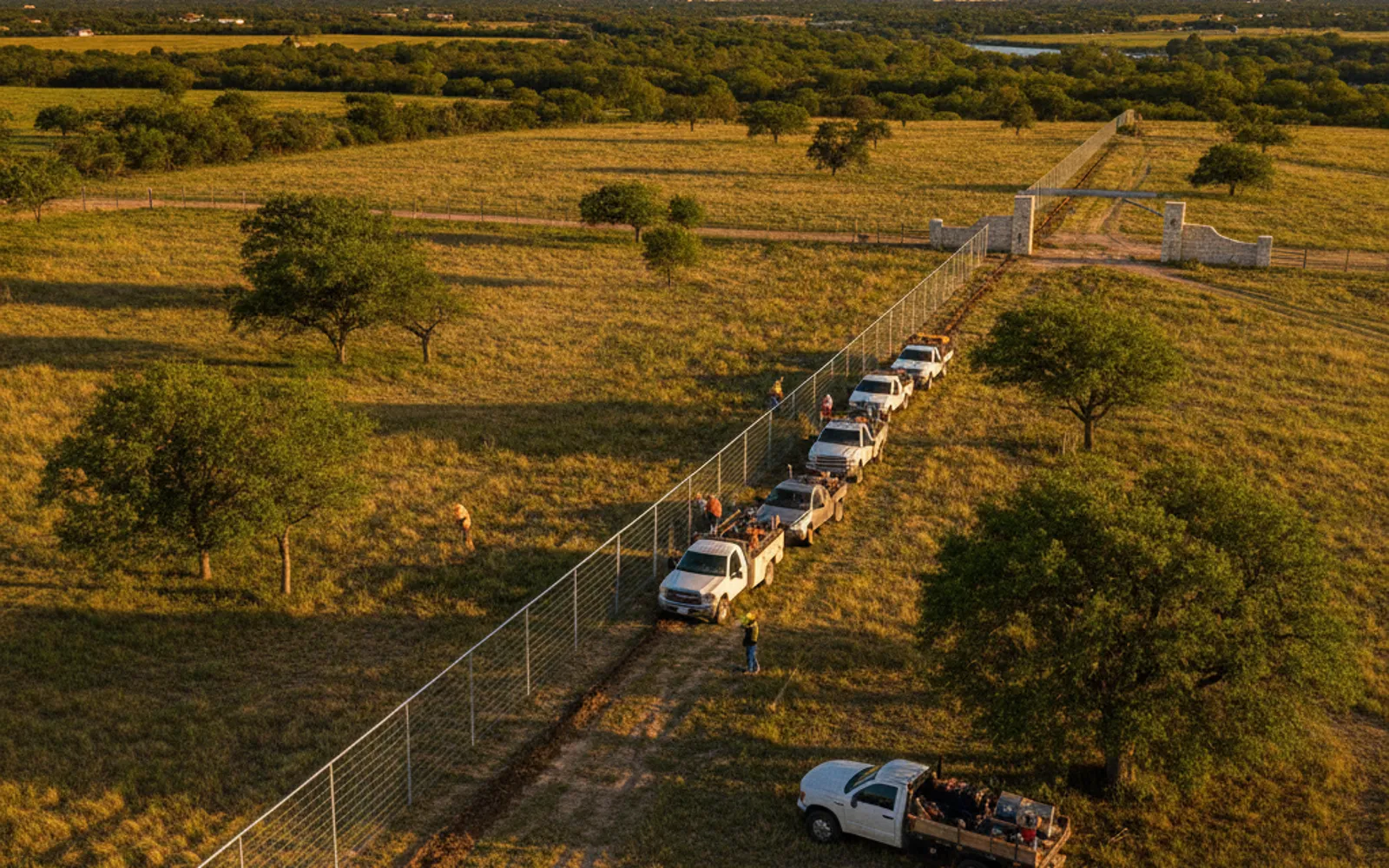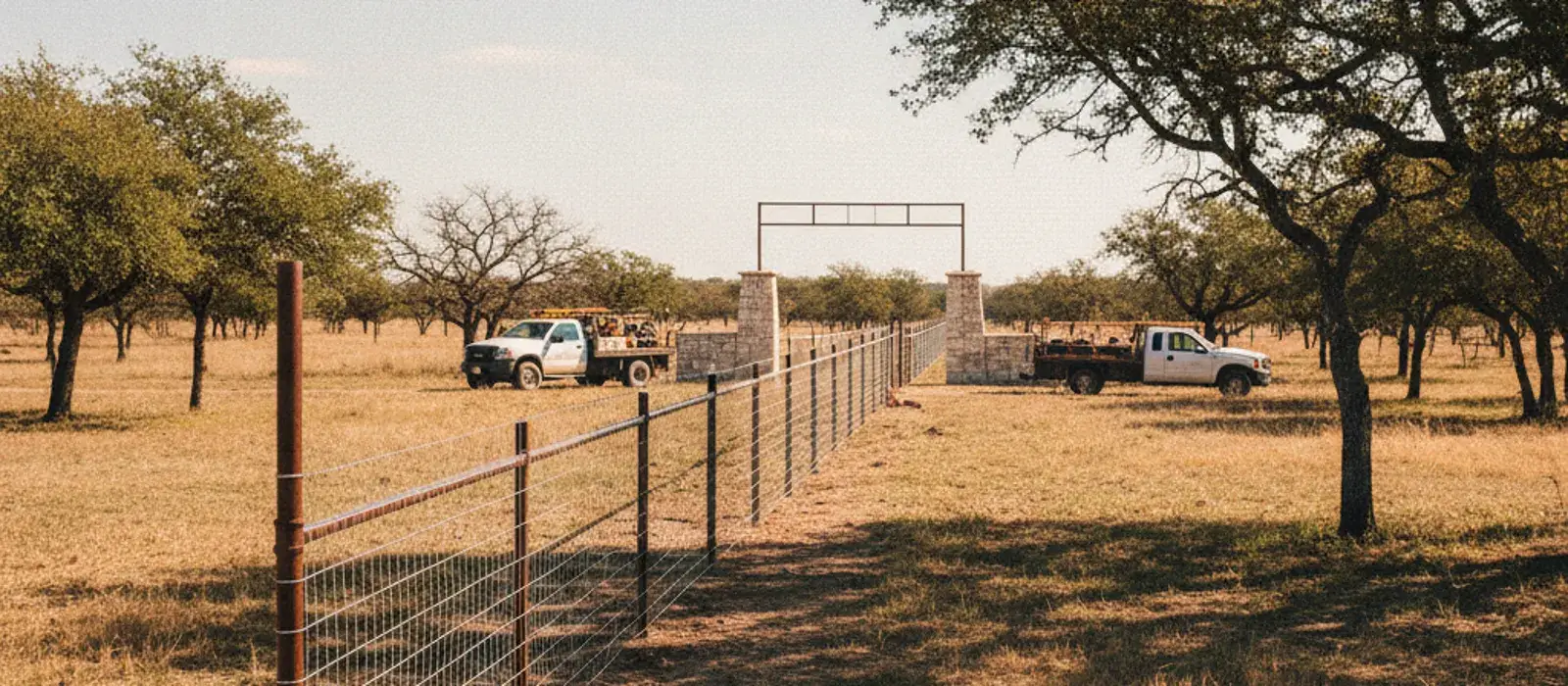
Ever set a corner post plumb and tight in March, then come back in August to find it leaning like it had a rough night? That’s not bad luck. That’s Blackland clay doing what Blackland clay does, and if you’re setting fence posts in clay soil anywhere around Waco, Crawford, or West, the dirt itself is the biggest variable in whether your fence lasts 30 years or 3.
We build fence in McLennan, Bosque, and Falls counties, which means almost every hole we dig goes into some of the most expansive soil in the country. Houston Black clay, the stuff most of the Blackland Prairie sits on, can swell and shrink enough to crack slab foundations. A fence post doesn’t stand a chance against it unless you set it right.
This guide covers how deep to go, when concrete helps and when it hurts, why corners fail first, and what all of it costs. Real numbers, real jobs, no fluff.
If you’d rather skip the digging altogether, call us at (254) 870-8898 and we’ll come look at your place. Written estimates are free.
Why Fence Posts in Clay Soil Lean, Heave, and Snap
Blackland clay is what soil scientists call expansive. It’s loaded with clay minerals that soak up water and swell, then give that water back in a drought and shrink. The ground around your post isn’t sitting still. It’s breathing, slowly, a few inches at a time.
Here’s what that does to a fence:
It heaves posts up. When wet clay swells, it grabs whatever’s in it and pushes. A post set 24 inches deep can get jacked up an inch or two per season. Over five years, your wire goes slack, your post wobbles, and your fence line looks like a picket of drunks.
It lets posts lean. In a dry summer, clay shrinks and pulls away from the post, leaving a gap around it. Then a wet norther blows through, water runs down that gap, softens the bottom of the hole, and the post tips the first time a 1,300 pound cow scratches on it.
It snaps rigid assemblies. Clay doesn’t push evenly. One side of a braced corner swells more than the other, and something has to give. Usually it’s a rail weld or a brace pin.
The zone doing all this movement is roughly the top 8 to 15 feet of soil, but the worst action is in the top 3 to 4 feet. That’s exactly where your fence post lives. You can’t stop the clay from moving. You can only build so the movement doesn’t matter, and that’s what the rest of this guide is about.
We wrote more about diagnosing tilted posts in our post on leaning fence posts, so if your fence is already crooked, start there.
Know Your Dirt Before You Dig
Not every acre in Central Texas is the same. Head west of the Bosque River toward Crawford and Valley Mills and you start hitting shallow limestone. Stay east and south, around Lorena, West, and most of the flat farmland in McLennan and Falls counties, and you’re in deep black clay.
You can check your exact soil for free using the USDA Web Soil Survey. Type in your property, and it’ll tell you whether you’re on Houston Black, Heiden, Branyon, or something friendlier. If the report says “very high shrink-swell potential,” everything in this article applies to you double.
Here’s why it matters in dollars. Dale Kubacek runs about 60 cows outside West, and he set his own corner posts three separate times over four years. Tamped earth the first time, a bag of sackcrete the second, a bigger post the third. Every spring the corner leaned again and his wire went slack. He finally had us rebuild both corners with deep-set pipe and proper H-braces for $2,800, and those corners haven’t moved through two wet winters and one brutal drought since. He spent close to $900 in posts, concrete, and weekends before that, all of it wasted because the holes were never deep enough for that dirt.
Texas A&M AgriLife Extension has good general guidance on livestock fencing if you want the academic version at agrilifeextension.tamu.edu. The short version for our area: know whether you’re fencing clay or rock before you buy a single post, because the two call for completely different setting methods.
How Deep to Set Fence Posts in Clay Soil
Depth is the whole ballgame in clay. The movement is worst near the surface, so the deeper your post goes, the more of it sits in soil that stays relatively stable. Shallow posts ride the clay like a cork on water. Deep posts anchor below the worst of it.
Here’s what we run on our own jobs in Blackland clay:
| Post type | Line or corner | Depth in clay | Typical installed cost |
|---|---|---|---|
| Steel T-post | Line post | 18 to 24 in driven | $6 to $9 each |
| 4 in wood post | Line post | 30 to 36 in | $20 to $32 each |
| 5 to 6 in wood post | Corner or brace | 42 to 48 in | $85 to $150 per assembly post |
| 2 7/8 in pipe | Corner or brace | 48 in in concrete | $150 to $250 per assembly post |
| 4 in pipe | Gate or heavy corner | 48 to 60 in in concrete | $250 to $400 each |
A few rules of thumb behind those numbers:
Line posts: a third in the ground, minimum. A 6.5 foot wood line post should have at least 30 inches buried in clay. In sandy loam you might get away with 24. In Houston Black, you won’t.
Corners: half again deeper than you think. Corner and gate posts carry all the wire tension, so they take the movement hardest. We don’t set a corner in clay shallower than 42 inches, and on heavy game fence or long pulls we go to 60.
T-posts are surprisingly good in clay. A driven T-post disturbs almost no soil, so there’s no loose backfill for water to work through. Clay grips the anchor plate tight. That’s part of why the classic Central Texas setup is steel T-post line posts between pipe corners. We compared the options in detail in t-post vs wood post.
Post spacing matters too. In clay we’d rather see posts at 10 to 12 feet than stretched to 15, because when one post heaves, its neighbors carry the load. Our fence post spacing article breaks that down by fence type.
Not sure what your soil needs? Request a free written estimate and we’ll bring the auger out and show you exactly what your dirt looks like at 4 feet.
Concrete, Gravel, or Tamped Earth: What Actually Holds
This is where most DIY fences in clay go wrong, because the standard internet advice is written for people with normal dirt.
Tamped earth or crushed base. For wood line posts, dry-tamped crushed limestone or the native clay itself, tamped hard in 4 inch lifts, works well. Tamping in lifts is the part everyone skips. Dumping loose dirt in the hole and stomping it twice is how you get a post you can wiggle by hand in a year.
Concrete done wrong. Here’s the trap. A shallow concrete collar in expansive clay makes things worse, not better. The clay grabs that fat concrete ball and heaves the whole thing like a piston. Worse, if you pour a mushroom cap of concrete at the surface, you’ve given the swelling clay a handle to lift with. We pull out heaved concrete footings every month that failed exactly this way.
Concrete done right. For corners, gates, and pipe fence, concrete is still the answer, but it has to be deep and shaped right. The hole should go 48 inches or more, be straight-sided or slightly wider at the bottom than the top, and the concrete should stop 2 to 3 inches below grade with soil over it. That shape resists uplift instead of inviting it. This is standard practice on our pipe fence installations in Waco, and it’s why a properly set pipe corner in clay will outlive the wire strung on it.
Drainage helps everything. A few inches of gravel at the bottom of a wood post hole gives water somewhere to go and slows down rot. In clay, water that gets in a post hole stays there, which is why wood posts rot faster in Blackland soil than the bag label suggests. Pair good drainage with the right post material, because clay plus trapped water will find out quick whether you cheaped out on posts.
Marcy Tullos, who runs goats on 30 acres near Lorena, learned the concrete lesson the expensive way. A handyman set her corner posts with one 50 pound bag each, about 8 inches of concrete sitting near the surface of a 24 inch hole. Two wet springs later, every corner had lifted and her net wire sagged enough that the goats treated it like a suggestion. Redoing six corner and gate assemblies correctly cost her $3,900. The original job had “saved” her about $1,200.
Bracing and Corners: Where Clay Punishes Shortcuts
In stable soil, a mediocre corner might limp along for years. In expansive clay, the corner is the first thing to fail, because it’s fighting both wire tension and soil movement at the same time.
Every corner and every gate opening in clay needs a true H-brace: two deep-set posts, a horizontal rail, and a diagonal tension wire. The H-brace spreads the pull across two posts and a bigger block of soil, so seasonal movement can’t tip a single post over. We walk through the build step by step in h-brace fence corners.
A few clay-specific bracing notes:
- Make the brace span at least 8 feet. A longer H resists overturning better in soft, wet clay.
- Pipe braces beat wood in heavy clay. Welded pipe H-braces move as one unit, so uneven swelling can’t rack them apart.
- Re-tension in the fall. Clay moves seasonally, so plan to snug your diagonal wires and wire stays once a year. It takes an hour and adds years.
Bracing matters most on long pulls of barbed wire, where a quarter mile of tensioned wire is all anchored to two corners. If those corners creep even a couple inches, you’ll feel it in every strand. That’s the fence style we build most around here, and you can see how we handle it on our barbed wire fence page.
Drought Cracks, Wet Winters, and When to Call a Pro
Clay problems come in seasons. In a wet winter, posts heave and lean. In a drought, the ground opens up cracks you can drop a hammer into, posts loosen in their holes, and wire tension sags across the whole line.
Last August, Roy Hendricks near Crawford called our emergency line at 6 a.m. because three heifers were standing on FM 185. A drought-loosened line post had given up, the wire dropped, and the cattle walked over it. We had the gap closed that morning and rebuilt 200 feet of line for about $900. The fix that would’ve prevented it, resetting two loose posts the previous fall, would’ve cost him maybe $150.
So walk your fence twice a year, spring and fall. Push on posts, watch for concrete footings showing at the surface, and look for gaps opening around post bases in dry weather.
And know when to stop DIYing. Call a professional when:
- Corners or gate posts are moving. Rebuilding a braced corner right takes an auger that can reach 4 feet, and doing it wrong means doing it twice.
- You’re fencing more than a few hundred feet. Hand-digging 48 inch holes in dry Houston Black clay is genuinely miserable, and a skid steer auger turns a week of pain into a morning.
- Cattle are getting out. That’s a liability problem, not just a fence problem. In most of McLennan County you’re under stock law, and a cow on the highway is your cow. Our emergency line runs 24/7 for exactly this.
- You’re near utilities. Call 811 before any digging, every time. It’s free and it’s the law.
We’re licensed, insured, and we set posts in this dirt every working day. Call (254) 870-8898 or request your free written estimate and we’ll spec the right depth, post, and footing for your exact soil.
Frequently Asked Questions
How deep should fence posts be in clay soil?
Line posts need 30 to 36 inches in Blackland clay, and corner or gate posts need 42 to 60 inches. That’s deeper than standard advice because the top 3 to 4 feet of expansive clay moves with the seasons. Getting below the worst of that movement is what keeps posts from heaving and leaning.
Should I use concrete for fence posts in expansive clay?
Yes for corners, gates, and pipe posts, but only if the hole is deep and the concrete stops a few inches below the surface. A shallow concrete collar or a mushroom-shaped cap at grade gives swelling clay something to grab and lift. Deep, straight-sided footings with soil over the top resist heave instead of inviting it.
Why do my fence posts keep heaving out of the ground?
Expansive clay swells when it’s wet and grips the post or its concrete footing, pushing it upward a little each cycle. Shallow posts and surface-heavy concrete make it worse. The fix is depth, proper footing shape, and in many cases driven T-posts for line posts, since they disturb the least soil.
Do T-posts work well in Blackland clay?
They work very well as line posts. Driving a T-post leaves no loose backfill, so the clay grips the anchor plate tightly and there’s no easy path for water. Just don’t ask T-posts to do a corner’s job. Corners and gates in clay still need deep-set wood or pipe with H-braces.