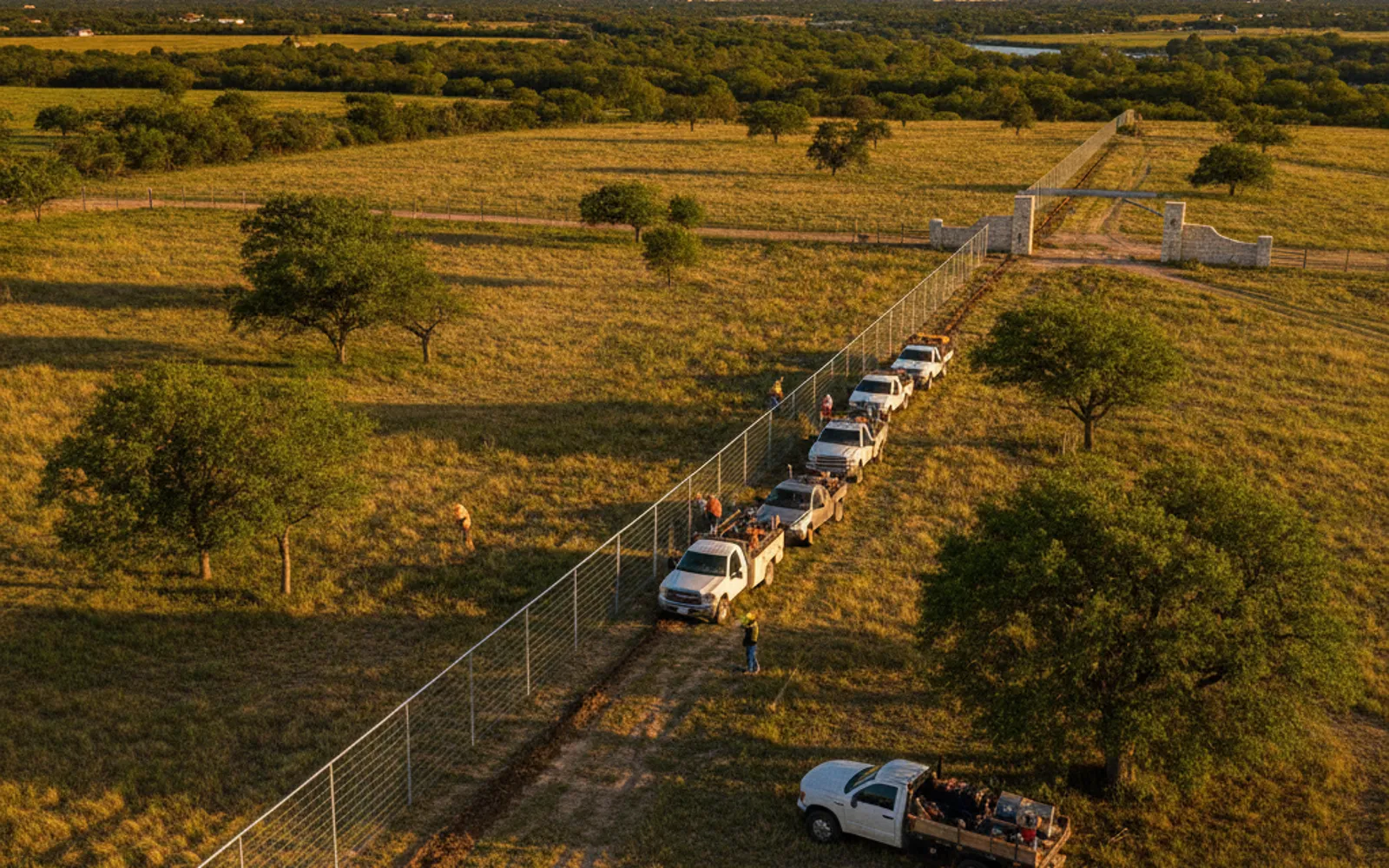
Fence sized for the animal that finds every hole. Four-inch mesh, a bottom tight to the ground, and hot wire where the goats have already made their point.
There is an old line about goats and fence: if it will not hold water, it will not hold a goat. It is closer to true than most people find comfortable. Brazos Ridge Fence Co. builds goat and sheep fencing across McLennan, Bosque, and Falls counties, mostly in the cedar and limestone country west of the Bosque River. Expect $3.50 to $8 per linear foot installed.
Sheep and goats fail fences in two different directions. Goats go through, over, and under, and they will spend all day working on it. Sheep mostly stay put until a coyote gives them a reason not to, which makes predator exclusion the bigger part of the job. A fence built for one is not automatically right for the other, and our guide on the best fence for goats and sheep walks through the difference.
Four-inch openings are small enough that a horned goat cannot get its head through and then panic. Six-inch field fence is exactly the wrong size, and it is how most stuck goats happen.
Forty-seven inches is the working height for goats. We add a barbed or electric strand on top where you have climbers, which most herds eventually produce.
Goats go under before they go over. We follow the contour with extra posts through the dips rather than leaving a gap at every low spot, and we run a bottom strand where the ground is uneven.
A single hot wire at nose height on the inside stops leaners and climbers before they start. It costs very little and it is the cheapest fix for a herd that has already learned bad habits.
Coyotes and loose dogs are the real threat to sheep around here. A tight bottom, a hot wire low on the outside, and no gaps at gates and water crossings is what actually keeps them out.
Goat country in Bosque County is cedar country. We clear the line before we build so the fence goes in straight and you can walk it later. Clearing is quoted as its own line item.
Most goat and sheep fencing runs $3.50 to $8 per linear foot installed. Fixed-knot 47-inch wire with 4-inch spacing is at the top of that range, and it is what we recommend for a perimeter you do not want to think about again. Hinge-joint field fence with wider stays is cheaper and is a reasonable choice for interior cross fence.
The two costs people do not budget for on goat ground are clearing and corners. In the cedar country around Clifton, Meridian, and Valley Mills, clearing the line can run $1 to $3 per foot (roughly $5,300 to $15,800 a mile) on its own before a post goes in. And rough ground means more direction changes, and every change of direction is a braced corner.
Add a hot wire and an energizer if you have any history of climbers, which is most herds after the first year. The materials are cheap and it protects the rest of the investment. Our ranch fence cost guide puts these numbers next to the other fence types if you are budgeting a whole place.
This is the single most important decision on a goat fence and the one that gets made wrong most often, usually by buying whatever field fence the farm store had on the trailer.
Standard field fence has 6-inch openings. A horned goat puts its head through a 6-inch opening easily, turns its head, and then cannot get the horns back out. Now you have a goat standing in a fence line in August, and if you do not find it, a predator will. It is the most common non-predator loss we hear about from goat producers, and it is entirely a fencing decision.
Four-inch mesh solves it by not letting the head through in the first place. It costs more per roll because it is more steel, and the difference across a mile of fence is real money. It is still less than losing animals, and far less than the labor of walking the fence twice a day looking for a stuck goat. If your herd is disbudded or polled the pressure is lower, but a mixed herd or one you plan to buy into over time will end up with horns eventually.
Sheep are relatively easy to contain and relatively hard to protect. Most sheep producers we work with are not worried about the flock leaving, they are worried about what comes in overnight.
A coyote does not climb a 47-inch fence if there is any alternative, and there almost always is: a washed-out low spot, a gap where a gate meets a post, a water crossing left open, or a place where the ground has settled under the bottom wire. Closing those is more effective than building the fence taller. We walk the line for exactly those spots.
Where pressure is heavy, a hot wire six inches off the ground and six inches outside the fence is the standard addition. It hits a coyote in the nose right where it starts to dig, and it takes one lesson. A second hot wire at the top handles anything that decides to climb. None of this replaces guardian animals, and most of the producers around here run both.
West of the Bosque River the blackland gives out and you are into limestone, cedar, and steep little draws. That is goat country for a reason: goats do well on browse that will not carry a cow. It is also the hardest ground in our service area to fence.
Post holes get drilled rather than augered, and a rock bit turns a fast day into a slow one. We price rock honestly rather than hiding it in the per-foot number, and our note on setting posts in rocky ground west of Waco explains what actually holds in shallow soil over rock.
The cedar is the other half. Ashe juniper along an old fence line has to come out before you can stretch new wire, and it does not resprout from the stump the way mesquite does, which makes clearing here a one-time job rather than an annual one. We handle it as part of the fence bid or as standalone clearing.
We build across McLennan, Bosque, and Falls counties, with most of our small-ruminant work in the western half of that range. Estimates are free and written, and they spell out mesh size, wire class, and height, because those three numbers are the whole fence and a bid that leaves them out is not comparable to anything.
If you already have fence and it is not holding, call before you replace it. Sometimes the answer is a hot wire and a hundred feet of repair rather than a new perimeter, and we would rather tell you that than sell you a mile of wire you did not need.
Forty-seven-inch woven wire with 4-inch mesh openings, stretched tight with the bottom close to the ground, plus an offset hot wire at nose height on the inside. The 4-inch mesh is the part that matters most, because 6-inch field fence lets a horned goat get its head through and stick.
Most goat and sheep fencing runs $3.50 to $8 per linear foot installed. Fixed-knot 47-inch wire with 4-inch spacing sits at the top of that range. In the cedar country west of the river, clearing the fence line is a separate cost of roughly $1 to $3 per foot (roughly $5,300 to $15,800 a mile).
The fence itself can be the same, but the priorities differ. Goats test the fence constantly, so mesh size, height, and a hot wire matter most. Sheep mostly stay put, so the job shifts to keeping predators out, which means a tight bottom, no gaps at gates and water crossings, and often a hot wire low on the outside.
Sometimes, and rarely for long. Multi-strand electric is cheaper to put up and works well on trained animals in a rotational setup, but a goat with a thick winter coat may not feel it, and one power outage or shorted-out weed can undo the training. We build electric as an addition to woven wire rather than a replacement for a perimeter.
Yes, and on most Bosque County jobs we have to. It is quoted as its own line item, usually $1 to $3 per foot (roughly $5,300 to $15,800 a mile) depending on how heavy the cedar is. Ashe juniper does not resprout from the stump, so clearing a line here is largely a one-time job.
Real prices and honest how-to advice from the same crew that will build your fence:
See the rest of what we build on the services page, or find your town on the service areas page.
Free written estimates. Emergency calls answered around the clock.
Most barbed wire fence around Waco runs $2.50 to $5.50 per foot installed, and game fence runs $4.50 to $10, so a written quote costs you nothing but a walk down the fence line. Call (254) 870-8898 or email info@brazosridgefence.com and we'll get you a free written estimate this week.
Call (254) 870-8898Around-the-clock line — a person answers, not a machine.