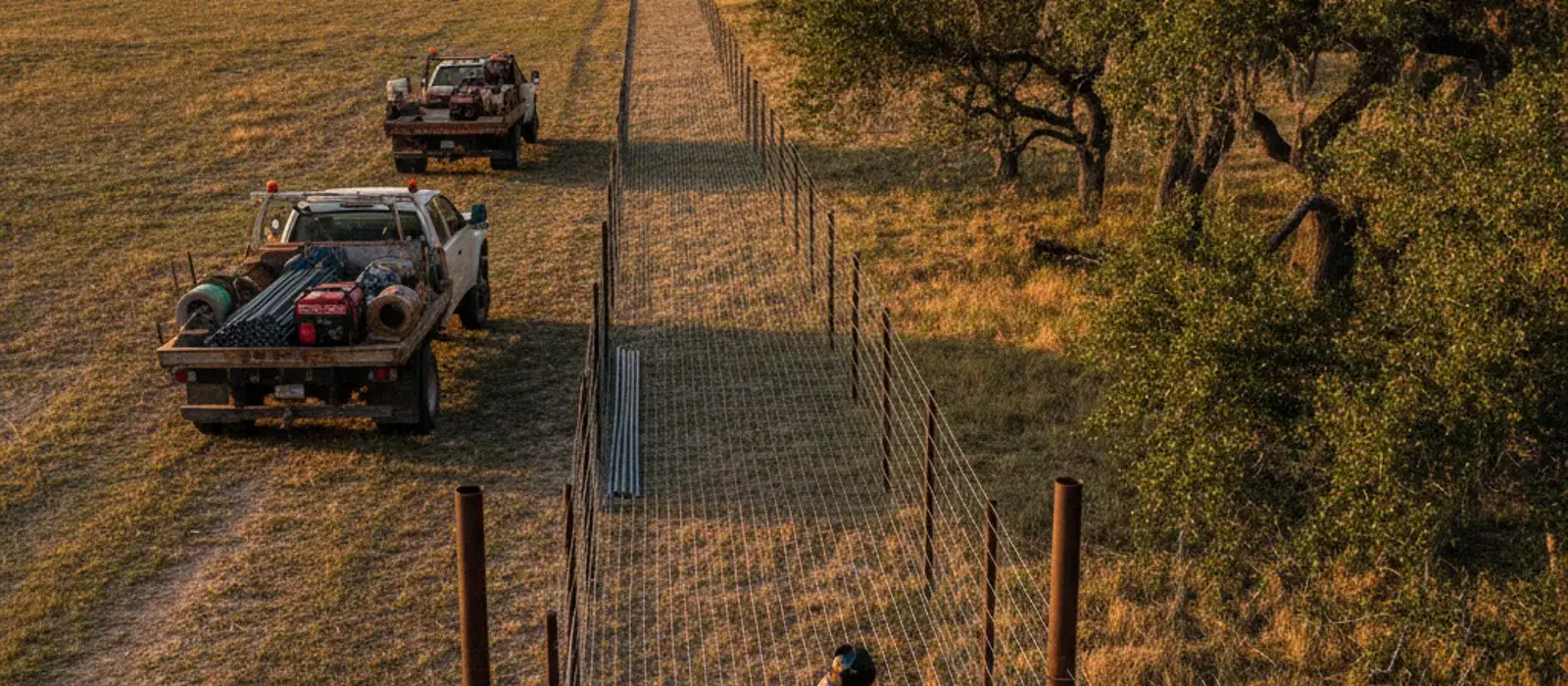
Two rolls of barbed wire sit side by side on the shelf at the farm store. Same gauge, same twist, same shine, and one costs about thirty bucks more. Here’s the part the price tag doesn’t tell you: the cheaper roll may start rusting in 8 years, while the other one can still be holding cattle 30 years from now.
The difference is the zinc coating, and it’s the single most ignored spec in ranch fencing. Class 3 galvanized fence wire carries roughly three times the zinc of Class 1, and that coating is the only thing standing between the steel and the rust. We build fence all over McLennan, Bosque, and Falls counties, and when we tear out a fence that failed early, thin galvanizing is the reason more often than not.
This article breaks down what the classes actually mean, how long each one lasts in Central Texas conditions, what the upgrade really costs per foot, and when Class 1 is honestly good enough. Real numbers, no fluff.
What the Zinc Coating Actually Does for Your Fence Wire
Bare steel wire rusts fast. Out in a Central Texas pasture with humidity rolling up from the Gulf, morning dew, and the occasional wet winter, unprotected steel can show surface rust in months and lose real strength within a few years.
Galvanizing fixes that by bonding a layer of zinc to the steel. Zinc does two jobs. First, it’s a physical barrier that keeps water and oxygen off the steel. Second, it’s a sacrificial metal. Even when the coating gets scratched, the zinc around the scratch corrodes first and protects the exposed steel underneath.
Here’s the key point: zinc wears away at a fairly steady rate for a given climate. That means the life of your wire is almost directly tied to how much zinc is on it. Double the zinc, roughly double the years before rust shows up. Triple it, and you’re talking about a fence that outlives the posts holding it.
That’s the whole argument between the classes. It’s not about stronger steel or a better barb. It’s about how thick the zinc is.
If you’re pricing a new perimeter fence and want somebody local to walk the line and talk wire specs with you, give us a call at (254) 870-8898. Estimates are free and in writing.
Class 1 vs Class 3 Galvanized Wire: The Real Difference
The classes come from ASTM standards that spell out the minimum ounces of zinc per square foot of wire surface. For common 12.5 gauge fence wire, the numbers look like this:
- Class 1: about 0.28 ounces of zinc per square foot
- Class 3: about 0.80 ounces of zinc per square foot
So Class 3 galvanized fence wire carries close to three times the zinc coating of Class 1 on the same wire. Same steel, same gauge, same breaking strength on day one. The difference only shows up over time, which is exactly why the cheap roll sells so well. Both look identical on the shelf.
Land grant universities have tested this for decades. Oklahoma State University Extension reports that Class 1 coatings can show rust in as little as 8 to 10 years in humid climates, while Class 3 coatings commonly go 20 to 30 years before rust appears. You can read their fencing materials fact sheet here: Oklahoma State University Extension, Selecting Wire Fencing Materials. The University of Georgia’s Fences for the Farm bulletin backs up the same pattern.
Central Texas isn’t the Gulf Coast, but it’s not West Texas desert either. Waco averages around 36 inches of rain a year, and low spots, creek bottoms, and shaded lines hold moisture. Our real-world experience lands close to those university numbers.
There’s also a Class 2 in some product lines, but you’ll rarely see it on a farm store shelf around here. The practical choice is almost always Class 1 or Class 3.
What About “Commercial” or Unlabeled Wire?
Some bargain import wire doesn’t state a coating class at all. Treat unlabeled wire as worse than Class 1, because it often is. If the tag or the manufacturer’s spec sheet won’t tell you the zinc weight, that’s your answer.
How Long Each Class Lasts in Central Texas Conditions
Rust doesn’t hit a whole fence evenly. It starts where moisture lingers: creek crossings, water gaps, shaded tree lines, and anywhere the wire touches vegetation. Once the zinc is gone in those spots, the steel underneath starts losing diameter, and a 12.5 gauge wire that’s rusted down loses breaking strength fast. That’s when a cow leaning on the fence turns into a cow on the county road.
Here’s what we tell customers to expect around Waco, assuming decent construction and normal maintenance:
| Spec | Zinc coating (12.5 ga) | First visible rust | Useful life in Central Texas | Typical cost per 1,320 ft roll |
|---|---|---|---|---|
| Unlabeled import wire | Often under 0.25 oz/sq ft | 3 to 6 years | 8 to 12 years | $75 to $95 |
| Class 1 galvanized | 0.28 oz/sq ft | 8 to 10 years | 12 to 18 years | $85 to $110 |
| Class 3 galvanized | 0.80 oz/sq ft | 15 to 25 years | 25 to 35 years | $110 to $145 |
Notice the cost column. On a quarter mile of 5-strand barbed wire fence, upgrading every strand from Class 1 to Class 3 usually adds $125 to $175 in materials. The labor, posts, braces, and gates are identical either way. You’re paying a few cents more per foot to roughly double the life of the whole fence.
Dale Prescott, who runs cows on a place along the Middle Bosque near Crawford, learned that math the hard way. His previous fence went in with bargain Class 1 wire, and the strands through his creek bottom were rusted through in under 10 years. We rebuilt about 2,600 feet of it for him at roughly $5,900, and the Class 3 wire on that job added only about $260 to the total. He’d have paid that upgrade ten times over to skip the rebuild.
Rust creeping in on an older fence? Before you decide anything, read our guide on whether rusted barbed wire is worth repairing or needs replacing.
What Class 3 Galvanized Fence Wire Costs, and When It Pays Off
Let’s put the numbers on a whole project, because per-roll prices hide the real story.
Say you’re fencing a quarter mile, 1,320 feet, with 5 strands of 12.5 gauge barbed wire, T-posts on 10-foot centers, and wood corner braces. Installed by a crew like ours, that job typically runs $2.50 to $4.00 per foot, call it $3,300 to $5,300 total depending on terrain and clearing.
The wire itself is only about 10 to 15 percent of that cost. Everything else is posts, braces, hardware, and labor. So look at what the coating choice does to your cost per year of fence life:
- Class 1 fence at $4,000 lasting 15 years: about $267 per year
- Class 3 fence at $4,150 lasting 28 years: about $148 per year
The Class 3 fence costs 4 percent more up front and roughly half as much per year of service. That’s the whole case in two lines.
Marcy Kolar, outside West, called us in 2024 to fence a new 10-acre horse trap. The Class 3 upgrade on her job came to $340 over the Class 1 quote of $8,200. She took it, and her reasoning was simple: she never wants to build that fence twice. That’s the right way to think about it, because the most expensive part of any fence is doing the work again.
When Class 1 still makes sense:
- Temporary cross fencing you plan to move or remove within 10 years
- Interior division fences where a failure means cattle in the wrong pasture, not on the highway
- Land you plan to sell soon, though a buyer walking the fence line will notice rust
For perimeter fence, highway frontage, or anything holding bulls, we spec Class 3 galvanized barbed wire as our standard on barbed wire fence installs in the Waco area. Same logic applies to net wire and to the woven wire we hang on game fence projects, where the fence is taller, costs more per foot, and is even more painful to rebuild.
Want a side-by-side quote with both wire classes priced out for your place? Request a free written estimate and we’ll break the numbers down foot by foot.
How to Tell What Class of Wire You’re Buying
The frustrating part is that Class 1 and Class 3 look identical new. Both come off the spool bright and shiny. Here’s how to protect yourself:
- Read the tag. Reputable American mills print the class right on the roll tag, along with the gauge and ASTM standard. If the tag says “12.5 ga Class 3,” you’re good.
- Check the weight. More zinc means a slightly heavier roll, but the difference is small enough that you can’t judge by feel. Trust the printed spec, not your hands.
- Be suspicious of prices that seem too good. A 1,320-foot roll of true Class 3 barbed wire under $100 in 2026 deserves a hard look at the label.
- Ask your contractor what they’re installing. A good fence builder will tell you the brand, gauge, and coating class without hesitating. If the answer is vague, that’s a red flag. Our list of questions to ask a fence contractor covers this and nine other things worth asking before you sign anything.
One more spec worth knowing: high-tensile wire is usually sold with Class 3 coating by default, which is part of why it lasts so long. Standard low-carbon barbed wire is where you have to watch the label, because both classes sit on the same shelf.
Gauge matters too. A heavier 12.5 gauge wire with Class 3 coating is the sweet spot for cattle in our area. If you’re weighing thickness options, our barbed wire gauge guide walks through it.
Make the Coating Match the Rest of the Fence
Here’s a mistake we see on DIY builds: premium Class 3 wire stretched between corner braces that won’t last 10 years, or hung on thin-wall T-posts that bend the first time a bull tests them. The fence is a system. The wire, the posts, the braces, and the stays all need similar lifespans, or the weakest piece sets the schedule for the whole rebuild.
If you’re going with 25-year wire, pair it with:
- Proper H-braces at corners and pulls. A fence is only as tight as its braces.
- Posts that will still be solid in 25 years. That means good treated pine, cedar, or pipe, not landscape timbers.
- Class 3 or better on the accessories too. Staples, clips, and stays rust just like wire does.
And know when to stop DIYing. Stretching 5 strands over flat, clean ground is a reasonable weekend project for a handy landowner. Creek crossings, big elevation changes, rocky ground, long pulls over a quarter mile, or any fence along a public road is where mistakes get expensive or dangerous. Wire under tension can whip hard enough to cut you when a stretch goes wrong, and a badly built water gap will take out a whole corner in one flood. That’s the point to bring in a crew that does this every day.
Ray Villarreal, south of Lorena, called us last spring to bid on replacing what he assumed was a worn-out fence from the previous owner. We walked the line and found 28-year-old Class 3 wire that was still bright under a little surface dust, with maybe 40 rusted feet at one water gap. Instead of the $11,000 replacement he expected, he spent about $850 fixing the water gap and resetting two braces. Good wire earns its keep in ways you don’t see until decades later.
Fence emergencies don’t wait, either. If storm damage or a blown-out water gap has cattle out right now, our emergency line answers 24/7 at (254) 870-8898.
Frequently Asked Questions
Is Class 3 galvanized fence wire worth the extra cost?
For any permanent perimeter fence, yes. The upgrade usually adds 3 to 5 percent to the total installed cost of a barbed wire fence and roughly doubles its useful life. Per year of service, Class 3 galvanized fence wire is about half the cost of Class 1. Skip it only on temporary fencing you plan to remove within a decade.
How long does Class 3 galvanized wire last in Central Texas?
Expect 25 to 35 years of useful life around Waco with normal maintenance, and often longer on dry, open ground. Class 1 wire in the same conditions typically gives 12 to 18 years, with rust showing up around year 8 to 10. Creek bottoms, shade lines, and spots where wire touches brush will always rust first regardless of class.
Can I mix Class 1 and Class 3 wire on the same fence?
You can, and sometimes it makes sense, like running Class 3 on the wet stretch through a creek bottom and Class 1 on high, dry ground. But most folks are better off keeping the whole fence one spec, because a fence built to two lifespans still has to be worked on when the cheaper wire fails. The labor to splice in new wire later costs more than the coating upgrade would have.
How do I know if my existing fence wire is Class 1 or Class 3?
On an existing fence you mostly judge by age and condition, since the tags are long gone. Wire that’s 15-plus years old and still mostly bright is almost certainly Class 3, while wire showing heavy rust at 8 to 10 years was likely Class 1 or unlabeled import. If you’re deciding whether that fence has life left, we’ll walk it with you as part of a free estimate.