One fence runs about $2 a foot installed and holds cattle just fine. The other runs closer to $4 a foot and holds almost anything with four legs. On a mile of fence, that gap is more than $10,000, so picking wrong hurts twice: once in your wallet, and again when your animals end up on the county road.
The barbed wire vs net wire fence question comes up on nearly every estimate we run in McLennan, Bosque, and Falls counties. And the honest answer isn’t “one is better.” It’s “one is better for your animals, your land, and your budget.” Cattle, goats, sheep, horses, and hogs all treat a fence differently, and the right choice on a Crawford goat place is usually the wrong choice on a West cow-calf operation.
Here’s how we walk landowners through it, with real numbers.
What’s the Real Difference Between Barbed Wire and Net Wire?
Barbed wire is a psychological fence. Four to six horizontal strands of twisted, barbed steel wire teach cattle to respect the line because leaning on it stings. There’s nothing below the bottom strand but air, and nothing between strands but more air. That’s fine for a 1,200 pound cow. It’s a revolving door for a 60 pound goat.
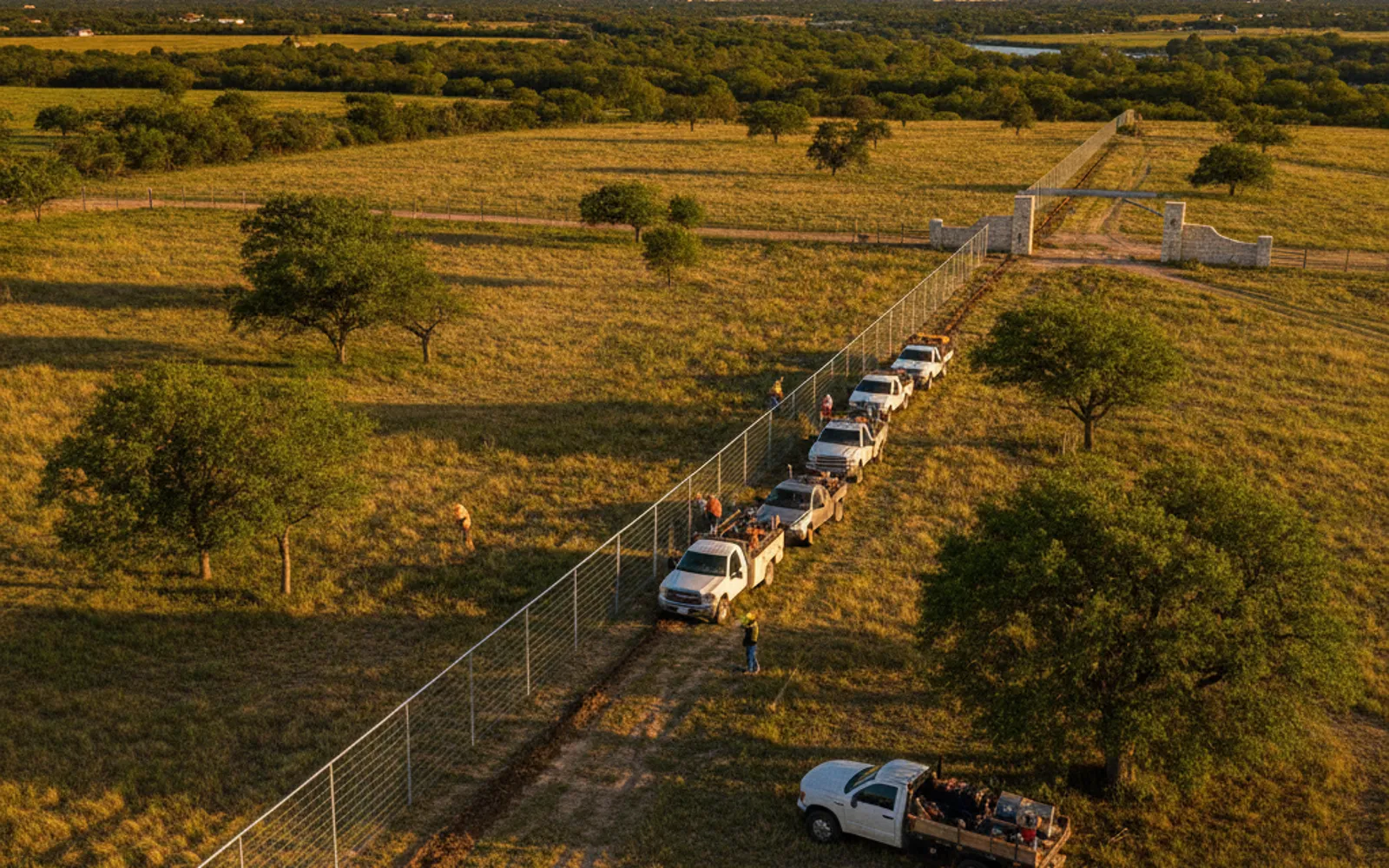
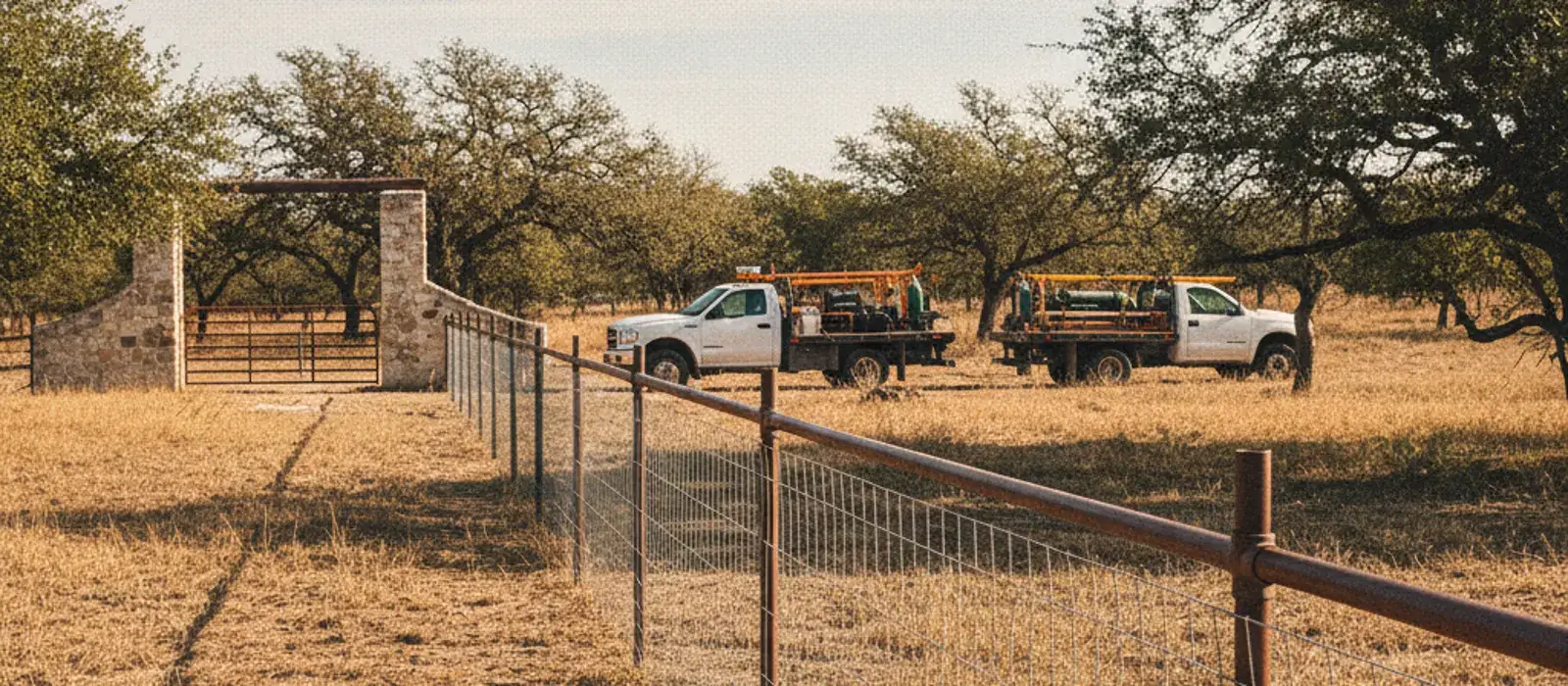
Net wire, also called field fence or woven wire, is a physical barrier. Vertical stay wires are woven or knotted to horizontal line wires, forming a mesh from the ground up to 39, 48, or 60 inches. Small animals can’t slip through, and predators have a much harder time getting in. Most net wire fences in our area also get one or two strands of barbed wire run across the top to keep cattle from mashing it down.
Both fences hang on the same bones: solid corner and gate braces, line posts every 10 to 12 feet, and wire stretched tight. The wire is the difference, and the wire is what drives the cost.
If you’re staring at a pasture right now trying to decide, skip the guesswork. Call us at (254) 870-8898 and we’ll walk the line with you and put real numbers on both options in a free written estimate.
Barbed Wire vs Net Wire Fence Cost in Central Texas
Here’s what these fences actually cost installed around Waco in 2026, assuming decent ground and a fence line that’s already clear:
| Factor | Barbed Wire (5 strand) | Net Wire (with top barbed strand) |
|---|---|---|
| Installed cost per foot | $1.75 to $3.25 | $3.50 to $5.50 |
| Cost per mile | $9,200 to $17,200 | $18,500 to $29,000 |
| Cost for 10 acres (about 2,640 ft) | $4,600 to $8,600 | $9,200 to $14,500 |
| Holds cattle | Yes | Yes |
| Holds goats and sheep | No | Yes |
| Holds horses safely | Not recommended | Yes (2x4 mesh) |
| Predator resistance | Poor | Good |
| Typical lifespan | 25 to 40 years | 20 to 30 years |
| Repair difficulty | Easy, splice one strand | Harder, patch or re-stretch a section |
Materials explain most of the gap. A mile of net wire is simply a lot more steel than a mile of five-strand barbed, and it takes more labor to stretch flat and tight without bagging. Rocky ground, brush clearing, and long runs without corners all move these numbers, which is why we put everything in writing before work starts. You can see how we break down pricing on our ranch fence cost page.
One more cost note: wire quality matters more than wire type. Cheap Class 1 galvanized wire of either kind can start rusting in under a decade in our humidity. Class 3 galvanized costs maybe 15 percent more up front and roughly doubles the coating life. On a $20,000 fence, that’s the best $3,000 you’ll ever spend.
Which Livestock Each Fence Actually Holds
This is where most fence decisions should start, because the animal picks the fence more than the budget does.
Cattle. Five strands of barbed wire on good braces holds cows and most bulls. It’s the standard for a reason: it’s the cheapest fence per foot that reliably does the job. If you run only cattle, net wire is usually money you don’t need to spend. Our barbed wire fence crews in Waco build more of this than everything else combined.
Goats and sheep. Barbed wire flat does not hold them. Goats walk through strand fences like they’re not there, and coyotes walk in the same way. You need net wire, and the knot style matters. We cover the details in our guide to fencing for goats and sheep, but the short version is: 48 inch net wire, small mesh at the bottom, and tight to the ground.
Horses. Barbed wire and horses are a bad mix. A spooked horse that hits barbed wire can tear itself up badly enough for a vet bill that costs more than the fence. Net wire with 2x4 inch mesh, often called horse wire, is the safe budget option.
Feral hogs. Neither fence truly stops a determined boar, but fixed-knot net wire slows hogs way down compared to barbed wire, which they walk under without noticing. If hogs are already tearing up your place, read our post on feral hog fence damage before you spend a dime on wire.
Dale Hutchins runs Spanish goats on 60 acres outside Crawford. He bought the place with a tired five-strand barbed fence and figured he’d make it work. In the first year he lost goats to the road and to coyotes, about $1,800 worth by his own count, plus the Saturday mornings spent hauling escapees home. We replaced 1,400 feet along his road frontage with 48 inch fixed-knot net wire for right at $5,900. He told us it paid for itself in three seasons just in goats that stayed home.
Terrain, Brush, and the Bosque County Factor
Wire type isn’t only about animals. The land votes too.
Net wire hates rough ground. Every dip and rise in the fence line either leaves a gap under the mesh or forces extra posts and dips in the wire. On the broken limestone country west of Valley Mills and Clifton, that adds real labor cost. Barbed wire handles rolling terrain much more gracefully because each strand can follow the ground on its own.
Creek crossings are another dividing line. A water gap built from barbed wire or swinging panels can wash out in a flood and be rebuilt in an afternoon. A net wire fence run through a draw catches every stick and leaf the creek sends down, and a spring rise can take out 100 feet of mesh at once.
Brush pressure matters too. Net wire catches falling limbs and holds them, and a limb lying on mesh stretches it out of shape permanently. Barbed strands shed most limbs or can be re-stretched in minutes.
The knot style is the piece most folks miss. Old-style hinge joint net wire is cheaper but crushes and bags when cattle lean on it or hogs hit it. Fixed-knot wire holds its shape under abuse and spans rougher ground with fewer posts. We break down the difference in fixed knot vs hinge joint if you want the full picture.
Marcy Villarreal learned the knot lesson the hard way on her place south of Valley Mills. Hogs coming up from the creek bottom tore through her older hinge-joint field fence in four places in one winter, and the patch quotes she gathered totaled about $2,200. Instead of patching, we rebuilt the 900 foot creek-side stretch in fixed-knot wire with a barbed bottom strand for $4,300. Two years later that stretch is still tight, and the hogs moved on to easier ground.
When Mixing Both Fences Makes the Most Sense
Here’s what a lot of first-time land buyers don’t hear: most working ranches around here don’t choose one wire. They use both, in different places.
The common pattern looks like this. Barbed wire on the long perimeter runs where only cattle push it. Net wire on the road frontage, around the house and pens, and on any trap or pasture that holds goats, sheep, weaned calves, or horses. You put the expensive wire only where the expensive problems are.
Roy Kubacak runs cows on about 300 acres west of West. When he priced fencing the whole perimeter in net wire, the number came back near $68,000. Five-strand barbed for the same perimeter priced at about $34,000. He went with barbed on the perimeter and had us build a 12 acre weaning trap in net wire near the pens for another $6,100. Total spend landed around $40,000 instead of $68,000, and every foot of wire is doing exactly the job it’s built for.
One legal note worth knowing: much of rural Texas is still open range under Texas Agriculture Code Chapter 143, but counties and highways carry stock law exceptions, and a fence that doesn’t hold your animals can still put liability on you when they reach a roadway. Good road frontage fence isn’t just about keeping livestock in. It’s about keeping you out of court.
If you’re pricing a mixed setup like Roy’s, request a free written estimate and we’ll price each stretch separately so you can see exactly where net wire earns its keep and where barbed wire saves you thousands.
How to Decide: Five Questions Before You Buy Wire
Run your place through these five questions and the answer usually falls out on its own.
- What animals will this fence hold in the next ten years? Fence for the livestock you’ll own, not just the livestock you own today. Plenty of folks add goats or a horse two years after building a cattle-only fence.
- What’s trying to get in? Coyote and dog pressure pushes you toward net wire for anything smaller than a cow. Hog pressure pushes you toward fixed-knot.
- What does the ground look like? Smooth, open ground suits net wire. Rocky, brushy, creek-cut country favors barbed.
- Which stretches carry the most risk? Road frontage and pens justify better wire. Back pasture lines usually don’t.
- What’s your real budget per foot? Get both numbers in writing before deciding. Land grant universities publish fence cost worksheets, like the University of Georgia Extension’s Fences for the Farm guide, and they all show the same thing: the spread between fence types is bigger than most owners expect.
A word on doing it yourself. Stringing a few strands of barbed wire between existing braces is honest weekend work. But stretching net wire flat and tight over any distance, and building the H-braces that keep 3,000 pounds of wire tension from pulling your corners over, is where DIY projects go sideways. If a corner post leans or the mesh bags in the first year, the fence fails early no matter how good the wire was. When the job involves new braces, long runs, creek crossings, or rocky ground, that’s the point to put the come-along down and call a professional.
That’s what we do all day, every day, from China Spring to Lorena. Call (254) 870-8898 for a free written estimate, and if a storm or a cow wreck has your fence open right now, that same number reaches our 24/7 emergency line.
Frequently Asked Questions
Can I put barbed wire on top of a net wire fence?
Yes, and around here you usually should. One or two barbed strands above the mesh keep cattle from leaning over and mashing the net wire down, and they add a few inches of effective height. It’s the standard build for combination cattle and goat fences in Central Texas.
Will net wire hold cattle by itself?
It will hold them, but cattle are hard on bare net wire because they lean over it to graze and rub on it. Without a barbed top strand, expect the top of the mesh to bow and bag within a few years. If cattle are the only stock, five-strand barbed is cheaper and takes the abuse better.
How long does each fence type last in Central Texas?
A well-built barbed wire fence on good posts commonly runs 25 to 40 years, and net wire typically runs 20 to 30. Wire coating matters as much as wire type, since Class 3 galvanized lasts roughly twice as long as Class 1 in our climate. Posts usually fail before good wire does, so post choice sets the real lifespan.
Is net wire worth the extra cost for a small acreage?
On small places it often is, because the total footage is low and the flexibility is high. Fencing 10 acres in net wire instead of barbed might add $4,000 to $6,000, and in exchange you can run goats, sheep, calves, or a horse without touching the fence again. On a small tract, one fence that holds everything usually beats a cheap fence that holds one species.