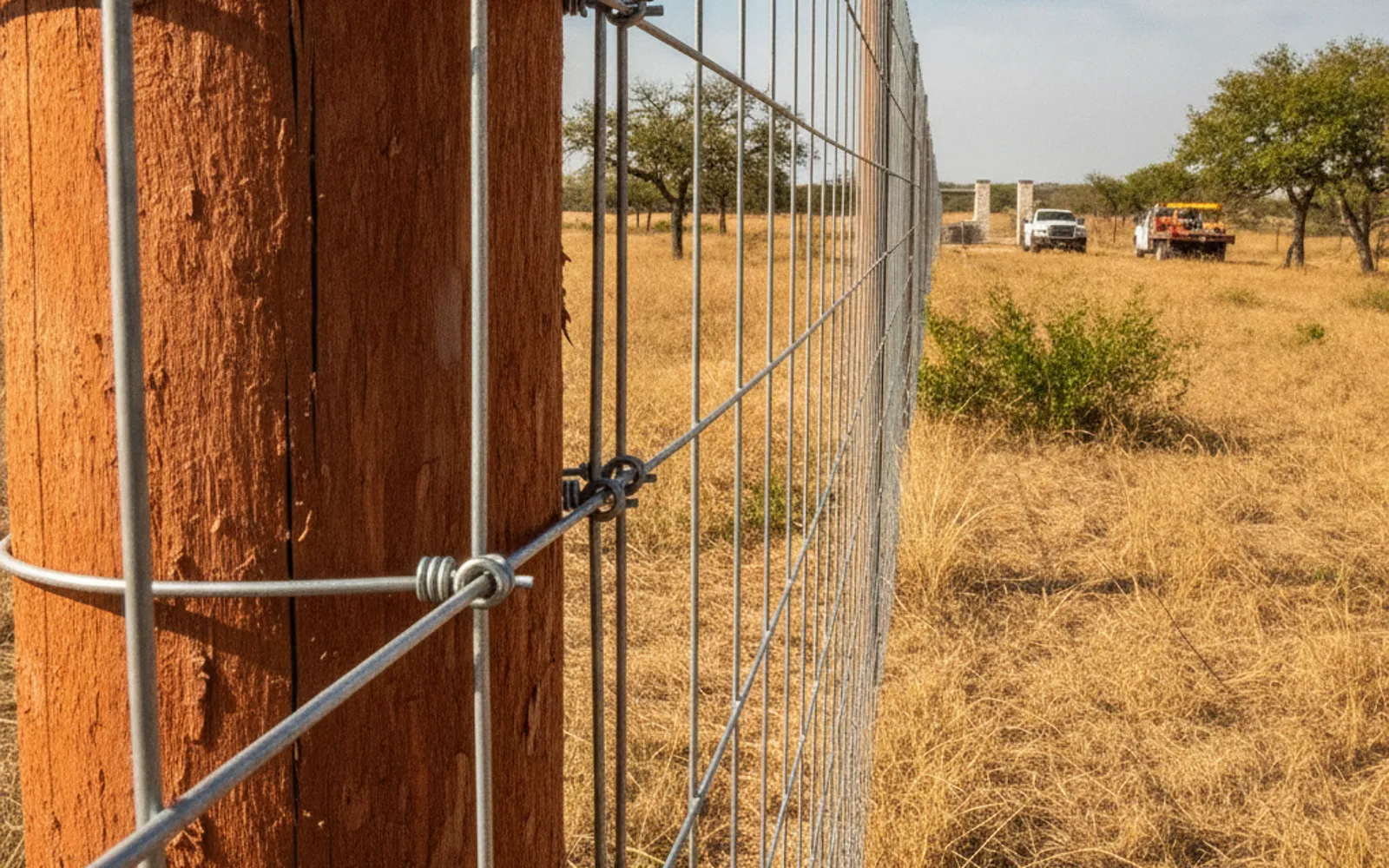
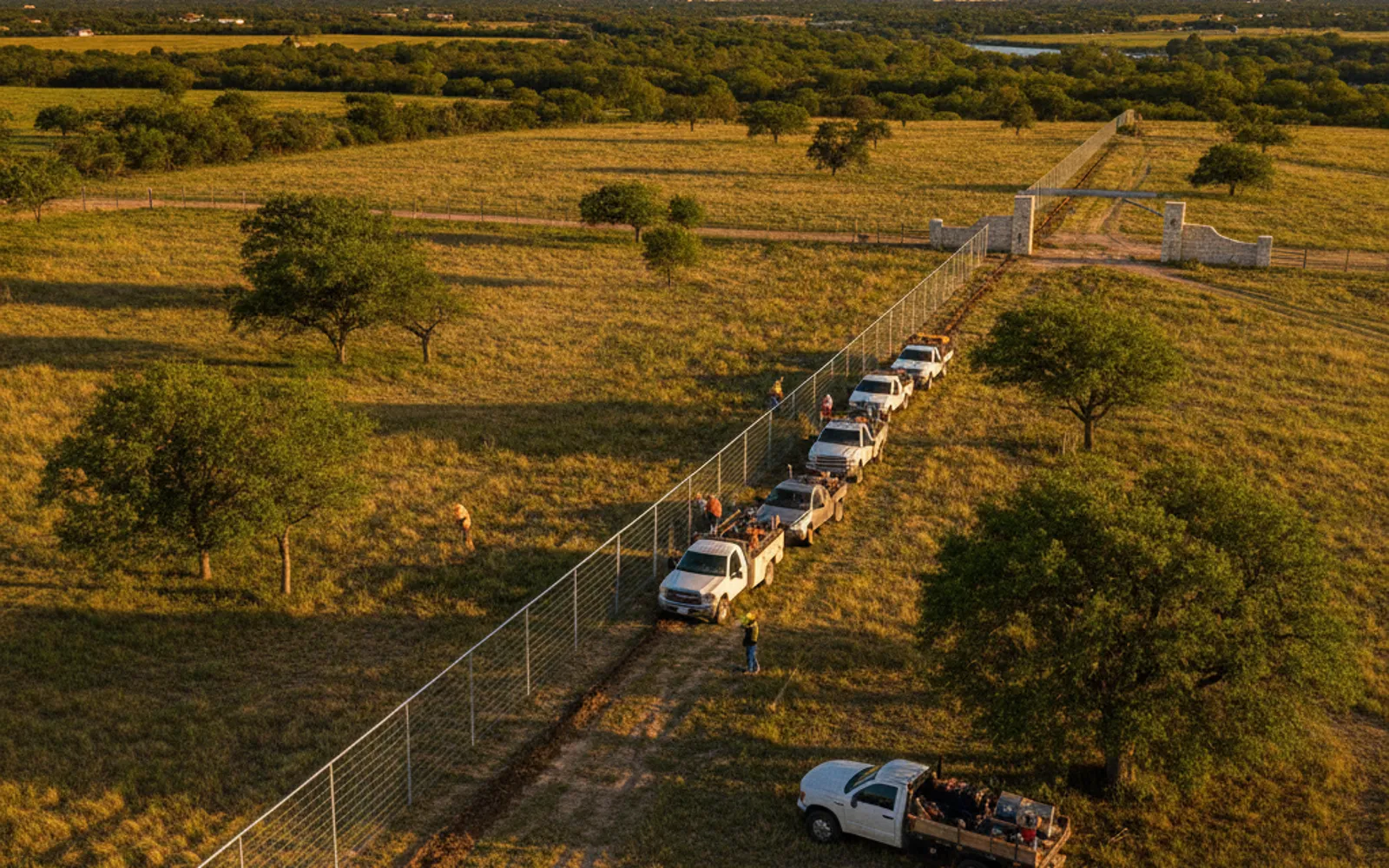
Eight-foot net-wire game fence built to hold whitetail, axis, and blackbuck on Central Texas ranch land. Free written estimates, real numbers per foot, and crews that know how to brace a corner.
If you're looking for a game fence builder in Waco, TX, you want somebody who's built high fence on real ranch country, not just backyard privacy fence. Brazos Ridge Fence Co. installs 8-foot net-wire game fence across McLennan, Bosque, and Falls counties for landowners running whitetail, exotics, or both. Most of our game fence runs $4.50 to $10 per linear foot installed, which works out to roughly $25,000 to $50,000 per mile depending on terrain and wire class.
A high fence is a big check, so we put everything in writing before a single post goes in the ground. You'll get a walked line, a per-foot price, and a clear number for any fence line clearing the job needs. If you're still comparing options, our ranch fence cost guide breaks down game fence against barbed wire and other styles so you can see where your money goes.
Full 96-inch fixed-knot or hinge-joint net wire that whitetail and most exotics can't clear. We stretch it tight and keep it tight.
H-braces and pipe corners set in concrete carry the load of a mile of stretched wire. Weak corners are why cheap game fences sag in three years.
Wire spacing and height matched to what you're holding, from whitetail and axis to blackbuck and aoudad. Smaller mesh down low keeps fawns and exotics from slipping through.
We clear cedar, mesquite, and brush along the line before we build, priced separately so you only pay for what your land needs.
Tall wire gates, cattle guards, and custom entrances that don't become the hole in your high fence. We build them to the same height as the line.
We walk your line, measure it, and hand you a written per-foot price. No guessing, no surprise change orders halfway through the job.
Straight talk on price: most 8-foot game fence in Central Texas runs $4.50 to $10 per linear foot installed. That's about $25,000 to $50,000 per mile. Where you land in that range comes down to wire class, post spacing, how rocky your ground is, and how many corners and gates the layout needs.
Fixed-knot high-tensile wire costs more up front than hinge-joint, but it holds tension longer and stands up better when a buck hits it at a dead run. On rocky Bosque County hillsides, drilling post holes takes more time than it does in Falls County bottomland, and the bid reflects that. Clearing is always extra, and heavy cedar can add real money, so we price it as its own line item.
A few things that move the number:
For a deeper breakdown, read our ranch fence cost guide, then call (254) 870-8898 and we'll put a real number on your line.
A game fence lives or dies at the corners. We set pipe corner posts and H-brace assemblies in concrete, because a mile of stretched net wire puts thousands of pounds of pull on every end post. Skimp there and the whole fence leans inside a few seasons.
Line posts go in on 15 to 20 foot centers depending on terrain, driven or set deep enough to handle our Central Texas clay that swells and shrinks with every wet and dry spell. Then we stretch 8-foot net wire in long runs, keeping the bottom tight to the ground so hogs and fawn-sized animals can't work their way under.
Many landowners pair a game fence with pipe fencing at the headquarters and a custom ranch entrance gate up front. We build all three, so the heights match, the braces tie together, and one crew is accountable for the whole perimeter.
Plenty of our game fence calls start with a tax question, not a deer question. If you're moving land from an ag exemption to a wildlife management valuation, or you're building a managed whitetail or exotics operation, a high fence is often part of the plan. It lets you control your deer density, protect your genetics, and keep your neighbor's spikes off your protein feeders.
We're fence builders, not appraisers, so your CAD office or wildlife biologist should drive the exemption paperwork. What we bring is a fence that actually holds what your management plan says it holds. An 8-foot perimeter that's tight, braced, and gapped correctly at gates and water crossings is what makes the rest of the program work.
If you're weighing a full high-fence perimeter against improving your existing low fence, we'll walk it with you and give you honest numbers on both. Sometimes the right answer is high fence on three sides and upgraded barbed wire where a creek or bluff already does the work.
Brazos Ridge Fence Co. builds game fence within about an hour of Waco, covering McLennan, Bosque, and Falls counties. That includes ranch country around China Spring, Crawford, McGregor, Valley Mills, Lorena, and West.
We're licensed and insured, and we run a 24/7 emergency line for storm damage and cattle-out situations, because a tree through your high fence can't wait until Monday when you've got stocker deer or exotics behind it. Call (254) 870-8898 or email info@brazosridgefence.com and we'll set up a time to walk your line. The estimate is free and it comes in writing.
Most 8-foot game fence around Waco runs $4.50 to $10 per linear foot installed, or roughly $25,000 to $50,000 per mile. Fixed-knot wire, rocky ground, and extra corners push you toward the top of that range. Clearing the fence line is priced separately. We give you an exact written number after we walk your property.
Eight feet is the standard for whitetail in Texas, and it's what we build. A healthy buck can clear a 6-foot fence without much effort, so shorter fence won't hold deer you're trying to manage. For jumpers like axis, 8 feet with tight bottom wire is the right spec.
A high fence by itself doesn't qualify you, but it's a common part of a wildlife management plan because it lets you control deer numbers and habitat use on your acreage. Your county appraisal district and a wildlife biologist handle the plan and paperwork. We build the 8-foot perimeter that makes the plan enforceable on the ground.
Figure 3 to 5 weeks for a mile on typical Central Texas ground, and longer if there's heavy cedar clearing or a lot of rock drilling. Corners, gates, and creek crossings are what eat the calendar, not the straight runs. We give you a schedule with the written estimate so you can plan around it.
Yes. We clear a working lane along the line before we build, usually 10 to 15 feet wide, so the crew can stretch wire properly and you can maintain the fence later. Clearing is billed separately from the fence itself because it varies so much, from light brush at a few hundred dollars per quarter mile to heavy cedar that costs considerably more.
Real prices and honest how-to advice from the same crew that will build your fence:
Free written estimates. Emergency calls answered around the clock.
Most barbed wire fence around Waco runs $2.50 to $5.50 per foot installed, and game fence runs $4.50 to $10, so a written quote costs you nothing but a walk down the fence line. Call (254) 870-8898 or email info@brazosridgefence.com and we'll get you a free written estimate this week.
Call (254) 870-8898Around-the-clock line — a person answers, not a machine.