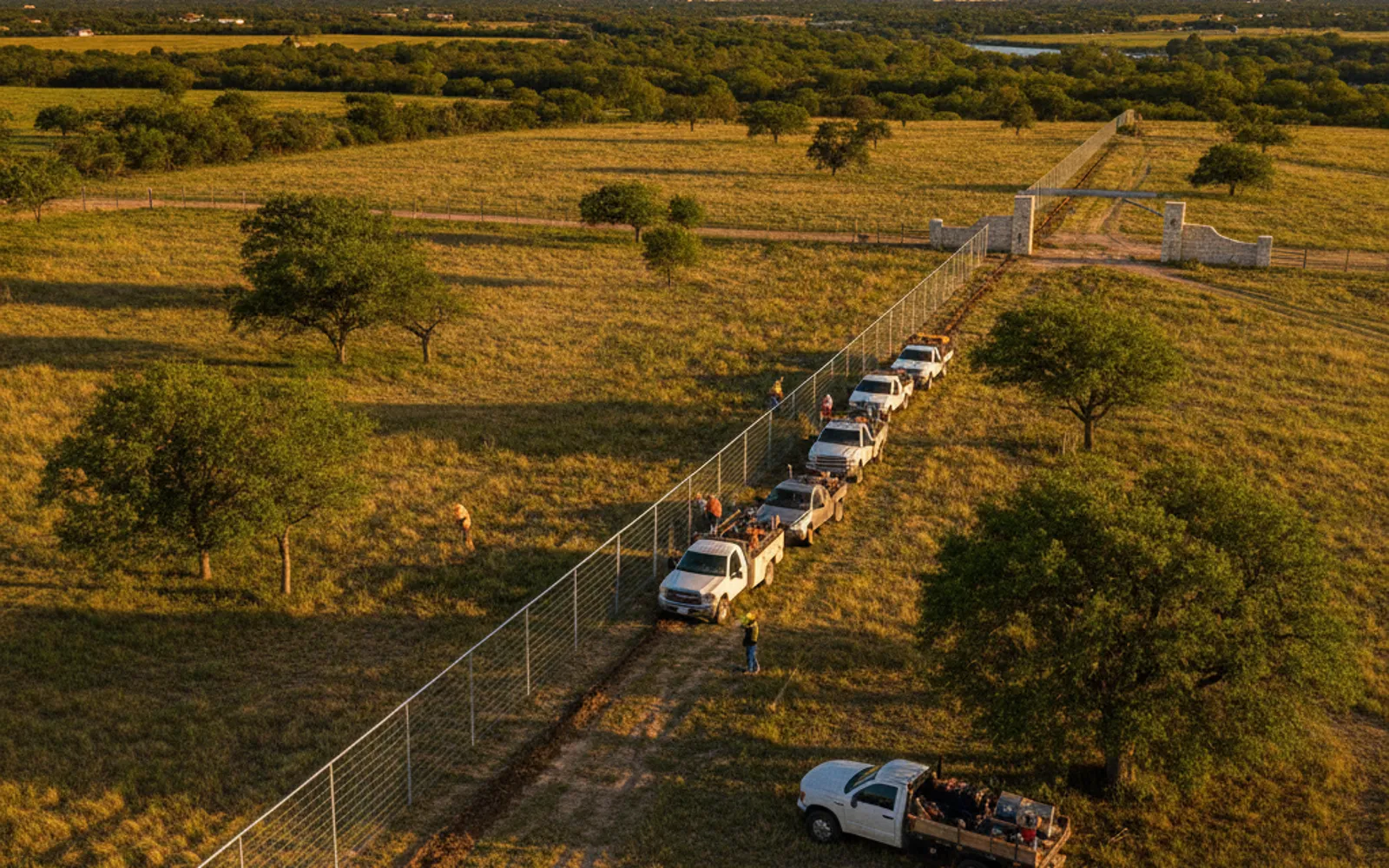
Pens, alleys, and chute setups laid out so one person and a dog can work the whole herd. Welded pipe, built to the ground you actually have.
A fence keeps cattle in. A corral lets you do something with them. Brazos Ridge Fence Co. builds working pens, sorting corrals, crowding setups, and loading chutes across McLennan, Bosque, and Falls counties. As a general market range, a complete working facility usually lands between $6,000 and $30,000, driven by head count, layout, and how much of the equipment you already own.
Most of the corral calls we get come from the same place: somebody has been catching cattle in a corner of the pasture with panels and a lot of shouting, and has finally had enough. A pen laid out correctly changes that job from a four-person Saturday into something one person can do on a Tuesday morning. That is what we are actually selling here, and it is worth more than the pipe.
Sized at roughly 20 square feet per head for cows, more for pairs. Enough pens to sort into, because a facility with one pen only lets you gather, not sort.
Both work. A tub uses continuous motion, a bud box uses the cattle turning back past you. We build either and will tell you which fits your ground, your herd, and how you like to work.
Twenty-six to thirty inches wide for mature cows, adjustable or sheeted sides for calves. Too wide and they turn around; too narrow and they jam. This is the measurement that makes or breaks a facility.
A squeeze chute anchored to concrete or to a pipe frame that does not move when a cow hits it. We set yours if you have one and build the approach if you do not.
Built to trailer deck height with a solid ramp and sheeted sides, positioned so you can back a gooseneck to it without a spotter and without unhitching.
Sorting gates hung to swing both ways and latch from either side, with man-passes at the corners. Every gate you can work from where you already are is a trip you do not make.
As general market ranges, a small setup for 20 to 30 head, meaning a holding pen, one sorting pen, a short alley, and a headgate, generally runs $6,000 to $12,000. A full facility for 100-plus head with a crowding tub, multiple sorting pens, a loading chute, and a mounted squeeze chute runs $18,000 to $30,000 and up.
The variables, roughly in order of how much they move the number:
We quote the pens, the alley, the chute mount, and the loading chute as separate items so you can build in stages. Plenty of operations start with a solid holding pen and alley and add the tub two years later.
Layout is the whole job. The pipe is just pipe.
Cattle move well when they are going where they can see, moving toward other cattle, and turning the way they came from. They move badly toward a dark shed, into a dead end, or against a crowd. A good facility uses those tendencies instead of fighting them, which is why the same herd will flow through one setup and wreck another.
Practical things that matter more than people expect: solid sides on the alley and the tub, so cattle look forward instead of at you. A man-pass at every corner, so you never have to climb. Gates that latch from both sides. And enough curve or angle that an animal in the alley cannot see the chute until it is committed.
We lay the pen out on the ground with you before we weld anything, walking through a working day out loud. Where do the cattle come from, where do they go after, where is the trailer parked, which way does the wind blow the dust. That conversation costs nothing and it is the difference between a pen you like and a pen you tolerate.
This is the one people argue about, and both camps are right about their own operation.
A crowding tub is a curved pen with a sweep gate that funnels cattle into the alley. It handles larger groups with less thinking, works well when several people are helping, and is what most commercial facilities use. It costs more to build and takes more room.
A bud box is a simple rectangular pen where cattle walk in, then turn back past the handler into the alley. It is cheaper, smaller, and works beautifully when it is built to the right dimensions and the handler knows how to position. It is unforgiving when either of those is off.
Our honest read: if you work cattle mostly alone and you are willing to learn the positioning, a bud box gives you more facility per dollar. If several different people will be using it, including neighbors and hired help who have never seen it before, a tub is more forgiving of whoever is standing in the wrong place.
A corral takes punishment a fence line never does. Cattle push against it under stress, they hit it, and they do it in the same three places every time. That is why almost everything we build for working facilities is welded drill-stem pipe rather than wire or wood.
Pipe corners in a pen get set deeper than fence corners and are usually filled or sleeved where the abuse concentrates. The rails go on the inside face of the posts so there is nothing protruding into the pen, and joints get ground smooth. Same principle as an arena: nothing that can hook a hip or a hide.
Continuous panel is the reasonable alternative when you want the option to move things later, and it is genuinely cheaper. We build with it when that is what you want, and we say so on the bid rather than quietly substituting. Either way, the setup ties into your existing pipe fence and ranch entrance if we built those too, so the heights match and the braces work together.
We build working pens and corrals across McLennan, Bosque, and Falls counties, including the working cattle country around Crawford, McGregor, and Marlin, and the smaller operations closer in around Lorena and Hewitt.
Come out and walk your place with us. Bring the trailer, tell us how you like to work, and we will draw the pen on the dirt before anyone quotes a number. Estimates are free and in writing.
As general market ranges, a small setup for 20 to 30 head, meaning a holding pen, a sorting pen, a short alley, and a headgate, runs about $6,000 to $12,000. A full facility for 100-plus head with a crowding tub, multiple pens, a loading chute, and a mounted squeeze chute runs $18,000 to $30,000 and up. We quote each piece separately so you can build it in stages.
Twenty-six to thirty inches for mature cows. Narrower and animals jam; wider and they turn around, which is how people get hurt. If you run calves through the same alley, we build adjustable or sloped sides so one alley handles both without a compromise that works badly for each.
A bud box is cheaper, smaller, and excellent when the handler knows how to position and works mostly alone. A crowding tub costs more and takes more room but is more forgiving of whoever happens to be helping that day. If several different people will use the facility, we usually recommend the tub.
Figure roughly 20 square feet per head for mature cows in a holding pen, and more for pairs, since a calf needs somewhere to be that is not under a cow. Crowding pens are deliberately tighter than that, but nothing should hold cattle at crowding density for longer than the few minutes it takes to work them.
Yes, and it is usually the right way to do it, because the pen wants to sit where the cattle already come to. We tie into existing pipe or wire, match heights, and add braces where a fence corner is suddenly carrying corral loads it was never built for.
Real prices and honest how-to advice from the same crew that will build your fence:
See the rest of what we build on the services page, or find your town on the service areas page.
Free written estimates. Emergency calls answered around the clock.
Most barbed wire fence around Waco runs $2.50 to $5.50 per foot installed, and game fence runs $4.50 to $10, so a written quote costs you nothing but a walk down the fence line. Call (254) 870-8898 or email info@brazosridgefence.com and we'll get you a free written estimate this week.
Call (254) 870-8898Around-the-clock line — a person answers, not a machine.