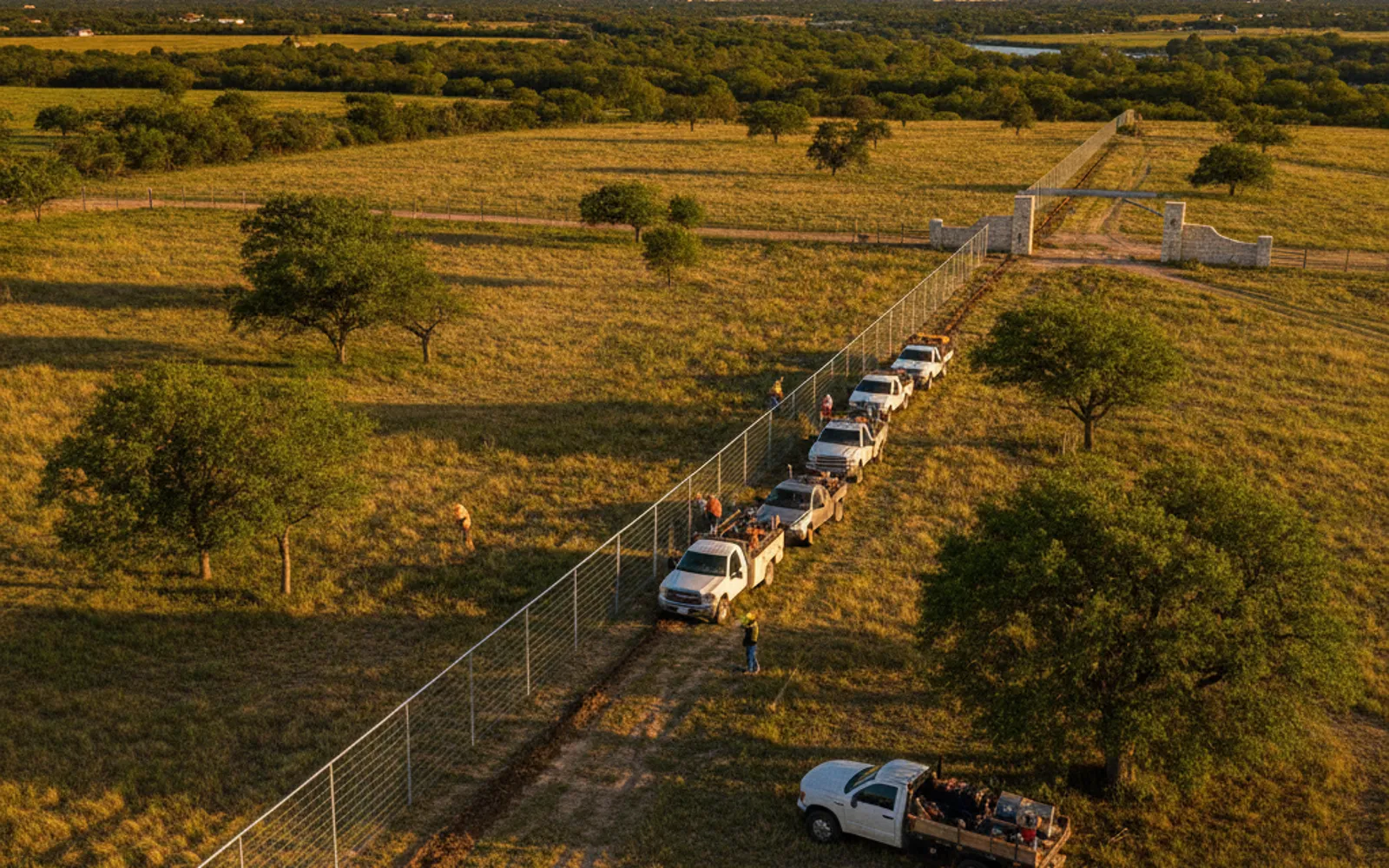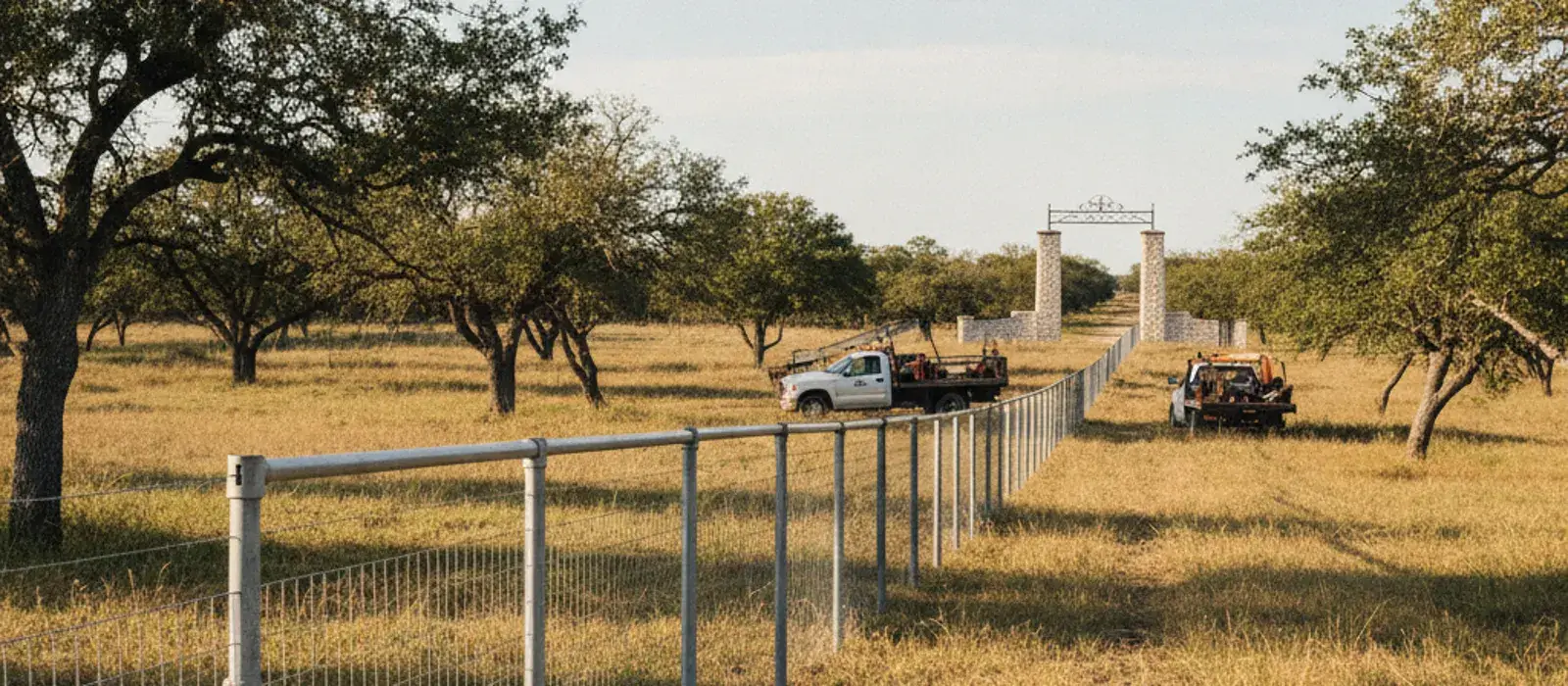
Five acres and two horses will teach you more about fencing than a thousand acres of open ranch ever will. On a big place, a fence just has to hold cattle. On a small place, it has to hold horses, goats, a donkey, and a dog, look decent from the road, survive your neighbor’s hunting lease traffic, and fit a budget that doesn’t have a ranch operation behind it.
That’s why small acreage fencing is its own conversation. The math is different, the animal pressure is different, and the mistakes cost more per acre. We build fence all over McLennan, Bosque, and Falls counties, and a big share of our calls now come from folks on 5 to 20 acres outside Waco, China Spring, Lorena, and Crawford. This guide covers what actually works on a hobby farm, what it costs in real numbers, and where people waste money.
Why Fencing 5 to 20 Acres Is Its Own Animal
Here’s the part that surprises new landowners: small places have more fence per acre than big ones. A square 10 acres needs about 2,640 feet of perimeter fence. A square 1,000 acres needs about 26,400 feet. That’s ten times the fence for a hundred times the land. Per acre, the small place pays way more.
Small acreage also concentrates animal pressure. Two horses on 8 acres walk the same fence line every single day. Goats on 5 acres test every low spot and every gap by lunchtime. On a 2,000-acre ranch, a cow might not touch a given stretch of fence for a month. On a hobby farm, your fence gets leaned on, rubbed on, and chewed on constantly.
Then there’s the neighbor factor. On small tracts, your fence is usually shared on at least two sides, your entrance is close to the county road, and any escaped animal is on pavement in minutes. Under Texas stock law in most of McLennan County, if your cow or horse causes a wreck on the road, you can be held liable if you were negligent about your fence. That raises the stakes on doing it right the first time.
So the small acreage fencing job has three goals: contain mixed animals under heavy pressure, keep them off the road, and do it without spending ranch money. Everything below flows from those three. If you’d rather just talk it through on your own fence line, call us at (254) 870-8898 and we’ll walk it with you.
What Small Acreage Fencing Costs Around Waco
Let’s talk real numbers, because this is where most folks start. Prices below are typical installed ranges in our area as of 2026, materials and labor, for straightforward ground. Rocky ridges near Valley Mills or tight clay bottoms along the Brazos can push these up.
| Fence type | Installed cost per foot | Best for | Square 10 acres (about 2,640 ft) |
|---|---|---|---|
| 5-strand barbed wire | $2.50 to $4.50 | Cattle only | $6,600 to $11,900 |
| Field fence (net wire) with barbed top | $3.50 to $6.00 | Goats, sheep, mixed stock | $9,200 to $15,800 |
| Horse-safe 2x4 net wire with top rail or hot wire | $6.00 to $9.00 | Horses, donkeys | $15,800 to $23,800 |
| Cattle panels on t-posts | $5.00 to $8.00 | Pens, small paddocks | Rarely used for full perimeter |
| Pipe fence | $28 to $45 | Road frontage, entrances, arenas | Frontage sections only |
A few things jump out of that table. First, barbed wire is cheap but it’s a cattle fence. It won’t hold goats and it’s a bad idea around horses, which we cover in barbed wire vs net wire. Second, nobody pipes a whole 10 acres. The smart play is pipe or a nice entrance across the front where you see it every day, then net wire down the sides and back. You can dig into full-perimeter math in our cost to fence 10 acres breakdown.
Budget rule of thumb for a mixed-animal hobby farm around Waco: plan on $10,000 to $20,000 for a solid perimeter on 8 to 12 acres, plus $2,500 to $7,500 if you want a pipe entrance with a gate that’ll still swing straight in ten years.
If you’d rather skip the guesswork, we’ll walk your property line and put a written number on it for free. Call us at (254) 870-8898 or request your free estimate here. Takes about an hour, and you’ll know your real cost instead of a blog range.
Match the Fence to the Animals, Not the Catalog
The single most expensive mistake on small acreage is building for the animals you have today instead of the animals you’ll have in two years. Almost every hobby farm ends up with more species than it started with. Plan for that.
Horses need visibility and smooth wire. A horse that hits barbed wire at a run can do thousands of dollars of vet damage in one night. Go with 2x4 “no-climb” net wire, a top rail or a hot wire on top, and posts on the outside of the wire. More detail in best fence for horses.
Goats and sheep are escape artists and predator bait in the same body. You want net wire with 4x4 or smaller openings, stretched tight, with the bottom close to the ground. Horned goats will hang themselves in cheap large-mesh field fence, so mesh size matters more than brand. Our fence for goats and sheep guide covers spacing and predator strategy.
A few cows or a steer for the freezer are the easy case. Five strands of barbed wire holds them fine, and if the rest of your fence is net wire for other animals, cattle respect it too.
Pigs and feral hogs are the wildcard. Domestic pigs root under anything that isn’t tight to the ground. Feral hogs around the Middle Bosque and Tonk Creek bottoms will flat tear a light fence open, and they don’t ask first.
Real example from last spring. Dana Whitlock bought 8 acres off Cooksey Lane in Lorena with an older barbed wire perimeter and brought home six Boer goats. The goats were out in nine days. We replaced 1,850 feet of the worst two sides with goat-height net wire and a barbed top strand for $11,300, and she kept the decent barbed wire on the side shared with a neighbor’s cattle. That’s the small acreage move: spend where your animals actually push, keep what still works.
Layout Tricks That Stretch a Small Acreage Fence Budget
On a small place, layout decisions swing your cost by thousands. Here’s what we tell folks on every walk-through.
Fence the perimeter right, cross-fence cheap. Your perimeter is your liability line and your predator line, so build it stout. Interior cross fences just sort animals, so they can be lighter: a couple strands of electric on t-posts makes a fine paddock divider for a fraction of net wire cost.
Put your money where the pressure is. Road frontage and the sides facing neighbors’ animals need your best fence. The back line along a wooded creek can often be a grade lower.
Plan gates before you build, not after. You need at least one 16-foot gate a truck and trailer can actually swing into from the road, plus a man gate near the barn. Cutting a gate into a finished stretched fence later costs more than framing it in now, because every gate needs braced posts on both sides. Corner and gate bracing is where cheap fences fail first, and our h-brace fence corners post shows why.
Don’t fence tight to the survey line without checking. On small tracts the pins matter. Six feet off on a 300-foot line is a real fight with a neighbor later.
The Kolar family in West learned the gate lesson the expensive way. They fenced 12 acres themselves in 2024 with a single 12-foot gate at the house. First hay delivery, the truck couldn’t make the turn, and they were hand-carrying round bale netting in the mud. We came back, cut in a 16-foot double gate with proper h-braces on the field side for $2,400. Framing that same opening during original construction would’ve run them around $900. Sequence matters.
One more layout note: leave yourself a working pen. Even two head of anything eventually needs to be caught, doctored, or loaded. A small cattle-panel pen in a corner, tied into the perimeter, costs $1,500 to $3,000 and saves you a rodeo every time the vet comes.
Posts, Wire, and What Central Texas Ground Does to Both
Material choices matter more here than the catalogs let on, because Central Texas ground is hard on fences. Blackland clay east of I-35 swells and shrinks with every wet-dry cycle, which heaves posts and slacks wire. West of Waco toward Crawford and Valley Mills, you’re fighting rock a foot down.
For posts, the honest answer for most hobby farms is a mix: treated wood or pipe at corners, gates, and braces, with t-posts between. Wood corner posts should be 6 inches or bigger, set 3 feet deep or more, and concreted at gates. In clay, deeper beats wider. In rock, we’re often drilling or driving pipe, which changes the bid, so tell your contractor what your ground is like before they price it.
For wire, buy class 3 galvanized, not class 1. It costs maybe 10 to 15 percent more and roughly doubles the life of the wire. On a fence you’re paying real money to install, cheap wire is a false economy. Texas A&M AgriLife Extension publishes solid fence construction guidance if you want the research side of post depth and bracing; it’s worth a read at agrilifeextension.tamu.edu.
And if part of your plan is grazing or a wildlife plan to qualify for an agricultural appraisal, know that fencing itself doesn’t earn the exemption, but your county appraisal district will expect infrastructure that matches a real ag use. The state’s ag-timber rules live at the Texas Comptroller site, and we break down how fences fit into it in ag exemption fencing in Texas.
Here’s what shortcuts look like a few years on. Marcus Trejo bought 6 acres near China Spring in 2023 with a fence the seller’s crew had thrown up fast: light t-posts, class 1 wire, no real braces. By early 2026 the corners were leaning and the top wire had a foot of sag. Patching it was going to run $3,800 and still leave bad bones. Rebuilding the two worst runs with proper h-braces and class 3 net wire ran $9,600, and the rest of the fence tightened up fine off the new corners. He got the itemized version of both options in writing first, which is exactly what you should demand from anybody bidding your place.
DIY or Hire It Out? An Honest Answer
Plenty of hobby farm fence work is genuinely DIY-friendly, and we’ll tell you so. Driving t-posts, stringing a hot wire cross fence, hanging a gate on existing posts, stapling wire on a repair: if you’ve got a weekend and a helper, go for it.
Where we see DIY go sideways is the structural work. Corner and gate braces carry the entire tension of the fence, and a brace that’s undersized or shallow fails slowly, then all at once. Stretching net wire takes equipment and technique; wire stretched by hand goes slack the first summer. Post holes in our rock and clay can turn a one-weekend project into a three-weekend fight that ends with a rented skid steer and a sore back.
The safety lines are simpler. Stop and call a professional if the fence borders a road where an escaped animal becomes a liability, if you’re working anywhere near buried utilities, if the job involves old wire under tension, or if you’re taking out an existing fence with unknown junk in the line. Rusty high-tensile wire under load can snap and whip, and it does not care how careful you feel.
A hybrid approach works great on small acreage: we set the corners, braces, and gates and stretch the wire, and you handle tear-out of the old fence and cleanup. That can shave 15 to 25 percent off the bill. There’s a fuller breakdown in DIY fence vs professional.
If you’re weighing options for your own place, that’s exactly what our free estimate is for. We’ll tell you which parts are worth doing yourself and put real numbers on the rest, with no pressure either way. Call (254) 870-8898 or reach us here. And if you want the fancy front entrance to go with the practical perimeter, our ranch entrance gates and pipe fence pages show what we build around Waco.
Frequently Asked Questions
How much does it cost to fence 5 acres near Waco?
A square 5 acres has roughly 1,870 feet of perimeter. In our area that runs about $6,500 to $11,000 in net wire for goats or mixed stock, and $4,700 to $8,400 in 5-strand barbed wire for cattle only. Horse-safe fencing, gates, a pipe entrance, and rocky or brushy ground add to that, which is why a free on-site estimate beats any online calculator.
What’s the best fence for a hobby farm with mixed animals?
Net wire with a barbed or electric top strand is the workhorse answer, because it holds goats, sheep, cattle, and donkeys in one build. If horses share the pasture, step up to 2x4 mesh and skip barbed wire entirely. Building the perimeter for your most escape-prone animal means you won’t rebuild when the herd changes.
Do I need a fence to keep my ag exemption?
Fencing alone doesn’t qualify land for an agricultural appraisal, but appraisal districts expect infrastructure that supports a genuine ag use, and grazing without a stock-tight fence is a hard sell. Check your county’s degree-of-intensity standards and the Texas Comptroller’s ag-timber guidelines. A functional perimeter fence is usually part of a credible grazing operation on small acreage.
How long does it take to fence a small place?
For a typical 5 to 12 acre perimeter, plan on 3 to 7 working days once materials are on site: a day or two for tear-out and clearing, a day for corners and braces, then stretching wire and hanging gates. Weather, rock, and brush along the line are the usual things that stretch a schedule. Most of our hobby farm jobs around Waco are done within a week.