Can you really save half the money building your own fence? Sometimes, yes. And sometimes you spend $4,000 on materials, burn three weekends, and end up calling us anyway to rebuild your corners.
We install fence for a living, so you’d expect us to tell you to hire a pro every time. We won’t. The honest answer on diy fence vs professional is that it depends on the job, your ground, your tools, and how much your Saturdays are worth. Plenty of Central Texas ranchers are perfectly capable of stretching wire, and we’ll tell you which jobs make sense to tackle yourself.
But we’ve also rebuilt enough failed DIY fence between China Spring and Lorena to know where the wheels come off. This article lays out the real numbers for both routes so you can decide with your eyes open.
Want a number to compare against before you commit either way? Call (254) 870-8898 or request a free written estimate. It costs nothing, and it gives your DIY budget an honest benchmark.
The real math on a DIY barbed wire fence
Let’s price a quarter mile, 1,320 feet, of 5-strand barbed wire. That’s a common stretch for a cross fence or a road frontage on small acreage around here.
Materials first. Figure t-posts on 10 to 12 foot spacing, wood or pipe corner posts, five rolls of wire, clips, staples, and concrete for the braces. At 2026 prices in the Waco area, you’re looking at roughly $1.30 to $1.90 per foot in materials for decent quality. Call it $1,700 to $2,500 for the quarter mile. If you cheap out on wire, buy Class 3 galvanized or better, because bargain wire rusts years sooner.
Now the part DIY budgets always skip: tools and equipment. A powered post driver or auger rental runs $100 to $350 a day. A decent wire stretcher, fence pliers, a spinning jenny for the wire rolls, and post levels add another $200 to $400 if you don’t own them. Hit rock, and you may need a skid steer with a hydraulic auger at $300 to $500 a day. Lots of ground west of the Bosque River is exactly that kind of rocky.
Then there’s time. A two-person crew that’s never built fence will spend 4 to 6 full days on a quarter mile if the ground cooperates. Clearing brush, setting and bracing corners, driving 110 to 130 posts, then stretching and tying five strands. If you’re doing it on weekends, that’s a month of Saturdays.
So the true DIY cost on our quarter mile is roughly $2,100 to $3,300 in cash, plus 80 to 100 man-hours. That’s the honest number to compare against a quote, not the materials receipt alone.
What professional fence installation actually costs
A professional crew in McLennan, Bosque, or Falls County will typically run $2.50 to $4.50 per foot for 5-strand barbed wire, installed, depending on terrain, brush, and corner count. Our quarter mile comes out around $3,300 to $5,900. Pipe corners, heavy brush, or rock push you toward the top of that range. The full picture by fence type is on our ranch fence cost guide.
What do you get for the difference? Mostly three things.
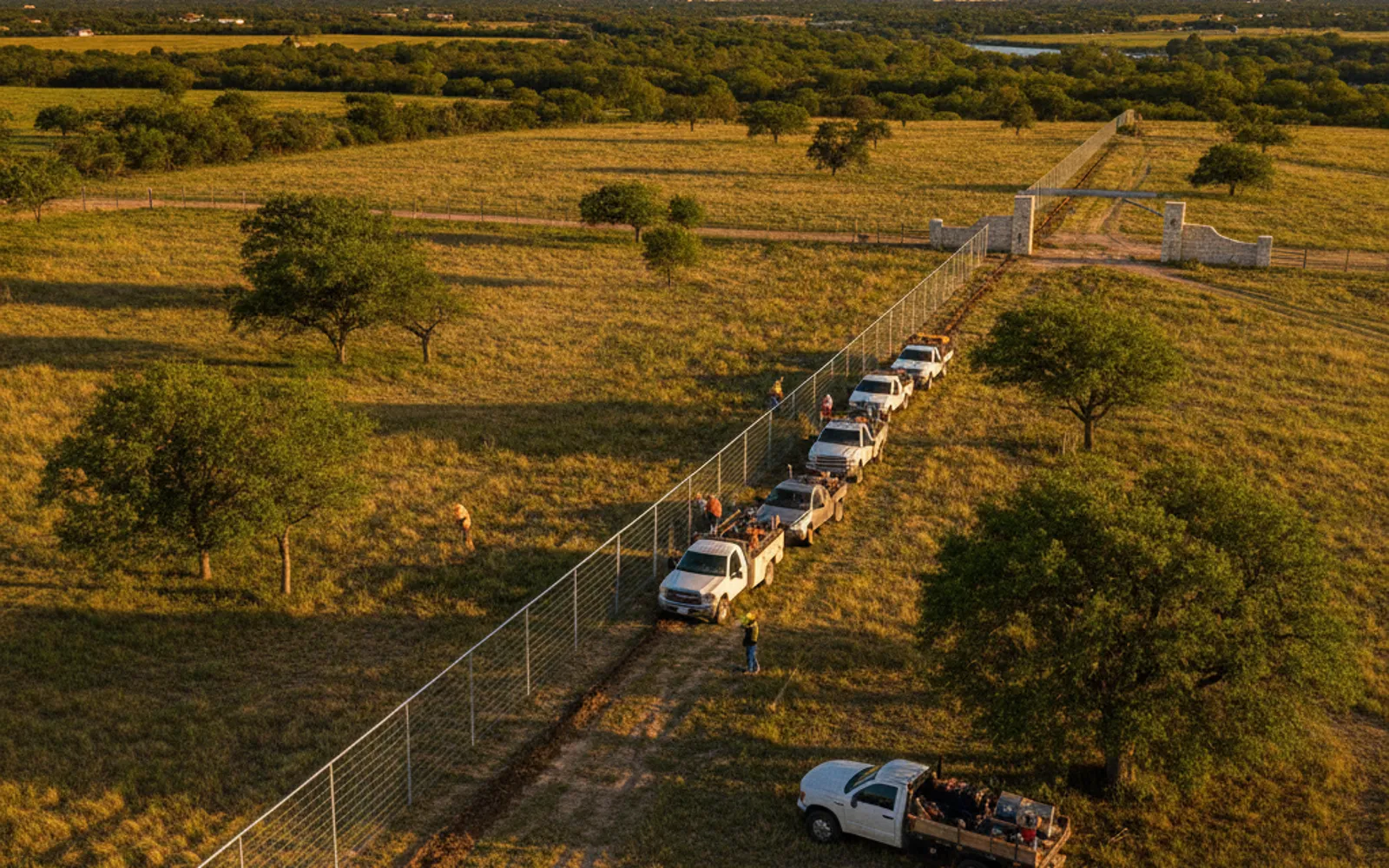
Speed is the obvious one. A crew with a skid steer, a hydraulic driver, and a pre-loaded wire trailer will knock out that quarter mile in a day and a half, maybe two. Your cattle are behind wire this week, not next month.
Corners are the second. Corner and brace assemblies carry the entire load of the fence. When we see a failed DIY fence, it’s almost never the wire. It’s an H-brace that was built wrong or skipped entirely, and the whole stretch went slack within a year. We build braces the same way every time because we’ve watched what happens when you don’t. If you do go DIY, our H-brace corner guide is the one article you should not skip.
The third is accountability. A licensed and insured contractor stands behind the work. If a stretch goes slack in six months, you make a phone call instead of losing another weekend.
If you’d rather see a real quote than guess from ranges, get a free written estimate here. We break out materials and labor so you can compare it line by line against your DIY math.
DIY fencing stories from around Waco: where it goes wrong
Names and numbers below are real jobs from the last couple of years, shared with permission.
Danny runs about 30 acres outside Crawford. He built 1,800 feet of barbed wire himself in the fall of 2024 and did most of it right. He spent $2,900 on materials and about five weekends. But he set his corner posts only two feet deep in soft ground with no concrete, and he didn’t brace them. By the next summer, the corners had pulled, and every strand on the place was sagging. We rebuilt six corner assemblies and re-stretched the wire for $2,140. His fence is fine now, but his total came within a few hundred dollars of our original bid, plus five weekends he’ll never get back.
Marcus, down in Lorena, had the opposite experience, and it’s worth telling. He fenced a 400 foot garden and orchard perimeter with t-posts and net wire for about $1,100 in materials over two weekends. Small job, no heavy corners under load, flat ground. He did it well and saved real money. That’s exactly the kind of project we’ll tell you to do yourself.
Then there’s Kathy near Valley Mills. She rented an auger for $280 a day to set posts along her west line and hit solid limestone 18 inches down on the first hole. Two rental days and eleven holes later, she’d spent $560 and had a tenth of her posts set. Rock work is its own trade. We put her remaining posts in with a hydraulic breaker in one day. If your ground sounds like hers, read fence posts in rocky ground before you rent anything.
DIY fence vs professional installation: side by side
Here’s the quarter mile of 5-strand barbed wire, both ways, with honest numbers for Central Texas conditions.
| Factor | DIY | Professional |
|---|---|---|
| Materials (1,320 ft) | $1,700 to $2,500 | Included in bid |
| Tool and equipment rental | $300 to $800 | Included in bid |
| Total cash cost | $2,100 to $3,300 | $3,300 to $5,900 |
| Your labor | 80 to 100 hours | Zero |
| Calendar time | 3 to 5 weekends | 1 to 2 days |
| Corner and brace quality | Depends on your research | Built to spec, every time |
| Rock or heavy brush | Often a dealbreaker | Priced in, right equipment |
| Warranty | None | Workmanship guaranteed |
| Expected life if built right | 20+ years | 20+ years |
Two things jump out. First, the cash savings on DIY are real but smaller than most people expect, usually $1,200 to $2,600 on this stretch once tools and rentals are counted. Second, the labor gap is enormous. If your time is worth even $20 an hour, the math flips fast.
Jobs worth doing yourself, and jobs that aren’t
After twenty-plus rebuilds of failed DIY fence, here’s how we’d sort it.
Good DIY projects: short runs of t-post and barbed or net wire on flat, soft ground. Garden and yard perimeters. Replacing broken strands or splicing wire. Swapping a bent t-post. Small goat or chicken pens. Repairs and maintenance in general, honestly. A rancher who can splice wire and reset a t-post will save thousands over the life of a fence.
Think hard before you DIY: quarter mile or longer runs, anything with more than four corner assemblies, ground you already know is rocky, and fence lines that need serious brush clearing first.
Leave it to a crew: pipe fence, full stop. Cutting and welding pipe corners and top rail is fabrication work, and a bad weld on a corner post fails under the first real load. High-tensile game fence is the same story, because 8 foot fixed-knot wire under proper tension will hurt somebody who doesn’t have the right stretching equipment. Entrance gates with long heavy leaves need to be hung dead level on properly set posts or they’ll sag inside a year.
One more that people underestimate: barbed wire along a road frontage or a shared property line. Under Texas law, a fence that fails and lets cattle onto a highway can put real liability on you. Texas A&M AgriLife Extension publishes good plain-language material on fence law and livestock liability at agrilifeextension.tamu.edu, and the statutes themselves live in Texas Agriculture Code Chapter 143. A fence that’s holding cattle off FM 185 is not the place to learn bracing by trial and error.
And a safety line we mean sincerely: wire under tension stores a lot of energy. Wear eye protection, never stretch wire with a vehicle, and if a job involves welding, big rock, or an old fence tangled in brush, stop and call somebody who does it every day.
How to make the call for your place
Ask yourself four questions.
How long is the run? Under 500 feet, DIY is on the table. Over a quarter mile, the time cost usually kills the savings.
What’s your ground like? Dig one test hole before you buy anything. If you hit rock or heavy clay at 18 inches, price professional installation before you price rentals.
What’s the fence holding? A garden fence that fails costs you tomatoes. A perimeter fence that fails puts cattle on the road at 2 a.m. Match the stakes to the builder.
What’s your realistic schedule? If the fence needs to be up before you turn cattle out in 30 days, a crew is the only honest answer. Weekends have a way of filling up.
If you land on hiring it out, get your quote in writing and make sure it specifies wire class, post type and spacing, and brace construction. If you land on DIY, spend your money on good corners and good wire, and start with our cost to fence 10 acres breakdown so your budget survives contact with reality.
Either way, we’re glad to look at your project. Call (254) 870-8898 or send us the details online and we’ll get you a free written estimate. If it’s a job you should do yourself, we’ll tell you that too. We’d rather earn the pipe fence job next year than talk you out of a garden fence you can handle this weekend.
Frequently Asked Questions
How much does DIY fencing actually save?
On a typical barbed wire job, DIY saves roughly 35 to 50 percent of the installed price in cash, before you count your time. On a quarter mile, that’s usually $1,200 to $2,600. The savings shrink fast if you have to rent equipment more than a day or two, and they can disappear entirely if corners fail and have to be rebuilt.
What’s the most common DIY fence mistake you see?
Weak or missing corner braces, by a wide margin. The corners carry all the tension in a stretched wire fence, and a corner post set shallow without an H-brace will lean within a year and let the whole fence go slack. Posts set too shallow in general and bargain-grade wire are the next two on the list.
Is it cheaper to repair my old fence or build new?
If the posts are sound and the wire isn’t badly rusted, repair is almost always cheaper, and it’s the kind of work most owners can do themselves. Once you’re replacing more than about a third of the posts or the wire has lost its galvanizing, new construction usually wins on cost per year of life. We’ll give you a straight answer either way on a free estimate.
How long does professional fence installation take?
For barbed wire, a good crew covers a quarter to a half mile a day once corners are set, so most small-acreage jobs finish in one to three days. Pipe fence and game fence run slower because of welding and heavier bracing. Weather and rock are the usual wild cards, which is one more reason to get the timeline in writing with your quote.