Here’s a number that surprises most landowners: a single strand of barbed wire stretched tight to fence tension pulls on your corner post with around 200 to 250 pounds of force. Run five strands and you’re asking one post to hold back more than half a ton, all day, every day, in Central Texas clay that swells when it rains and shrinks hard when it doesn’t.
That’s why the h brace fence corner exists. It’s not decoration and it’s not overkill. It’s the anchor that makes the whole fence work. When we get called out to fix a sagging fence in McLennan, Bosque, or Falls County, we can usually tell you what went wrong before we’re out of the truck. Nine times out of ten, the corner wasn’t braced right, or wasn’t braced at all.
This article walks through what an H brace actually does, why corners fail without one, how a proper brace goes together, and what it costs to do it right around Waco.
What an H Brace Fence Corner Actually Does
Picture your corner post as a lever stuck in the ground. The wire pulls on it near the top, and the dirt holds it near the bottom. Wire tension never sleeps, but soil does. Every wet spring softens the ground, every August drought cracks it open, and the post loses a little grip each cycle.
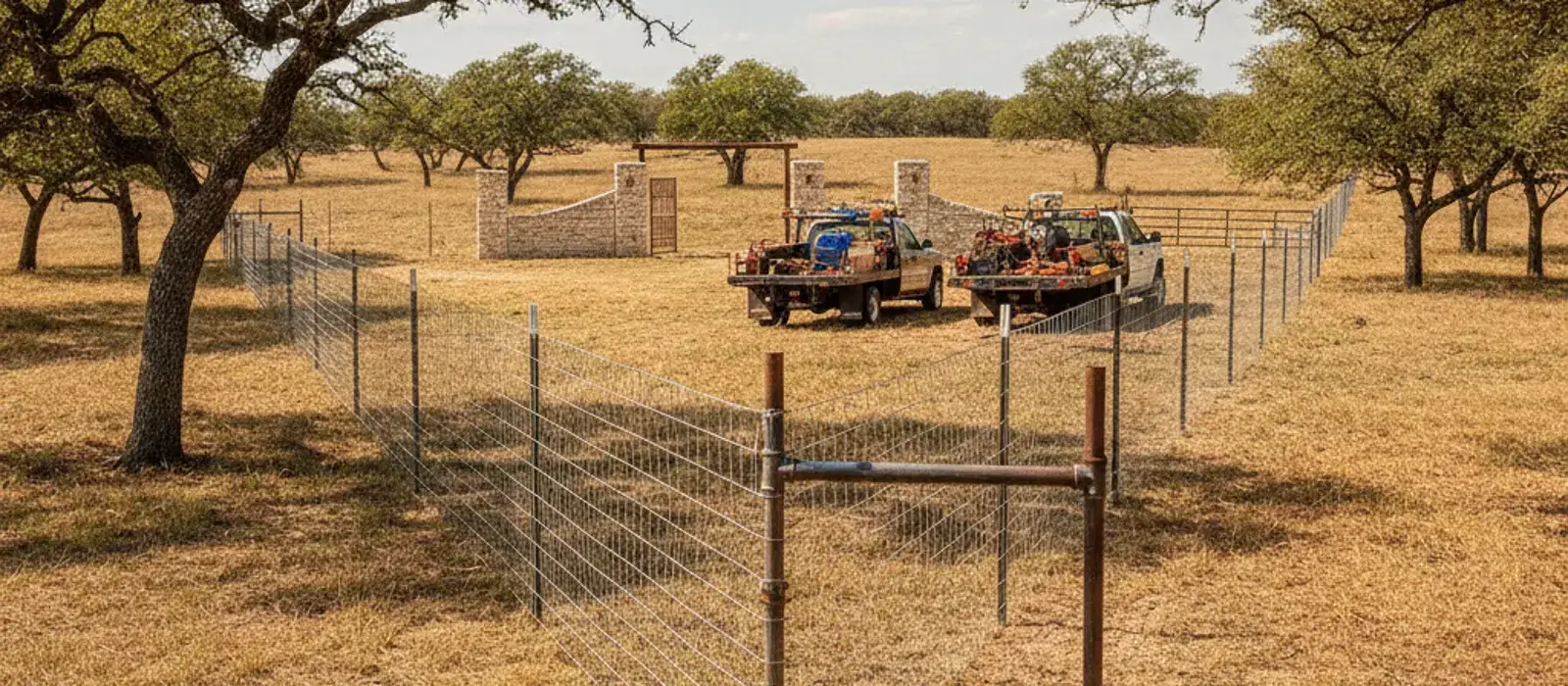
An H brace turns one post into a team of two. You’ve got the corner post, a second brace post set 8 feet away down the fence line, a horizontal rail pinned between them at the top, and a diagonal brace wire twisted tight from the bottom of the corner post to the top of the brace post. From the side it looks like a capital H, which is where the name comes from.
The magic is in how the parts share the load. The wire tries to tip the corner post over. The horizontal rail pushes that force into the brace post. The diagonal wire pulls it back down toward the base of the corner. Instead of one post fighting a lever battle it can’t win, the whole assembly spreads the pull across two posts, a rail, and about 20 square feet of soil contact.
Done right, a wood H brace fence assembly holds 3,000 pounds of pull or more. That’s enough to keep five strands of barbed wire or a full run of net wire banjo tight for decades.
If your corners are already leaning, get eyes on them before you restretch anything. Request a free written estimate and we’ll tell you straight whether your braces can be saved or need to be rebuilt.
Why Fence Corners Fail Without a Brace
An unbraced corner post doesn’t fail all at once. It creeps. First season, it leans an inch and the wire drops a little tension. You tighten the wire, which pulls the post harder, and next season it leans two more inches. Within three to five years the post is pointing at the neighbor’s place and the bottom wires are loose enough for calves to walk through.
Central Texas soil makes it worse. Our blackland clay acts like a sponge. When it’s saturated, a post can lean under wire tension alone. When it bakes dry, the clay pulls away from the post and leaves a gap that fills with water at the next rain. If you’ve read our piece on leaning fence posts, you know this wet-dry cycle is the number one killer of fences in our area, and corners take the worst of it because they carry the most load.
Here’s what that failure costs in real life. Dale Hoffman runs cows on 160 acres outside Crawford. His previous fence guy set the corners in concrete but skipped the braces, figuring concrete was enough. It isn’t. Concrete just makes a heavier lever. After the wet spring of 2024, three corners rolled over, a quarter mile of five-strand went slack, and his cows found the county road. Dale paid us $4,100 to rebuild the corners and restretch the wire. Proper H braces on day one would have run him about $1,100. The lean cost him three times what the brace would have.
And that’s the cheap version of the story. A loose fence with cattle on a road is a liability problem, not just a fencing problem. If your fence is slack right now and stock are testing it, that’s a today problem. Call our line at (254) 870-8898, day or night, and we’ll get a crew moving.
How a Proper H Brace Goes Together
There’s a right way to build an H brace, and there are a dozen wrong ways that look fine for a year. Here’s the spec we build to, and it lines up with what university fencing guides like the University of Missouri Extension’s wire fence construction guide recommend.
Posts. Both posts should be at least 5 to 6 inches in diameter, pressure treated or a durable species. The corner post goes 3.5 to 4 feet in the ground, and depth matters more than concrete. A post set 4 feet deep in tamped native soil will outhold a post set 2 feet deep in a bag of sakrete every single time.
Spacing. Set the brace post 8 feet from the corner post, measured center to center. Short braces are one of the most common mistakes we see. A 4 foot brace makes a steep diagonal that actually helps jack the corner post out of the ground.
The rail. The horizontal rail should be a 4 inch or bigger post, 8 feet long, pinned into both posts with steel brace pins near the top, roughly two-thirds to three-quarters of the way up. Toenailing it with a couple of screws won’t cut it once real tension hits.
The brace wire. Run a double loop of 9 gauge smooth galvanized wire from the bottom of the corner post to the top of the brace post, then twist it tight with a stick or an in-line strainer. Direction is the part people get backwards. The wire runs low on the corner, high on the brace post, so it pulls the corner post down and back against the pull of the fence.
Doubling up. For pulls longer than about 650 feet, for net wire, or for high-tensile game fence, we build a double H brace, which is two H assemblies in a row sharing three posts. On heavy gate corners, a welded pipe fence corner is the no-maintenance option, since steel doesn’t rot and doesn’t care how wet the spring gets.
One more thing worth saying: brace post spacing and line post spacing are different jobs. Your line posts just hold wire up and stock off. Your braces hold the whole fence tight. Our guide on fence post spacing covers how the two work together.
H Brace Fence Cost in Central Texas
So what does it cost to do this right? Here are the numbers we quote around Waco in 2026. Materials move a little with lumber and steel prices, but these ranges hold for most jobs in McLennan, Bosque, and Falls counties.
| Corner assembly | Materials | Installed by us | Holds |
|---|---|---|---|
| Single wood H brace | $90 to $140 | $250 to $400 | 5-strand barbed wire, pulls to ~650 ft |
| Double wood H brace | $170 to $260 | $450 to $700 | Net wire, long pulls, high-tensile |
| Welded pipe corner | $200 to $350 | $500 to $850 | Anything, plus gates, near zero upkeep |
| Unbraced post in concrete | $40 to $80 | We won’t build it | 1 to 3 years, then it leans |
A full corner where two fence lines meet needs a brace assembly on each line, so figure roughly double the single-brace price at true 90 degree corners. End posts at gates need one.
Now compare that to the cost of not bracing. Restretching a quarter mile of slack five-strand runs $600 to $1,200. Rebuilding a failed corner plus restretching is usually $900 to $1,500 per corner. And if the fence gets loose enough that stock start walking through it, you’re into chasing cattle, patching wire, and praying nobody hits one on FM 185 at night. Our post on cattle getting out of the fence gets into why a loose fence trains cattle to test it, and that habit is hard to break once it starts.
Marcy Villareal learned the math the easier way. She bought 42 acres near Valley Mills last fall, and the seller’s fence looked decent from the road. We walked it before she closed and found every corner was a lone post in concrete, most already leaning. She negotiated $3,500 off the sale price, then paid us $2,150 to rebuild six corners with double H braces and restretch the existing wire, which was still good. Same wire, same line posts, completely different fence, because now something is actually anchoring it.
Common H Brace Mistakes We Fix Every Week
Even fences that have braces fail when the braces are built wrong. These are the ones we see most on repair calls:
Brace wire running the wrong direction. High on the corner and low on the brace post looks the same from the truck, but it pulls the corner post over instead of holding it down. We see this on maybe a third of DIY braces.
Brace too short. A 4 or 5 foot rail makes the diagonal too steep, and the assembly lifts the corner post instead of loading it. Eight feet, center to center.
Rail too low. A rail pinned at knee height does almost nothing, because the wire pulls near the top of the post. Two-thirds of post height or better.
Shallow posts. A corner post 2 feet deep will lean no matter how pretty the brace is. In our clay, 3.5 feet is the floor and 4 is better. Rocky ground west of Crawford and Valley Mills takes different technique, and soggy bottomland near the Brazos takes another. Depth is not negotiable in either one.
Skipping the twitch. The diagonal wire has to be twisted tight enough to hum. Loose brace wire is a decoration.
Cedar rails on treated posts. Untreated rails rot at the pin in 5 to 8 years, and then the brace quietly stops working while looking fine.
Tommy Kubacek, who runs stockers on leased ground outside West, called us about a stretch of fence that wouldn’t stay tight no matter how many times he crimped and spliced. The wire was fine. Every brace on the line had the diagonal wire run backwards, built that way 15 years ago and creeping ever since. We rebuilt four braces for $1,350 and restretched the run, and he told us it was the first winter in a decade he didn’t patch that fence. The USDA’s Natural Resources Conservation Service fencing standards make the same point our crews do: the brace assembly, not the wire, decides how long a fence stays tight.
When to Brace It Yourself and When to Call Us
Plenty of handy landowners can build a solid H brace, and if you’ve got a tractor with an auger, good posts, and a free Saturday, a single brace on flat ground is a fair DIY project. Follow the spec above, take your time on the diagonal wire, and check it after the first hard rain.
Call a professional when any of these are true. You’re anchoring a long pull or high-tensile wire, where a brace failure releases a lot of stored energy fast. You’re in rock and can’t get to depth. You’ve got multiple failed corners, because that usually means the whole fence needs tension work, not just new posts. Or the fence is currently down and stock are loose, because that’s an emergency, not a weekend project. Stretching wire against a fresh brace is also where most DIY injuries happen, so if you’ve never used a fence stretcher under real tension, have someone show you before you learn the hard way.
We build and repair braces across Waco, China Spring, Crawford, McGregor, Valley Mills, Lorena, West, and everywhere in between. Estimates are free, in writing, and we’ll tell you if your existing corners are worth saving. Get your free estimate here or call (254) 870-8898. For storm damage or cattle out on a road, that line answers 24/7.
Frequently Asked Questions
How far apart should H brace posts be?
Set the brace post 8 feet from the corner post, measured center to center. Shorter spans steepen the diagonal wire and can actually lift the corner post out of the ground under tension. If you can’t get 8 feet, get as close as the site allows and never go under 6.
Do H brace posts need concrete?
Depth and tamping matter far more than concrete. A 6 inch post set 3.5 to 4 feet deep in well-tamped native soil holds better than a shallow post in concrete, and concrete can trap moisture against wood and speed up rot. We use concrete selectively, mostly on gate posts and in loose or sandy spots.
How many H braces does a fence need?
You need a brace assembly at every corner, every end, every gate, and roughly every 650 feet on long straight pulls of barbed wire. Net wire and high-tensile fence need double H braces at the same points because they carry more total tension. Big elevation changes may need extra bracing at the top and bottom of steep grades.
Can I fix a leaning corner post without rebuilding it?
Sometimes, if the post itself is sound and the lean is under a few inches. We can excavate, plumb the post, re-tamp, and add a proper brace assembly to stop the creep. If the post is rotted at the ground line or leaning past about 10 degrees, rebuilding the corner is cheaper than fighting it, and it’s the only fix that lasts.