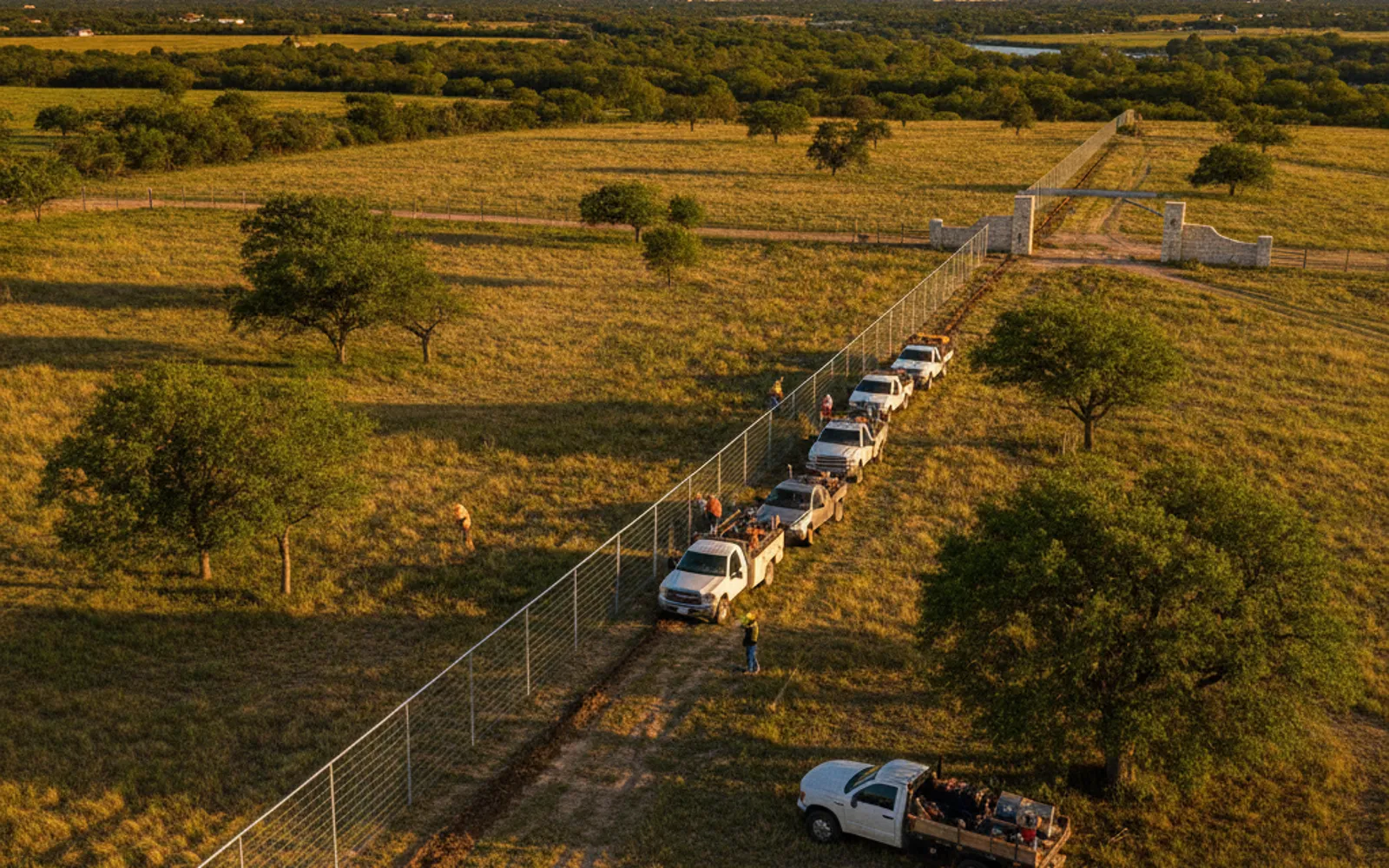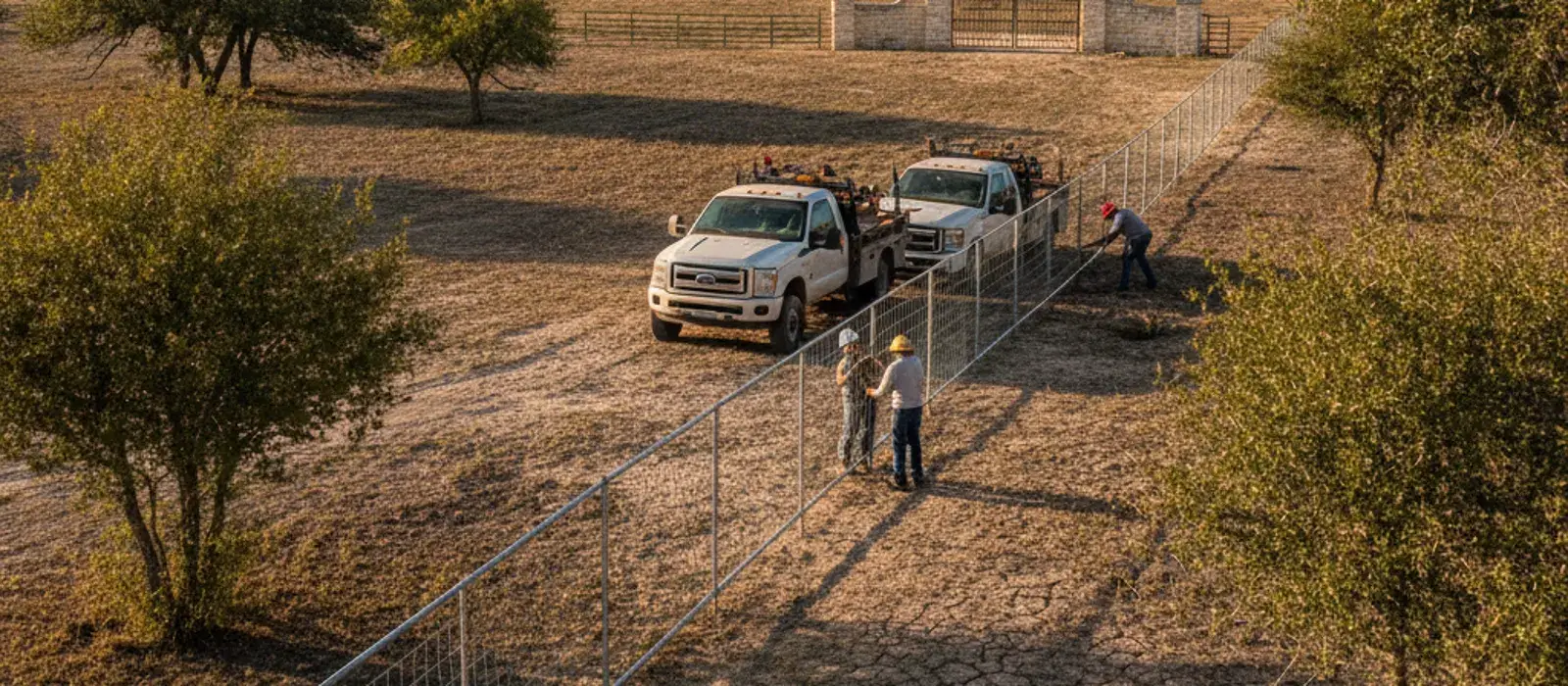
There’s an old saying around here: if a fence won’t hold water, it won’t hold a goat. That’s an exaggeration, but not by a lot. We’ve walked hundreds of fence lines in McLennan, Bosque, and Falls counties, and the calls that start with “my goats are in the neighbor’s garden again” outnumber almost every other kind.
So what’s the best fence for goats and sheep on Central Texas land? Short answer: 48-inch fixed knot net wire with 4-inch mesh, wood posts on the corners, and a hot wire along the top if your goats are climbers. That setup runs about $6.50 to $9.00 per foot installed around Waco, and it’ll hold goats, hold sheep, and keep most coyotes on the wrong side of it.
The long answer matters more, because the wrong fence for small ruminants is one of the most expensive mistakes a landowner can make. You’ll pay for it twice: once to build it, and again to replace it after your herd proves it doesn’t work.
Why goats test a fence harder than cattle ever will
A cow mostly respects a fence. She leans on it, she reaches through it for grass, and if a tree knocks it flat she’ll wander. But she’s not out there looking for a way through.
A goat is looking. All day, every day. Goats climb, they jump, they squeeze, and they push their heads through anything wide enough to fit their horns. Sheep are calmer, but they’re escape followers. One goat finds the gap, and your whole flock of ewes is on the county road by supper.
That’s why the 5-strand barbed wire that’s held cattle on Central Texas ranches for a hundred years is close to useless for goats. A mature Boer goat walks between strands two and three without slowing down. Kids go under the bottom wire. We’ve seen folks add strands until they had eight or nine wires, and the goats still got out. You can’t build a barbed wire fence tight enough for goats at any price that makes sense.
Sheep have a second problem barbed wire can’t solve: predators. Barbed wire doesn’t even slow down a coyote, and Central Texas has plenty of them. If you’re running sheep or goats, your fence has two jobs. Keep the animals in, and keep the killers out.
If you’re staring at a pasture right now trying to figure out what that means for your place, call us at (254) 870-8898. We’ll walk the line with you and give you a free written estimate, no pressure and no guessing games.
The best goat fence for most Central Texas places: net wire done right
For probably 8 out of 10 properties we fence for goats or sheep, the answer is net wire, sometimes called field fence or woven wire. But the details decide whether it works or fails.
Mesh size: 4 inches, not 6. Standard cattle field fence has 6-inch vertical stays. A horned goat pushes his head through a 6-inch opening, can’t pull it back out, and now you’ve got a trapped animal in the July sun. Sheep and goat wire uses 4-inch by 4-inch mesh. Heads stay out, kids stay in, and coyotes can’t slip through.
Knot type: fixed knot beats hinge joint. Hinge joint wire is cheaper, and for goats that’s a trap. Goats stand on fences. Hinge joint mesh folds down under that weight, and after a season you’ve got a ramp instead of a fence. Fixed knot wire holds its shape when a 150-pound buck puts his front hooves on it. We wrote up the full comparison in fixed knot vs hinge joint if you want the details.
Height: 48 inches minimum. Most goats won’t clear 48 inches. If you’re running athletic breeds like Spanish goats or you’ve got a known jumper, go 60 inches or add an offset hot wire at the top.
The bottom matters most. Goats and predators both work the bottom of a fence. We run the wire tight to the ground and, on uneven terrain, add a barbed strand at ground level so nothing digs or shimmies under.
Dale Whitaker out in Crawford learned most of this the hard way before he called us. His Boers had been walking through an old cattle fence for two years, and his neighbor was done being patient about it. We pulled the old wire and built 1,800 feet of 48-inch fixed knot with treated wood corners and a barbed ground wire. The job came to $13,050, right at $7.25 a foot. He told us later the fence paid for itself the first year just in hay he stopped losing and peace he made with the neighbor.
Sheep fencing and the predator problem
Sheep will test your fence less than goats, but they’ll pay a higher price when it fails. A coyote that gets into a goat pen might kill one animal. A coyote in a sheep pen, especially during lambing, can kill several in one night and come back the next.
The same 4-inch fixed knot net wire is the backbone of good sheep fencing, but for predator country we add layers:
- A barbed wire strand at ground level to stop digging
- One or two barbed strands above the net wire, taking total height to 52 to 56 inches
- An offset electric wire, about 8 inches off the ground on the outside, aimed at the nose of anything trying to dig
Marissa Cantu runs about 30 hair sheep on 12 acres just outside Lorena. She lost four lambs in one spring before she called us. Her net wire was decent, but it was hinge joint with a loose bottom, and the coyotes had found two dig spots along a creek-side low run. We tightened the whole line, added a ground-level barbed strand and an outside hot wire, and rebuilt her water gap. The retrofit cost her $3,400. She hasn’t lost a lamb to a coyote since, and that’s two lambing seasons now.
Texas A&M AgriLife Extension has good research on predator behavior and non-lethal control if you want to go deeper. Their small ruminant resources at agrilifeextension.tamu.edu are worth an evening of reading before you spend fence money.
What goat and sheep fencing costs around Waco
Here’s what we’re seeing for installed prices in McLennan, Bosque, and Falls counties in 2026. Materials, labor, and normal terrain. Rocky ground, heavy brush, and lots of corners push these numbers up.
| Fence type | Installed cost per foot | Holds goats? | Stops coyotes? | Typical lifespan |
|---|---|---|---|---|
| 5-strand barbed wire | $2.00 - $4.00 | No | No | 20-30 yrs |
| Hinge joint field fence (6” mesh) | $4.50 - $6.50 | Poorly | Somewhat | 15-20 yrs |
| Fixed knot sheep & goat wire (4” mesh) | $6.50 - $9.00 | Yes | Yes | 25-30 yrs |
| Cattle panels (16 ft, 4” grid) | $8.00 - $12.00 | Yes | Yes | 25+ yrs |
| Electric netting (temporary) | $1.50 - $2.50 materials | Rotational only | Mostly | 5-10 yrs |
A few notes on that table. Cattle panels make excellent small pens, working corrals, and buck pens, but the per-foot price gets painful fast on a long perimeter. Electric netting is a rotational grazing tool, not a perimeter fence. And that cheap hinge joint line looks tempting until you price the repairs.
The Hendersons outside Valley Mills went with hinge joint on a 2,400-foot perimeter to save money, about $900 less than the fixed knot quote they’d gotten. Within 18 months their goats had mashed down three long sections, and they’d spent roughly $2,600 on repairs and patch panels before they had us replace the worst runs with fixed knot. Cheap wire for goats isn’t cheap.
One more cost note: if you’re improving grazing land, the USDA’s EQIP program sometimes cost-shares fencing for rotational grazing systems. It’s worth a call to your county NRCS office before you build.
Want a real number for your property instead of a range? Request a free written estimate and we’ll measure it, walk it, and price it line by line.
Electric fence for goats: a good helper, a bad boss
We get asked all the time whether a few strands of hot wire can replace net wire for goats. Our honest answer: not as a perimeter fence in this country.
Electric works on animals that learn and remember. Goats do learn, but a goat with a full winter coat, a scared goat with a dog behind it, or a buck in rut who smells does across the road will take the hit and go. And when a storm knocks your charger out or a grass load drains the line, an all-electric fence is just string.
Where electric earns its keep:
- A top offset wire that stops climbers and leaners cold
- A low outside wire that teaches coyotes and dogs to stay back
- Interior cross-fencing for rotational grazing inside a solid perimeter
If you already have hot wire that’s not doing its job, check the charger, the grounding rods, and the vegetation load before you blame the goats. And know your limits on the DIY side. Fence energizers are safe when installed right, but tying electric into existing wire, grounding in our dry summer soils, and crossing gates and water gaps are places where a mistake bites you. If you’re not sure, have a pro set it up.
Mistakes that let goats out and coyotes in
After years of fixing goat fences other people built, the same handful of problems keeps showing up:
Loose wire. Net wire has to be stretched properly against solid braced corners. Loose mesh sags, goats climb it, and predators push under it. This is the number one failure we see, and it usually traces back to weak corner assemblies.
Gates that don’t match the fence. A $9-a-foot fence with a sagging tube gate hung 8 inches off the ground is a goat door. Gates need the same mesh, hung tight and low. For heavy-use entrances, a pipe fence corner and gate section takes the abuse goats and equipment dish out.
Ignoring water gaps and washes. Every creek crossing and low spot is an exit. Goats find them in days, coyotes in weeks.
Wrong wire for the animal. If you’re still weighing wire types for mixed herds, our barbed wire vs net wire breakdown covers which animals each one actually holds.
Too few posts. Goat fence wants closer post spacing than cattle fence, especially on hills and curves, because goats load the wire between posts.
And a word on small places: if you’re fencing 2 to 10 acres for a handful of goats or sheep, the math and the layout work differently than a ranch perimeter. We covered that in our guide to small acreage fencing around Waco.
If your current fence is losing the fight, don’t wait for the phone call from the neighbor. Reach out through our contact page or call (254) 870-8898. Free written estimates, licensed and insured, and if animals are out on a road right now, our emergency line runs 24/7.
Frequently Asked Questions
How tall should a fence be for goats?
Go 48 inches minimum for most breeds. Athletic goats like Spanish or Kiko lines, or a herd with a known jumper, may need 60 inches or a hot offset wire at the top. Height alone isn’t enough, though. A loose 60-inch fence fails faster than a tight 48-inch one, because goats climb slack wire instead of jumping it.
Will barbed wire hold goats or sheep?
No. Goats walk between the strands and kids crawl under the bottom wire, no matter how many strands you add. Sheep hold a little better but their wool protects them from the barbs, and barbed wire does nothing to stop coyotes. Barbed wire is a cattle fence. For goats and sheep you need 4-inch mesh net wire.
What does goat fencing cost per foot near Waco?
Installed 48-inch fixed knot sheep and goat wire runs about $6.50 to $9.00 per foot in our area in 2026, depending on terrain, brush, corners, and gate count. A quarter mile (1,320 feet) lands between $8,600 and $11,900 in most cases. Rocky ground west of the Bosque River and heavy cedar push jobs toward the top of that range.
Can I keep goats behind electric fence alone?
We don’t recommend it for a perimeter. Trained goats respect hot wire most of the time, but chargers fail, grass loads drain lines, and a spooked or motivated goat will take the shock and keep going. Use electric as a top or offset wire on net fence, or for interior cross-fencing inside a solid physical perimeter.