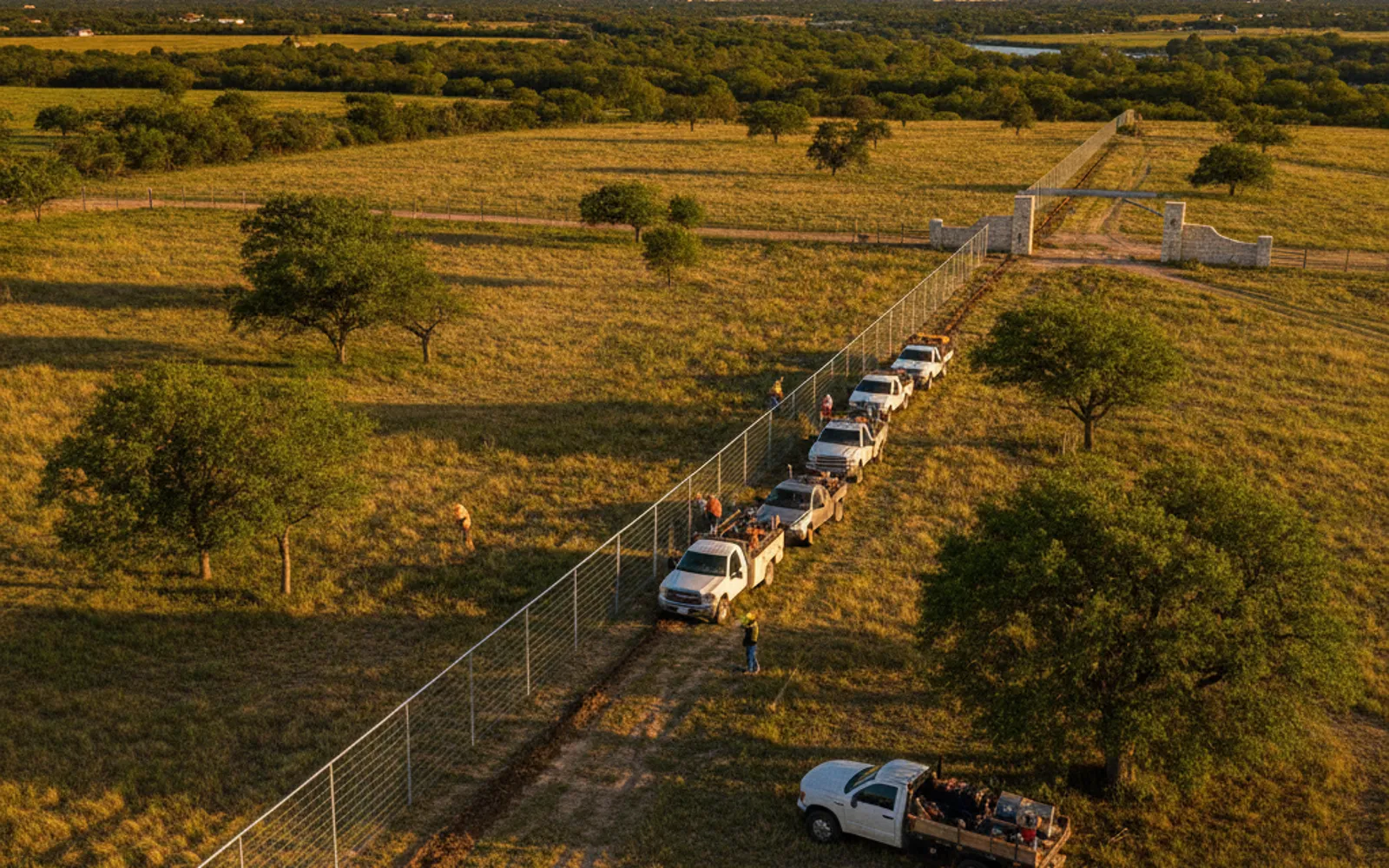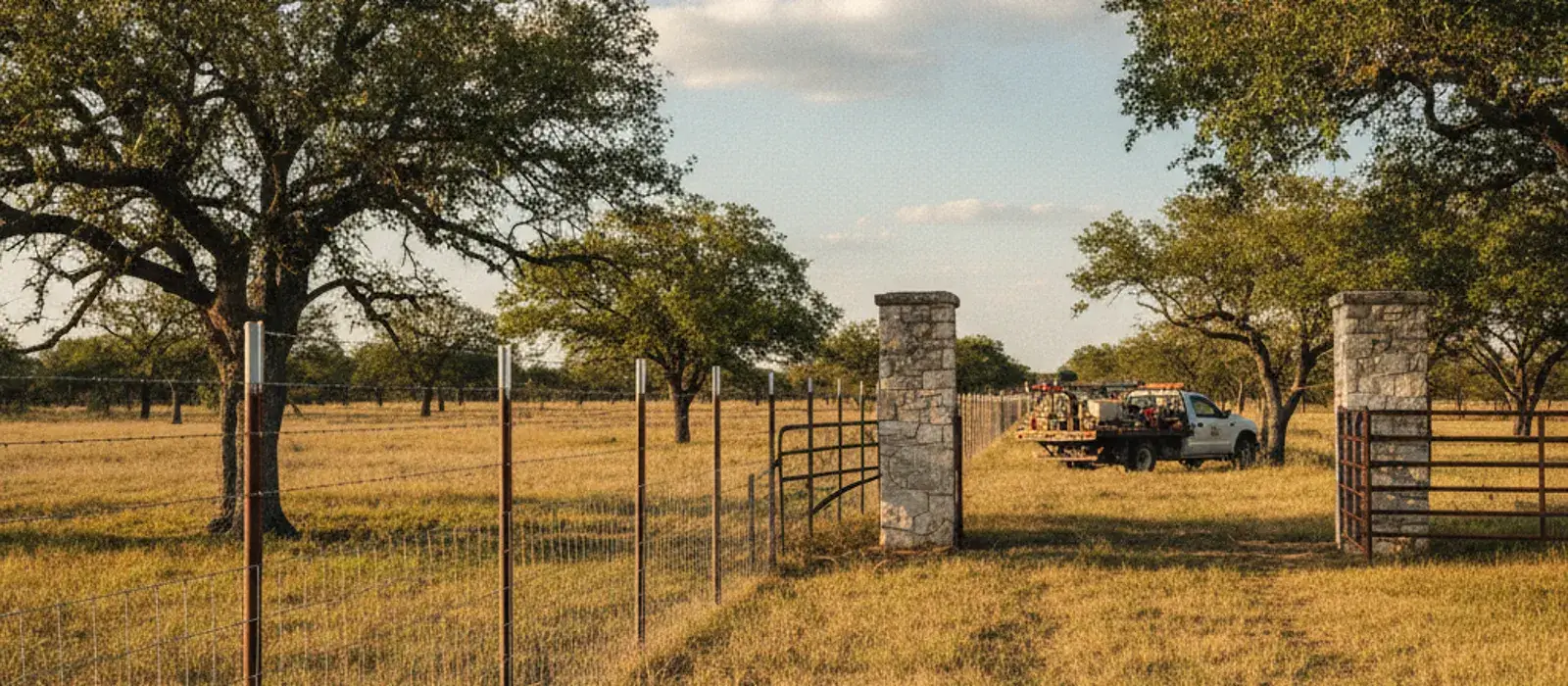
Two landowners in McLennan County can fence the same 10 acres and one pays $7,000 while the other pays $70,000. Same dirt, same property line, wildly different bill.
The difference isn’t a scam. It’s fence type, terrain, and how much clearing the line needs. The real cost to fence 10 acres in Central Texas runs anywhere from about $6,600 for basic barbed wire to well past $30,000 for pipe fence, and 25 or 100 acres doesn’t scale the way most folks expect.
We build ranch fence every week around Waco, China Spring, Crawford, and down through Lorena, so we’ll walk you through the actual numbers we quote. If you’d rather skip the math and get a firm figure for your place, request a free written estimate or call us at (254) 870-8898.
Why Acreage Math Fools Almost Everybody
Here’s the thing nobody tells you at the feed store: you don’t pay for acres. You pay for feet of fence line. And perimeter doesn’t grow at the same rate as acreage.
A square 10 acre tract has about 2,640 feet of perimeter, exactly half a mile. Quadruple the land to 40 acres and the perimeter only doubles. That’s why fencing cost per acre drops fast as tracts get bigger.
Rough perimeter numbers for square tracts:
- 10 acres: about 2,640 linear feet (0.5 mile)
- 25 acres: about 4,180 linear feet (0.8 mile)
- 100 acres: about 8,350 linear feet (1.6 miles)
Real tracts are rarely square. A long skinny 10 acres along a county road can carry 3,500 feet of line or more, and that’s 30 percent more fence for the same acreage. Creek crossings, rock, and brush move the number too, which is why we always measure before we quote.
The other thing that moves your bill is corners and gates. Every corner needs a braced assembly, and H-braces are where good fences earn their keep. A tract with eight corners and three gates costs real money beyond the straight-line footage.
The Real Cost to Fence 10 Acres
For a typical square 10 acres with decent access and light clearing, here’s what we see quoted around Waco in 2026:
- 5-strand barbed wire: $2.50 to $4.50 per foot installed, so $6,600 to $11,900 for the tract
- Net wire (field fence) with a top barbed strand: $3.50 to $6.00 per foot, so $9,250 to $15,850
- High game fence: $4.50 to $8.00 per foot, so $11,900 to $21,100
- Pipe fence: $12 to $28 per foot, so $31,700 and up
Barbed wire is still the workhorse for cattle on small acreage. Net wire earns its premium if you run goats, sheep, or you want to keep dogs in and coyotes out. Pipe is the forever option for perimeters along roads and around headquarters.
Last spring we fenced 10 acres off Old Lorena Road for Travis Kubacek, a young family that bought their first piece of land outside Lorena. He’d budgeted $5,000 off a national cost website. His tract was long and narrow with 3,100 feet of line, heavy cedar on the back side, and blackland clay that had swallowed the old posts. The real number for 5-strand barbed wire with two 16-foot gates came to $9,850, and the clearing was almost $1,800 of that.
That’s the pattern we see over and over. The wire is the cheap part. Clearing, corners, gates, and terrain are what separate the internet estimate from the written quote.
One more line item people forget: tearing out the old fence. If there’s a rusted, grown-in fence on the line already, removal and haul-off typically adds $1 to $2 per foot.
Cost to Fence 25 Acres: The Per-Foot Sweet Spot
Twenty five acres is where the per-acre math starts working in your favor. You’ve got 2.5 times the land of a 10 acre tract but only about 60 percent more fence line.
Typical 2026 ranges for a square 25 acres (about 4,180 feet):
- 5-strand barbed wire: $10,500 to $18,800
- Net wire: $14,600 to $25,100
- High game fence: $18,800 to $33,400
Per-foot pricing usually improves a little on jobs this size too. Once a crew can mobilize for a week instead of two days, the setup costs spread out and most contractors sharpen the pencil.
Doyle Pritchett runs about 15 cow-calf pairs on 25 acres between Crawford and Valley Mills. His granddad’s net wire had rusted through and the cows had started walking through it to visit the neighbor’s winter oats. We replaced the full perimeter with 5-strand barbed wire on t-posts with cedar corners, plus one new 14-foot gate, for $14,300. The rocky stretch along the county road took a hydraulic breaker for about 40 post holes, which added around $1,100.
Doyle’s job shows why we quote after walking the line, not before. On paper his tract priced at $12,000. Rock and a washed-out water gap moved it $2,300, and he knew that before we drove the first post because it was in the written estimate.
If you’re pricing a job this size, get two or three bids and make sure they specify wire class, post spacing, and brace count so you’re comparing the same fence. We wrote a whole guide on comparing fence quotes line by line.
Fencing 100 Acres: Mile and a Half of Wire
At 100 acres you’re a real ranch operation, and you’re buying fence by the mile. A square 100 acres carries about 8,350 feet of perimeter, roughly 1.6 miles.
Typical 2026 ranges:
- 5-strand barbed wire: $20,900 to $37,600
- Net wire: $29,300 to $50,100
- High game fence: $37,600 to $66,800
Cross-fencing changes the total fast. Most cattle operations this size want at least two or three pastures for rotation, and every cross fence is more footage. A single cross fence through the middle of a square 100 adds about 2,090 feet, call it $5,200 to $9,400 in barbed wire.
Two years back we fenced a full 100 acre perimeter for the Machalek place north of West, a family that had leased the land for hay and finally bought it. They went with 5-strand barbed wire using Class 3 galvanized wire on the long runs, a short stretch of net wire around the pens, and a 20-foot pipe entrance off the FM road. All in, the project ran just under $34,000, and the ranch entrance gate was about $6,500 of it.
At this scale, wire quality matters more than anywhere else. Cheap Class 1 wire can start rusting in under a decade in our humidity, while Class 3 galvanized commonly lasts 25 to 30 years or more. On a mile and a half of fence, you do not want to do this twice.
One planning note for bigger tracts: if you’re running livestock, fencing is generally an eligible practice under USDA cost-share programs like EQIP in some situations, and it factors into your ag valuation. Check the USDA NRCS Texas office and the Texas Comptroller’s ag exemption rules before you build, because paperwork done early can save real money.
Side by Side: 10, 25, and 100 Acres by Fence Type
Here’s the whole picture in one table. These are installed ranges for square tracts with normal access and light clearing, based on what jobs are actually running around McLennan, Bosque, and Falls counties in 2026.
| Fence type | Cost per foot | 10 acres (~2,640 ft) | 25 acres (~4,180 ft) | 100 acres (~8,350 ft) |
|---|---|---|---|---|
| 5-strand barbed wire | $2.50 to $4.50 | $6,600 to $11,900 | $10,500 to $18,800 | $20,900 to $37,600 |
| Net wire + barbed top | $3.50 to $6.00 | $9,250 to $15,850 | $14,600 to $25,100 | $29,300 to $50,100 |
| High game fence | $4.50 to $8.00 | $11,900 to $21,100 | $18,800 to $33,400 | $37,600 to $66,800 |
| Pipe fence | $12 to $28 | $31,700 to $73,900 | $50,200 to $117,000 | Rarely full perimeter |
Add-ons that show up on most jobs:
| Add-on | Typical cost |
|---|---|
| 12 to 16 ft ranch gate, installed | $450 to $1,200 |
| Pipe entrance with swing gates | $4,000 to $12,000+ |
| Heavy brush clearing | $1 to $3 per foot |
| Old fence removal and haul-off | $1 to $2 per foot |
| Rock drilling for post holes | $15 to $40 per hole |
Nobody’s tract matches a table exactly. Treat these as brackets for budgeting, then get a written number.
How to Keep the Bill Down (and When to Stop DIYing)
You can trim a fencing budget without building a fence you’ll regret. A few honest ways to do it:
Fence in phases. Do the road frontage and the hot side where cattle pressure is worst this year, and finish the back line next year. Wire prices move, but a planned phase two beats a maxed-out credit card.
Share the line cost with your neighbor. Texas has its own rules on boundary fences, and a neighbor who splits a half-mile of line fence cuts your bill by thousands. Get the agreement in writing before anybody buys wire.
Don’t cheap out where it counts. Corners, braces, and wire class are the fence. Stretching post spacing from 12 feet to 20 feet to save money is how you end up with a saggy fence and cattle on the county road. Texas A&M AgriLife Extension publishes solid guidance on fence construction and livestock management if you want a second opinion from the university folks: agrilifeextension.tamu.edu.
Know your DIY limit. Plenty of landowners can string a repair stretch or hang a gate. But building corner braces that hold a quarter mile of stretched wire, drilling post holes in rock, and stretching net wire on a slope are jobs where mistakes get expensive or dangerous. High-tensile wire under tension can cut you badly when it snaps, and a bad brace fails in year two, not day two. If the job involves tensioned wire over long runs, road frontage, or anything near power lines or buried utilities, call a professional and always call 811 before you dig.
We’re happy to be the second or third bid on your project. Our estimates are written, itemized, and free, and we’re licensed and insured. Tell us your acreage and what you’re running on it at our contact page or call (254) 870-8898. If a storm just dropped your fence and cattle are out tonight, that same number is our 24/7 emergency line.
Frequently Asked Questions
How much does it cost to fence 10 acres with barbed wire?
For a typical square 10 acres around Waco, plan on $6,600 to $11,900 installed for a 5-strand barbed wire fence, which covers about 2,640 feet of line. Odd-shaped tracts, heavy brush, rock, and extra gates push it higher. Get a walked-the-line written quote before you set a budget.
Is it cheaper per acre to fence more land?
Yes, and by a lot. Perimeter grows much slower than acreage, so 100 acres has only about three times the fence line of 10 acres. Barbed wire that costs roughly $660 to $1,190 per acre on a 10 acre tract drops to roughly $210 to $375 per acre on a square 100.
What’s the cheapest fence that will actually hold cattle?
A properly built 5-strand barbed wire fence on t-posts with wood or pipe corner braces is the most cost-effective cattle fence in Central Texas. The key word is properly built, meaning good braces, correct post spacing, and Class 3 galvanized wire. A cheap fence that lets cattle out onto a road can cost you far more than the savings.
How long does it take to fence 25 or 100 acres?
A good crew can typically build a 25 acre perimeter in barbed wire in about one to two weeks, depending on clearing and rock. A 100 acre perimeter usually runs three to five weeks. Weather, terrain, and gate and entrance work are the usual variables, and we put a schedule in every written estimate.