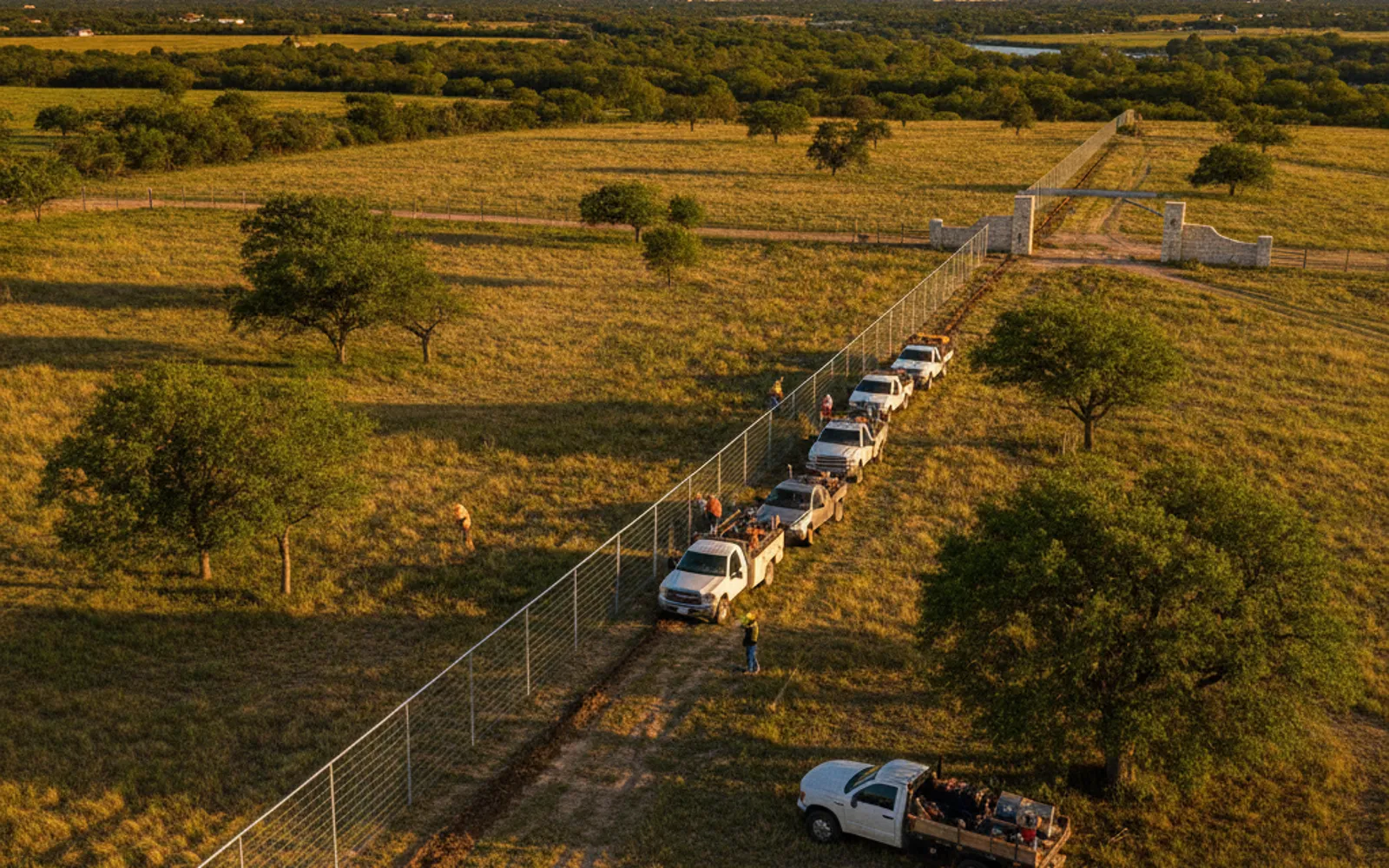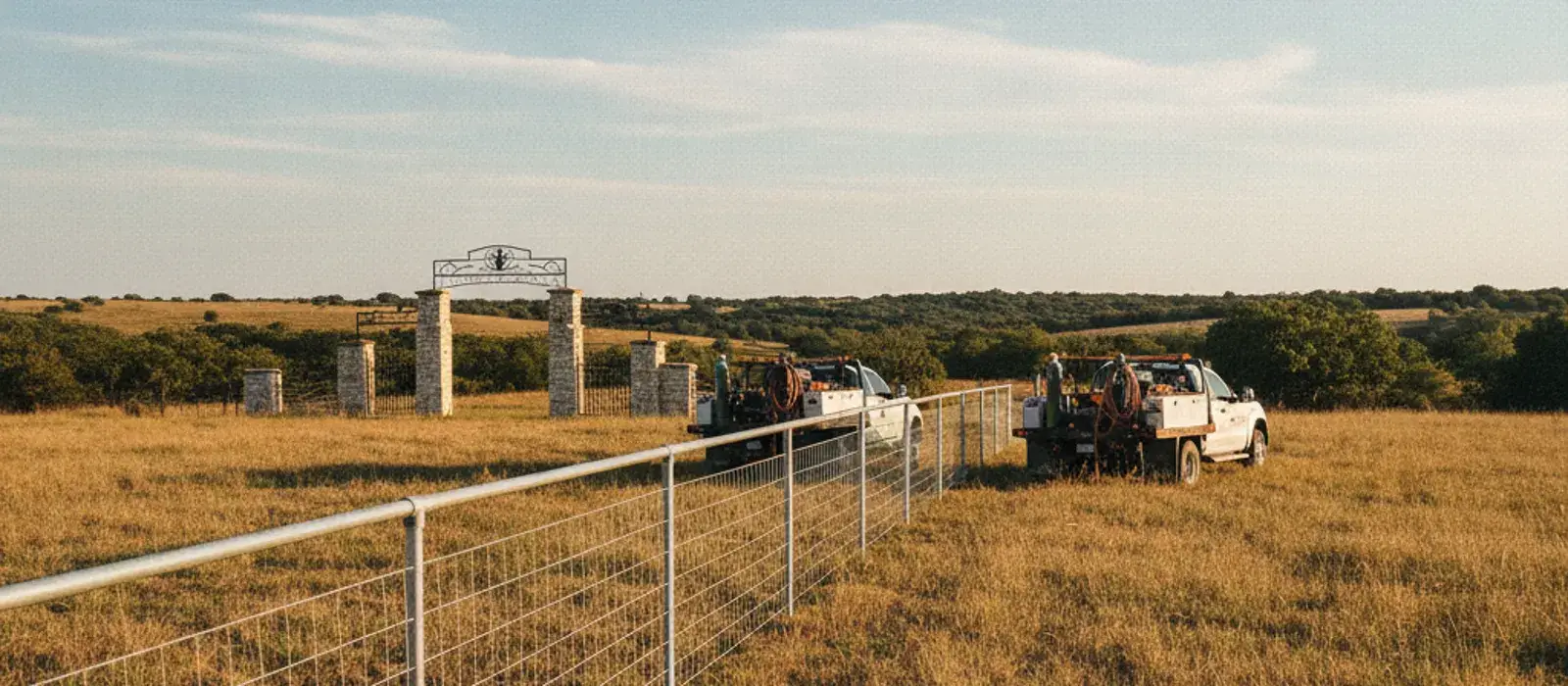
A $65 splice today or a $2,300 corner rebuild next spring. That’s the real choice most ranchers are making every time they drive past a sagging stretch of wire and tell themselves they’ll get to it later.
We build and repair fence all over McLennan, Bosque, and Falls counties, and the pattern never changes. The ranches that spend a few weekends a year on ranch fence maintenance almost never call us in a panic. The ones that don’t are the folks calling our emergency line at 10 pm because a bull is standing in the middle of a farm-to-market road.
This checklist is the same routine we recommend to every customer after we finish a job. Print it, stick it in the truck, and work through it season by season. Most of it takes a pair of fence pliers, a bucket of staples, and a good pair of gloves.
Why Ranch Fence Maintenance Beats Emergency Repairs Every Time
Fence problems are cheap when they’re small and expensive when they’re not. A loose staple costs nothing to fix. A leaning corner post that’s been pulling for two years takes a full H-brace rebuild, and that’s real money.
Dale Hutchins runs about 120 momma cows on a place near Crawford. Two summers ago he noticed a corner post on his east line starting to lean and figured it would hold through fall. It didn’t. The corner gave way after a wet October, four spans of wire went slack, and his cows found the gap within a week. By the time we rebuilt the corner, restretched 600 feet of wire, and he’d paid a neighbor for a flattened food plot, Dale was out about $2,300. The fix in July would’ve been a $65 brace wire and an afternoon.
That’s the math behind every line on this checklist. Fence doesn’t fail all at once. It fails slowly, then suddenly. Your job is to catch it in the slow phase.
Twice-a-year inspections are the backbone. In Central Texas the natural rhythm is early spring, before things green up and hide problems, and late fall, before winter weather and hungry cattle start testing your wire. If you’d rather have a professional set of eyes on it, we do fence-line inspections with a free written estimate for any work we find. Call us at (254) 870-8898 and we’ll walk your lines with you.
The Spring Ranch Fence Inspection: Walk or Ride Every Foot
Spring is your big one. Winter freezes, saturated clay, and storm season all do their damage between November and March, and you want it found before summer bakes the ground hard.
Ride your entire perimeter, not just the stretches you can see from the county road. Take fence pliers, a hammer, staples, wire clips, and a can of spray paint to mark anything you can’t fix on the spot.
Here’s what to check:
- Every corner and gate post. Push on them hard. Any movement at all means the brace assembly is failing or the ground has let go. Corners carry the tension for the whole line, so a weak corner is a weak fence. If your braces look rough, our guide to H-brace fence corners shows what a proper assembly looks like.
- Wire tension on every stretch. Grab the top strand mid-span. More than an inch or two of easy deflection means it needs a splice-and-stretch. Sagging wire is the number one thing cattle learn to push through, and our post on fixing sagging barbed wire fence walks through the repair step by step.
- Line posts. Look for leaners, snapped T-posts, and wood posts that wiggle at the ground line. Probe wood posts with a screwdriver right at the soil. If the tip sinks in, rot has started. Catch it early and you replace one post, not twenty. More on that in our fence post rot article.
- Staples and clips. Loose staples let wire slide and sag. Reset them as you go. On T-posts, replace any missing wire clips.
- Water gaps. Every creek and draw crossing needs a hard look after spring rains. A washed-out water gap fence is an open door, and cattle find open doors fast.
- Gates and latches. Swing every gate. Tighten hinge bolts, oil latches, and check that gate posts haven’t heaved.
- Grounding and chargers on electric fence. Test voltage at the far end of every hot line, not just at the charger.
Marcy Templin, who runs stockers on leased ground outside China Spring, learned the water gap lesson the hard way. A spring flood took out a gap on Hog Creek and she didn’t check it for three weeks. Fourteen head crossed onto the neighbor’s wheat. Between gathering costs, a hired day of labor, and paying for grazed-out wheat, she figured it cost her about $1,900. The gap itself was a $450 rebuild. Now she checks every crossing within 48 hours of any hard rain.
Summer Upkeep: Heat, Drought, and Brush on the Line
Summer maintenance is less about the fence and more about what’s happening around it.
Drought is hard on fence in ways people don’t expect. When our blackland clay dries out, it shrinks and cracks, and posts that were tight in April can be loose by August. Walk your corners again in mid-summer and check for movement. If you’re on heavy clay, our post on fence posts in clay soil explains why this happens and what depth and concrete work actually fix it.
Brush is the other summer job. Cedar, mesquite, and greenbriar growing into your fence line do three things: they hide damage, they hold moisture against your wire and speed up rust, and they give feral hogs cover to root right along your fence. Clearing a strip on both sides of the wire is some of the highest-value ranch fence maintenance you can do. It also makes every future inspection twice as fast because you can actually see the fence.
Summer is also when hog damage shows up, since dry conditions push hogs toward creek bottoms and stock tanks. Look for rooted-up soil under your bottom strand and stretched or popped net wire. Patch small breaches immediately, because hogs return to a working hole every night until it’s fixed.
Two more quick summer items:
- Check any stretch of fence near a stock tank or pond. Cattle crowd there in the heat and lean on wire while they wait their turn.
- Look at your shade lines. Wherever cattle bunch up under oaks in July, the fence behind them takes a beating.
Fall and Winter Prep: The Second Annual Fence Inspection
Your fall inspection mirrors the spring one, but the priorities shift. Now you’re getting ready for winter weather and for the season when grass runs short and cattle start reaching through fences for whatever’s green on the other side.
Work through this list in October or November:
- Restretch anything marginal. Wire that’s borderline in October will be on the ground by February once ice storms and cattle pressure hit it.
- Replace questionable posts now. Setting posts is miserable work in a January cold snap. Do it in decent weather.
- Walk every foot of fence between your herd and a road. This is the stretch that matters most. Texas courts look hard at whether a rancher maintained his fences when cattle end up on a roadway, and our article on cattle on road liability in Texas covers why that fence deserves your best wire and your closest attention.
- Service gates before mud season. A gate that drags in November will be dug into a mudhole by January.
- Test electric fence weekly through winter. Dry winter soil weakens grounding, and a charger that reads fine at the barn can be dead two pastures away.
- Stockpile repair material. Keep a roll of wire, a bag of staples, splice sleeves, and two spare posts in the barn. Storm repairs happen on the storm’s schedule, not yours.
Roy Kubacak, who backgrounds calves on a place east of West, puts it simply: he spends two Saturdays every November on fence and hasn’t had calves out in six years. His neighbor skipped fall prep last year, lost a stretch of rusted wire in a February ice storm, and spent $3,100 on an emergency rebuild plus a long cold night gathering calves off Highway 77 right-of-way. Same weather, same county, very different winter.
If your fall walk-through turns up more problems than you can handle before winter, don’t sit on it. Request a free written estimate and we’ll tell you straight what needs fixing now and what can wait until spring.
What Maintenance Costs vs. What Neglect Costs
Here’s the comparison we show customers who ask whether maintenance is really worth the time. These are typical Central Texas numbers we see on real jobs.
| Problem Caught Early | Early Fix Cost | Ignored For a Year or Two | Typical Cost Later |
|---|---|---|---|
| Loose staples, minor sag | $0 to $50 DIY | Cattle push through, wire on ground | $400 to $900 restretch |
| One rotting line post | $25 to $60 per post | Rot spreads, section collapses | $1,500 to $4,000 section rebuild |
| Leaning corner post | $50 to $150 brace repair | Corner fails, whole line goes slack | $1,800 to $3,000 corner and restretch |
| Small water gap damage | $150 to $500 repair | Full washout, cattle out | $2,000 plus gathering and crop damage |
| Surface rust on old wire | Monitor, spot-splice | Brittle wire snaps under load | $2 to $4 per foot full replacement |
| Brush on fence line | Weekend of clearing | Hidden damage, hog highways, rust | Varies, often thousands |
Notice the pattern. Almost every line item gets ten times more expensive when it’s ignored. A full picture of replacement pricing is in our ranch fence cost guide, and if your barbed wire is at the end of its life, our barbed wire fence installation page covers what new construction runs per foot.
Good maintenance also stretches the life of the fence itself. Texas A&M AgriLife Extension publishes solid guidance on livestock fencing construction and materials at agrilifeextension.tamu.edu, and the USDA Natural Resources Conservation Service at nrcs.usda.gov offers fencing practice standards and, in some cases, cost-share programs for qualifying landowners. Both are worth a look before your next big fence decision.
When to Stop Patching and Call a Professional
Most of this checklist is honest DIY work, and we’d never tell a rancher to pay for something he can do with pliers and an afternoon. But there’s a line where patching stops making sense, and knowing where it is will save you money.
Call a professional when:
- Corners or H-braces have failed. Brace assemblies carry serious tension. Built wrong, they fail again within a year, and a snapped brace wire under load can hurt you.
- You’re splicing the same stretch every month. Wire that’s rusted brittle can’t be saved a splice at a time. At some point you’re spending replacement money on repairs.
- More than about a third of your posts in a section are bad. Past that point, section replacement is cheaper per year of fence life than post-by-post patching.
- Storm damage is widespread. Trees on wire, multiple broken posts, and downed spans across a whole pasture need equipment and crew, not a weekend.
- The fence holds cattle next to a road. This is not the place for a marginal repair. The liability risk is too high to gamble on old wire.
One safety note we mean sincerely: never cut a wire that’s under heavy tension without knowing where it will go, and stay clear of any fence tangled with downed power lines. Call the utility first, every time.
We repair and rebuild ranch fence across Waco, China Spring, Crawford, McGregor, Valley Mills, Lorena, and West. If your inspection turned up problems bigger than a bucket of staples can solve, call (254) 870-8898. Estimates are free and in writing, and our emergency line answers 24/7 when cattle are out or a storm has your fence on the ground.
Frequently Asked Questions
How often should I inspect my ranch fence?
Walk or ride the full perimeter twice a year, once in early spring and once in late fall. Add a quick check after every major storm, flood, or hard freeze, paying special attention to water gaps and any fence along a road. Most serious fence failures give weeks or months of warning to anyone who’s looking.
How long should a well-maintained barbed wire fence last?
With good posts, quality galvanized wire, and regular upkeep, 30 to 40 years is realistic in Central Texas, and some fences go longer. Neglected fence often needs major work in half that time. The biggest life-extenders are keeping brush off the wire, fixing sags before cattle exploit them, and replacing rotting posts one at a time instead of letting rot spread.
What’s the most important part of the fence to maintain?
Corners and gate ends, without question. They carry the tension for every strand on the line, so one failed corner can put a quarter mile of fence on the ground. After corners, prioritize water gaps and any stretch separating your cattle from a public road, since those failures cost the most when they happen.
Is it worth paying someone to do fence maintenance?
Routine work like stapling, clipping, and minor splices is well within most ranchers’ reach. Paying a professional makes sense for brace rebuilds, large restretches, storm damage, and any job where more than a third of the posts or wire in a section is failing. A good contractor will give you a written estimate and tell you honestly which repairs can wait.