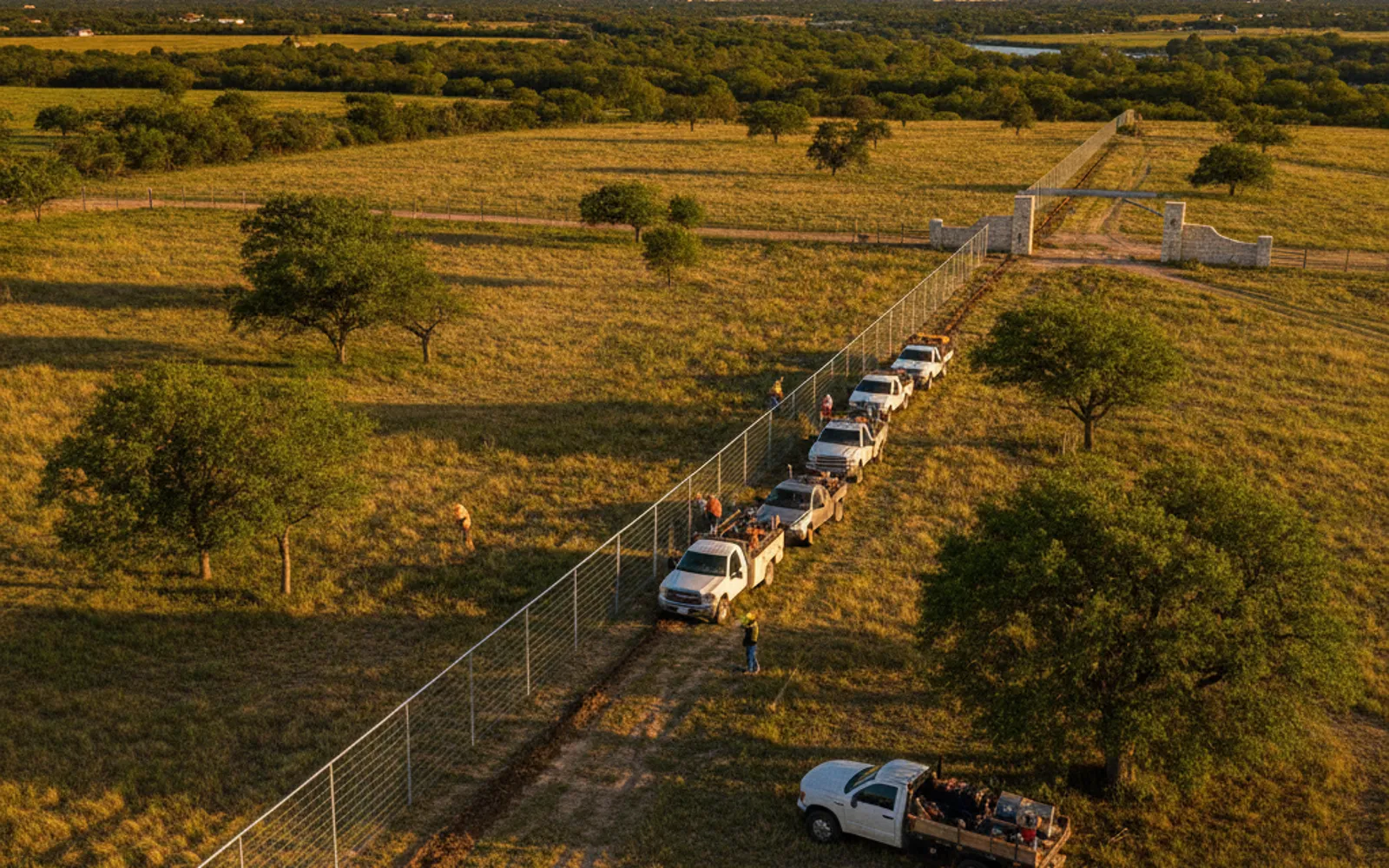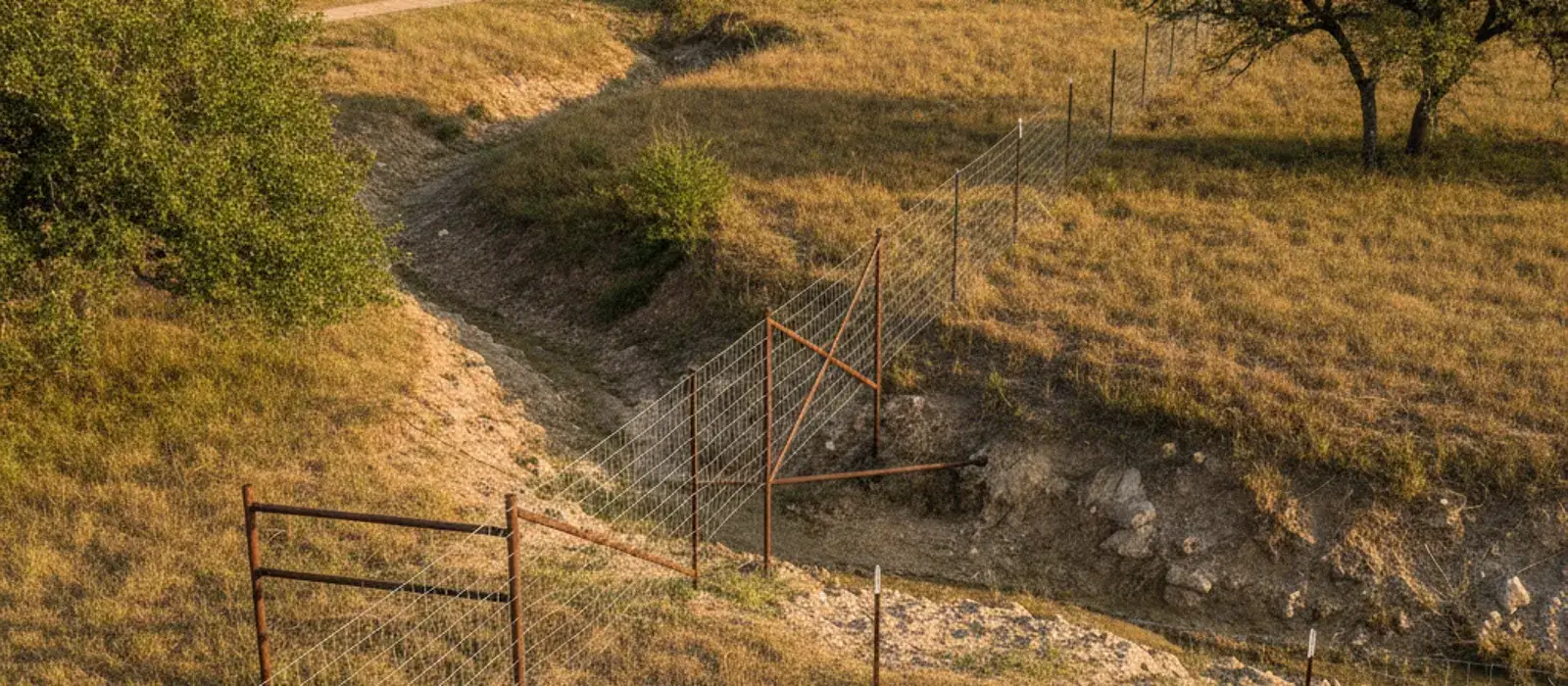
One hard rain on Hog Creek can tear out more fence in ten minutes than a whole herd of cattle can wreck in ten years. We’ve seen it happen over and over across McLennan, Bosque, and Falls counties. The fence that crosses the creek gets loaded up with brush, limbs, and floodwater, and the current rips out not just the crossing but fifty, a hundred, sometimes three hundred feet of good fence on either side.
That’s why every fence that crosses moving water needs a water gap fence. A water gap is a short, sacrificial section of fence built across a creek, draw, or drainage that’s designed to give way or swing open when floodwater comes through, then go right back to holding cattle when the water drops. Build it right and a flood costs you an hour of cleanup. Build it wrong, or skip it entirely, and a flood costs you a week of rebuilding and cattle scattered down the county road.
We build and repair water gaps all over Central Texas, from the Bosque River bottoms up around Valley Mills down to Cow Bayou near Lorena. Here’s how they work, what they cost, and how to keep yours from becoming next spring’s headache.
Why Creek Crossings Destroy Fences
Water is patient and it’s strong. When a creek rises after a Central Texas gully washer, it’s not just water coming down that channel. It’s tree limbs, cedar brush, hay net wrap, and sometimes whole trees.
All that debris hangs up on your wire, and now your fence isn’t a fence anymore. It’s a dam. Water piles up behind it, the force multiplies fast, and something has to give.
Here’s the part that stings. A solid fence doesn’t fail neatly at the creek. The wire is stretched tight for hundreds of feet in both directions, so when the crossing rips out, it drags the line with it. Posts snap, braces lean, and wire ends up wrapped around trees a quarter mile downstream.
The National Weather Service ranks flash flooding as one of the deadliest weather hazards in Texas, and our creeks can rise several feet in under an hour (weather.gov flood safety). Your fence has to live with that reality. A water gap is how it does.
If you’ve got a crossing you’re worried about, don’t wait on the next storm. Call us at (254) 870-8898 and we’ll take a look and give you a free written estimate.
How a Water Gap Fence Works
The idea behind a water gap fence is simple. You end your permanent fence on solid ground on each bank, anchored with stout braced posts that floodwater can’t reach or move. Then you span the channel itself with a separate, lighter section that’s built to fail on purpose.
That sacrificial section holds cattle just fine in normal conditions. When the creek rises and debris starts pushing, it breaks away, swings up, or lays down instead of fighting the current. The flood passes through, your permanent fence stays put, and you’re repairing a 20 foot gap instead of 300 feet of line fence.
Three things make the whole system work:
- Strong anchors on the banks. Heavy braced posts set above the normal flood line. These take the strain of the permanent fence so the gap section carries none of it.
- A weak link in the channel. The gap panel or wires attach with light wire, smooth wire loops, or hinges, never with the full-strength connections you’d use on line fence.
- Nothing for debris to grab. The fewer strands and posts in the channel, the less the water can load up on.
Get those three right and you’ve got a crossing that shrugs off high water. Get them wrong and you’ve built a debris trap with your name on it.
Types of Water Gaps We Build in Central Texas
There’s no single right water gap design. The right one depends on how wide the channel is, how hard the water comes through, and what kind of stock you’re holding. Here are the four we build most.
Breakaway wire gap. The simplest version. Barbed wire strands cross the channel attached to the anchor posts with light tie wire designed to snap under load. Cheap, quick, easy to rebuild after a rise. Best for narrow draws and seasonal creeks. Pairs naturally with a standard barbed wire fence.
Swinging or floating panel. A cattle panel, pipe frame, or row of vertical stays hung from a cable or pipe stretched high across the channel. Water and debris push the panel downstream and it swings up out of the flow, then gravity drops it back into place when the water falls. Great for creeks that rise often, because there’s often nothing to rebuild at all.
Hinged flap gap. Similar idea but hinged at the top from a rigid pipe header, usually built from drill stem. This is the heavy-duty option for crossings that see real current. If you’ve already got a pipe fence, a pipe-framed water gap matches it in both strength and looks.
Electric water gap. One or two hot wires across the channel on breakaway connections. Almost nothing for debris to catch, and cattle respect it. The catch is it only works if your charger and grounding are solid, and it needs checking after every rise.
Here’s how they compare on cost and upkeep for a typical 20 to 30 foot crossing:
| Water gap type | Installed cost (typical) | Flood survival | Rebuild after a big rise | Best for |
|---|---|---|---|---|
| Breakaway wire | $250 to $600 | Sacrificial, breaks away | 1 to 2 hours, cheap materials | Narrow draws, seasonal creeks |
| Swinging panel | $600 to $1,200 | Swings clear, usually survives | Often none, just clear debris | Creeks that rise several times a year |
| Hinged pipe flap | $1,000 to $2,500 | Toughest option | Rarely needed | Wide crossings, strong current |
| Electric gap | $200 to $500 | Minimal debris load | Reconnect wires, test charger | Managed pastures, gentle cattle |
Those are typical ranges for our area. A wide crossing, rock excavation, or a long haul to the site can push numbers up, which is why we always quote off a site visit, not a phone guess.
What a Water Gap Costs Compared to Not Having One
The cheapest water gap we build costs less than a single flood repair. That’s the whole math, and it’s not close.
Roy Kettler runs cows outside Valley Mills, with a North Bosque tributary cutting through his east pasture. His old fence crossed the creek dead solid, five strands bank to bank with no gap. The May storms two years back loaded that crossing with cedar and took out 260 feet of fence. Our repair bill was $2,850. We rebuilt the crossing with a swinging panel gap for $875, and it’s been through four good rises since without costing him a dime.
Down near Lorena, Dana Fuchs had it worse. Her crossing on a Cow Bayou drainage blew out overnight and eleven pairs went through before sunup. She spent the morning horseback getting them off a neighbor’s wheat, and cattle getting out is a liability problem on top of a fence problem. The repair ran $1,600. The breakaway wire gap we built her afterward cost $425, and now when the bayou rises, the gap pops loose like it’s supposed to and she resets it herself in an hour.
And out west of Crawford, Tom Villarreal called us after his third blowout in two years on the same Middle Bosque crossing. He’d been rebuilding it solid every time, roughly $900 a pop, so he was almost $2,700 in before we ever showed up. A hinged pipe flap gap cost him $1,850 once. It’s outlasted every rise since.
Add it up across a few storm seasons and the water gap is the cheapest insurance on the ranch. If you’re doing the math on your own crossing, our ranch fence cost guide covers what full fence rebuilds run per foot, and it’ll make the gap look even better.
Want a real number for your crossing instead of a range? Request a free written estimate and we’ll walk the creek with you.
Building a Water Gap Fence the Right Way
Whether we’re building it or you’re handy enough to tackle a simple one yourself, the same rules apply.
Set your anchors high and heavy. The braced posts on each bank are the foundation of the whole crossing. Put them above the debris line from past floods. Look for the rafts of sticks and grass hung in the brush; that’s your creek telling you how high it gets. Use a full H-brace on each bank, because these posts are holding the tension of your entire line fence.
Dead-end the permanent fence at the banks. Never run your line fence wire continuously across the channel. Tie it off at the anchor braces so the gap section is structurally separate. That separation is what saves the rest of your fence when the gap lets go.
Make the weak link actually weak. The most common mistake we see is a water gap wired in so tight it can’t release. Light gauge tie wire, smooth wire loops, or a proper hinge at the top. If it takes fence pliers and a fight to remove the gap section by hand, the flood is going to take your braces instead.
Keep the channel clean. Fewer strands, fewer stays, no old wire or T-posts left lying in the creek bed. Every extra piece of steel in that channel is a debris hook.
Match the gap to the stock. Cows need less than calves, and calves need less than goats and sheep. A two-strand gap that holds mature cows will not hold a weaned calf that’s walked the creek and found daylight under the bottom wire. Build the gap for the smallest animal in the pasture.
Think about the neighbors. If the creek is a boundary line, talk to the landowner across the fence first. A shared water gap split two ways is cheaper for both of you.
One safety note that outranks all of this. Never work in a creek channel while water is rising or heavy rain is falling upstream. Central Texas creeks come up fast enough to trap you. The gap can wait a day.
Water Gap Maintenance After Every Rise
A water gap isn’t a build-it-and-forget-it item. It’s a build-it-and-check-it item. The whole design assumes you’ll walk the crossing after high water, because a gap that released in the last flood isn’t holding anything today.
After every significant rise, do four things:
- Walk the crossing and confirm the gap is back in place or rehang it.
- Pull off any debris hung on the panel, wires, or anchor braces.
- Check the bank anchors for scour. Water cutting under a brace post is a slow failure you can catch early.
- If it’s an electric gap, test the wire with a fence tester, not the back of your hand.
Twice a year, give the crossing a harder look. Erosion moves creek banks, and an anchor post that sat five feet from the edge can end up two feet from it after a wet spring. Wire living in a creek bottom also rusts fast, and our guide on rusted barbed wire will help you decide whether to patch or replace.
The USDA Natural Resources Conservation Service publishes fencing practice standards that treat stream crossings as their own engineering problem, and some cost-share programs through NRCS can even help pay for fence work on grazing land (nrcs.usda.gov). Worth a conversation with your local office if you’re refencing a place with a lot of water on it.
When to Call a Pro on a Water Gap
Plenty of ranchers build and maintain their own breakaway wire gaps, and we’ll never talk you out of work you can do well. But some crossings are past DIY territory.
Call a professional when the channel is wider than about 20 feet, when the creek carries real current and big debris, when you’ve rebuilt the same crossing more than once, or when the banks are eroding around your anchors. Those situations need engineered anchors and pipe work. Sometimes moving the crossing 50 feet to a straighter, shallower stretch of creek solves a problem that no amount of rebuilding ever will.
We’ve built water gaps on just about every creek, draw, and bayou in the Waco area, and we know which designs survive which water. We’re licensed and insured, estimates are free and in writing, and if a storm just took your crossing out and there are cattle on the wrong side of it, our emergency line answers around the clock.
Call (254) 870-8898 or request your free estimate online, and let’s make the next flood a non-event.
Frequently Asked Questions
What is a water gap fence?
A water gap fence is a short, sacrificial section of fence built where a fence line crosses a creek, draw, or drainage. It’s designed to break away, swing up, or lay down when floodwater and debris push on it, so the flood passes through without tearing out the permanent fence anchored on each bank. After the water drops, you rehang or rebuild the small gap section instead of hundreds of feet of line fence.
How much does a water gap fence cost?
For a typical 20 to 30 foot crossing in Central Texas, a simple breakaway wire gap runs about $250 to $600 installed, a swinging panel gap runs $600 to $1,200, and a heavy hinged pipe gap runs $1,000 to $2,500. Wide channels, rock, and hard access add to that. Compare that to flood repairs on a solid crossing, which routinely run $1,500 to $3,000 per blowout, and the gap pays for itself in one storm.
Will cattle get out through a water gap?
Not if it’s built and maintained right. A properly hung gap holds stock just like the rest of the fence in normal conditions, and it only opens under flood load. The risk comes after a rise, when a released gap sits open until someone resets it. Walk your crossings after every high water event, and build the gap tight enough for the smallest animal in that pasture.
Do I need a water gap on a creek that’s dry most of the year?
Yes, and dry creeks are honestly where we see the worst damage. A draw that runs twice a year still moves serious water and debris when it does, and a solid fence across it becomes a dam the first time it flows hard. If a channel shows signs of flow, like scoured rock, bent grass, or debris hung in brush, it needs a water gap.