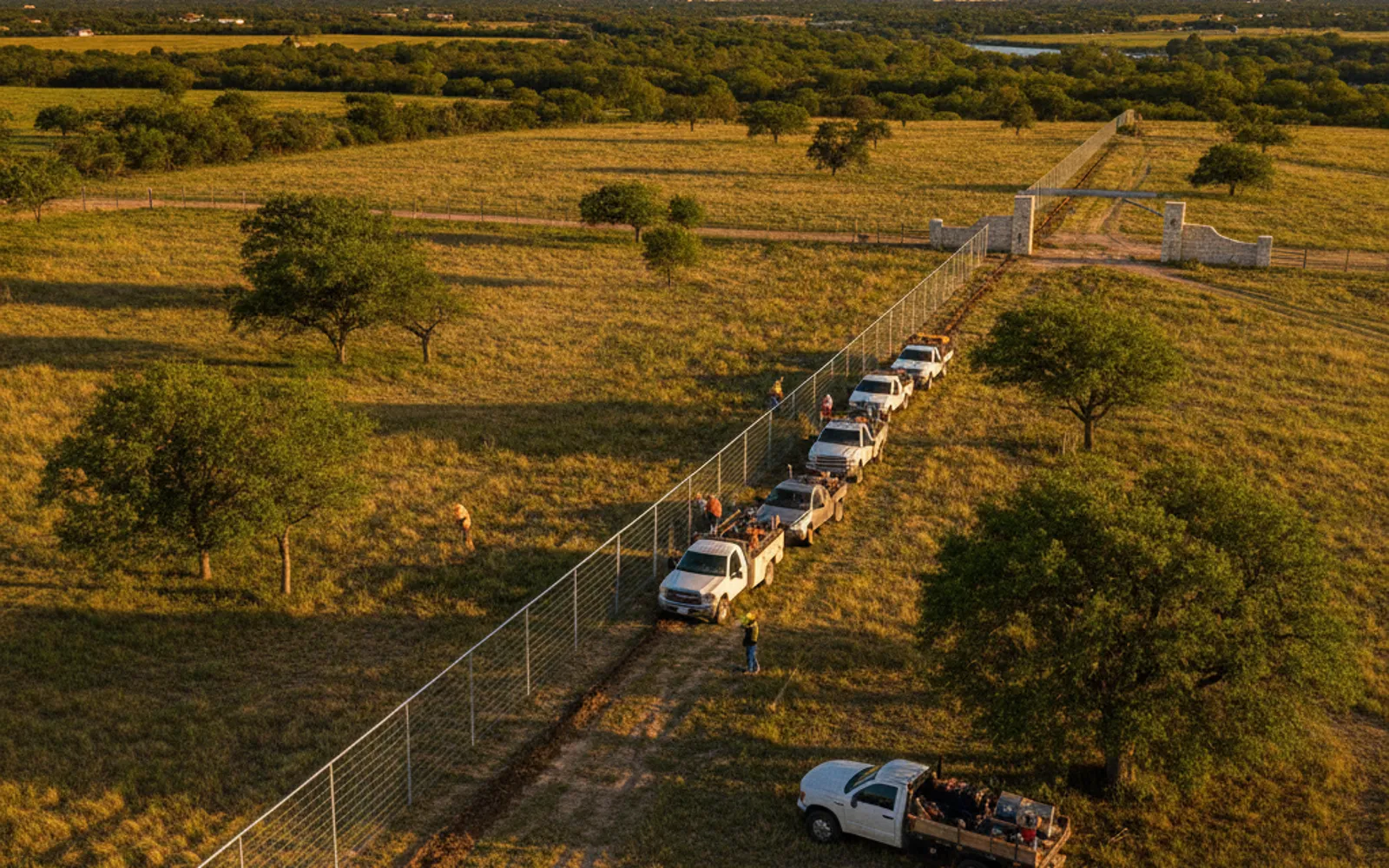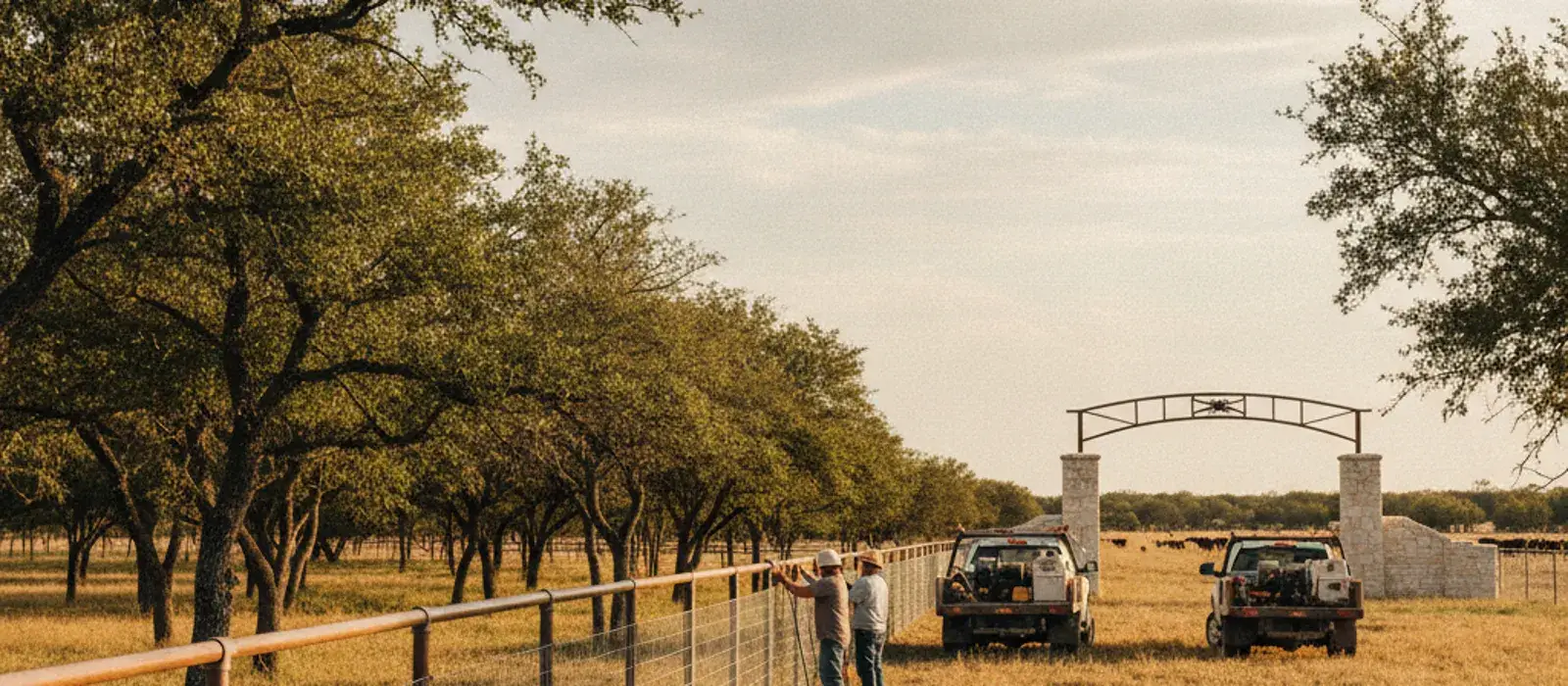
A driver hits your cow on a dark stretch of FM 185 at 10 p.m. The car is totaled, the cow is dead, and his lawyer calls your house Monday morning. Do you owe him a dime?
The honest answer is: it depends on which road, which county, and what shape your fence was in. Cattle on road liability in Texas confuses even lifelong ranchers because the state runs on a patchwork of old open range law, county-by-county stock laws, and one big highway statute that overrides both. We build and repair ranch fence all over McLennan, Bosque, and Falls counties, and we’ve watched good neighbors learn these rules the hard way. Here’s how it actually works.
Texas Is Still Open Range by Default
Most states make livestock owners fence their animals in. Texas flipped that script back in the trail-drive days. Under Texas common law, the default rule is “fence out.” Your neighbor has to fence cattle out of his property if he doesn’t want them there. You have no general duty to fence them in.
The Texas Supreme Court backed this up as recently as 1999 in a case called Gibbs v. Jackson, where a horse wandered onto a farm-to-market road and caused a wreck. The court refused to invent a new duty for the owner. No stock law, no highway statute, no liability.
But hold on before you relax. That default rule has two huge exceptions, and one or both of them cover most of the roads around Waco:
- The state highway statute. On U.S. and state highways, a separate law applies everywhere in Texas.
- Local stock laws. Counties and precincts voted decades ago to flip themselves from open range to closed range, and most of the settled parts of Central Texas did exactly that.
So “Texas is open range” is true the way “Texas is dry” is true. It depends entirely on where you’re standing.
If you already know your fence is the weak link in this whole conversation, don’t wait for a lawyer’s letter to find out how the rules apply to you. Request a free written estimate or call Brazos Ridge Fence at (254) 870-8898 and we’ll walk your road frontage with you.
Cattle on Road Liability in Texas Comes Down to Three Questions
When a wreck happens, every lawyer, adjuster, and judge involved works through the same three questions.
1. What kind of road was it? A U.S. highway or state highway (think I-35, US 84, TX 6, TX 317) triggers the statewide highway statute. A numbered farm-to-market road, a county road, or a gravel lane does not. This distinction alone decides a surprising number of cases.
2. Does a stock law cover that spot? If the county or precinct passed a stock law, the area is closed range and you have a legal duty not to let cattle run at large. If it didn’t, the old open range rule still applies on local roads.
3. Was the owner negligent, or did he knowingly let stock roam? This is the big one. Texas does not make cattle owners automatically liable just because a cow was in the road. Even in closed range country, the driver has to prove you were negligent. On highways, he has to show you knowingly permitted the animal to roam. A cow on the pavement is not proof by itself. A cow on the pavement for the third time this month, through the same broken wire your neighbor texted you about, is a different story.
Keep those three questions in mind and the rest of this article will snap into place.
The Highway Rule: U.S. and State Highways Play by Statewide Law
Texas Agriculture Code Section 143.102 says a person who owns or controls cattle, horses, or other listed livestock “may not knowingly permit the animal to traverse or roam at large, unattended, on the right-of-way of a highway.” You can read the full chapter yourself on the Texas Legislature’s statutes site.
Three things matter here.
It applies everywhere in Texas. Open range county, closed range county, doesn’t matter. If your bull is standing on US 84, this statute is in play.
“Highway” has a narrow definition. The statute defines highway as a U.S. highway or a state highway, and it specifically excludes numbered farm-to-market roads. That’s why the FM road question comes up so often in these cases, and why demand letters over FM road wrecks sometimes fall apart.
“Knowingly” is the fight. Violating the statute is a misdemeanor, and it opens the door to civil liability. But the driver’s side has to show you knew. Evidence that wins these cases for drivers looks like this: prior escapes you didn’t fix, a fence that’s been visibly down for weeks, calls from the sheriff’s office you ignored, or gates you knew didn’t latch. Evidence that wins for ranchers looks like a tight five-strand fence, dated repair receipts, and a cut wire or storm-downed limb nobody could have predicted.
If storm damage is what put your fence down along a highway, that’s exactly why we run a 24/7 emergency line. A tree through your right-of-way fence at midnight is a tonight problem, not a Monday problem.
Stock Laws in McLennan, Bosque, and Falls Counties
Stock laws are local option elections, most of them held between the early 1900s and the 1930s. Voters in a county or a single precinct could adopt a law making it illegal to let cattle, horses, hogs, sheep, or goats run at large. Where a stock law passed, that area became closed range, and it still is today.
Here’s the frustrating part: there’s no clean statewide map. The election results live in dusty commissioners court minutes at each county clerk’s office. Most of the populated parts of Central Texas, including the areas around Waco, adopted stock laws for cattle generations ago, but coverage can vary by precinct and by species. Before you bet your ranch on being open range, verify it with the county clerk in Waco, Meridian, or Marlin. Texas A&M AgriLife Extension also publishes solid plain-language material on fence law and stock laws at agrilifeextension.tamu.edu.
Here’s how liability tends to shake out by road type:
| Where the wreck happens | Open range area | Closed range (stock law) area |
|---|---|---|
| U.S. or state highway (I-35, US 84, TX 6) | Liable only if you knowingly let stock roam | Same highway rule, plus your local duty |
| Farm-to-market road (FM 185, FM 933) | Generally no duty to fence cattle in | Liable if the driver proves negligence |
| County road or gravel road | Generally no duty | Liable if the driver proves negligence |
| Private lane or easement | Rarely a liability issue | Rarely a liability issue |
One more time, because it matters: even in a closed range precinct, Texas courts do not apply strict liability. The driver must prove you failed to act as a reasonably prudent rancher. Your fence, and your paper trail on that fence, is what that fight is about.
Who Ends Up Liable for Cattle on the Road: Three Central Texas Stories
Rules are abstract. Here’s what they look like on real ground around here.
The 2 a.m. call outside West. Danny runs about 40 pairs on leased ground northeast of West. Last spring a rusted-out water gap let six heifers onto a county road, and a deputy had him out of bed at 2 a.m. pushing cattle in his boots and shorts. No wreck, thank God, so no lawsuit. But the scare cost him real money anyway: about $3,800 to rebuild the water gap and re-stretch a quarter mile of wire, plus a formal warning that the county considered him on notice. If those heifers get out again and someone gets hurt, that warning becomes Exhibit A on the “knowingly” question.
The bull on Highway 6 near Valley Mills. Rachel keeps a small commercial herd along TX 6. Her old netwire had been sagging for two seasons, and her bull had already walked through it twice. The third time, a pickup clipped him at dusk. The driver’s claim came in at $11,000 in truck damage plus medical bills. Because a neighbor had texted her photos of the down fence weeks earlier, “knowingly” was very much on the table under the highway statute. Her farm liability carrier settled for $18,500, her premium jumped, and she finally replaced 1,900 feet of fence at roughly $8 a foot. The fence would have cost about $15,000. The escape cost more, and she still had to build the fence.
The demand letter in Crawford. Tommy’s cows got onto an FM road west of Crawford after a feral hog rooted under his wire. A driver swerved, hit a culvert, and his attorney sent Tommy a $14,000 demand. Tommy’s lawyer answered with two points: the FM road isn’t a “highway” under Section 143.102, and the driver would have to prove negligence under the local stock law, which he couldn’t, because Tommy had receipts showing the fence was checked and repaired that same month. The claim died. Winning still cost Tommy about $2,500 in legal fees. His maintenance records are what kept it from costing ten times that.
Three different roads, three different outcomes, one common thread: the condition of the fence, and the proof of it, decided everything.
Your Fence Is Your Best Legal Defense
You can’t control juries, drivers, or county stock law records from 1922. You can control your fence. In practice, cattle owner liability in Texas rises and falls on whether you can show you kept a reasonable fence in reasonable repair.
Here’s what “reasonable” looks like along road frontage in our country:
- Five strands of barbed wire, stretched tight, on posts spaced right for the terrain. A saggy three-strand relic won’t impress an adjuster. If your wire is drooping, start with our guide to fixing sagging barbed wire fence, or have us rebuild the barbed wire fence properly.
- Solid corners and braces. Most fence failures start where the tension lives. Along highways, a lot of our customers step up to pipe fence for road frontage because it shrugs off vehicle strikes and never rots.
- Working gates and water gaps. Gates left unlatched and washed-out water gaps are the two most common escape routes we see. Check them after every rain.
- A paper trail. Photos, receipts, and dated notes every time you walk or fix the fence. Tommy’s $2,500 outcome instead of a $14,000 one came down to receipts.
- Fast response when cattle get out. Get animals off the road safely, call the sheriff’s non-emergency line, and put flashers on if it’s dark. Never try to haze cattle off a highway alone at night in dark clothes. Your life is worth more than the cow.
If your cattle are getting out and you can’t figure out where, our article on why cattle get out of fences covers the usual suspects. And if you want the deeper history on fence-in versus fence-out, we broke down the Texas open range law in plain English.
Know your limits on the DIY side, too. Patching a stretch of wire on an interior cross fence is a Saturday job. Rebuilding storm-flattened fence along a state highway right-of-way, with traffic flying by at 75 and liability hanging over your head, is not. That’s when you stop and call a professional crew with the equipment to do it fast and do it right.
That’s what we’re here for. Brazos Ridge Fence builds and repairs cattle-tight fence across McLennan, Bosque, and Falls counties, we’re licensed and insured, and estimates are free and in writing. Call (254) 870-8898, day or night on the emergency line if you’ve got cattle out or storm damage on a road, or reach us here to get on the schedule.
Frequently Asked Questions
Am I automatically liable if a driver hits my cow in Texas?
No. Texas has no strict liability rule for livestock on roads. On U.S. and state highways, the driver must show you knowingly let the animal roam at large. On other roads in closed range areas, the driver must prove ordinary negligence, and in true open range areas there’s generally no duty at all on local roads.
Does open range law still apply in McLennan County?
Mostly no in practice. Like most settled Central Texas counties, McLennan County adopted stock laws for cattle generations ago, though coverage can vary by precinct and species. The election records sit with the county clerk, so verify your specific precinct before you rely on open range status. And remember the highway statute applies everywhere regardless.
What should I do first if my cattle get out on the road?
Get there fast, but work safe. Call the sheriff’s non-emergency line so deputies can slow traffic, use your truck’s flashers, and move cattle off the pavement toward the nearest gate. Once they’re contained, photograph the escape point before you fix it, then repair it and keep the receipt. That documentation protects you if a claim shows up later.
Will my insurance cover a cattle-vehicle accident?
A standard farm and ranch liability policy usually covers damage your livestock cause to third parties, including vehicle wrecks, and it pays for your legal defense. Homeowners policies often exclude livestock operations, so don’t assume. Talk to your agent about your herd, your road frontage, and your policy limits before you need them.