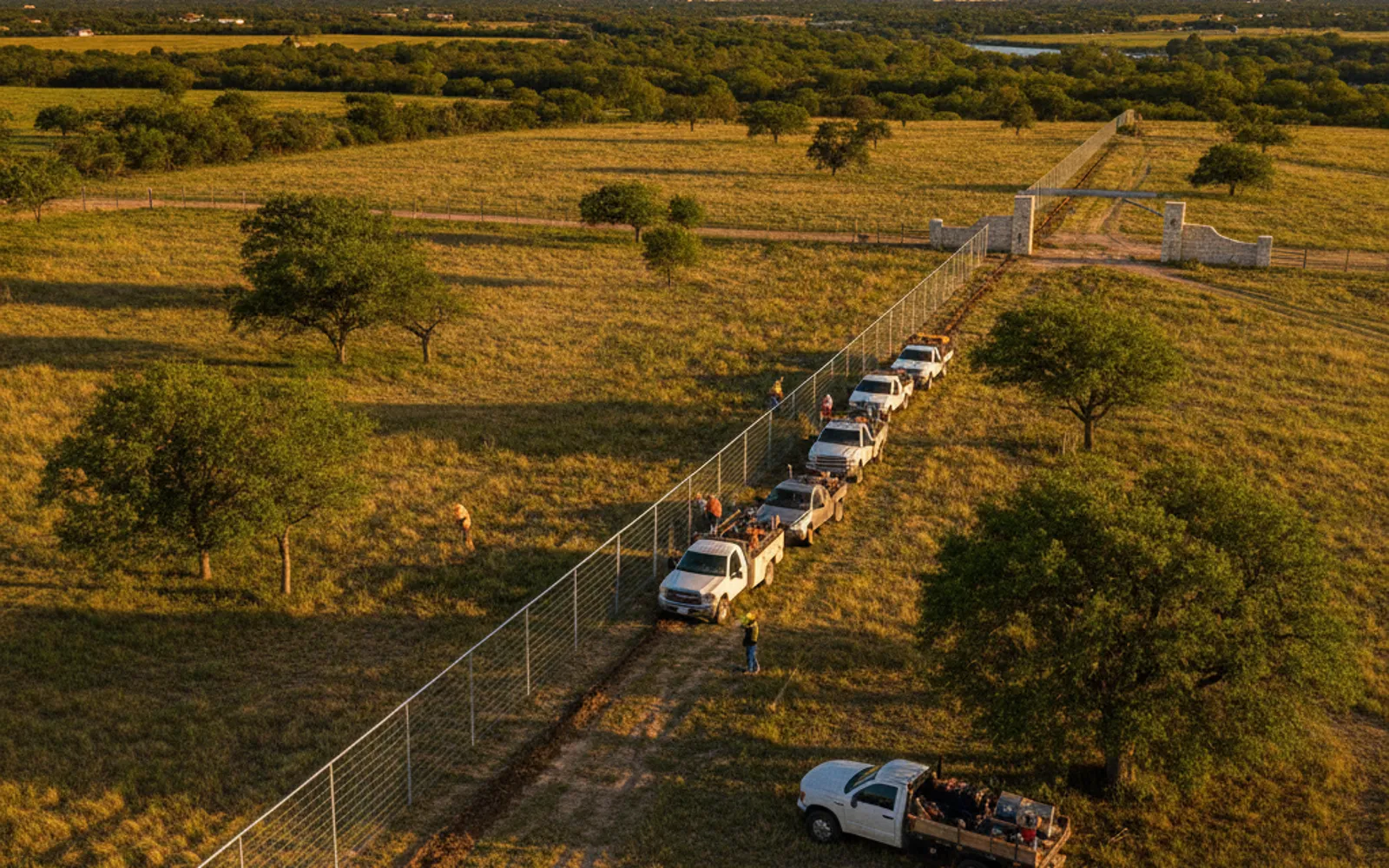
To stretch woven wire fence, set and settle your corner braces first, unroll the wire along the livestock side of the posts, tie the starting end to the first brace, clamp a stretcher bar through the far end so the whole height pulls evenly, and pull with a tractor, truck or fence stretcher until the small tension curves in the line wires are partly straightened, not flat. Then tie off at the far brace, let the pull off slowly, and fasten the wire to the line posts.
Field fence goes wrong in the details: a brace that moves an inch, a pull that leaves the bottom loose, staples driven tight, and dips where the fence floats off the ground.
If you would rather have someone walk the line and give you a number before you buy a roll, call (254) 870-8898 for a free on-site estimate anywhere in McLennan, Bosque or Falls County.
Before the wire comes off the trailer
Woven wire is only as tight as the posts it is tied to. Most sagging field fence traces back to something that happened before the first roll was cut open.
Braces first, and let them settle
Every corner, every end, both sides of every gate, and any hard bend in the line needs a brace assembly. Net wire pulls on a corner far harder than a few strands of barbed wire, because you are stretching 8 to 10 line wires at once on the common 32 to 47 inch styles. Our post on H brace fence corners covers how a brace goes together. Two points from the Texas NRCS fence specification matter most for woven wire:
- A single H-brace is only allowed as an end brace on stretches under 660 feet in the current March 2021 edition (the 2015 edition set the limit at 330 feet). Longer pulls need a double H or a welded three-post assembly.
- Brace posts go at least 3 feet deep unless driven, and on Blackland soils the spec allows concrete up to 12 inches from the surface, capped with soil.
That spec is the NRCS Texas Conservation Practice Specification for Fence, Code 382, revised in March 2021. The older 2015 edition, still hosted by the AgriLife Extension office in Leon County, is where some of the numbers below come from, and we say so where the two differ. The 2015 edition also says to let new braces settle before you load them. A brace set in the morning and pulled against that afternoon can lean by the weekend, especially in wet black clay. Our notes on setting posts in clay soil explain why the shrink-swell ground around Waco punishes shallow corners.
Line posts and in-line pull braces
Line posts go in on a straight line between braces at the spacing your wire and stock call for; fence post spacing has the ranges for net wire. The 2015 NRCS spec called for a 6-foot t-post set 24 inches deep, or a 5 1/2 foot post set 18 inches in rocky ground; the 2021 edition simply says to drive it until the anchor plate is at least 2 inches underground. Wood line posts go at least 2 1/2 feet in the 2021 edition (24 inches in 2015).
On a long run, set in-line pull assemblies so no single stretch carries the whole line. The spec puts them at the bottom and top of steep slopes and caps the distance between pull assemblies at 1,320 feet, even on straight, flat ground. Around here, plan on more braces, not fewer.
Which side of the post
On a boundary fence, hang the wire on the side of the post facing the animals you are holding. A cow or goat that leans on it then pushes the wire into the post instead of popping the fasteners out. The University of Georgia’s Fences for Horses bulletin gives the same rule, and the NRCS spec allows either side only on interior cross fences.
Unrolling the wire
A standard roll of woven wire is 330 feet and heavy. Stand it upright at the starting brace with the tight mesh at the bottom. On graduated field fence the line wires are closest together near the ground, which is where calves, kids and hogs test it.
Tie the starting end to the first brace post before you unroll anything. Work out how much wire it takes to wrap the post twice, clip out enough vertical stays to free that length of each line wire, then wrap each line wire around the post and back around itself. The 2015 NRCS spec calls for at least 6 wraps. Then roll the wire out along the livestock side. A roll unwinder on a tractor makes this easy; rolling it by hand on rough ground takes two people.
If the run is longer than one roll, splice the next roll on before you stretch, one line wire at a time. The 2021 spec calls for a Western Union splice with at least 4 wraps on each side of center (the 2015 edition asked for 8, and more wraps never hurt), or crimp sleeves rated at 80 percent or more of the wire’s strength.
Once the wire is out, stand it up and hang it loosely every few posts with a partly driven staple or a loose clip. It should sit near height but still slide when you pull.
Setting the stretcher bar
The stretcher bar is a steel bar (or a pair of bars) with clamps or wedges that grip every line wire across the full height, so the top, middle and bottom come tight together.
Set it a few feet past the far brace post so you have room to tie off. Clamp it vertically between two stays with every line wire captured. A bar that is cocked or misses the bottom wire gives you a fence that is tight at the top and slack where it counts.
Run a chain from each end of the bar to a single pull point, like a bridle, so the load splits between top and bottom. Hook that to a tractor, a truck, or a fence stretcher anchored to something that will not move. Do not pull off the top of the corner post you are about to tie to.
Stay-Tuff, a fixed-knot wire maker, lays out a two-bar method in its guide to stretching fence wire, with the bars set 10 to 19 feet apart depending on the length of the pull. It also says to plan on at least two workers for fences under 8 feet tall.
How tight to stretch woven wire
The wire answers this one for you. Most woven wire has small kinks pressed into each line wire called tension curves (some makers say crimps). They are a spring. They let the fence give when an animal hits it and take up slack when the wire expands in summer heat.
Pull until the curves are partly straightened, not gone:
| Wire type | How far to straighten the tension curves | Source |
|---|---|---|
| Standard woven wire / field fence | About one-third | MU Extension G1192, Constructing Wire Fences |
| Stay-Tuff fixed-knot | About 50 percent | Stay-Tuff stretching guide (linked above) |
| Any brand | Whatever the tag or installation sheet says | The wire maker |
Pull the curves flat and the spring is gone, so the next hard hit or cold snap loads the knots and braces directly. Barely touch them and the fence sags by summer. The NRCS spec also says to account for temperature, since wire tightens in cold weather and expands in hot. Wire stretched on an August afternoon will be tighter in January, so do not crank it to the limit in the heat.
Pull slowly. Stop every few feet of travel and walk back along the line, lifting the wire off any t-post stud or root it has caught on. Watch the vertical stays: they should stand straight. If they lean toward the stretcher at the top, the top wires are taking the load and the bottom is still loose, so let off and even up the chains.
Tying off at the far brace
With the stretcher holding tension, tie off the far end the same way as the start. Cut out the stays for enough length to wrap the brace post twice, then work one line wire at a time: around the post, back, and wrapped around itself at least 6 times. Stay-Tuff’s guide has you tie off a few of the middle line wires first, which holds the fence at height while you work out to the top and bottom. On a wood brace post, staple each wrap so it cannot ride up or down.
When every wire is tied, let the stretcher off slowly and watch the brace. If the corner post moves as the load transfers, stop and fix it now.
Fastening to the line posts
Fasten to the line posts only after both ends are tied off, and walk the whole run as you go so the wire sits at the same height on every post.
T-posts. Use galvanized wire clips. Clip the top and bottom line wires on every post and several in between, with the bottom wire sitting right at the ground on level stretches.
Wood posts. Staples go over the line wires, never the vertical stays. The 2021 NRCS spec calls for 9-gauge staples at least 1 1/2 inches long in any post (the 2015 edition allowed 1 inch in the posts it listed as hardwoods, which included cedar and mesquite). The UGA bulletin says never shorter than 1 1/2 inches and prefers 1 3/4 or 2. Drive each staple diagonally to the grain at a slight downward angle (upward where the wire pulls up) so it does not split the post.
Do not drive staples tight. Leave room for the wire to slide as it expands and contracts. A staple driven flat pins the wire, scrapes off the zinc, and makes that post the place where the wire rusts first.
Dips, rises and creek crossings
Woven wire wants to run straight between braces. The ground does not.
Dips. In a low spot, the stretched wire pulls up off the ground and lifts the post with it. A t-post at the bottom of a swale can pull right out. Set a heavier post at the low point and anchor it down (concrete, a buried deadman, or a short brace), then pull the wire down to it. The NRCS spec calls for line posts at every significant high and low point, and for extra measures where a fence crosses a draw, to keep posts from being pulled up out of the ground.
Rises. Over a crest, the wire presses down and the bottom can dig in. Add posts on the crest, and on a steep slope put an in-line pull brace at the top and bottom so you stretch each face of the hill on its own.
Creeks. Do not stretch net wire across a creek. Tie off on braces at each bank and build a gap that is meant to be rehung after high water; see our post on water gap fences. A flash flood will take stretched woven wire and pull the braces on both banks with it.
Barbed strands go on last
A barbed wire a few inches above the net wire keeps cattle from leaning the top over, and one along the bottom helps with hogs. Run them after the net wire is stretched and fastened, not before, so they do not get in the way of the stretcher bar.
Doing it yourself or calling a crew
A landowner with a tractor, a stretcher bar and a helper can build a few hundred feet of hinge-joint field fence on decent ground. The hard parts are the ones that do not show in a video: corners that hold in Blackland clay, posts drilled into limestone west of the Brazos, and a pull across broken ground with cedar and mesquite in the line. Our honest take is in DIY fence vs professional.
Treat the stretch with respect. A slipped stretcher bar or a snapped wire can whip. Wear gloves and eye protection and keep everyone out from behind the chains.
Installed net wire and field fence in our area runs $3.50 to $8 per foot. A quarter mile (1,320 feet) works out to about $4,620 at the low end ($3.50 x 1,320) and $10,560 at the high end ($8 x 1,320), before gates or clearing. The full table is on our ranch fence cost page, the net wire fence page covers heights and knot types, and goat and sheep fence covers mesh for smaller stock.
If you want a builder to walk the line, look at the corners and the low spots, and put a number in writing, call (254) 870-8898. The on-site estimate is free.
Frequently Asked Questions
How tight should woven wire fence be?
Stretch it until the tension curves in the line wires are partly straightened. MU Extension says about one-third for standard woven wire, and some fixed-knot makers call for about half. Never pull the curves flat, because they are the spring that lets the fence take a hit and ride out temperature swings. Follow the tag on your roll if it gives a number.
Can you stretch woven wire fence with a truck or tractor?
Yes, and most crews do. Clamp a stretcher bar through the full height of the wire, run chains from both ends of the bar to one pull point, and hook that to the tractor or truck. Pull slowly in short steps, walking the line between pulls.
Which side of the post does woven wire go on?
On a boundary or exclusion fence, hang it on the side facing the livestock you are holding. When an animal leans on the fence, it presses the wire into the posts instead of prying the staples or clips loose. On an interior cross fence the Texas NRCS spec allows either side.
How far can you stretch woven wire in one pull?
A roll is 330 feet, and you can splice rolls together before you stretch. The Texas NRCS fence spec caps the distance between pull assemblies at 1,320 feet on straight, flat ground and limits a single H-brace to runs under 660 feet (330 feet in the 2015 edition). On rolling pasture, shorter pulls between in-line braces are easier to get tight.
Should woven wire fence touch the ground?
On level ground the bottom wire should sit right at the surface so calves, goats and hogs cannot slip under. In dips, anchor a post at the low point and pull the wire down to it rather than leaving a gap. Where you cannot close the gap, a barbed strand run along the bottom helps a great deal.