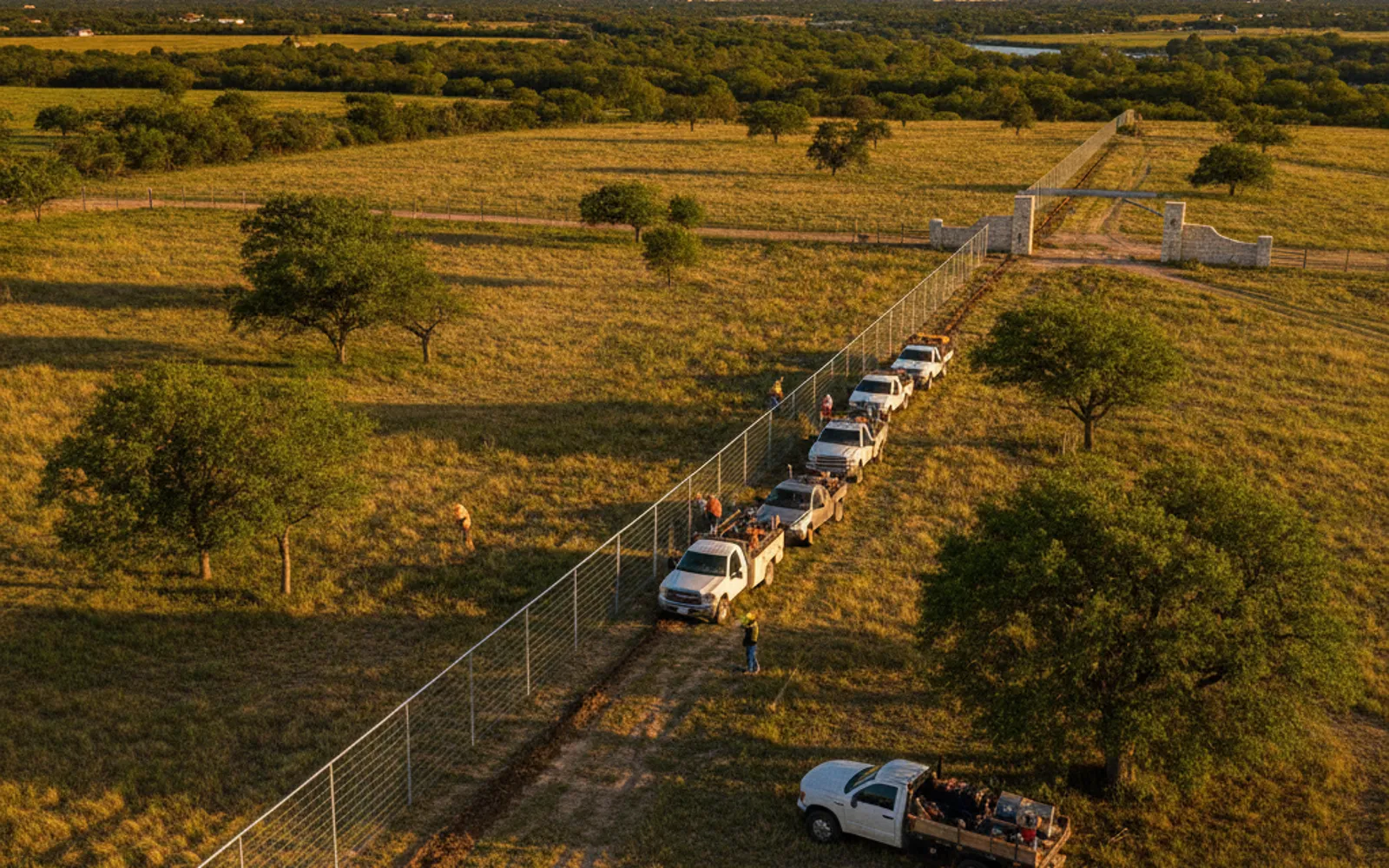
The two most expensive mistakes we see in horse pasture fencing around Waco are both layout mistakes, not material mistakes. One is fencing the whole place as a single pasture. The other is hanging a 10 foot gate where a 14 foot gate belonged.
Neither one shows up the week the fence goes in. They show up the first dry July, when three horses have grazed twelve acres down to bare dirt and there is nowhere left to move them. Or the first time you try to back a hay trailer through a gate that will not take it.
Material matters, and we will get to cost per foot. But layout is the part you live with for twenty years, and the part almost nobody puts on paper first.
Walk your place with a builder before you buy a single roll of wire. We will come out, walk the line with you, and give you a free on-site estimate. Call now at (254) 870-8898.
How Many Acres Per Horse Actually Works Around Waco
The number people quote is two acres per horse. That is a reasonable planning figure for Central Texas, but it is not a promise of grazing.
What an acre grows here depends on soil, rainfall and what was done to the ground before you bought it. Blackland clay in a wet spring will carry stock that the same acreage of thin limestone soil west of the river will not. In a drought year, and we get them, no amount of acreage grazes.
So plan for the dry side. If you have twelve acres and three horses, do not build one twelve acre pasture and call it done. Build grazing paddocks you can rest, plus a smaller lot you can hold horses on when the grass is gone or the ground is too wet to walk on.
Extension programs publish pasture management guidance worth reading before you draw a fence line. The University of Georgia Extension’s fences-for-horses bulletin covers the rotation logic well, and it applies here even though our forage species are different.
Here is the plan we lay out most often on a small horse place:
- One sacrifice lot or dry lot near the barn, roughly a half acre to an acre, built tough.
- Two or three grazing paddocks you rotate through.
- A lane connecting them so you can move a horse without leading it across a paddock you are resting.
That is three to five fence runs instead of one, and yes it costs more up front. It is also the difference between pasture and a dirt lot with a fence around it.
Horse Paddock Layout: Shapes, Lanes and Gate Widths
Horses hurt themselves in corners. Two geldings sort out who is boss, one gets pushed into a corner, and there is nowhere to go.
A few layout rules we build to.
No acute corners. Any corner tighter than 90 degrees is a trap. If the property line forces a sharp angle, we round it off with two or three short runs, or we fence across it and give up the sliver of grass. Losing a tenth of an acre is cheaper than a vet call.
Nothing narrower than 16 feet. Lanes, alleys and the strip between two paddocks all need room for a horse to turn around. Twelve feet works for equipment. Sixteen to twenty feet is better when horses use it.
No dead ends. A lane that stops at a solid corner will eventually have a horse in it that cannot get out and another one coming. Put a gate at both ends.
Keep water out of the corners. A trough set in a corner puts the boss horse in position to hold everybody else off it. Set troughs along a straight run, and if you can, set one in the fence line so it waters two paddocks at once. One water line, one float, half the trips.
Look at where the horses run. Most pastures have a natural run along one line, usually toward the barn or the neighbor’s horses. That run needs the most visible fence you are willing to pay for, because that is where a horse hits at speed.
Get gate width right the first time. It is the cheapest thing to plan and the most annoying thing to fix later. Our rule of thumb:
- 12 feet minimum anywhere a tractor goes.
- 14 to 16 feet where hay equipment, a stock trailer or a truck and trailer has to swing through.
- A 4 foot walk gate near the barn so you are not swinging a big gate twice a day.
Hang gates so they open into the paddock and away from the direction horses crowd. Gate posts take more abuse than any other post on the place, so they get set deeper and in concrete, and on a horse lot we will often set pipe.
Post spacing on horse mesh runs 8 to 12 feet depending on terrain and how hard the fence gets used. Wider than that and the mesh bellies out when a horse leans on it. Spacing is one of the numbers to ask about when you compare quotes, and we cover it in our fence post spacing guide.
Cap every T-post. An uncapped T-post is the most common preventable injury on a horse place, and caps cost a couple of dollars each.
What Horse Pasture Fencing Costs Per Foot in Central Texas
Here is what we actually charge to build the pieces of a horse place across McLennan, Bosque and Falls counties. These are installed prices, not materials.
| Where it goes | What we usually build | Installed cost per foot |
|---|---|---|
| Perimeter and paddock lines | Horse-grade no-climb mesh (2x4 inch), wood posts, top rail | $3.50 to $8 |
| Cross fence between grazing paddocks | Net wire or field fence, wood corners, capped T-posts | $3.50 to $8 |
| Dry lot, barn lot, stallion run, arena | Welded pipe | $12 to $28 |
| Back pasture shared with cattle only | 5-strand barbed wire (not for horses) | $2.50 to $5.50 |
Horse-grade mesh sits at the top of that net wire band, not the bottom. The $3.50 end is a hinge-joint field fence on flat, clear ground with cattle behind it. A 2x4 inch no-climb roll with a top rail, built where a horse will lean on it, prices near the $8 end. That is honest, and anybody quoting you horse mesh at cattle-fence money is either using lighter wire or wider post spacing than we would.
Two costs that are not per foot: a custom ranch entrance runs $5,000 to $25,000 and up depending on what you want built, and a cattle guard installed runs $3,500 to $8,000. Full numbers for every fence type are on our ranch fence cost page.
If you want a number for your specific place rather than a range from an article, we will walk it with you and put a figure on it. Ask for a free on-site estimate here.
Three Field Examples With Real Numbers
A 12-acre horse place outside Lorena, three horses. The owner wanted the whole thing in horse fence. We laid it out as an 8 acre grazing block split into two 4 acre halves, a 3 acre back paddock, and a 1 acre dry lot off the barn. Perimeter came to about 2,900 feet, cross fencing another 1,400 feet.
We built the perimeter and the cross fences in 2x4 inch no-climb with a treated top rail, posts on 10 foot centers. At the upper end of the net wire band that came to roughly $19,000 to $23,000 for the wire fence, plus a short pipe run around the dry lot where the horses crowd the gate. Three paddocks instead of one means the grass gets a rest, and the dry lot means she is not turning horses onto soaked clay in February.
A limestone hill section near Valley Mills where every post has to be drilled. About 1,400 feet of it. There is four to eight inches of soil over rock, and an auger will not take a post down. Every hole gets drilled and the post gets set in concrete or rock is packed back around it.
That work is slower, it needs a rock drill on site, and it prices at the top of whatever band the fence type falls in. On that job the mesh line ran near the $8 per foot ceiling where the flat ground on the same property ran closer to $6. If a builder quotes you rocky ground at flat-ground prices, ask what happens when the auger stops. Our notes on setting fence posts in rocky ground go through it in more detail.
A 40-acre place north of China Spring with a seasonal creek. Two horses and a hay meadow. The mistake already in the ground was a single perimeter fence with the creek crossing it, so every high-water event took out sixty feet of wire.
We put the horses on 9 acres of fenced paddock away from the creek, left the meadow open for hay, and built a proper water gap at the crossing so the next rise takes out a hanging panel instead of a braced corner. Gates went in at 16 feet so the hay equipment clears them. Fixing the layout cost less than rebuilding the same fence a fourth time.
Building Horse Pasture Fencing That Survives Blackland Clay
Central Texas clay swells when it is wet and shrinks when it is dry, and it does both hard. Posts move. A fence that was tight in May can be loose by September, then tight again after a wet spell.
That is why bracing matters more here than in most of the country. Every corner and every gate post needs a proper H-brace with the horizontal set at the right height and the brace wire twisted tight. A corner that is not braced right will lean within two seasons, and a leaning corner takes the whole run with it.
Wire choice matters too. Class 3 galvanized mesh holds up far longer than class 1 in our humidity, and on a horse fence you are paying for the fence to last twenty years, not eight.
Electric wire has a place on a horse fence, usually a single hot strand on standoffs to keep horses off the mesh and stop them rubbing the top rail down. It is not a perimeter fence on its own, and it will not stop a spooked horse. If you want to run it, our page on electric fence for horses is worth ten minutes.
For the safety reasoning behind mesh, visibility and smooth wire, Penn State Extension’s fence planning guide for horses is a good independent read.
Where to Spend and Where to Save
If the budget is tight, spend it in this order.
First, the dry lot and the barn lot. That is where horses spend the most hours and stand closest to each other, so that is where pipe or heavy mesh earns its money. See corrals and working pens for what we build there.
Second, the run. Whatever line the horses gallop toward gets the visible, hoof-proof fence.
Third, the perimeter along a road. A horse loose on a farm-to-market road at night is a problem far bigger than a fence bill.
Last, the back paddock line where horses drift rather than run. That line can be lighter, and honestly it can wait a year if the budget says so. We would rather build half your place right than all of it thin. Details on what we install are on our horse fence page and in our guide to no-climb horse fence.
When you are ready to put it on the ground, call now at (254) 870-8898. We will walk the fence line with you, talk through the paddock layout, and give you a free on-site estimate before any number gets quoted.
Frequently Asked Questions
How many acres do I need per horse near Waco?
Two acres per horse is a fair planning figure for grazing in Central Texas, but it depends entirely on your soil, your rainfall and the condition of the pasture. Blackland clay ground carries more than thin soil over limestone. Plan for a dry year, and build a dry lot so you have somewhere to hold horses when the grass is gone or the ground is too wet.
What is the smallest paddock size that is safe for turnout?
For a single horse to move and stretch, most people work from about a quarter acre as a minimum turnout, and a dry lot of a half acre to an acre works well on small acreage. The shape matters as much as the size. A long narrow paddock with no acute corners is safer than a square one with a tight angle a horse can get pinned in.
Can I use barbed wire on a horse pasture?
We build a lot of barbed wire, and it is a good cattle fence, but it is not a horse fence. Horses do not back off wire the way cattle do, and thin strands are nearly invisible at dusk. If you already have barbed wire and horses, the highest value change is usually mesh on the run line and the road line first.
How much does it cost to fence a 10 acre horse pasture?
Ten acres squared up is roughly 2,640 feet of perimeter, so at the horse-grade end of our net wire range of $3.50 to $8 per foot you are looking at a wide band depending on terrain, brush and how much of it is rock. Cross fencing, gates and a dry lot are on top of that. The only way to get a real number is to walk the line, which we will do at no charge.