A horse walked through a single strand of poly tape at eleven at night in August, and the owner spent the next two hours walking a county road ditch with a flashlight. The fence had tested fine in June. What changed was not the tape and not the horse. It was the ground under the ground rods, which had opened up into cracks you could drop a pen into, and a fence that cannot find dirt cannot shock anything.
That is the whole story of an electric horse fence in Central Texas. The hardware is cheap and the theory is simple, and almost every failure traces back to soil, vegetation, or a charger that was undersized the day it was bought. Done right, hot wire is one of the most useful tools on a horse place. Treated as a substitute for a real perimeter, it is how horses end up on the highway.
Below is what electric fence does well for horses, how to choose between wire, tape, rope and coated rail, how to size a charger and a ground field for clay and limestone, and what actually goes wrong out here.
What an Electric Horse Fence Actually Does, and What It Doesn’t
An electric fence is a psychological barrier. It teaches an animal to respect a line. It does not physically stop anything, and a horse that is genuinely panicked, or that has learned the fence is dead, will go through it and barely notice.
That matters more for horses than for cattle. A cow tests a fence with her nose at walking speed. A horse spooks and leaves at a dead run, sometimes in the dark, sometimes toward a road.
Here is the split we recommend on almost every horse place we walk. Physical fence on the perimeter, especially anything fronting a public road. Electric on the inside, for cross fencing, rotational grazing, temporary paddocks, keeping horses off a new wire fence, and keeping them out of the round bale.
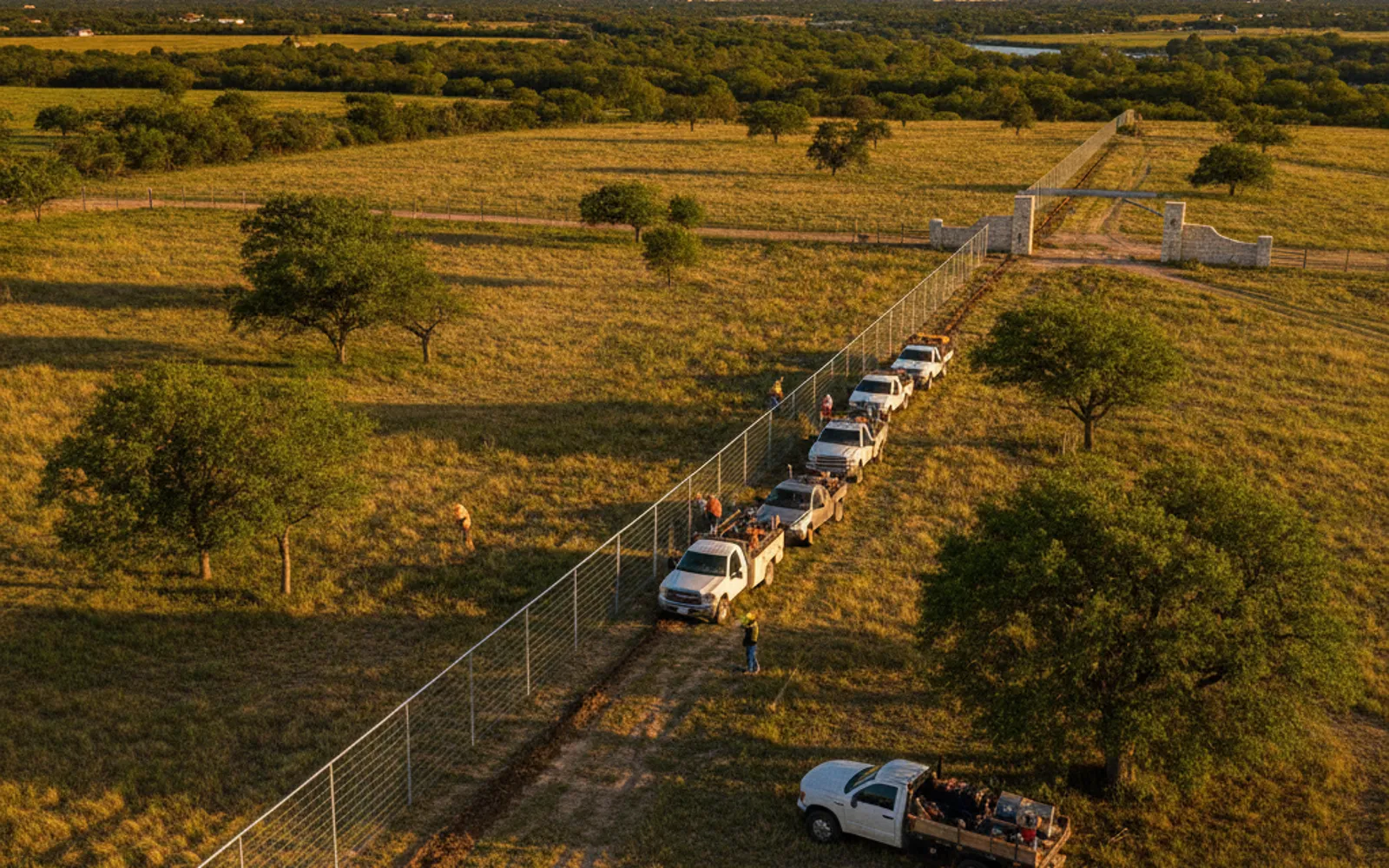
For the perimeter itself, no-climb woven mesh with a visible top rail is the common answer here, and horse-grade 2x4 mesh sits at the upper end of our net wire and field fence band of $3.50 to $8 per foot. Welded pipe runs $12 to $28 per foot and is what most folks put around pens and road frontage. Our horse fence page covers both, and the no-climb horse fence writeup gets into mesh specs.
If you are trying to decide how much of a place needs physical fence and how much can be hot wire, that is a fence line conversation, not a phone conversation. Call (254) 870-8898 and we will walk it with you. On-site estimates are free.
Wire, Tape, Rope or Braid: Picking the Conductor
The single biggest safety factor in an electric horse fence is whether the horse can see it. A horse that sees the line slows down. A horse that does not see the line learns about it at speed.
Smooth high-tensile wire is the best conductor and the cheapest to run, and it is close to invisible at dusk. If you use it, give the horse something to look at: a wide tape on the top strand, a top rail, or sighter markers.
Poly tape is the opposite. The conductive filaments woven through it are thin, so it carries current poorly over distance and breaks down under Texas UV. Wide tape also acts like a sail, and on an exposed line 2 inch tape will loosen posts and stretch out of shape faster than most people expect.
Poly rope and braid sit in the middle. They are visible enough for most horses, they shed wind better than wide tape, and the better ones carry mixed metal filaments that hold conductivity longer than cheap tape. For interior division fences on a small place, rope is usually the practical answer.
One rule with no exceptions on horses: never electrify barbed wire. A shocked horse that jumps into barbs is the wreck the electric fence was supposed to prevent. If you have existing barbed wire and you want it hot, the answer is an offset smooth wire on standoff insulators, sitting 6 to 10 inches in front of the barbs.
| Conductor | Visibility | Typical service life | Materials-only estimate, per foot | Where it fits |
|---|---|---|---|---|
| 12.5 ga high-tensile smooth wire | Poor on its own | 20+ years | $0.05 - $0.12 | Long cross fences, offset wires on existing fence |
| Poly rope or braid, about 1/4 in | Good | 5 - 10 years | $0.10 - $0.25 | Interior division fences, temporary paddocks |
| Poly tape, 1.5 in | Very good | 4 - 8 years | $0.15 - $0.35 | Short runs, sheltered lines, foal paddocks |
| Poly tape, 2 in and wider | Best | 3 - 7 years | $0.25 - $0.60 | Sighter strand on a top line, arena wings |
| Coated polymer electric rail | Very good | 15 - 20 years | $1.50 - $3.50 | Barns, show places, high-traffic frontage |
Those figures are general materials-only estimates for the strand itself, not a quote from us. Posts, insulators, the energizer, gate handles and labor sit on top of them, and our installed pricing is on the ranch fence cost page.
Sizing the Charger and Getting the Ground Right
Chargers are rated in joules and in miles. Ignore the miles number. It assumes clean wire with nothing touching it, which describes no fence in McLennan County in April.
Size on output joules instead. A rough working rule out here is one joule of output per mile of conductor, then double it if the line runs through grass, brush, or anything you are not going to spray and mow. Vegetation load, not acreage, is what decides the size.
Mains power beats solar every time you can reach it. Solar units are sized to their battery and panel, they lose ground on short December days, and a dusty panel under a cedar is a slow fade nobody notices until the horses find it.
Grounding is where most of these fences fail. The circuit runs charger to wire to horse to soil and back through the ground rods, so dry soil is a broken circuit. Plan on a minimum of three galvanized ground rods, 6 to 8 feet long, spaced at least 10 feet apart, tied together with continuous galvanized wire and galvanized clamps.
Keep the metals matched. Copper clamps on galvanized rod corrode at the joint and quietly cost you a thousand volts a year later. Put the ground field somewhere that stays damp, usually the shaded side of a barn or near a tank overflow rather than out in the open.
Then there is our particular problem. Blackland clay shrinks in a dry summer and pulls away from the rod, and limestone and caliche will not let you drive a rod at all. On rocky ground the options are a drilled and backfilled ground bed, a horizontal ground trench, or a hot and ground return design, where alternate strands are wired to the ground system so the horse completes the circuit through two wires instead of through dry dirt.
Test with a digital fence tester, not by grabbing it or laying a grass stem across it. For horses we want to see roughly 3,000 volts or better at the far end of the fence, and anything under about 2,000 is a fence horses will start to test. Penn State Extension’s fence planning guide for horses and University of Georgia Extension both cover the safety side in more detail.
What Goes Wrong With an Electric Horse Fence
Almost every dead fence we get called about is one of these six things, roughly in order of how often we find it.
The ground field. Too few rods, rods too short, rods in rock, corroded clamps, or soil that has dried out since the fence was installed. A fence can read fine at the charger and near zero at the horse when the ground is the problem.
Vegetation. Spring grass on the bottom strand will pull a fence down to nothing in a week. The bottom wire should either sit high enough to stay clear or be left dead.
Insulators and staples. Cracked plastic, UV-brittle insulators, or a staple driven tight over a wire on a wood post. Any of them will leak to the post, worse when the wood is wet.
Tape connections. Poly tape does not conduct through a knot. Every splice and corner needs a buckle or crimp connector, and a tape fence with four knotted repairs has four dead sections behind them.
Lightning. A strike on a long line will take out an energizer, and this is a summer thunderstorm region. A lightning arrestor on its own ground is the difference between a $40 part and a new charger.
Gates and undergrounds. The lead-out from the charger and any wire crossing under a gate has to be double-insulated underground cable. Bare wire in poly pipe is not insulation.
If your fence has quit and you want to run the checks yourself, we walked through the diagnostic order in electric fence not working. If you would rather someone else find it, book a free estimate and we will bring a tester and a fault finder.
Three Places Around Waco Where This Plays Out
A 12-acre horse place outside Lorena. Two mares, road frontage on one side, and one strand of tape around the whole thing from the previous owner. We put horse-grade no-climb mesh with a top rail on the road side and the two neighbor lines, priced at the upper end of the $3.50 to $8 per foot net wire band because of the 2x4 mesh and the rail. The interior stayed electric, about 900 feet of poly rope on two strands with a mains energizer, which let the owner run three paddocks and rest the grass. Electric where a loose horse ends up in the next paddock, physical fence where a loose horse ends up on pavement.
A 300-acre lease west of Crawford. Cattle and a few using horses, two miles of tired barbed wire the owner did not want to replace yet. We ran an offset hot wire on standoff insulators along the worst mile and a half, which stopped the leaning that was flattening the wire in the first place. That took a 6 joule mains energizer and a proper three-rod ground field, and the offset conductor itself was a materials-only cost in the low hundreds. It bought that fence several more years, but it did not make it a horse fence.
A limestone hill section near Valley Mills. Every post hole on that ridge is a rock drill hole, and the ground rods would not go in past 18 inches. The fix was a hot and ground return layout on the hot wire sections so the circuit did not depend on that dry shelf rock, plus a drilled ground bed down at the bottom of the slope where there was actual soil. That is a case where the site decides the design, and no amount of charger will substitute for a ground field that cannot work.
Where Electric Fits in a Real Horse Fence Budget
Electric fence looks cheap on paper because people price the wire and forget the rest. A charger, ground rods, insulators, gate handles, a cutout switch and a tester add up before the first strand goes on, and none of it holds a horse without posts.
The way we think about it is simple. Spend the money on the perimeter, particularly the part that touches a road, and use hot wire to make that perimeter last longer and to divide the interior. An offset wire that keeps horses from rubbing and leaning is the cheapest fence-life extender there is.
If the current fence is old barbed wire and horses are already behind it, hot wire is a stopgap and not a fix. Compare the options in best fence for horses and electric fence vs barbed wire, then decide which sections need real wire and which can wait.
Call (254) 870-8898 or ask for an on-site estimate, and we will walk the line with you, look at the soil and the road frontage, and put numbers on paper before anything gets built. We build across McLennan, Bosque and Falls counties, and repairs are on our fence repair page.
Frequently Asked Questions
Will an electric fence hold a horse by itself?
Sometimes, and not reliably. Electric fence is a training barrier, so it works on a horse that has learned to respect it and does nothing for a horse that is running scared or that has figured out the power is off. For interior paddocks that is an acceptable risk, but we do not recommend electric alone as the perimeter on any place with road frontage.
How many strands does an electric horse fence need?
Most horse paddocks here run three strands, with the top around 48 to 54 inches, a middle strand at chest height, and a third low enough to discourage reaching under. Small acreage with foals or minis often needs a fourth. Leave the bottom strand dead or set it high enough to stay out of the grass, otherwise vegetation will short the fence every spring.
What voltage should an electric horse fence read?
Check it with a digital fence tester at the far end of the fence, not at the charger. Aim for about 3,000 volts or better for horses. Below roughly 2,000 volts, horses start testing the fence, and the cause is almost always the ground field, vegetation on the wire, or a failed insulator rather than the energizer itself.
Can I electrify my existing barbed wire fence for horses?
No. Electrified barbed wire is the one setup we will not build on a horse property, because a shocked horse that jumps into barbs is exactly the injury you are trying to avoid. If you want to hot up an existing barbed wire line, run a smooth offset wire on standoff insulators 6 to 10 inches in front of the barbs so the horse meets the hot wire first.