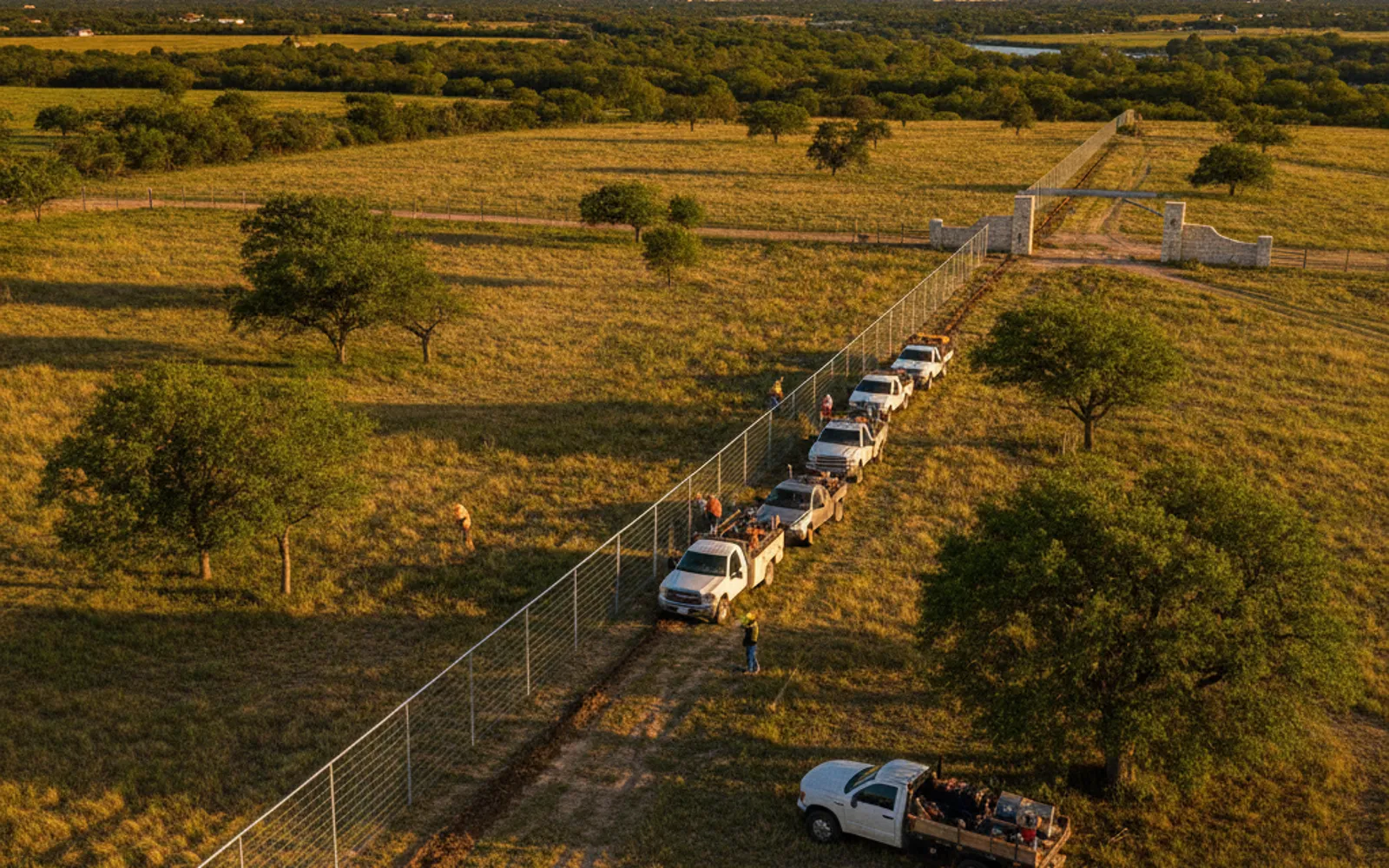
A horse can put a front hoof through a loose field fence at midnight and turn a cheap roll of wire into a vet bill that runs into four figures. That is the whole argument for no climb horse fence, and it is why 2x4 inch woven mesh ends up on most of the horse jobs we bid around Waco.
The question is not whether it works. It works. The question is whether it is worth the extra dollars per foot on your place, or whether your horses would be just as safe behind something cheaper.
This article gives you the real per-foot range in McLennan, Bosque and Falls counties, three jobs we have priced and what moved the numbers, and an honest read on where no-climb is overkill. If you would rather skip to a number for your own fence line, call (254) 870-8898 and we will come walk it with you. On-site estimates are free.
What No Climb Horse Fence Costs Per Foot Around Waco
No-climb belongs to the net wire family, so we price it against our net wire fence band of $3.50 to $8 per foot installed. Horse-grade 2x4 mesh sits at the upper end of that band, and there is a reason for it.
Horse mesh is heavier wire, tighter spacing, and usually a taller roll than the field fence a cattleman puts up. It also gets built differently. Horse fence gets more posts, better corners, and almost always a top rail or a sight board, because bare mesh at nose height is close to invisible to an animal at a dead run.
So when we talk about no-climb on a horse place here, we are usually talking about the $6 to $8 end of that range, and the low end of the band is field fence for goats and cattle, not a finished horse fence.
| Fence type | Installed cost per foot | Where it fits |
|---|---|---|
| 5-strand barbed wire | $2.50 to $5.50 | Cattle on acreage. Not a horse fence. |
| Net wire / field fence | $3.50 to $8 | Horse-grade 2x4 no-climb sits at the top of this band |
| Welded pipe fence | $12 to $28 | Pens, arenas, road frontage, stud runs |
| Custom ranch entrance | $5,000 to $25,000 and up | The gate at the road |
Those are our installed numbers, materials and labor together, for this three-county area in 2026. You will see rolls of 2x4 no-climb on the shelf at farm stores for somewhere around $400 to $700 for a 330-foot roll, and that is worth knowing, but treat it as a general materials-only figure and not as a quote from us. It leaves out posts, braces, gates, clips, fuel, and the two or three days it takes to build the thing straight and tight.
Full pricing for everything else we build is on our ranch fence cost page.
Why the 2x4 Mesh Is the Whole Point
Everything expensive about this fence comes back to one measurement. A 2 inch by 4 inch opening is smaller than a hoof. That is it. That is the feature you are paying for.
Standard field fence has openings that get wider as you go up the roll, and a horse pawing at grass on the other side can slide a foot through and then panic when it will not come back out. Hinge-joint field fence also mashes down when a 1,100 pound animal leans on it, and once it is bellied out it stays bellied out. If you want the detail on wire construction, our guide to fixed knot versus hinge joint covers how the two behave under pressure.
The other half of a horse fence is visibility, and mesh alone does not solve it. We put a wood rail, a pipe rail, or a wide sight board on top of nearly every no-climb fence we build. It gives the horse something to see and it keeps the top of the mesh from getting rolled over by a horse reaching across.
This is not just our opinion. Penn State Extension’s fence planning guide for horses walks through the same reasoning on mesh size and visibility, and the University of Georgia Extension horse fencing material comparison lays out the tradeoffs by material if you want a second read before you spend the money.
One more thing worth saying plainly. No fence makes a horse injury-proof. A horse that is determined enough will find a way to hurt itself on the safest fence ever built. What no-climb does is take the two most common wrecks, a leg through the fence and a run-through, and make them a lot less likely.
Three Jobs, Three Very Different Numbers
The per-foot range only tells you so much. Here is how it actually lands on real ground in this area.
A 12-acre horse place outside Lorena. Two mares and a gelding on flat blackland, roughly 2,900 feet of perimeter. Wood corners, treated line posts on 10-foot spacing, 60-inch 2x4 no-climb with a treated top rail, one 12-foot gate and one walk gate. That job prices at the top of the net wire band, call it $20,000 to $23,000, because the top rail and the tighter post spacing are doing real work. Straight field fence with no rail on the same line would have come in several thousand dollars lower and would have been a worse fence for those horses.
A limestone hill section near Valley Mills where every post has to be drilled. Only about 600 feet of new fence, but the auger will not touch it. Every hole gets a rock drill, and some posts get set in concrete because there is nothing to backfill with. Short runs like this land at the ceiling of the band, around $8 per foot, so roughly $4,800 for a stretch that would have cost half that on soft ground a mile away. Rock is the single biggest surprise on bids in the Bosque County hills, and it is why we walk the line before we quote. More on that in our notes on setting fence posts in rocky ground.
A 40-acre place west of Crawford with a split approach. Pipe on the two working pens and the 300 feet of road frontage where the horses crowd the gate, no-climb on the rest of the perimeter. At $12 to $28 per foot, the pipe sections alone can run from about $5,000 to $12,000 depending on pipe size and rail count, so putting pipe everywhere was never on the table. Concentrating it where the horses push and where traffic goes past is how most people around here get the safety they want without doubling the budget. Our pipe fence page covers that comparison in more depth.
If you want a number for your own place rather than somebody else’s, call (254) 870-8898. We will walk the line with you and price what is actually there.
When a No-Climb Horse Fence Is Worth the Money
There are four situations where we will push hard for no-climb, and we will say so on the walk.
Small acreage with real stock density. Five to twenty acres with two or more horses on it means the horses are in contact with the fence every day. They will lean on it, paw at it, and reach through it for the neighbor’s grass. On a small tract you also have more corners per foot of fence, which raises the per-foot price on any fence type, so the gap between cheap and good is smaller than people expect.
Foals and young stock. A foal will find the one gap you did not think about. A 2x4 mesh does not have one.
Road frontage. A horse loose on a farm-to-market road at dusk is somebody’s worst day. Where a pasture touches pavement, we want either no-climb with a rail or pipe, and we would rather build pipe.
Boarders, lesson horses, or anything you do not own. When somebody else’s horse is behind your fence, the calculation changes. That is a business decision as much as a fencing one.
When It Is Not Worth It
We would rather tell you to spend less than sell you a fence you do not need.
If you are running two quiet, older horses on 60 acres of open pasture, no-climb around the whole perimeter is a lot of money spent on wire those horses will never touch. A well-built smooth wire or field fence on the back sections, with no-climb only around the barn trap and the lots where the horses actually spend their time, gets you most of the safety for a fraction of the total.
If you run cattle and horses together, no-climb still works, but a lot of folks here are better served by a good field fence with a hot wire offset at chest height. The offset keeps horses off the fence entirely, which protects both the animal and the wire. It is not free, and an electric fence is only as good as the ground rods and the weekly habit of checking it, but it is cheaper per foot than rebuilding a mile of mesh.
And if the budget genuinely is not there yet, do not build half a bad fence around everything. Fence the small lot properly, run the perimeter in something economical, and upgrade in sections as money allows. Our ranch fence cost breakdown is honest about what each compromise actually costs you.
Everything we install for horses, mesh, pipe, rail, gates and pens, is on the horse fence page.
What Moves Your Price Up or Down
Two horse places a mile apart can get bids that differ by 30 percent on the same footage. Here is what does it.
Rock. Limestone and caliche mean drilling instead of augering. That is time, wear, and sometimes a second machine on site.
Brush. A clean line is a cheap line. Heavy cedar or mesquite along the route has to come out before the first post goes in, and it will show up as its own item on the estimate.
Corners, gates and braces. Every corner and every gate opening needs a proper H-brace or a pipe corner. A square 12-acre tract has far more corners per foot than a mile of straight perimeter, which is why small jobs cost more per foot than big ones.
Top rail choice. Treated wood, pipe, or none at all. This is often the single biggest lever you control on a horse fence bid.
Access. Line we can drive a truck along costs less than line we have to carry material into by hand.
Water crossings. Any creek or draw needs a water gap built so it fails safely in a flood instead of taking out 200 feet of good fence with it.
None of that gets settled over the phone. Call (254) 870-8898 or ask for a free on-site estimate, and we will walk your fence line, look at what is in the ground, and give you a number you can build a budget around. We cover McLennan, Bosque and Falls counties.
Frequently Asked Questions
How much does no climb horse fence cost per foot in Central Texas?
Installed, it falls in our net wire band of $3.50 to $8 per foot, and horse-grade 2x4 mesh sits at the upper end of that range. Most finished horse fence with a top rail lands around $6 to $8 per foot on normal ground. Rock, heavy brush, and a high number of corners and gates push it toward the ceiling.
Is no-climb fence better than pipe for horses?
Pipe is tougher and more visible, and it is the better answer for pens, arenas and road frontage at $12 to $28 per foot. No-climb costs a fraction of that and is safer than any wire fence with gaps a hoof can fit through. Most horse places here end up with both, pipe where the horses crowd and mesh on the rest of the perimeter.
Do I need a top rail on a no climb horse fence?
We recommend one on nearly every horse fence we build. Mesh alone is hard for a horse to see at speed or in poor light, and the top edge takes a beating from horses reaching over it. A wood or pipe rail solves both problems and adds a few dollars per foot.
How long will a no-climb fence last around Waco?
A class 3 galvanized mesh on sound posts is a long-term fence here, and we expect to see two decades or more out of one that is built tight and kept clear of standing water. Lifespan depends on your soil, your drainage, and how hard your stock uses it. Posts almost always fail before the wire does, so post choice and how they are set matter more than the brand on the roll.