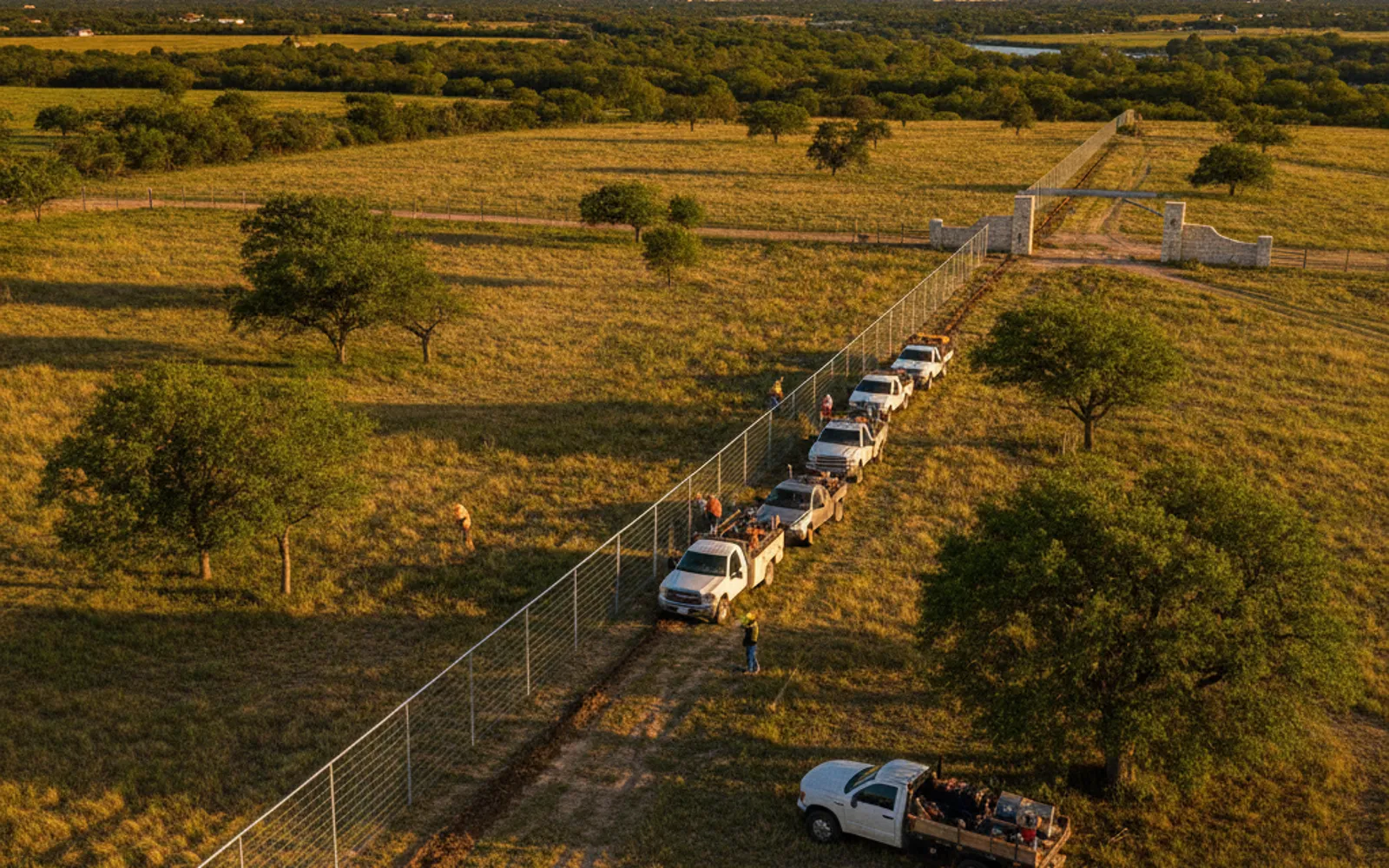
A hog proof fence is won or lost in the bottom 18 inches. Feral hogs almost never go over a fence. They put their snout under the lowest wire, lift, and push. So the fence that keeps them out has small openings near the ground, a bottom wire that touches dirt everywhere, something to stop them digging under (a buried curtain or an apron), and ideally a hot wire at snout height on the side the hogs come from.
The rest is detail. If hogs have already torn your fence up, our post on feral hog fence damage covers the repair side.
If you would rather have someone walk your line and tell you which stretches need it, call (254) 870-8898 for a free on-site estimate anywhere in McLennan, Bosque or Falls County.
What “hog wire” means on a ranch
Search “hog wire fence” and you get backyard panels: welded wire in a cedar frame, sold as a garden or patio look. That is decoration. It will not hold a feral hog.
On a ranch, hog wire means woven wire (also called net wire or field fence) with the horizontal wires close together at the bottom and wider at the top. The small openings low down are the point: a hog gets far less leverage in a 3 or 4 inch gap than in a 6 inch one.
Woven wire rolls carry a code that tells you what you are buying. A 1348-6, for example, is 13 horizontal line wires, 48 inches tall, with vertical stays 6 inches apart. More line wires in the same height means tighter bottom spacing. Rolls sold as hog fence tend to be shorter, often somewhere in the 32 to 39 inch range, with 6 inch stays.
Three specs matter more for hogs than for cattle:
- Stay spacing. Six inches or tighter. A 12 inch stay spacing gives a hog room to get its head in and twist.
- Knot type. Fixed knot wire holds its shape when a hog leans into it. Hinge joint can fold. We cover the difference in fixed knot vs hinge joint.
- Galvanizing. The bottom wires sit in wet grass and mud. Class 3 zinc lasts noticeably longer there than Class 1, and rust at the ground line is where hog fences quietly fail.
Bekaert, one of the big woven wire makers, sums up its hog fence requirements as 35 to 48 inches tall with graduated line wire spacing, plus an apron when the job is keeping feral hogs out, because they will root under.
How tall does a hog fence need to be?
Shorter than most people expect, with one caveat.
Texas A&M research on keeping hogs off deer feeders tested fences at 20, 28 and 34 inches. The 20 inch fence cut hog visits but did not stop them. The 28 and 34 inch fences kept them out completely, and the researchers now recommend 34 inch hog panels for feeder pens. The Natural Resources Institute summary adds the caveat: hogs have been recorded jumping much higher when escaping a trap. A feeding hog and a panicked hog are different animals.
So the numbers climb when the goal changes. AgriLife’s Coping with Feral Hogs preventative options page describes a strong 6 foot net wire perimeter as one that will deter most feral hogs, with the bottom touching the ground everywhere. USDA’s Fencing out Feral Swine information sheet for agricultural producers goes further: at least 5 feet high, strands no more than 4 inches apart, and the fence reinforced into the ground.
Think of height in tiers:
| Goal | Practical fence | Why |
|---|---|---|
| Keep hogs off a deer feeder or small plot | 34 inch hog panels on t-posts | Research-tested for feeding hogs |
| Keep hogs out of a hay field or pasture | 35 to 48 inch woven wire, bottom on the ground, apron or buried edge, hot wire outside | Stops the rooting and pushing that does most damage |
| Keep hogs away from domestic pigs, or where they get chased or hunted hard | 5 to 6 ft net wire, reinforced into the ground, plus electric | Spooked hogs jump much higher; no room for error |
For most cattle and hay places around Waco, the middle row is the working answer.
Lock the bottom down
This is where a hog fence earns the name.
Get the bottom wire on the ground
Set the fence so the bottom line wire touches dirt the whole way. On flat blackland that is easy. On rolling ground west of the Brazos, where the line crosses draws and humps, every dip is a place the wire floats 6 or 8 inches up, and a hog will find it.
Stay-Tuff’s fixed knot installation guide tells builders to set a heavier post (it calls them line bosses) at the lowest point of a dip and at the crown of a hump, so the fence is held down and up at those points. For hogs, do that, then stake and tie down any low spot that still gaps.
Add an apron or a buried curtain
A bottom wire on the ground slows digging. Wire that continues along or under the ground stops most of it.
- Apron. A strip of woven wire, a foot or two wide, attached to the bottom of the fence and laid flat on the ground on the side the hogs come from, pinned down every couple of feet. The hog starts to root at the fence and finds wire under its nose. Grass grows through it within a season.
- Buried curtain. The bottom edge of the fence, or a separate strip, is trenched a few inches into the ground. AgriLife lists this as a way to prevent digging under. It works in sandy loam. In blackland clay, or on the limestone and caliche west of Waco, trenching a long line is slow going and an apron is usually the better call.
The apron goes on the side facing the pressure. If hogs come off a creek bottom onto your field, it goes on the creek side.
A barbed strand at ground level
A tight strand of barbed wire run right under the bottom of the woven wire discourages rooting at the fence line, and Bekaert includes a barbed bottom wire in its hog fence spec. It is cheap to add during the build. On moderate pressure it is often enough; on heavy pressure it is not a replacement for an apron.
Add a hot wire at snout height
Physical fence stops the hogs that push. Electric teaches the ones that test.
AgriLife recommends at least two electric strands for hogs, placed to hit juveniles and adults on the nose: about 8 inches and 18 inches off the ground. On an existing fence, the usual method is offset brackets that hold a smooth wire several inches out on the side the hogs approach, so the hog touches the hot wire before it reaches the fence.
What makes it work:
- Keep the line clean. A wire 8 inches up is in the grass all summer, and weeds touching it drain the charge. Mow or spray under it.
- Smooth wire only. Never electrify barbed wire.
- Do not rely on electric alone. AgriLife notes hogs can get used to the shock when food is short or pressure is heavy. Electric works best as the second layer on a physical fence.
If a hot wire is not holding, our electric fence troubleshooting guide walks through grounding, shorts and charger checks.
Woven wire vs hog panels
Hog panels are rigid welded panels, usually 16 feet long and around 34 inches tall, with graduated openings. They go up fast on t-posts, cannot be stretched open, and are what the Texas A&M feeder research used. But they do not follow rolling ground, and the cost per foot adds up on a long run. They suit feeder pens, gardens, small pens, trap wings and short high-pressure stretches.
Woven wire comes in rolls of a few hundred feet, follows terrain when stretched properly, and costs less per foot over distance. It is under tension, so it needs good braces at every end and corner. It is the right material for pasture perimeters and long runs along a creek.
Often the answer is both: woven wire for the perimeter, panels where hogs hammer hardest.
Retrofitting an existing barbed wire fence
Most people reading this already have 4 or 5 strands of barbed wire that the cattle respect and the hogs walk right under. You do not always have to tear it out.
- Offset hot wires only. Two smooth wires on offset brackets at roughly 8 and 18 inches, on the hog side. Cheapest and fastest, and effective on light to moderate pressure if you keep the weeds down.
- A low strip of woven wire on the existing posts. Hang hog-rated woven wire (around 32 to 35 inches) along the bottom of the existing fence, tied to the posts and lower strands, bottom wire on the ground, with an apron or ground strand. The barbed strands above still hold cattle.
- Full rebuild in woven wire. When posts are rotten, braces are leaning, or the wire is rusted through, adding hog wire is money spent on a fence that is already failing. Start over with new braces and woven wire, and add the hot wire.
Option 2 lives or dies on the braces. Woven wire pulled tight on a tired corner will lean it further. If your corners are already moving, read up on H-brace fence corners first.
The weak points hogs find first
A fence is only as hog proof as its worst 10 feet. Build these spots right and check them often.
- Water gaps and creek crossings. Hogs travel creek bottoms, and flood water leaves a gap floating off the ground after every rise. A swinging gap that drops back into place is the usual fix; see our water gap fence post.
- Corners and braces. Woven wire tied off at a brace often lifts slightly at the bottom as it is tensioned. Tie the bottom wire down at every brace and recheck after a few weeks.
- Gates. A gate hung 8 or 10 inches off the ground is an open door. Hang gates as low as the ground allows, and add a panel skirt along the bottom where a gap cannot be avoided.
- Low spots, washes and culverts. Anywhere water runs under the fence, a hog can crawl. Blackland slopes wash out under the bottom wire after a hard rain, so walk these after every big storm.
- Brush on the line. Cedar and mesquite in the fence give hogs cover, hold moisture against the bottom wires, and short the hot wire. A cleared lane makes the fence easier to check and the electric easier to keep live. That is part of what fence line clearing is for.
What a hog fence costs, and when to call
Woven wire installed runs $3.50 to $8 per foot on our published ranch fence cost table. A quarter mile (1,320 feet) works out to roughly $4,620 to $10,560 ($3.50 x 1,320 and $8 x 1,320). Where a job lands in that range depends on terrain, how many dips and water crossings the line has, and whether an old fence comes out first. Clearing a lane where cedar has taken the line runs $1 to $3 per foot on top.
You rarely need to hog proof the whole ranch. Most places get hit along one side, the creek or the brush line, and building those stretches right is usually the sensible spend.
If you want someone to walk the line, point out where hogs are crossing and say what it would take to close it, call (254) 870-8898. The estimate is free and done on site, and we build net wire fence across McLennan, Bosque and Falls counties.
Frequently Asked Questions
Is hog wire the same as a hog panel?
Not quite. On a ranch, hog wire usually means woven wire in a roll with tight spacing at the bottom, stretched between braced corners. A hog panel is a rigid 16 foot welded panel, also with small openings at the bottom. Rolls are cheaper and follow the ground over long runs. Panels go up faster and suit short, high-pressure stretches like feeder pens and gardens.
Can feral hogs jump a fence?
They can, but a feeding hog rarely does. Texas A&M research found 28 and 34 inch fences kept hogs off deer feeders entirely. Hogs that are scared or trapped jump much higher, which is why fences around domestic pigs or heavily hunted areas are built 5 to 6 feet tall. On a pasture fence, the bottom matters far more than the top.
Do I need to bury the bottom of a hog fence?
Not always. A buried curtain works, but in blackland clay or on rock it is hard going. An apron of woven wire laid flat on the ground on the outside of the fence, pinned down every couple of feet, does the same job without trenching. On light pressure, a tight bottom wire on the ground plus a barbed strand at ground level may be enough.
How high should the hot wire be for hogs?
Texas A&M AgriLife recommends at least two electric strands, one around 8 inches and one around 18 inches off the ground, so both young and adult hogs get hit on the nose. Mount them on offset brackets on the side the hogs come from, use smooth wire rather than barbed, and keep the grass under them short so they hold their charge.
Will a regular barbed wire fence stop hogs?
Rarely. A standard 4 or 5 strand barbed fence leaves the bottom strand well off the ground, and hogs go under it. You can improve it with offset hot wires, a barbed strand at ground level, or a low strip of hog-rated woven wire hung along the bottom on the existing posts, as long as the posts and braces are sound.