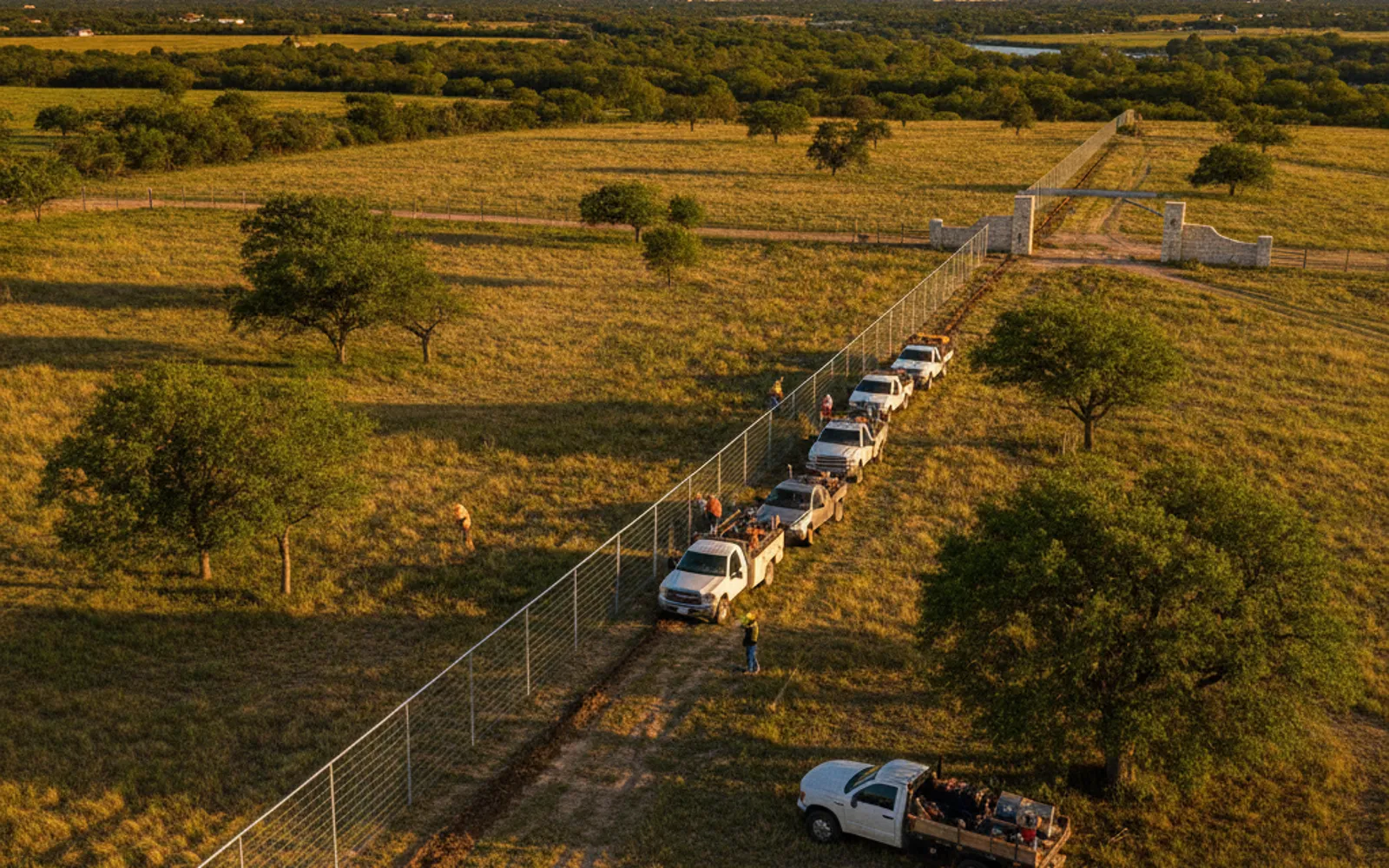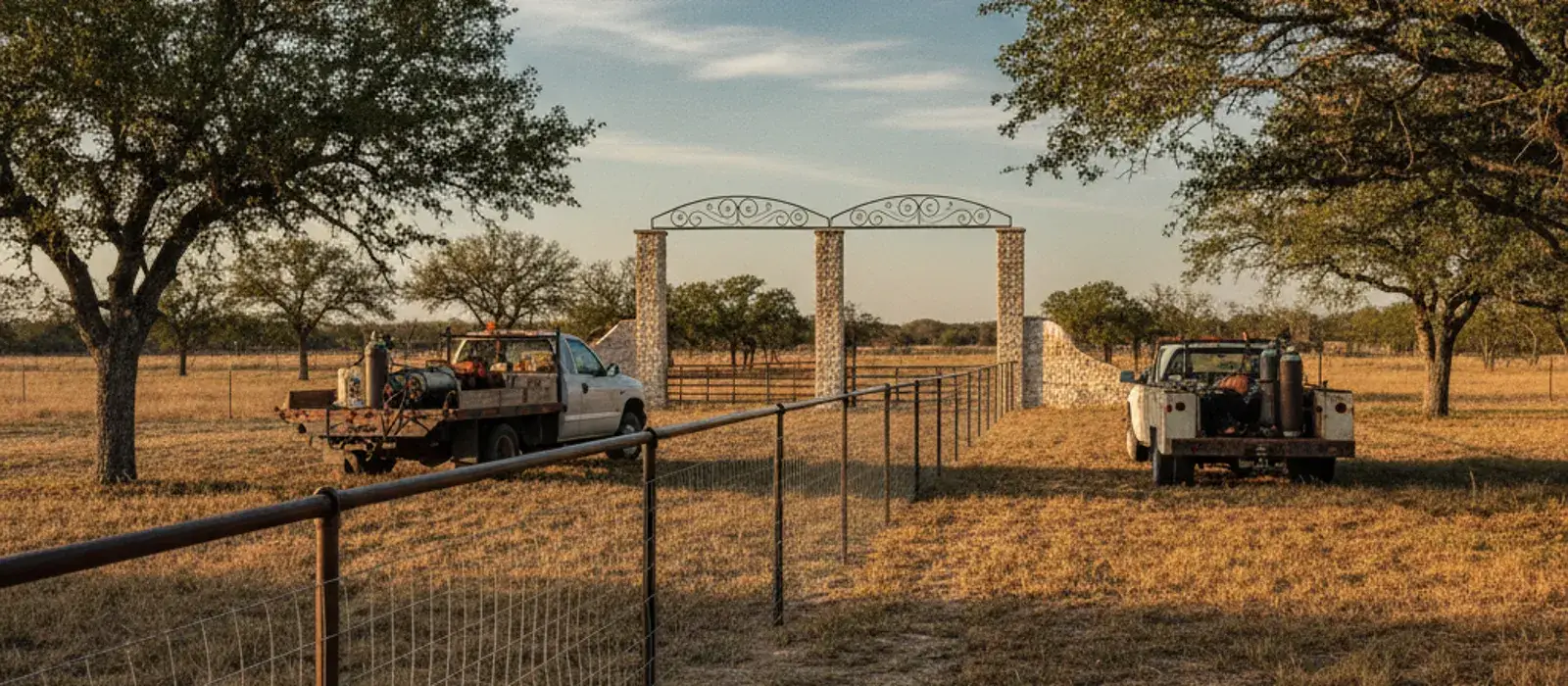
Two net wire fences can look identical from the county road, yet one will still be standing tight in 30 years while the other sags out in 12. The difference usually comes down to one small detail you can pinch between two fingers: the knot.
If you’re weighing a fixed knot vs hinge joint fence for your place, the choice matters more here in Central Texas than almost anywhere else. We’ve got cattle that lean, feral hogs that plow, deer that jump, and summer heat that makes wire expand and go slack. Around Waco, McLennan, Bosque, and Falls counties, we build both types every month, and we’ve torn out plenty of both too. Here’s the honest breakdown, with real numbers.
What Actually Separates Fixed Knot From Hinge Joint Wire
Both are net wire, sometimes called woven wire or field fence. Both come in rolls, both use vertical stay wires crossing horizontal line wires, and both will turn a cow that’s not motivated. The difference is how those wires connect.
Hinge joint wire wraps each vertical stay around the horizontal wire in a loose loop, like a door hinge. That loop lets the fence flex, which sounds good until you understand what flexing means over 20 years. Every time a calf pushes through it, a hog roots under it, or a buck hits it at speed, that hinge folds. It doesn’t spring back. It stays folded, and the fence slowly develops that swaybacked look you see on old field fence all over Bosque County.
Fixed knot wire uses a separate piece of wire wrapped tight around the joint, locking the vertical and horizontal wires in place. Nothing pivots. When something hits it, the whole panel absorbs the load and the high tensile wire springs back to shape. Fixed knot is almost always built from high tensile wire in the 12.5 gauge range with heavy galvanizing, while most hinge joint rolls are softer low carbon wire.
That knot is why a fixed knot fence can run 15 to 20 feet between posts while hinge joint really wants a post every 8 to 12 feet. Fewer posts per mile is real money, and we’ll get to those numbers below.
One more piece matters as much as the knot: the coating. Look for Class 3 galvanized wire on either style. The short version on coatings: Class 3 carries roughly triple the zinc of Class 1 and can double the rust-free life of the wire. The Texas A&M AgriLife Extension Service covers wire selection and fence planning for Texas operations if you want the research side of it.
Not sure what’s on your fence line now? Call us at (254) 870-8898 and we’ll walk your place, identify what you’ve got, and give you a free written estimate on what it’d take to fix or replace it.
Where Hinge Joint Fence Still Makes Sense
We’re not here to trash hinge joint wire. It’s been holding livestock in Texas for a hundred years, and for some jobs it’s the right call.
Hinge joint shines when the budget is tight and the pressure is low. A small trap for gentle cows, a boundary line behind a hay field nobody pushes on, a temporary division fence you plan to move in ten years. In those spots, spending extra on fixed knot is money you won’t get back.
It’s also more forgiving to install for a DIY crew. Low carbon wire stretches and ties easier than high tensile, and it doesn’t punish sloppy bracing quite as fast. If you’re fencing a few acres yourself, hinge joint with wood posts on 10-foot centers will do the job. Just build your corners right, because net wire of any kind pulls hard on the ends, and a weak H-brace will let either wire type go slack.
Where hinge joint falls apart, literally, is under animal pressure. Goats climb it and fold the hinges down. Horses paw it. Bulls fight across it. And feral hogs treat it like a screen door. Once hogs find a soft spot in hinge joint wire, they’ll open a hole in one night that your calves find by morning. We covered what that costs ranchers in our feral hog fence damage post, and it’s not pretty.
A Tale of Two Fences in Crawford and Valley Mills
Last spring we got a call from Dale, who runs about 120 cows on leased ground outside Crawford. His hinge joint perimeter fence was 14 years old and he’d spent, by his own math, around $3,800 over three years patching hog holes and splicing folded sections. Then a section gave out along FM 185 and two heifers ended up on the road. No wreck, thank God, but that was the last straw. We replaced 2,600 feet of his worst line with fixed knot on t-posts and wood line posts for about $11,700. His words at the walkthrough: “Should’ve done this the first time.”
Contrast that with Marcy in Valley Mills, who bought 25 acres in 2024 to run Boer goats. Her land came with decent hinge joint cross fences, and she asked if she had to rip it all out. We told her no. We built her 1,900 feet of new fixed knot goat fence, using a tighter 4-inch mesh at the bottom, on the two sides where her goats and the neighbor’s dogs met, for right at $9,300. The old hinge joint stayed on the quiet sides. She spent money where the pressure was and saved roughly $8,000 by not fencing all four sides in fixed knot. If you’re running goats, our fence for goats and sheep guide digs into mesh sizes and predator issues.
That’s the honest answer on fixed knot vs hinge joint fence: it’s not one or the other for your whole place. It’s matching the wire to the pressure on each line.
Fixed Knot vs Hinge Joint Fence: Cost and Lifespan Numbers
Here’s what these fences actually run in the Waco area in 2026, installed with good bracing on typical ground. Rocky ground, heavy brush clearing, and long material hauls move these numbers up.
| Factor | Hinge Joint | Fixed Knot |
|---|---|---|
| Wire type | Low carbon, 12.5 to 14 gauge | High tensile, 12.5 gauge typical |
| Materials only, per foot | $0.90 to $1.60 | $1.40 to $2.40 |
| Installed, per foot | $2.50 to $4.50 | $3.50 to $6.00 |
| Post spacing | 8 to 12 ft | 15 to 20 ft |
| Typical lifespan here | 10 to 20 years | 25 to 40 years |
| Hog and predator resistance | Poor to fair | Good to excellent |
| Best use | Low-pressure lines, tight budgets | Perimeters, goats, hogs, game fence |
Read that lifespan row twice. A hinge joint fence at $3.50 a foot that lasts 15 years costs you about 23 cents per foot per year. A fixed knot fence at $4.75 a foot that lasts 32 years costs about 15 cents per foot per year. The cheaper fence is the expensive one, as long as you’re planning to own the land past the first fence’s funeral.
The post spacing line is where fixed knot claws back its higher wire price. On a mile of fence, going from 10-foot to 16-foot spacing cuts out roughly 200 posts. At $8 to $15 per t-post or line post installed, that’s $1,600 to $3,000 saved per mile before you’ve hung any wire.
Every place prices out a little different, which is why we do free written estimates instead of guessing over the phone. Request yours here and we’ll put real numbers on your actual fence lines, usually within a week.
Which Net Fence Lasts Longer on Central Texas Ground?
On lifespan alone, fixed knot wins and it isn’t close. But it’s worth understanding why, because our conditions do the damage.
First, heat cycling. Wire out here might see 25 degrees in January and 140 degrees of surface temperature in August. Low carbon hinge joint wire stretches with each cycle and doesn’t recover, so it goes slack, and slack wire is what livestock learn to push through. High tensile fixed knot wire holds tension through those swings. You’ll retension a hinge joint fence every couple of years if you want it tight. A well-built fixed knot fence mostly gets left alone.
Second, our clay soils move. Blackland clay swells when it rains and shrinks hard in drought, which heaves posts and changes wire tension along the whole run. A fence that tolerates fewer, better-set posts and holds its own tension handles that movement better. Ask anybody who fenced through the dry years what August did to their old field fence.
Third, animal pressure never stops. Hogs are in every county we serve. Whitetail numbers keep climbing. If your fence sees deer traffic, fixed knot is also what taller game fence is built from. We install a lot of it, and you can see what that involves on our game fence installation page.
One caveat: fixed knot only outlasts hinge joint when the bracing is right. High tensile wire pulls 150 to 250 pounds of tension per strand, and a weak corner will lean over in a season. Corner and end construction is the whole ballgame. The USDA Natural Resources Conservation Service publishes fence standards that spec brace assemblies for exactly this reason, and their drawings look a lot like what we weld and set every week.
How to Pick for Your Place
Here’s the decision process we walk through with customers from West down to Lorena.
Start with what’s pushing on the fence. Gentle cows on improved pasture, hinge joint can work. Goats, sheep, horses, hogs, deer pressure, or a road frontage where an escape becomes a liability problem, go fixed knot. If it’s a boundary along a highway, that’s not the place to save a dollar a foot.
Then look at your timeline. Selling in five years? The cheaper fence might pencil out, though good perimeter fence does show up in land value. Holding the place for your kids? Fixed knot with Class 3 galvanizing is the last net fence that line will need in your lifetime.
Then be honest about maintenance. Hinge joint isn’t a build-it-and-forget-it fence. It needs walking, splicing, and retensioning, and every hog hole needs patching the week it appears or your stock finds it. If you’d rather check your fence twice a year than twice a month, that’s an argument for fixed knot.
And if net wire isn’t the clear answer at all, it might be that plain barbed wire fits your cattle operation better and cheaper. We compared the two head to head in barbed wire vs net wire, and our barbed wire fence page covers what those builds cost.
A word on DIY: stretching high tensile fixed knot wire is a different animal than rolling out field fence. The wire stores serious energy under tension, and a slipped stretcher bar or a snapped strand can hurt you badly. Pulling a few hundred feet of hinge joint with a truck and a stretcher is a reasonable weekend job. Building fixed knot corners and tensioning a quarter mile of 949 wire is where we’d tell most landowners to stop and call a professional crew with the right stretching equipment.
One last gut check, from a job in China Spring: a landowner named Pete priced his own materials for 1,200 feet of fixed knot, figured $2,100 in wire and posts, and started building. Two pulled-over corners and one trip to urgent care for a wire whip across the forearm later, he called us. We rebuilt the corners, restretched the wire, and finished the run for $4,400 on top of what he’d already spent. He’d have been at roughly $5,900 total if we’d built it from scratch. DIY can save money, but only if the corners and the stretch are done right the first time.
Whatever direction you’re leaning, we’ll give you a straight answer and a written number. Call (254) 870-8898 or request a free estimate. We’re licensed and insured, and if a storm or a cow wreck takes a fence down tonight, our emergency line answers 24/7.
Frequently Asked Questions
Is fixed knot fence worth the extra cost over hinge joint?
For perimeter fence, high-pressure lines, and anything holding goats or facing hog traffic, yes. Fixed knot costs roughly $1 to $1.50 more per installed foot but lasts 10 to 20 years longer and needs wider post spacing, which claws back much of the price difference. On low-pressure interior cross fences, hinge joint can still be the smarter spend.
How long does a hinge joint fence last in Central Texas?
Plan on 10 to 20 years depending on wire coating, animal pressure, and maintenance. Class 1 galvanized hinge joint under heavy cattle and hog pressure can be sagging badly inside 10 years, while Class 3 wire on a quiet line can push past 20. Heat cycling and our shrink-swell clay soils shorten the low end compared to milder climates.
Can I use t-posts with fixed knot wire?
Yes, and most of our fixed knot builds mix t-posts with wood or pipe line posts. The critical parts are the corners and ends, which must be braced heavily enough to hold high tensile wire at full tension for decades. T-posts between strong braces work fine at 15 to 20 foot spacing on typical ground.
What mesh size do I need for goats or exotics?
For goats and sheep, we usually run fixed knot with smaller openings low on the fence, often a 4-inch stay spacing, so kids can’t slip through and predators can’t push in. For whitetail and exotics, fixed knot game fence runs 7.5 to 8 feet tall with graduated mesh. The right spec depends on your animals, so have a contractor look at your operation before ordering wire.