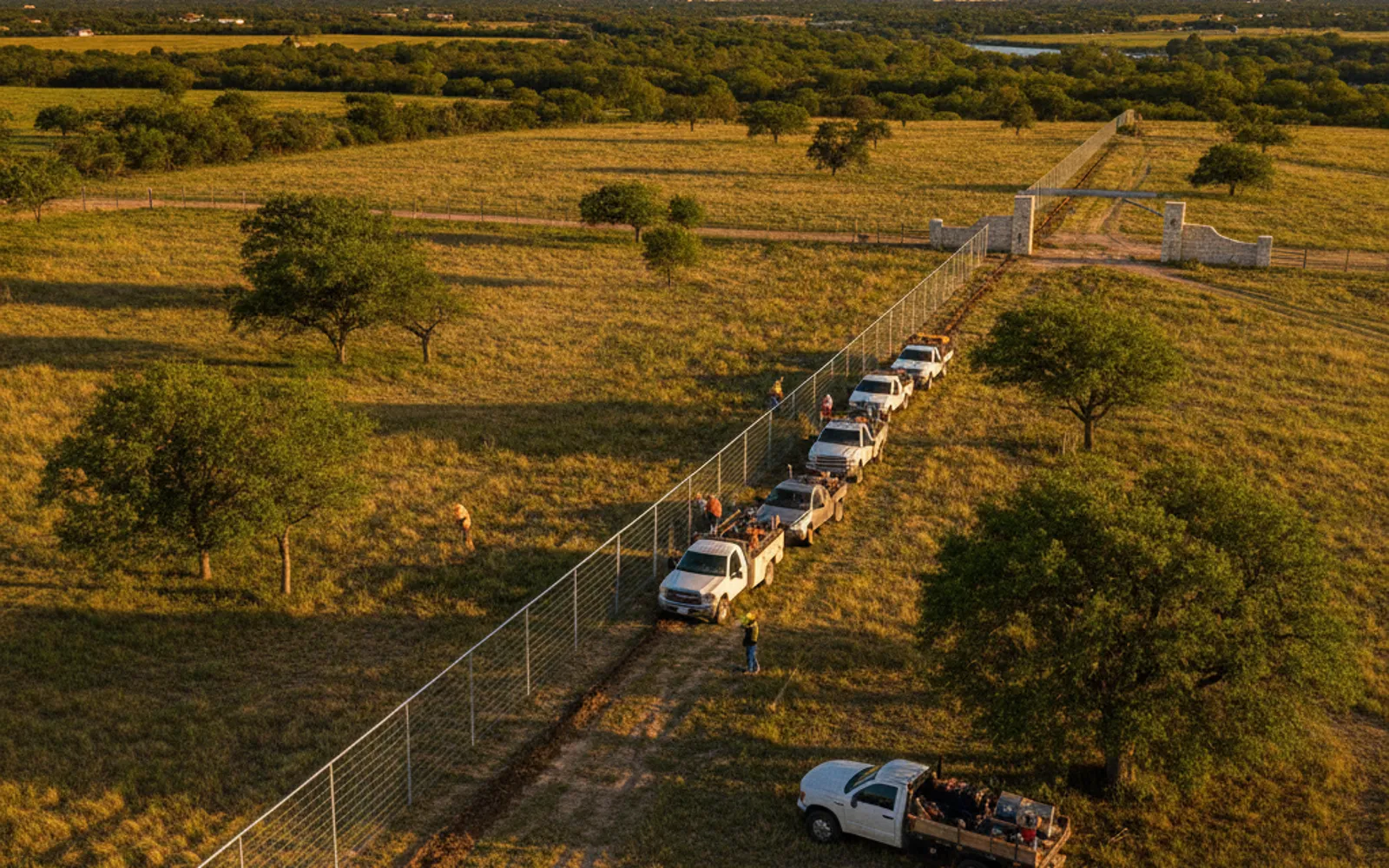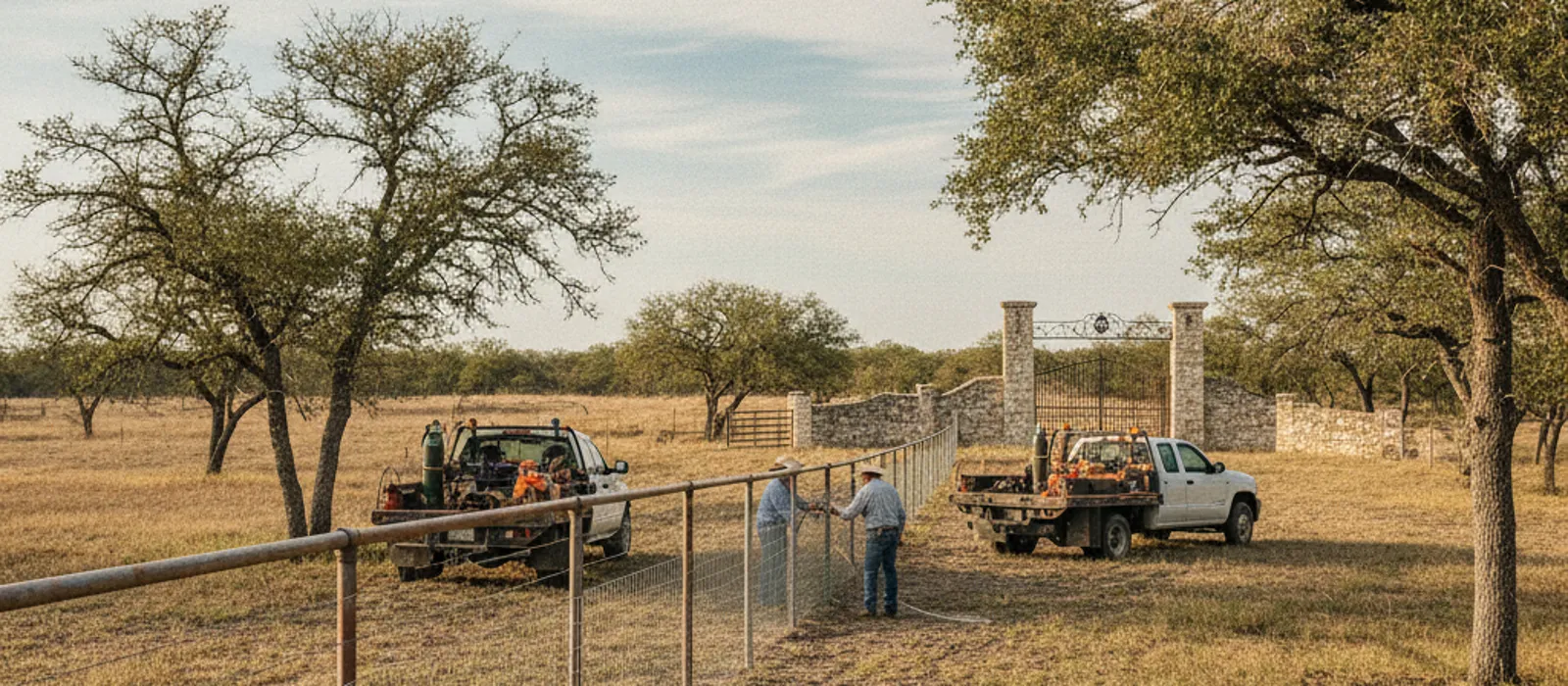
It’s 6 a.m., your phone’s buzzing, and it’s your neighbor telling you your cows are standing in the middle of the FM road again. If your cattle keep getting out of fence lines you swore were fine last month, you’re not dealing with bad luck. You’re dealing with a fence that’s telling you exactly where it’s failing, and it usually gives you the answer in one of seven places.
We build and repair ranch fence all over McLennan, Bosque, and Falls counties, and when a rancher calls about escaping cattle, the problem is almost always on this list. Walk your fence line with these seven checks and you’ll find the weak spot before your herd finds it again.
And if you’d rather have a second set of eyes on it, call us at (254) 870-8898. We do free written estimates, and we run a 24/7 emergency line for cattle-out situations, because a cow on the highway at midnight can’t wait until Monday.
1. Loose, Sagging Wire: The Top Reason Cattle Keep Getting Out of Fence
Barbed wire only works when it’s tight. A properly stretched strand has enough tension that a 1,200 pound cow leaning on it feels resistance and backs off. Once that wire loses tension, it stops being a barrier and starts being a suggestion.
Here’s the test. Grab a strand mid-span and push it down with moderate pressure. If it deflects more than 3 or 4 inches, it’s loose enough for a motivated cow to push through or step over. Cattle learn fast. One cow reaches through a slack spot for green grass, stretches it further, and within a couple weeks the whole herd knows where the door is.
Wire goes slack for a few reasons: heat expansion in our Texas summers, tree limbs falling across the line, cattle rubbing on it, and staples pulling out of dry posts. Small sections can be re-tensioned with a fence stretcher and inline crimps, and we cover the full process in our guide to fixing sagging barbed wire fence.
If more than a quarter of the fence line is slack, though, re-tensioning strand by strand becomes a losing game. That usually means the bracing has failed, which brings us to the next two problems.
2. Rotten, Broken, or Leaning Posts
Posts are the skeleton of your fence. When they fail, everything attached to them fails with them.
Walk the line and push on each wood post at chest height. A solid post won’t move. A post that wobbles, leans, or flexes at the ground line is done, even if it looks fine above grade. Wood posts almost always rot right at the soil line where moisture and oxygen meet, so a post can look healthy at eye level and be mush six inches down. Kick the base or probe it with a screwdriver. If the blade sinks in easy, that post isn’t holding anything.
T-posts fail differently. They bend when cattle or equipment hit them, and they heave out of the ground in our Central Texas clay, which swells when wet and shrinks hard in a drought. A t-post that’s lifted 4 inches has lost most of its grip.
Danny Kolar runs about 40 head just outside West, and he’d been patching the same stretch of fence for two years, one post at a time, maybe $30 or $40 in materials each trip. His heifers kept finding the next weak post anyway. When we finally walked the whole line with him, 22 of 60 posts failed the push test. We replaced the bad posts and re-stretched a quarter mile of wire for about $1,850, and he told us later it was cheaper than the diesel and Saturdays he’d burned chasing cattle.
Replacing scattered posts is a fair DIY job. If a third or more of your posts are failing, get a professional opinion before you spend another weekend on it, because the fence may be at the end of its life.
3. Failed Corner Braces and H-Braces
Here’s the one most folks miss. If your wire keeps going slack no matter how many times you tighten it, the problem usually isn’t the wire. It’s the corners.
Every strand of tensioned wire pulls on the corner and end assemblies. A proper H-brace, two posts with a horizontal rail and a diagonal tension wire, spreads that load so the corner post can’t lean. When the brace rots, the diagonal wire snaps, or the assembly was never built right to begin with, the corner post slowly tips inward. Every inch it leans, every strand on that pull loses tension at once. You can re-stretch wire all day and it’ll be slack again in a month.
Check each corner: is the post vertical, is the rail solid, is the diagonal wire tight? A leaning corner post with tight wire attached is a corner that’s actively failing.
Rebuilding an H-brace properly means new posts set deep in concrete or well-tamped, a solid rail, and correctly wrapped tension wire. It’s precise work, and it’s the foundation of the whole fence. This is a spot where hiring it out pays for itself, because a brace built wrong fails again in a year. On a barbed wire fence, we figure a new H-brace assembly runs $250 to $450 depending on access and soil.
4. Gates That Sag, Drag, and Get Left Unlatched
Ask any rancher where cattle get out and half will admit it: the gate. Gates fail three ways.
First, they sag. A 16 foot tube gate on a rotting wood post drops at the far end, drags the ground, and stops latching clean. Folks start chaining it loosely instead, and a smart cow noses a loose chain until the gate swings.
Second, the latch itself. Cattle work latches with their noses more than people believe. If your latch can be opened with a push and a wiggle, a bored cow will eventually open it. Use a latch that requires a lift and a pull, or add a chain with a clip.
Third, plain human error. Feed deliveries, hunters, utility crews. If a gate keeps ending up open, a spring-loaded latch or a posted “close the gate” sign costs almost nothing compared to a loose herd.
If your entrance gate is the weak point, a properly hung gate on a concrete-set steel post is a permanent fix. We build and repair ranch entrance gates around Waco and can usually re-hang a sagging gate in a morning. Want us to look at yours? Request a free estimate and we’ll put a number on it in writing.
5. Electric Fence That Isn’t Actually Hot
Electric fence is a psychological barrier. The wire itself won’t stop a cow. The memory of the shock does. Which means the moment your fence drops below about 3,000 volts, you effectively have no fence, and it can look perfect the whole time.
Carla Simmons runs cows on 60 acres near Crawford, and hers started walking through a two-strand electric cross fence like it wasn’t there. She was quoted $12,000 by an out-of-town outfit to rebuild the whole interior fence system. When we tested it, the charger was putting out fine at the box but the fence read under 800 volts. The culprit was two bad ground rods in dry soil and a stretch of grass loading down the bottom wire. Roughly $400 in ground rods, insulators, and labor brought it back over 6,000 volts, and her cows quit testing it within a week.
Check these in order: charger output at the terminals, ground rod system (three rods, 6 to 8 feet, is the standard for most chargers), vegetation touching the wire, cracked insulators, and broken splices. A $40 fence tester will save you hours of guessing. Our full troubleshooting walkthrough is here: why your electric fence isn’t working.
One safety note. Never troubleshoot charger wiring on the supply side while it’s plugged in, and if your setup involves anything on the 120 volt side beyond plugging in the charger, that’s electrician territory, not fence territory.
6. Water Gaps, Washouts, and Hog Damage
Creeks and draws are the back doors of every Central Texas ranch. A water gap, the flexible fence section that crosses a drainage, is designed to swing or break away in a flood so the whole fence doesn’t go with it. That also means it’s the first thing to fail after every big rain, and cattle find the opening within days.
After heavy rain, check every creek crossing before you check anything else. Look for washed-out gaps, debris piled on wire, and banks that have eroded away from your end posts. Marcus Villarreal, who runs stockers near Lorena, learned this one the expensive way. A May storm took out a water gap on Bull Hide Creek, and before he found it, his steers had spent two days in the neighbor’s coastal patch. He paid the neighbor $600 for hay damage, and we rebuilt the gap with a swinging panel design for about $650. Now it’s the first spot he checks after every rain.
Feral hogs cause a similar problem from below. Hogs root under the bottom wire and leave a torn-up gap that calves slip through first, then cows follow. If you’re finding rooted-up dirt and lifted bottom wire, you’ve got a hog problem and a fence problem, and we wrote up the fixes in our guide to feral hog fence damage.
7. When Cows Keep Getting Out Through a Decent Fence
Sometimes you walk the whole line and the fence honestly checks out. If cows keep getting out anyway, look at the herd and the setup.
Every rancher eventually owns a fence crawler, one cow that’s learned to work through anything. One crawler will train your whole herd, and the honest answer is usually a trailer ride to the sale barn. It’s a hard call, but she’s cheaper to replace than a mile of fence upgrades.
Hungry cattle test fences and content cattle don’t. If your pasture is grazed down and the other side of the wire is green, no reasonable fence stops that pressure forever. Same story with a bull who can smell cycling cows on the neighbor’s place. Four strands of aging barbed wire won’t hold a determined bull, and that’s a situation where five or six tight strands, an offset hot wire, or a stout pipe fence around the pens is the real fix.
Texas A&M AgriLife Extension has solid guidance on stocking rates and forage management for our part of the state if grazing pressure is the root cause: agrilifeextension.tamu.edu.
What These Fixes Cost in Central Texas
Here’s what we typically see for repair costs in McLennan, Bosque, and Falls counties. Your numbers will move with access, soil, and materials, which is why we always put estimates in writing.
| Problem | Typical Fix | Typical Cost Range |
|---|---|---|
| Loose or sagging wire | Re-stretch and splice, per span section | $0.40 to $0.70 per foot |
| Rotten wood posts | Replace, set, and re-attach wire | $35 to $75 per post |
| Failed H-brace corner | Rebuild brace assembly | $250 to $450 each |
| Sagging gate | Re-hang on new steel post | $300 to $600 |
| Dead electric fence | Grounding, insulators, splices | $200 to $600 |
| Washed-out water gap | Rebuild with breakaway or swing panel | $400 to $900 |
| Fence past its life | Full rebuild, 5-strand barbed wire | $2.50 to $5.50 per foot |
One rule of thumb we give every caller: if you’ve repaired the same stretch three times in a year, stop patching and price a rebuild. Repair money spent on a fence that’s structurally done is money you’ll spend again.
There’s a legal reason to stay ahead of this too. In much of Texas, and especially along highways and in counties with stock laws, a livestock owner can face real liability when cattle end up on a roadway. The state’s fence and stock law framework is laid out in Texas Agriculture Code Chapter 143, and it’s worth knowing where your county stands.
If you’re tired of the 6 a.m. phone calls, we’ll walk your fence line with you, show you exactly what’s failing, and give you a free written estimate with real per-foot numbers. Reach out here or call (254) 870-8898 any time, day or night, if you’ve got cattle out right now.
Frequently Asked Questions
Why do my cattle keep getting out even after I fix the fence?
Usually because the visible break wasn’t the real problem. Slack wire almost always traces back to a failed corner brace or leaning posts, so patching the wire alone means it goes loose again within weeks. Walk the corners and push-test the posts before you blame the wire, and check whether one specific cow is leading the escapes.
How many strands of barbed wire does it take to hold cattle?
Five strands of tight, properly spaced barbed wire is the standard for cattle in Central Texas, and four can work for calm cows on good grazing. Bulls, weaned calves, and cattle under grazing pressure justify five or six strands or an added offset hot wire. Strand count matters less than tension, though. Five loose strands hold less than four tight ones.
Am I liable if my cattle get out on the road in Texas?
It depends on your county and the road. Texas is historically open range, but most populated counties, including much of our area, have adopted stock laws, and state law separately requires keeping livestock off U.S. and state highways. If your cattle cause a wreck where a stock law applies, you can be on the hook, so a sound fence is cheap insurance. Check your county’s stock law status to know where you stand.
When should I stop repairing and replace the whole fence?
If more than a third of the posts fail a push test, the wire is rusted through in multiple spots, or you’ve repaired the same section three or more times in a year, replacement is usually the better spend. A full 5-strand barbed wire rebuild typically runs $2.50 to $5.50 per foot here. We’re glad to walk the line and tell you honestly which side of that call your fence is on.