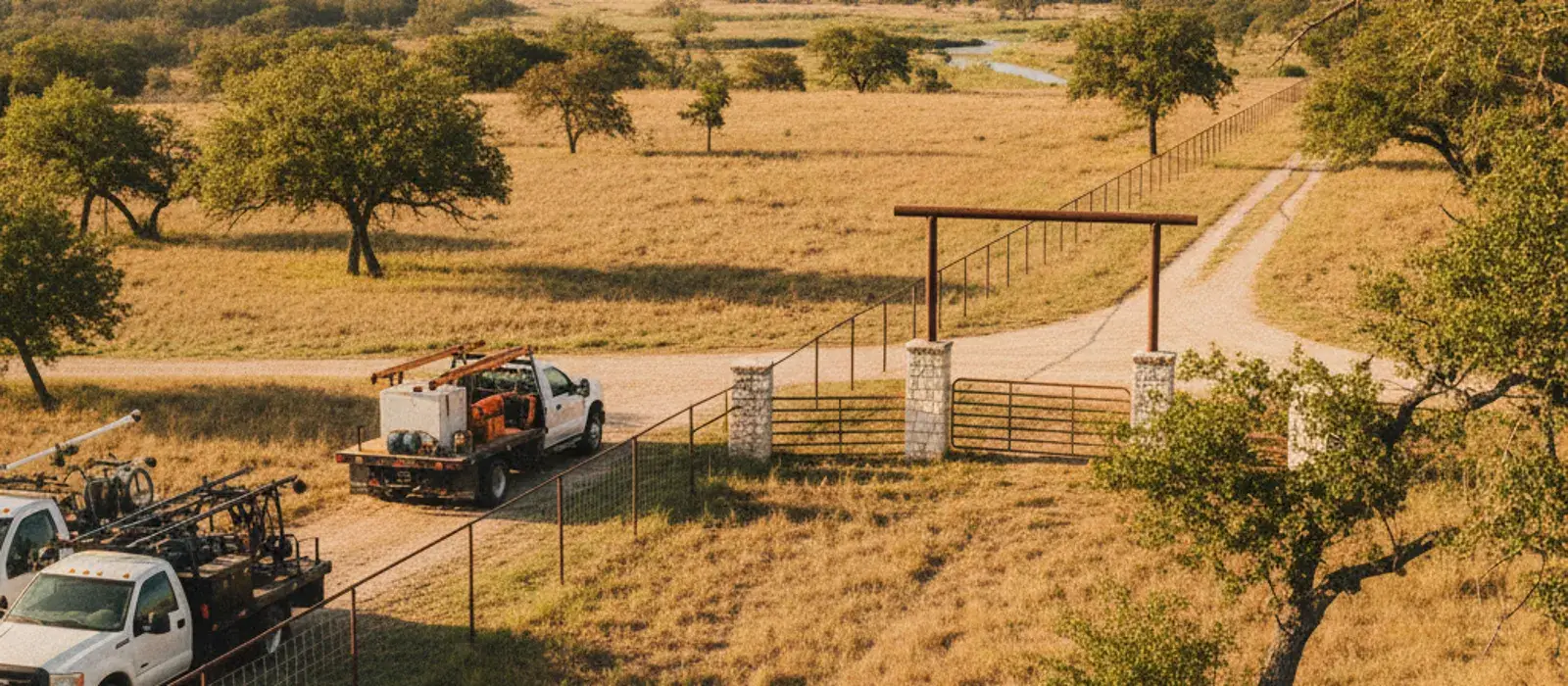
You know the move. Lift the gate with your hip, drag it through the dirt, then fight the chain for ten seconds before it finally catches. Every rancher in Central Texas has done that dance, and most of us have done it for two years longer than we should have.
Here’s the good news. Learning how to fix a sagging gate is one of the easiest wins in ranch maintenance. Most sagging gates come down to one of three problems: loose hinges, a leaning post, or a bent gate. Two of those you can usually fix yourself in an afternoon for under $50. The third one depends on how bad it is.
We build and repair ranch gates all over McLennan, Bosque, and Falls counties, so we’ve seen every version of this problem there is. This guide walks you through diagnosing your gate, fixing what you can, and knowing when it’s time to put the wrenches down and call somebody.
Why Ranch Gates Sag in Central Texas
A gate is basically a lever hanging off a post. A 16-foot tube gate weighs 90 to 130 pounds, and all of that weight pulls sideways on the hinge post every minute of every day. Add a few thousand swings, some kids riding it like a carnival ride, and a bull scratching his neck on it, and something’s going to give.
Around Waco, our soil makes it worse. Most of the ground here is expansive blackland clay. It swells when it rains and shrinks hard in a drought, and that movement works posts loose the same way it cracks slab foundations. The Natural Resources Conservation Service maps most of McLennan County as clay or clay loam, and if you’ve ever dug a post hole in August, you don’t need a map to believe it.
So before you touch a wrench, figure out which of these is your actual problem:
- Hinge trouble. The hinge pins have worked loose, worn out, or were never adjusted right. The post is still plumb.
- Post trouble. The hinge post is leaning toward the gate. Put a level on it and you’ll see it fast.
- Gate trouble. The gate frame itself is racked or bent, usually from an animal or a tractor bumping it.
Stand back 20 feet and look at the gate closed. If the post is straight but the latch end droops, it’s hinges or the gate. If the whole post tilts, that’s your answer, and it’s a bigger job.
If you’d rather have somebody else sort it out, that’s what we’re here for. Request a free written estimate or call us at (254) 870-8898 and we’ll take a look, usually within a couple of days.
How to Fix a Sagging Gate at the Hinges First
Always start with the hinges, because it’s the cheapest fix and it solves the problem more often than people expect. Standard tube gates hang on J-bolt hinges: a lag-thread or bolt-through pin on the post, with a hinge strap on the gate that drops over it. There’s adjustment built into that system that most folks never use.
Step 1: Tighten everything. Grab a wrench and snug up every hinge bolt on the post and both hinge straps on the gate. Loose hardware alone causes a surprising amount of sag. Five minutes, zero dollars.
Step 2: Adjust the bottom hinge. Here’s the trick most people miss. On a typical setup, the top hinge pin points down and the bottom pin points up, which keeps the gate from being lifted off. To raise a drooping latch end, you usually want to move the bottom hinge pin outward, away from the post, or move the top pin in tighter. That tips the whole gate back and lifts the far end. Turn the lag-style pins a few rotations at a time and check your latch height as you go.
Step 3: Replace worn pins. Hinge pins wear egg-shaped over the years, and the gate settles into the slop. New J-bolt hinge pins run $8 to $15 apiece at any farm store in Waco. Swap them and you’ve often bought yourself another decade.
Step 4: Check the hinge spacing. Hinges mounted too close together give the gate less leverage to resist sag. If yours are less than about two-thirds of the post height apart, spreading them out helps more than any other single adjustment.
Kenny Braswell out in Crawford called us last spring convinced he needed a whole new entrance because his 16-foot gate was dragging a trench in the caliche. His post was dead plumb. We replaced two worn hinge pins, re-tensioned the bottom hinge, and squared the latch. Total bill was $165, and he’d been quoted $1,100 by somebody else for a full rebuild he didn’t need.
Fixing a Sagging Gate Post That Leans
If the level shows your hinge post tipping toward the gate, no amount of hinge tweaking will hold for long. The post is the foundation, and you fix foundations first.
Check for rot or rust at the ground line. Wood posts fail where they meet the soil, not at the bottom. Shove a screwdriver into the post right at grade. If it sinks in easy, the post is done and needs replacing, not straightening. We cover the warning signs in our post on fence post rot. Steel pipe posts can rust through at the same spot, so give them a hard look too.
Straighten and re-tamp a sound post. If the post is solid but leaning, dig out one side, pull the post plumb with a come-along anchored to your truck hitch or a solid tree, then pack the hole in 3 to 4 inch layers of damp soil or crushed base, tamping each layer hard. Tamped properly, that post will hold better than a sloppy concrete pour. Our guide on leaning fence posts walks through this in more detail.
Upgrade the post if it keeps failing. A gate post is not a line post. For a 14 to 16 foot gate, you want at least a 2 7/8 inch steel pipe post or a 6 to 8 inch treated wood post, set 36 to 48 inches deep in concrete. Texas A&M AgriLife Extension’s fencing guidance (agrilifeextension.tamu.edu) makes the same point: braced, deep-set gate and corner posts are what keep a fence system standing. In our blackland clay, we also bell the bottom of the hole slightly so the seasonal shrink-swell can’t jack the post up. If your soil turns to concrete every summer, our article on fence posts in clay soil explains what’s happening underground.
Lisa Hutyra near Valley Mills had a gate post that leaned a little more every year no matter how many times her son straightened it. It was a 4-inch wood post carrying a 16-foot gate, way undersized. We pulled it, set a 2 7/8 inch pipe post 4 feet deep in concrete with an H-brace tie-back, and rehung her gate. That job ran $425 and the gate hasn’t moved an inch since, through one wet winter and one brutal August.
When the Gate Itself Is Bent or Racked
Sometimes the post is plumb, the hinges are tight, and the gate still droops. Sight down the top rail from the hinge end. If it curves or the frame looks like a parallelogram instead of a rectangle, the gate is racked.
You’ve got three options:
Cable and turnbuckle kit. An anti-sag kit runs $15 to $30. Run the cable from the top hinge corner down to the bottom latch corner, then crank the turnbuckle until the latch end lifts. This works well on wood gates and lightly sagged tube gates. It will not fix a gate with a crushed or kinked rail.
Weld it back square. A racked tube gate can sometimes be pulled square and reinforced with a welded diagonal brace. If you or a neighbor can weld, it’s an hour of work. If you’re paying a mobile welder around Waco, expect $125 to $250.
Replace the gate. A new 16-foot tube gate costs $140 to $260 depending on gauge. If your gate has been run over, wallowed out at the hinges, and welded twice already, replacement is usually the cheaper path over the next ten years. Heavier 2-inch pipe gates cost more but shrug off cattle abuse, which is why we build them onto most of our pipe fence projects.
One more thing worth saying: a gate that sags open is how cattle end up on the county road, and in Texas that can become your legal problem in a hurry. We’ve written about what happens when cattle keep getting out, and a bad gate latch is one of the top causes we find.
What Sagging Gate Repairs Cost: DIY vs Hiring It Out
Here’s what the common fixes run in the Waco area right now. DIY numbers are parts only. Pro numbers are our typical range, parts and labor, and every job gets a free written estimate first.
| Repair | DIY Parts Cost | Pro Cost (Typical) | Time |
|---|---|---|---|
| Tighten and adjust hinges | $0 | $95 - $150 | 30 min |
| Replace hinge pins and hardware | $15 - $40 | $125 - $200 | 1 hour |
| Cable anti-sag kit on gate | $15 - $30 | $110 - $175 | 1 hour |
| Straighten and re-tamp gate post | $0 - $25 | $200 - $350 | 2 - 3 hours |
| Replace gate post (pipe, concreted) | $60 - $120 | $350 - $600 | Half day |
| New 16-ft tube gate, hung and latched | $140 - $260 | $300 - $550 | 2 hours |
| Full pipe entrance rebuild | Not a DIY job | $1,800 - $4,500+ | 1 - 2 days |
Two honest notes on that table. First, the cheap fixes at the top solve most sagging gates, so start there. Second, if you’re fixing the same gate for the third time, the math flips. Sink money into the foundation once instead of the band-aid three times. Our ranch fence cost guide breaks down where repair money goes furthest across a whole place.
Danny Kolar, who runs cows on 60 acres outside West, kept a tally one year: three trips to the farm store, two Saturdays, and about $190 in parts fighting a gate on a rotted post. He finally had us replace the post and hang a new heavy gate for $780, and his words were “should’ve called you the first Saturday.”
When to Stop DIY and Call a Fence Pro
Most of what’s in this article is safe, sensible work for anyone comfortable with hand tools. But there are lines worth respecting.
Call a professional when:
- The post needs replacing and it’s tied into a brace or corner. Cut the wrong thing and you can drop tension on a quarter mile of wire.
- You’re dealing with heavy pipe gates. A 16-foot pipe gate can weigh 250 pounds or more. That’s a two-man lift with pinch points that will take a finger.
- Welding is involved and you don’t weld. Galvanized coatings give off toxic fumes when burned, and gate repairs are not the place to learn.
- The gate is part of an entrance with masonry columns or an automatic opener. Openers have force settings and safety requirements that matter, especially with kids and livestock around.
- Utilities might be in the ground. Any time you’re digging a new post hole near your entrance, call 811 first. It’s free and it’s the law in Texas.
And if the sag is really a symptom of a whole entrance that’s past its prime, it might be time to think bigger. A properly built entrance with concreted pipe posts and a heavy gate is a 30-year fix, not a 3-year one. Take a look at our ranch entrance gates page to see what that looks like on places around Central Texas.
Either way, you don’t have to guess. Call (254) 870-8898 and we’ll tell you straight whether your gate needs a $15 part or a new post. If it’s a $15 part, we’ll say so.
Keep It From Sagging Again
A few habits make gate repairs stick:
- Latch it every time. A gate left swinging in the wind works its own hinges loose.
- Don’t let anybody ride it. One kid swinging on the latch end applies more leverage than a year of normal use.
- Add a gate wheel on long spans. For 16-foot gates that only open one direction on firm ground, a $30 gate wheel carries the latch-end weight and takes nearly all the load off the hinge post.
- Check hinge bolts twice a year. Add it to your spring and fall walk-around along with your wire and braces. Our ranch fence maintenance checklist has the full routine.
- Grease the pins. A shot of grease on each hinge pin once a year cuts wear and keeps the swing smooth.
Ten minutes of prevention twice a year beats an afternoon with a come-along every time.
Frequently Asked Questions
Can I fix a sagging gate without taking it off the post?
Usually, yes. Hinge tightening, hinge pin adjustment, and cable anti-sag kits can all be done with the gate hanging. You’ll only need to lift the gate off if you’re replacing hinge pins entirely or resetting the post, and even then a floor jack or a helper makes it a quick job.
How much does it cost to fix a sagging ranch gate?
Most sagging gates in the Waco area cost between $95 and $350 to fix professionally, depending on whether it’s a hinge adjustment or a post reset. DIY parts for the common fixes run $15 to $50. A full post replacement with a new heavy gate typically lands between $500 and $1,000.
Why won’t my gate latch in summer but works fine in winter?
That’s our blackland clay talking. Expansive clay soil shrinks in dry heat and swells when it rains, which moves your posts enough to throw off latch alignment by an inch or more. A deeper-set post in concrete with a slightly belled hole rides out the movement, and an adjustable latch gives you seasonal wiggle room.
Is a gate wheel a good fix for a sagging gate?
It’s a good assist, not a cure. A gate wheel carries the latch-end weight and works well on firm, level ground where the gate swings one direction. It won’t help on rough or muddy ground, and it doesn’t fix the underlying hinge or post problem, so do the diagnosis first and add the wheel as insurance.