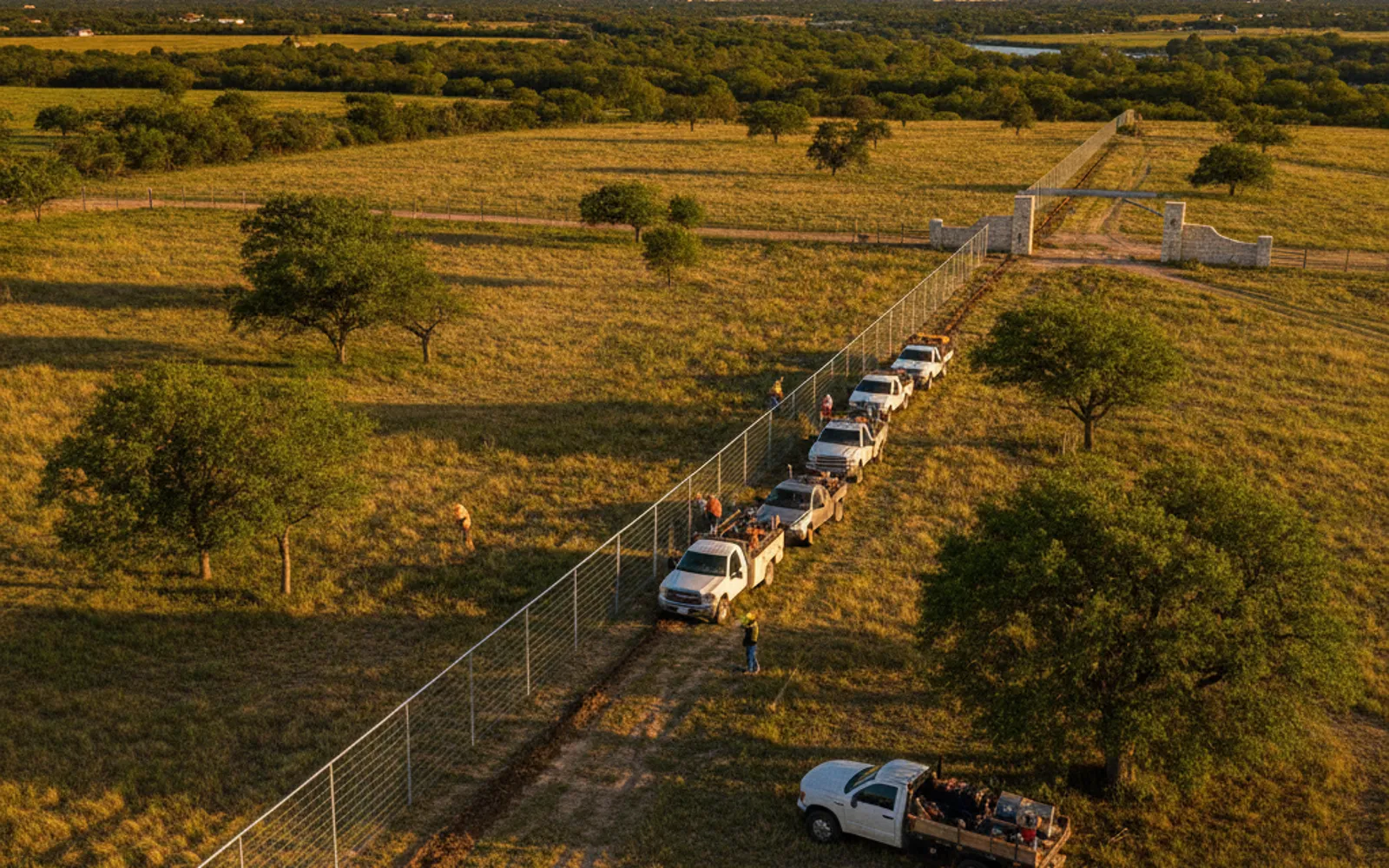
Call five fence companies around Waco and you’ll get five different numbers for the exact same stretch of pipe fence. One guy says $14 a foot, another says $28, and nobody explains why. That gap isn’t dishonesty. It’s the difference between pipe sizes, new steel versus used oilfield pipe, and how much welding your layout actually needs.
So let’s put real numbers on it. In McLennan, Bosque, and Falls counties, pipe fence cost per foot typically runs $12 to $28 installed, depending on the style. That’s a wide range, and this article breaks down exactly where your project will land inside it. We build pipe fence every week around Waco, China Spring, Crawford, and Lorena, so these are the numbers we quote off our own trucks, not something scraped from a national calculator.
Pipe Fence Cost Per Foot: The Short Answer
Here’s what the common pipe fence styles run installed in Central Texas right now. These prices include materials, labor, welding, and paint. They assume decent access and normal soil, which we’ll get into later.
| Pipe Fence Style | Installed Cost Per Foot | Best For |
|---|---|---|
| Pipe top rail with T-posts and net wire | $12 - $16 | Perimeter fence with a clean look |
| Pipe posts with 4 or 5 strands of barbed wire | $12 - $16 | Cattle perimeter that outlasts wood posts |
| Pipe posts with cable (3 to 5 runs) | $14 - $18 | Horse-safe pastures on a budget |
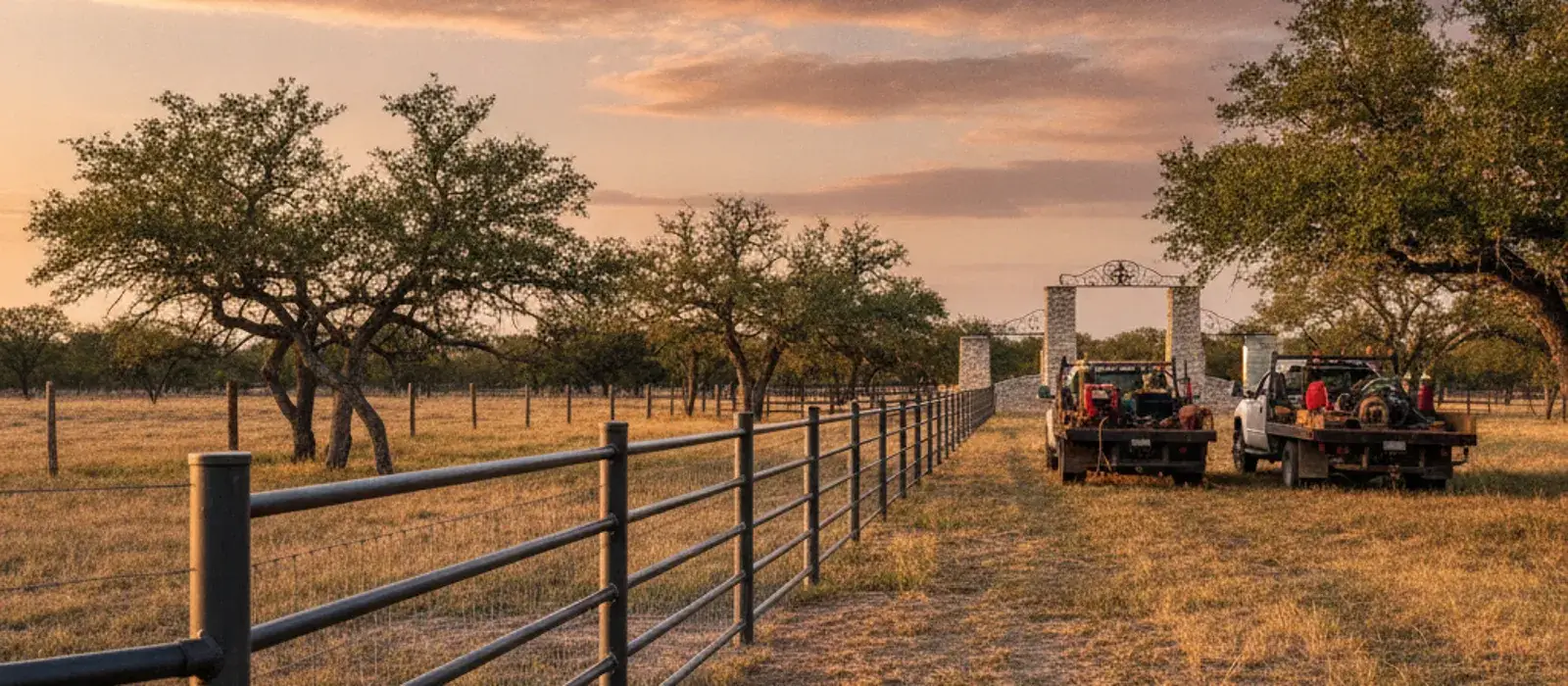
| Full pipe fence, used oilfield pipe, 3 rail | $16 - $22 | Working pens, arenas, road frontage |
| Full pipe fence, new steel, 4 to 5 rail | $22 - $28 | Show-front fencing, horse facilities |
A quick gut check on totals. At $20 a foot, a quarter mile (1,320 feet) of pipe fence runs about $26,400. A 300 foot road frontage at the same rate is $6,000. Pipe fence isn’t cheap, but it’s the last fence most people ever build on that line.
If you want a number for your specific place instead of a range, that’s what we’re here for. Call us at (254) 870-8898 or request a free written estimate. We’ll walk the line with you and price it foot by foot, no pressure and no rounding up.
What Drives Pipe Fencing Cost Up or Down
Two neighbors on the same road can get quotes $8 a foot apart and both quotes can be fair. Here’s what actually moves the number.
Pipe size and wall thickness. Most fence around here uses 2 3/8 inch pipe for posts and top rail, with 1 to 1 1/4 inch for fill rails. Step up to 2 7/8 inch posts for a heavy cattle setup and you add $2 to $4 a foot in steel alone. Wall thickness matters just as much as diameter. We covered the tradeoffs in our guide to what size pipe to use for a pipe fence.
New steel vs used oilfield pipe. This is the single biggest lever on price, and it gets its own section below.
Number of rails. Every rail you add is more pipe, more welding time, and more paint. Going from 3 rails to 5 rails typically adds $4 to $8 a foot.
Corners, gates, and short runs. A long straight run is efficient. A layout with six corners, four gates, and three short segments means more setting, more welding, and more mobilization per foot. Gates are priced separately, and a good pipe entrance can run $1,500 to $6,000 or more. See our ranch entrance gates page for what those setups involve.
Ground conditions. Most pipe posts around Waco get set 3 feet deep in concrete. In the blackland clay east of I-35 that’s routine. Get into the rocky ground around Crawford and Valley Mills and we may be coring rock, which adds drilling time and cost.
Total footage. Setup and mobilization get spread across the job. A 2,000 foot job almost always prices lower per foot than a 250 foot job, sometimes by $4 to $6.
Tearout and brush. If there’s an old fence coming down or a fence line grown up in mesquite and cedar, budget for removal and clearing on top of the build. Old fence tearout typically adds $2 to $5 a foot depending on what’s tangled in it, and heavy brush work is usually billed by the hour with a skid steer. It’s worth doing right, because a clean line makes the new fence faster to build and easier to maintain.
New Pipe vs Used Oilfield Pipe: Where the Savings Are Real
Used oilfield pipe, often called structural pipe, is drill stem and tubing that’s done its service in the oil patch. It’s heavy, it’s plentiful in Texas, and it usually costs 30 to 40 percent less than new steel of the same size.
Ruben Salazar, who runs cattle on 40 acres outside West, is a good example. He wanted 900 feet of 3 rail pipe along his county road frontage. New steel priced out at $24 a foot, about $21,600. We quoted the same fence in good used 2 3/8 inch drill stem at $18 a foot, or $16,200. That’s $5,400 back in his pocket for a fence that will still outlive both of us.
The catch is that “used pipe” covers everything from excellent to junk. Good drill stem has thick walls with surface rust you can wire brush and paint. Bad pipe has wall loss, splits, and internal scale that bleeds rust through paint for years. We inspect and reject pipe before it ever gets welded on your place. If you’re weighing this choice, read our full breakdown on used oilfield pipe fence before you buy a trailer load off a classified ad.
One more note. New pipe comes with mill specs, so if you want a uniform, dark-painted showpiece along your entrance, new steel gives the cleanest result. For working pens and pasture fence, used pipe is usually the smarter spend.
Real Pipe Fence Cost Per Foot on Three Local Jobs
Ranges are helpful, but real jobs are better. Here are three from the past year, with numbers.
Crawford: 1,300 feet of cattle fence with pipe posts and barbed wire. Gary Whitlock had cedar posts rotting off at the ground line on his east fence, and his cows knew it. We pulled the old fence, set used pipe posts on 10 foot centers, welded a pipe top rail, and strung 5 strands of new barbed wire. Cost came to $15 a foot, $19,500 total including tearout. That fence will hold cattle for 40 years or more with almost no maintenance.
Valley Mills: 480 feet of pipe and cable for a horse paddock. Dana Kirkpatrick keeps two barrel horses and wanted something safer than barbed wire near the barn. Barbed wire and horses are a bad mix, and vets will tell you the same. We built pipe posts and top rail with 4 runs of smooth cable at $17 a foot, $8,160 total. If you’re fencing for horses, our guide on the best fence for horses walks through why cable and pipe beat wire every time.
West: Ruben’s 900 feet of 3 rail used pipe from the section above, at $18 a foot. Six months in, he’s already asked us to price the next stretch. The road frontage looks sharp, and he told us the fence has already survived one neighbor’s loose bull leaning on it without so much as a bent rail.
Notice the spread: $15, $17, and $18 a foot for three different jobs, all fairly priced. Style and materials set the number, not the zip code.
Want to know where your project lands? Get a free written estimate and we’ll give you a firm per-foot price on paper, broken out so you can see exactly what you’re paying for.
Where the Money Actually Goes: Materials vs Labor
On a typical $20 per foot pipe fence, here’s roughly how the dollar splits.
Steel is the biggest line, usually 40 to 50 percent of the job. Pipe prices track the broader steel market, which is why quotes from two years ago don’t hold today.
Labor and welding run 30 to 40 percent. Pipe fence is a welded product. Every post gets cut, set, plumbed, and every rail gets fitted and welded on both sides. A crew that hurries the welds leaves you with rails that pop loose the first time a bull leans on them.
Concrete, paint, and consumables take the rest. Every post gets concrete. Paint matters more than people think, because primer and a proper topcoat are what keep used pipe from streaking rust.
That’s also why the cheapest bid deserves a hard look. If a quote comes in $5 a foot under everyone else, the money is coming out of pipe wall thickness, weld time, or paint. Ask every bidder the same three questions: what size and wall of pipe, new or used, and how deep the posts are set. If the answers are vague, keep shopping. Texas A&M AgriLife Extension publishes solid fence planning and cost research at agrilifeextension.tamu.edu if you want a university-backed second opinion on materials and construction.
How to Bring Your Pipe Fence Price Down
You can’t change the price of steel, but you can control the design. A few honest ways to trim the quote:
Use pipe where it counts, wire where it doesn’t. A lot of our customers put full pipe fence on the road frontage and around pens, then run pipe posts with barbed wire on the back perimeter. You get the strength and the look where people see it, at half the cost on the rest.
Choose used pipe for working fence. As Ruben’s job showed, that’s 25 to 35 percent off with no real loss in service life.
Drop from 4 rails to 3. Three rails hold cattle fine in most setups. Save the 4 and 5 rail builds for horses and show frontage.
Fence more at once. Combining this year’s and next year’s phases into one mobilization usually beats doing them separately.
Check your ag exemption. If your land qualifies for an agricultural appraisal, fencing is part of qualifying ag use in Texas, and materials may qualify for the sales tax exemption. The Texas Comptroller explains the ag/timber exemption at comptroller.texas.gov/taxes/ag-timber.
A word on DIY. Plenty of ranchers can weld, and if that’s you, you already know what your time is worth. But pipe fence is unforgiving work. It means hundreds of overhead and vertical welds in the heat, trenching and coring near buried utilities, and handling 30 foot joints of steel that can hurt you fast. If you don’t weld regularly, or your line involves rock, slopes, or a water gap, stop and call a professional. A failed weld on a corner post can let a whole stretch of fence go slack, and loose cattle on a road is a liability you don’t want. Our pipe fence installation page covers how we build them and what’s included in every quote.
If cattle are already testing a weak spot, don’t wait on it. Our emergency line runs 24/7 for cattle-out and storm damage calls: (254) 870-8898.
Frequently Asked Questions
How much does pipe fence cost per foot in the Waco area?
Most pipe fencing in McLennan, Bosque, and Falls counties runs $12 to $28 per foot installed. Pipe top rail with wire sits at the low end, full 4 or 5 rail new steel at the top. The most common builds we do land between $16 and $22 a foot.
Is used oilfield pipe good enough for a fence?
Good used drill stem is excellent fence material and saves 25 to 35 percent versus new steel. The key is inspection, because wall loss and splits hide under surface rust. We check every load before it’s welded, and we reject pipe that doesn’t measure up.
How long does a pipe fence last?
A properly welded and painted pipe fence set in concrete will last 40 to 70 years in Central Texas, and often longer. Compare that to wood posts that can rot out in 15 to 25 years in our clay soils. Repaint every 10 to 15 years and it’ll outlast the mortgage.
Is pipe fence worth the cost compared to barbed wire?
For pure pasture perimeter, barbed wire on T-posts is cheaper up front at $2.50 to $5.50 a foot. Pipe wins where strength, safety, or looks matter: pens, horse areas, entrances, and road frontage. Many owners split the difference with pipe up front and wire on the back fence, and that combination is what we quote most often.