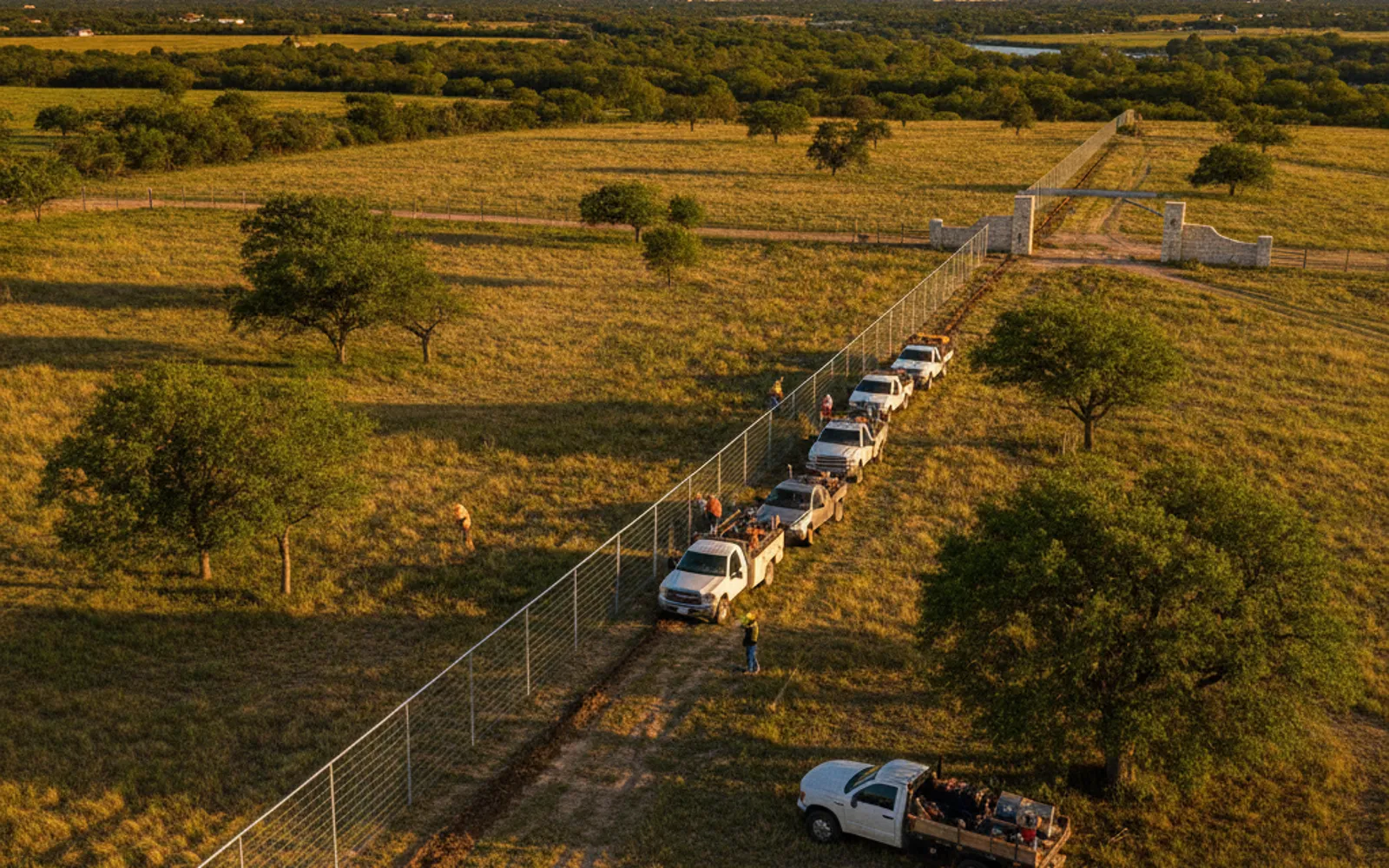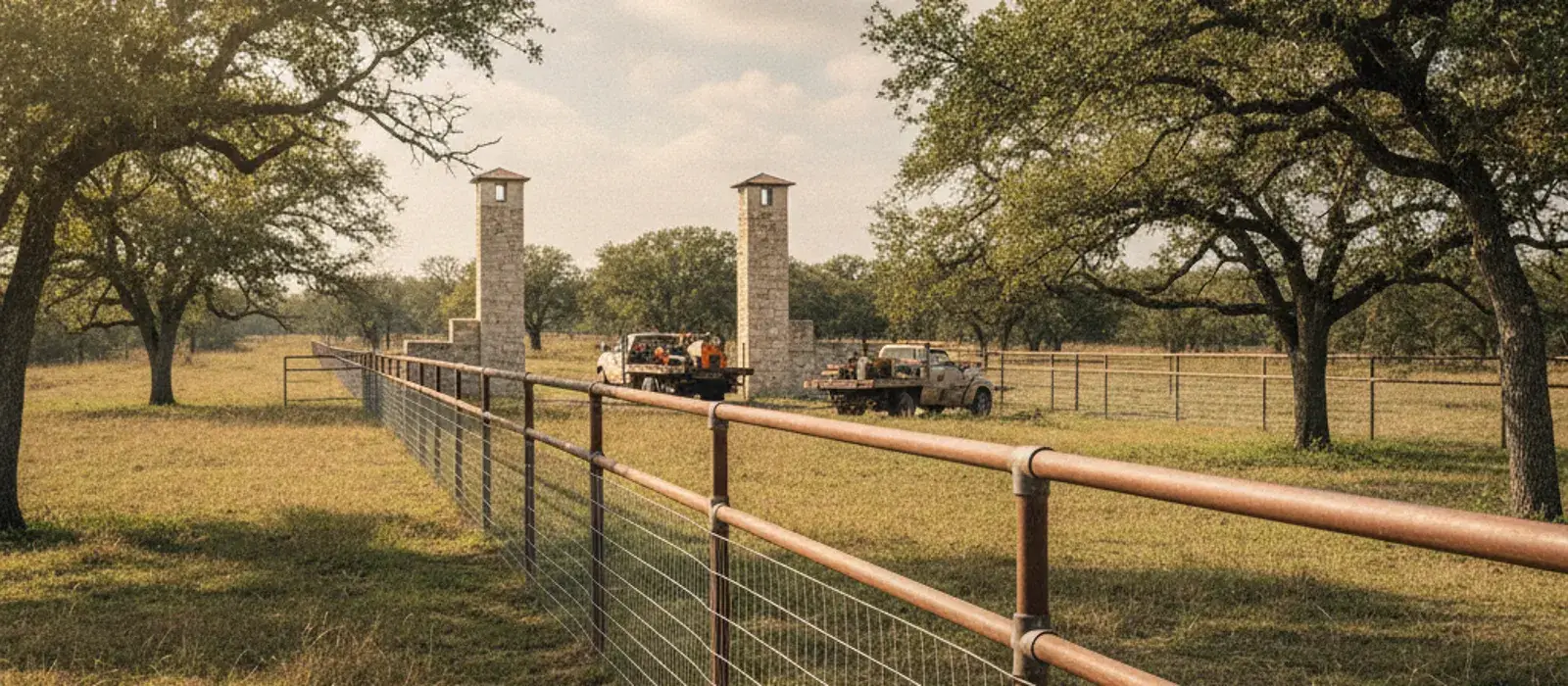
A half inch of steel can be the difference between a fence that shrugs off a 1,400 pound bull and one that folds like a lawn chair. That’s really what you’re deciding when you ask what size pipe for pipe fence work makes sense, because in Central Texas the choice almost always comes down to two numbers: 2 3/8 and 2 7/8.
Those are the outside diameters, in inches, of the two most common sizes of used oilfield tubing sold around Waco. Between China Spring, Crawford, and Valley Mills, we’d bet 9 out of 10 pipe fences are built from one or both of them.
Here’s the short version. 2 3/8 pipe handles line posts and top rails on most cattle and horse fences. 2 7/8 pipe belongs at corners, gates, H-braces, and anywhere heavy animals lean, rub, or crowd. The rest of this article explains why, what each size costs in real dollars, and exactly where cheaping out ends up costing you more.
The Quick Answer: What Size Pipe for a Pipe Fence
If you just want the answer so you can go order pipe, here it is.
For a standard perimeter or cross fence holding cows or horses, use 2 7/8 pipe for corner posts, gate posts, and brace posts. Use 2 3/8 pipe for line posts set every 8 to 10 feet, and 2 3/8 or 1.9 inch pipe for the top rail. That combination is what we install on most ranches in McLennan, Bosque, and Falls counties, and it’s the setup that holds up decade after decade.
Why not just build the whole thing from 2 7/8? You can, and for bull pens, working corrals, and arenas we often do. But 2 7/8 weighs about 6.5 pounds per foot compared to roughly 4.7 for 2 3/8. On a quarter mile of fence, that’s thousands of pounds of extra steel you’re paying for, hauling, and welding, mostly in places that don’t need it.
Why not all 2 3/8? Because corners and gates take loads that line posts never see. A 300 pound gate hanging off a post is a lever working on that post every single day. A corner post takes the pull of every stretched wire tied to it, which can add up to thousands of pounds on a long run. That’s where the bigger pipe earns its keep.
If you’d rather skip the math and the welding altogether, we build pipe fence in Waco and the surrounding counties every week. Request a free written estimate and we’ll spec the right pipe sizes for your land and your animals, no guesswork and no upselling.
2 3/8 Pipe: The Workhorse for Line Posts and Top Rails
2 3/8 inch pipe is the most common size on Central Texas ranches for good reason. It’s strong enough for line duty, light enough for two people to handle, and cheap enough that fencing a whole pasture doesn’t require a second mortgage.
Set 30 to 36 inches deep in concrete on 8 to 10 foot spacing, a 2 3/8 line post will hold barbed wire, net wire, or continuous fence panels for decades. Most used 2 3/8 tubing runs a wall thickness around 0.190 inches. That’s real structural steel, not the flimsy fence tubing you’ll find at big box stores.
Where 2 3/8 shines:
- Line posts on cattle and horse fences
- Top rails over barbed wire or net wire
- Stays and verticals in continuous fence
- Light walk gates and trailer gates
Where it falls short is exactly where you’d guess: anywhere the fence takes concentrated load. Roy, who runs about 60 cow-calf pairs outside Crawford, learned that one the expensive way. His previous fence builder set 2 3/8 corners on 1,200 feet of new fence to shave a few dollars off the bid. Two summers of bulls leaning through the shade line and both corner assemblies were tipped 6 inches out of plumb, with every wire on the fence gone slack. We rebuilt both corners with 2 7/8 posts and proper braces for $2,800. The original savings from the smaller pipe was about $190.
If your existing fence is already doing that lean, our article on leaning fence posts covers what’s fixable and what needs to come out of the ground.
2 7/8 Pipe: Corners, Gates, and Anywhere Cattle Push
2 7/8 inch pipe is the muscle of a pipe fence. The extra half inch of diameter doesn’t sound like much, but stiffness in a round pipe climbs fast as diameter grows. Combined with a heavier typical wall, a 2 7/8 post resists bending roughly half again better than 2 3/8 under the same load.
Use 2 7/8 for:
- Corner posts and end posts
- Gate posts, especially anything hanging a gate 12 feet or wider
- H-brace and pull posts on long wire runs
- Bull pens, working pens, and alleyways
- Entrance columns and cattle guard wings
Gate posts deserve special mention. A 16 foot pipe gate can weigh 250 to 350 pounds, and every time it swings, sags, or catches a tractor bucket, that load works on the hinge post. A 2 7/8 post set 4 feet deep in concrete shrugs it off for a lifetime. A 2 3/8 post slowly rolls toward the gate until nothing latches anymore. If your entrance is already doing this, read our guide on how to fix a sagging ranch gate, or have us build the entrance right the first time. Our ranch entrance gates in Waco crew handles everything from hinge posts to overhead signs.
For fences that see serious abuse, some ranchers step up to 3 1/2 or even 4 1/2 inch pipe at gates and main corners. That’s rarely necessary on a family ranch, but it’s standard on feedlots and heavy commercial operations, and it’s cheap insurance on a wide entrance gate.
Wall Thickness Matters as Much as Pipe Size
Here’s the part most pipe sellers won’t volunteer: two sticks of 2 7/8 pipe can differ wildly in strength. Outside diameter is only half the story. Wall thickness is the other half.
Common used tubing walls run from about 0.190 up to 0.217 inches and heavier. Structural grades and drill stem can run thicker still. A thin-wall, heavily pitted 2 7/8 can actually be weaker than a clean, heavy-wall 2 3/8. The quick check is weight. Honest 2 7/8 at 0.217 wall weighs about 6.5 pounds per foot. If a yard is selling “2 7/8” that weighs 4.5 pounds per foot, you’re buying a big diameter wrapped around thin steel.
Danny, who bought 25 acres near Valley Mills in 2023, found a deal on 2 7/8 at about 60 cents a foot under market. He saved roughly $600 on the load. The pipe turned out to be badly pitted from years of downhole service, with walls rusted paper thin in spots you couldn’t see under the scale. Within a year, 14 of his posts had rusted through at ground level and snapped in a spring storm. Cutting them out and replacing them ran $1,900, three times what the cheap pipe saved him.
When you’re buying used pipe, check for:
- Deep pitting or scale flaking off in sheets
- Split seams or crushed ends
- Walls you can dent with a hammer blow
- Heavy internal scale that hides thin spots
Texas A&M AgriLife Extension publishes solid guidance on fence planning and materials for Texas landowners at agrilifeextension.tamu.edu, and it’s worth a read before you spend real money on steel. For a deeper dive on sourcing, grades, and fair prices, our post on used oilfield pipe fence covers what to buy and what to walk away from.
Not sure what you’re looking at on a trailer full of rusty pipe? Call us at (254) 870-8898 before you pay for it. A five minute conversation is free. A load of junk pipe is not.
Cost Comparison: 2 3/8 vs 2 7/8 Pipe
Prices move with the scrap and oil markets, but here’s what used oilfield pipe has been running around Waco in 2026, along with where each size belongs on your fence.
| Spec | 2 3/8 Pipe | 2 7/8 Pipe |
|---|---|---|
| Outside diameter | 2.375 in | 2.875 in |
| Typical weight | About 4.7 lb/ft | About 6.5 lb/ft |
| Used price per foot | $1.60 to $2.50 | $2.25 to $3.50 |
| Cost per 8 ft post | $13 to $20 | $18 to $28 |
| Best use | Line posts, top rails, stays | Corners, gates, braces, pens |
| Set depth | 30 to 36 in | 36 to 48 in |
| Concrete per post | About 1 bag | 1.5 to 2 bags |
On a typical 1,320 foot quarter mile of fence, the difference between an all 2 7/8 build and a smart mixed build usually lands between $800 and $1,500 in pipe alone, before you count the extra concrete, welding wire, and labor the heavier pipe demands.
Flip it around, though, and upsizing only the posts that matter is cheap. Corners, gates, and braces might account for 10 or 15 posts on that quarter mile. Upgrading just those from 2 3/8 to 2 7/8 costs maybe $75 to $120 in pipe. That’s the best hundred dollars you’ll spend on the whole project.
Installed pipe fencing in Central Texas generally runs $22 to $45 per foot depending on rail count, pipe size, and terrain. We break the whole budget down, materials and labor both, in our pipe fence cost guide.
When to Mix Pipe Sizes on the Same Fence
Almost every fence we build mixes sizes, and yours probably should too. Here’s how we spec jobs across our service area, from China Spring to Lorena.
Perimeter fence with wire. 2 7/8 corners, gates, and H-braces. 2 3/8 line posts every 8 to 10 feet with a 2 3/8 top rail, then 4 or 5 strands of barbed wire or net wire below. This is the standard Central Texas ranch fence. If you’re stretching wire between pipe posts, our h-brace fence corners guide explains why those brace assemblies carry the whole fence.
Horse fence. Same post layout, but we tighten spacing and often add a second rail or continuous fence panels. Horses lean, chew, and spook into fences, so smooth, stout, and visible wins. Karen, who keeps three barrel horses on 10 acres south of Lorena, had us build about 600 feet of paddock fence with 2 7/8 gate and corner posts, 2 3/8 lines and rails, and net wire below the rail. The total came to $9,600, and after two springs of storms and one gelding that tests everything, it hasn’t moved an inch.
Bull pens and working pens. All 2 7/8 posts, sometimes heavier, with 2 3/8 rails stacked 5 or 6 high. A 2,000 pound bull hitting a fence at a trot is not a load you engineer down to a price.
Entrances. 2 7/8 minimum on gate posts, and often 4 1/2 inch or larger on main entrance columns that carry a heavy swinging gate or an overhead sign.
One more sizing note: depth beats diameter. A 2 7/8 post set 18 inches deep will fail before a 2 3/8 post set 3 feet deep in concrete. The USDA Natural Resources Conservation Service fence practice standards, available through nrcs.usda.gov, lean hard on proper embedment and bracing for exactly this reason. Our blackland clay around Waco and West swells and shrinks with the weather, so shallow posts walk out of plumb faster here than almost anywhere.
A word on DIY before you fire up a welder. Cutting and joining used oilfield pipe means grinding scale, breathing weld fumes, and running a hot arc over dry Texas grass. If you’re not set up with proper gear, a fire watch, and water on hand, this is the point to stop and call a professional. Burns and grass fires cost a lot more than a fence contractor does. And if the pipe has any coating or galvanizing on it, don’t weld it at all without real ventilation. Zinc fumes will put you on your back.
If you want it done once and done right, get your free written estimate here. We’re licensed and insured, we put every pipe size and wall thickness in writing so you can compare bids apples to apples, and we answer our own phone.
Frequently Asked Questions
Is 2 3/8 pipe strong enough for fence corner posts?
For a short garden fence, maybe. For a stretched wire fence holding livestock, no. Corner posts take the combined pull of every wire plus animal pressure, and undersized corners are the most common pipe fence failure we see around Waco. Spend the extra few dollars on 2 7/8 at corners, ends, and gates.
How deep should pipe fence posts be set?
Line posts should go 30 to 36 inches deep in concrete, and corner and gate posts 36 to 48 inches. In the blackland clay around Waco and West, deeper is better because that soil swells and shrinks with moisture and can work shallow posts loose. In rocky ground near Crawford or Valley Mills, you may need a rock auger, and that’s usually a job worth hiring out.
What size pipe is best for a top rail?
Most top rails are 2 3/8 or 1.9 inch pipe. The rail mostly keeps animals from leaning over the wire and gives the fence a straight, finished look, so it doesn’t need corner-post strength. On horse fences and working pens where animals hit the rail hard, stay with 2 3/8 or heavier.
Is used oilfield pipe safe to buy for fencing?
Yes, and it’s what most Central Texas pipe fences are built from, but quality varies a lot from load to load. Inspect for deep pitting, thin walls, and split seams before you pay, and weigh a stick if you can, since weight per foot tells you the true wall thickness. If a price looks too good to be true, the wall thickness usually explains why.