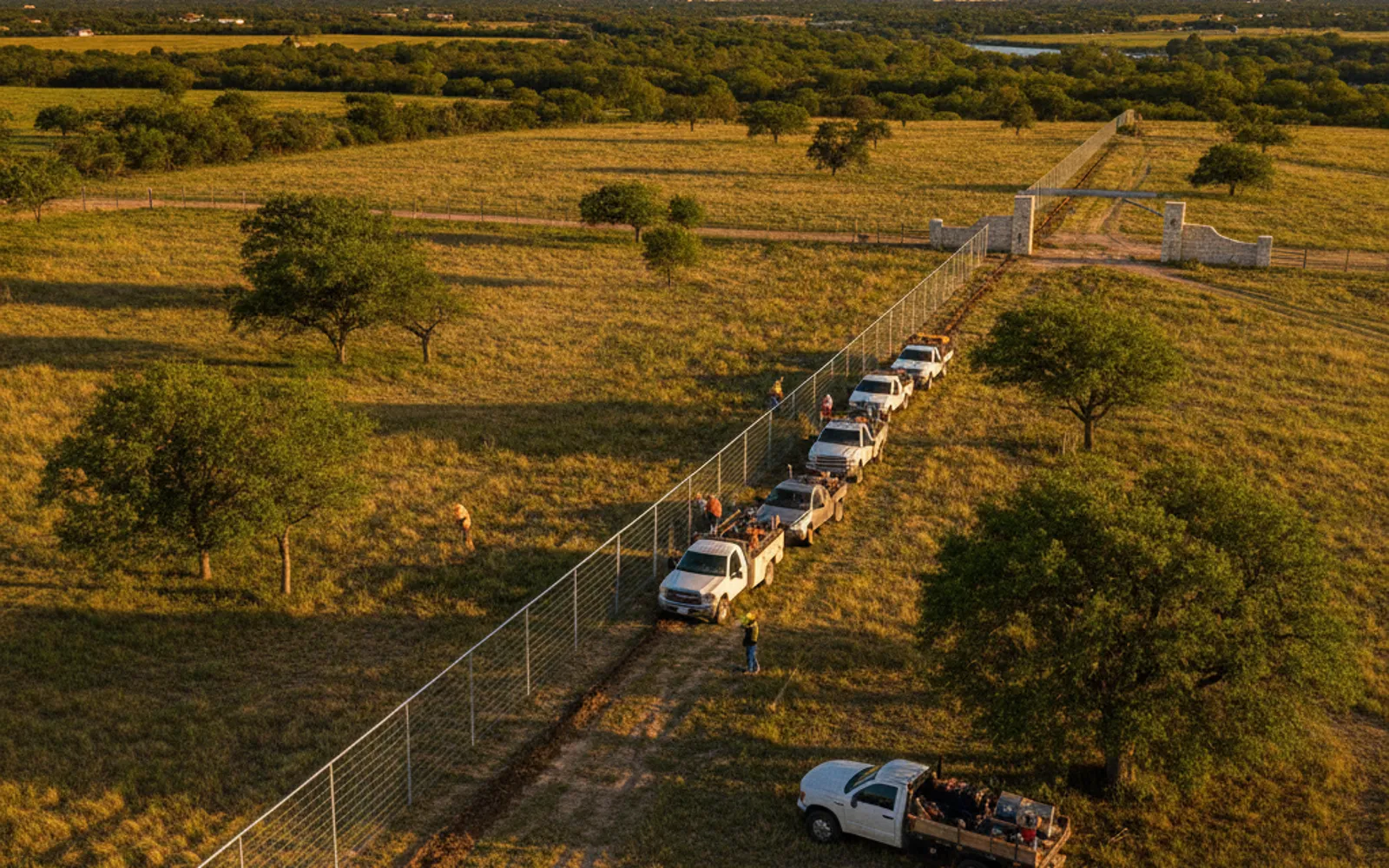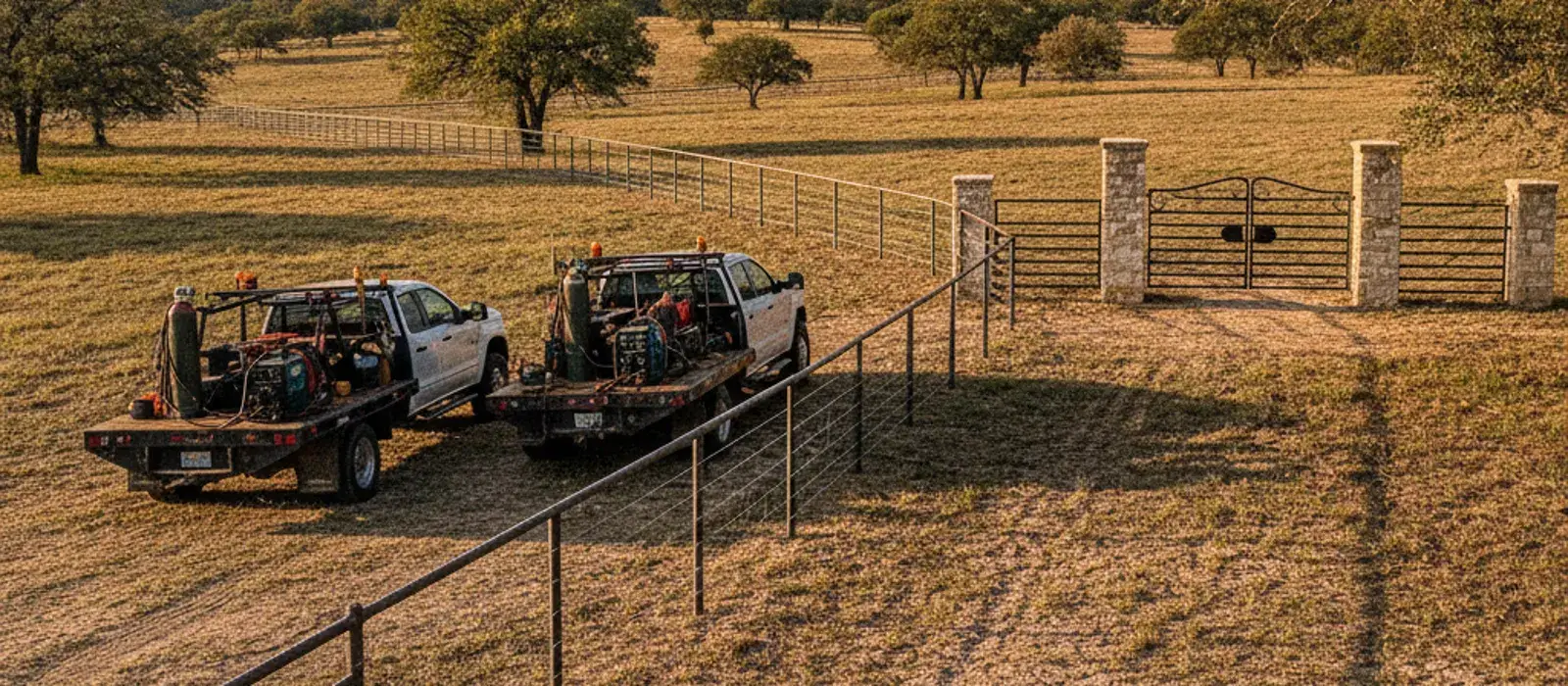
Drive any ranch road between Waco and Crawford and you’ll see it. Rust-brown pipe fence running straight as a rifle shot, and most of that pipe pumped oil out of a West Texas well before it ever held back a cow.
A used oilfield pipe fence is the standard around here for a reason. Drill stem costs about half what new structural pipe runs, it’s heavier walled than most new fence pipe, and a bull can lean on it all day without moving it. But “used” covers everything from nearly perfect pipe to junk that’ll rust through in ten years, and the difference isn’t always obvious sitting in a stack at the pipe yard.
We build pipe fence all over McLennan, Bosque, and Falls counties, and we’ve bought a lot of used pipe over the years. Here’s what it really costs, where it goes wrong, and exactly what to check before you hand anybody money.
Why a Used Oilfield Pipe Fence Makes Sense in Central Texas
Start with what the stuff actually is. Drill stem is the threaded pipe that turns the drill bit downhole. Once it’s been through enough trips in and out of a well, it gets retired from drilling and sold off as structural pipe. The most common size you’ll see for fencing is 2 3/8 inch outside diameter, followed by 2 7/8 inch for posts and heavier corners.
Here’s why ranchers keep choosing it:
- Price. Used 2 3/8 drill stem runs about $1.60 to $2.50 per foot around Waco right now. Comparable new pipe runs $3.50 to $5.00 per foot. On a corral or a long stretch of fence line, that gap adds up to thousands of dollars.
- Wall thickness. Drill stem was built to survive thousands of feet downhole under torque. Typical wall thickness is around 0.19 inch, which is thicker than a lot of new “fence grade” tubing. Thicker wall means more years before rust wins.
- Strength. It’s high-grade steel. A pipe corral built from sound drill stem will outlast the person who built it, and it shrugs off cattle, horses, and the occasional tractor bump.
- Looks. That uniform rust patina is part of the ranch look in Central Texas. Plenty of folks skip paint entirely and let it brown out even.
For working pens, arena rails, entrance ways, and corner braces on wire fence, it’s hard to beat. If you’re pricing a full project, our pipe fence installation page breaks down what we build and how we build it.
Want a real number for your place instead of internet ranges? Call us at (254) 870-8898 and we’ll walk your fence line and put a written estimate in your hand for free.
The Downsides Nobody Mentions at the Pipe Yard
Used pipe isn’t free money. There are four real drawbacks, and you should know them before you commit.
It’s inconsistent. New pipe comes with a spec sheet. Used pipe comes with a history you can’t see. One joint in a load might have thin spots from downhole corrosion while the joint next to it is near perfect. You’re buying a mixed bag unless you inspect piece by piece.
Inside scale and gunk. Pipe that carried oil or produced water often has paraffin, scale, or cement inside. That matters when you weld. Burning through paraffin makes ugly, contaminated welds and a lot of nasty smoke. Cement-lined joints are miserable to cut and nearly worthless for fencing.
NORM contamination. Some oilfield pipe picks up naturally occurring radioactive material, called NORM, from scale that builds up inside during production. Reputable yards test and reject hot pipe, but it’s a real thing the EPA documents in its overview of oil and gas production wastes. The Railroad Commission of Texas also regulates how NORM-contaminated oilfield equipment gets handled in this state (rrc.texas.gov). Buy from a yard that can tell you their pipe has been surveyed. Don’t buy mystery pipe off a trailer at a gas station.
Hard on tools and welders. Drill stem is high-carbon steel. It cuts slower, eats blades, and it’s less forgiving to weld than mild steel. Welds on high-carbon pipe can crack if they cool too fast, which is one reason a cheap DIY pipe fence sometimes starts popping welds after the first hard freeze.
Here’s what that last point looks like in real life. Gary Hoelscher, who runs a small cow-calf place outside Valley Mills, called us in March after the corral he’d welded up himself over two summers started failing. He’d bought bargain pipe at auction, some of it thin-walled tubing mixed in with the drill stem, and his welds were cracking at the rail joints. We ended up cutting out and rebuilding about 60 feet of it for $4,200. Good pipe from the start would’ve cost him maybe $900 more than the auction load.
What to Check Before You Buy Used Oilfield Pipe
This is the part that saves you money. Whether you’re buying pipe yourself or checking a contractor’s material, run through this list on the actual pipe, not the photo in the listing.
1. Ring it. Tap each joint with a hammer. Sound pipe rings clear like a bell. A dull thud means heavy scale inside, internal cement, or a wall so thin it can’t ring. This one test catches more bad pipe than anything else.
2. Look down the bore. Hold one end up to the light and look through. You want to see daylight. Heavy paraffin, scale buildup, or blockage means welding headaches and hidden wall loss.
3. Check the wall at the cut ends. Fresh-cut ends show you true wall thickness. On 2 3/8 drill stem you want to see roughly 3/16 inch of steel. If the wall looks like a soup can at the ends, walk away, because it’s worse somewhere in the middle.
4. Hunt for pitting, not surface rust. Uniform orange surface rust is fine and normal. Deep pitting, flaking layers, or holes near the tool joints mean the pipe corroded downhole. Drag a gloved hand along the joint and feel for rough, cratered sections.
5. Watch for crooked and worn joints. Sight down each pipe like a rifle barrel. Slight bows are workable for rails. Banana pipe is not. Also check the upset ends where the tool joints are, since heavy wear there means the pipe had a hard life.
6. Ask about NORM surveys. A legitimate pipe yard will answer this question without blinking. If the seller gets cagey, that tells you what you need to know.
7. Confirm what you’re actually buying. Drill stem, tubing, casing, and sucker rod are different products at different prices. More on that below, but don’t pay drill stem money for thin-wall production tubing.
Kyle Determan, who runs cattle northwest of China Spring, called us last fall before buying a $3,800 load of 2 7/8 pipe he’d found online. We looked at it with him and rang every joint. About a third of the load thudded dead, and two joints had visible pitting you could catch a fingernail in. He passed, bought a cleaner load from a yard in West for $4,300, and got pipe that’ll still be standing when his grandkids run those pens.
If you’d rather skip the pipe-yard homework entirely, request a free estimate and we’ll source inspected pipe, build the fence, and warranty the welds.
Used vs New Pipe Fence: Cost Comparison
Here’s how the numbers shake out in the Waco area as of mid-2026. Prices move with the steel market, so treat these as solid ranges, not gospel.
| Item | Used Drill Stem | New Structural Pipe |
|---|---|---|
| 2 3/8” pipe, per foot (material) | $1.60 - $2.50 | $3.50 - $5.00 |
| 2 7/8” pipe, per foot (material) | $2.25 - $3.25 | $4.50 - $6.50 |
| Consistency | Varies joint to joint | Uniform, comes with specs |
| Wall thickness (2 3/8”) | ~0.19” typical | 0.11” - 0.19” depending on grade |
| Welding | Harder, high-carbon steel | Easier, predictable |
| Expected life if sound | 40+ years | 40+ years |
| Installed 5-rail fence, per foot | $28 - $40 | $38 - $55 |
Two things jump out of that table. First, the material savings are real, usually 40 to 50 percent on the pipe itself. Second, sound used pipe lasts just as long as new. The whole game is the word “sound,” which is why the inspection list above matters more than the price per foot.
For a deeper dive on total project pricing, including labor, concrete, and gates, read our full breakdown at pipe fence cost. And if you’re deciding between 2 3/8 and 2 7/8 for posts and top rail, we cover that in what size pipe for a pipe fence.
Drill Stem, Tubing, Casing, and Sucker Rod: Know What You’re Buying
Sellers throw these terms around loosely, and the differences matter to your wallet.
Drill stem is the workhorse. Thick wall, high strength, threaded tool joints on the ends. It’s what you want for posts, top rails, and braces. The 2 3/8 and 2 7/8 sizes cover almost everything on a ranch.
Production tubing looks similar but usually runs thinner walled because it just carried fluid instead of turning a bit. It’s fine for middle rails where loads are lighter, and it’s cheaper. It’s not what you want holding a corner under a quarter mile of stretched wire.
Casing is the big-diameter pipe, 4 1/2 inch and up, that lines the wellbore. It makes outstanding corner posts, H-brace posts, and entrance columns. If you’re planning a headgate entrance off the county road, casing uprights are the standard look, and our ranch entrance gates page shows how we build them.
Sucker rod is the solid steel rod, usually 3/4 or 7/8 inch, that ran the downhole pump. It’s the classic material for continuous-rail fence and top rails on wire fence. It’s springy, strong, and cheap, but it’s also high-carbon and snaps welds if it’s not welded right.
One more real example. Maria Villarreal bought 12 acres outside Lorena last year and wanted pipe corners and an H-brace layout for a new net wire perimeter. She’d been quoted a load of “heavy pipe” that turned out to be thin production tubing when we rang it. We sourced true 2 7/8 drill stem for the corners instead, set them in concrete, and her whole corner and brace package came to $2,650. Her wire will still be tight in twenty years because the corners won’t move. If you want to understand why corners decide everything, read H-brace fence corners.
When to DIY and When to Call a Pro
Plenty of ranchers around here are handy with a welder, so let’s be straight about where the line is.
Reasonable DIY territory: hauling and inspecting pipe, cutting and painting rails, and welding non-structural stuff like a hay ring repair. If you’ve got a good machine, real hood time, and patience for preheating high-carbon steel, a small pen is doable.
Call a professional when any of these apply:
- Corners and braces on stretched wire. A failed corner weld lets a whole quarter mile of wire go slack, and then the cattle get out. That’s a liability problem on a public road, not just a fence problem.
- Entrance gates and anything overhead. A pipe header over a driveway is hanging steel above people’s vehicles. Cracked welds up there aren’t a someday problem.
- Horse fencing. Horses find every sharp edge and every gap. Rail spacing and smooth finishes matter more than with cattle.
- Long runs on a deadline. A crew with a pipe trailer, welders, and an auger will set in three days what takes a solo weekend warrior all summer.
Also know your limits on the buying side. If you can’t confidently tell drill stem from tubing, or you can’t inspect a load in person before paying, let somebody who buys pipe every week do it. The most expensive pipe fence in the county is the cheap one you build twice.
We’re happy to be that somebody. Call (254) 870-8898 or hit our contact form for a free written estimate anywhere in McLennan, Bosque, or Falls county. We answer the phone, we show up when we say, and our welds hold.
Frequently Asked Questions
How much does used oilfield pipe cost for fencing?
Around Central Texas in 2026, used 2 3/8 inch drill stem runs about $1.60 to $2.50 per foot, and 2 7/8 inch runs about $2.25 to $3.25 per foot. Casing for corner posts is usually priced per joint rather than per foot. A fully installed 5-rail pipe fence built from used pipe typically lands between $28 and $40 per foot including labor and concrete.
Is used oilfield pipe safe, or is radiation a real concern?
NORM contamination is real but manageable. It shows up as radioactive scale inside some production pipe, and reputable pipe yards survey their inventory and pull hot joints before resale. Buy from an established yard that can confirm their pipe has been checked, and skip private sellers who can’t answer the question.
How long will a used oilfield pipe fence last?
Sound drill stem with good wall thickness will last 40 years or more as a fence, and often much longer in our dry Central Texas climate. The failures you see are almost always thin-wall pipe that should’ve been rejected, or cracked welds from poor technique on high-carbon steel. Buy good pipe, weld it right, and it’s a one-time fence.
Should I paint used pipe fence or let it rust?
Either works, and it’s mostly a looks decision. Surface rust on thick-wall pipe advances very slowly here, so plenty of ranchers let it brown out naturally. If you want paint, a rust-converting primer plus an oil-based enamel holds up best, and dark colors hide future rust bleed. Paint adds roughly $3 to $6 per foot if a crew does the prep and spraying.