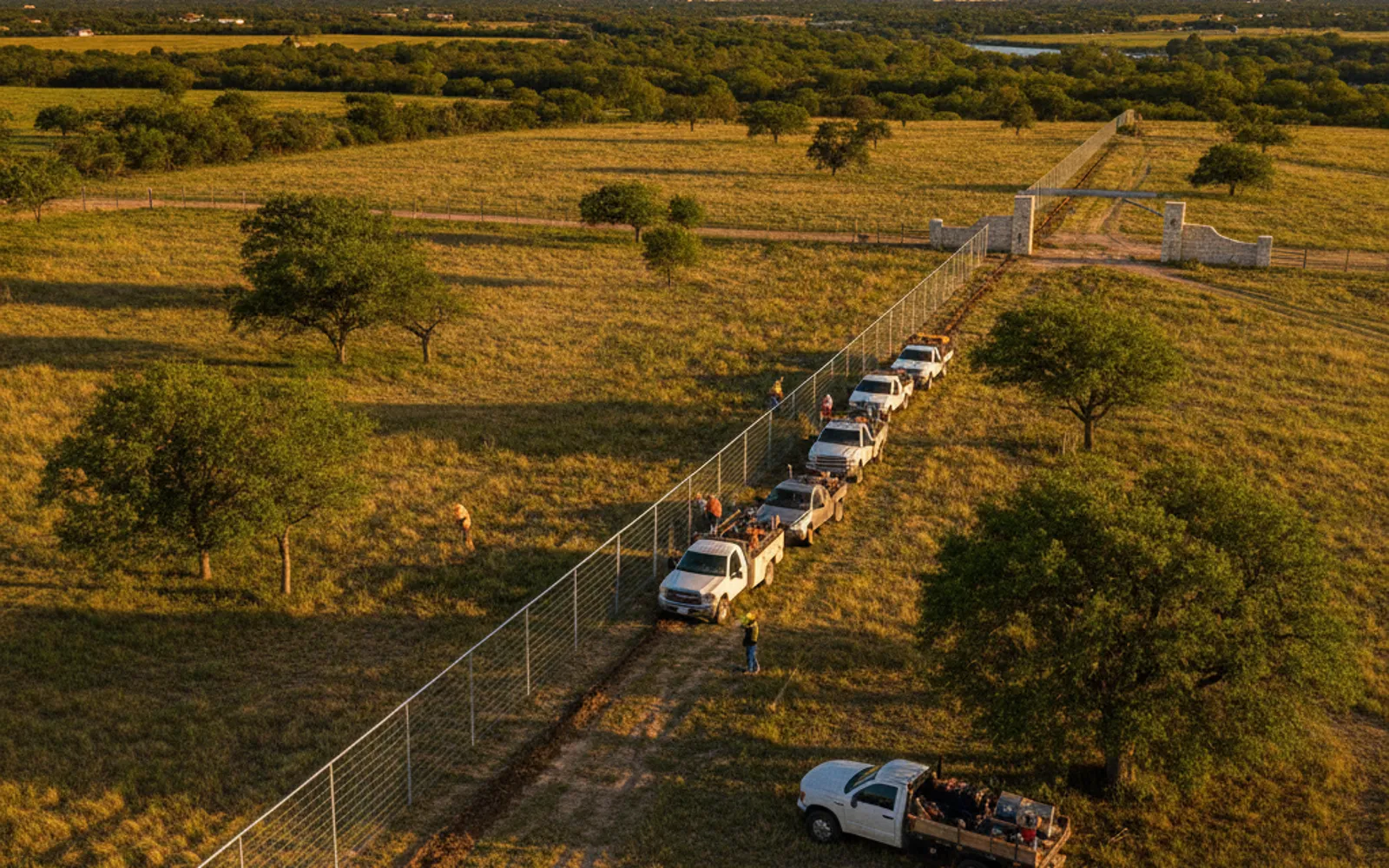
From the truck, a roll of welded wire and a roll of woven wire look close enough: a galvanized grid on a roll. The difference is at the joints. Welded wire is spot welded where the wires cross. Woven wire has its vertical stays wrapped or knotted around the horizontal line wires, and the line wires carry little kinks that act like springs.
That one detail decides the answer. For cattle, goats, sheep, horses or anything with hogs pushing on it, woven wire is the fence. Welded wire is fine for a garden, a dog run, a chicken yard or a backing on something stronger. Put welded wire on a pasture line and the welds start popping once the cows start leaning on it to reach the grass on the other side.
If you have a line to build and want a straight answer on which wire fits it, call (254) 870-8898 and someone will walk the line for a free on-site estimate.
How each wire is built
Welded wire
Welded wire is made by laying straight horizontal and vertical wires over each other and resistance welding every crossing. The common farm-store roll is 14 gauge with a 2 x 4 inch opening, in heights from 36 inches up, and every wire in the roll is the same size. Lighter garden rolls run 16 gauge and thinner, and some are vinyl coated. The line wires are straight, with no tension curves, so the roll has almost no give.
Woven wire
Woven wire (net wire, field fence, hog wire, sheep and goat wire, all the same family) is built differently. Horizontal line wires run the length of the roll, and vertical stays are wrapped around them. On hinge joint wire the stay wraps in a loose loop. On fixed knot wire a separate short wire locks the crossing. Either way, nothing is welded.
The line wires are crimped at the factory with small kinks called tension curves. When you stretch the fence you pull some of that crimp out, and the rest stays in reserve. When the steel expands on a 105 degree afternoon or a steer hits the fence, the curves take up the slack or absorb the hit, then pull the wire back.
Woven wire is also sold by a design number printed on the tag. The University of Tennessee’s Planning and Building Fences on the Farm explains the code: in 1047-12-11, the 10 is the number of line wires, 47 is the height in inches, 12 is the stay spacing in inches and 11 is the gauge of the filler wires. The top and bottom wires are usually heavier than the fillers, which is where the fence takes the most abuse.
Hinge joint against fixed knot has its own post, fixed knot vs hinge joint. Here both count as woven wire, and both beat welded wire under stock.
Why welded wire fails under livestock
A weld holds fine when the load is small, like a rabbit bumping the garden fence. Livestock load is sideways, repeated and heavy: a cow leaning her neck through for the grass on the other side, a goat standing on the fence with her front feet, a hog shoving his snout under the bottom wire and lifting, a horse rubbing its rump.
When that load hits welded wire, the rigid grid cannot flex, so the force goes straight into the nearest welds. One pops. Now the wires around it carry the load that weld used to hold, so the next one pops sooner. A few crossings later you have loose wires, a bulge the animals keep working, and the start of a hole, with no spring to pull it back.
The University of Georgia’s horse fencing bulletin, Fences for Horses, notes that galvanized welded wire with 2 x 4 inch openings sometimes gets used because it is cheap, but says the joints will not hold up under field conditions and does not recommend it for horses.
Woven wire handles the same load differently. The line wires stretch into their tension curves and the load spreads along the fence to the posts and braces. When the animal backs off, the curves pull the fence straight again.
Welded wire does not stretch well either
A fence only turns stock if it is tight. Woven wire is designed to be pulled with a stretcher bar until the tension curves are partly straightened. Welded wire has no curves to pull out, and the welds do not like being stretched against. Pull it hard and you bend the verticals or break welds before you ever get it tight. Pull it lightly and it sags between posts by the first August.
Gauge and galvanizing: the other half of the gap
Gauge
On a typical 14 gauge welded roll, the top and bottom wires are the same thin 14 gauge as everything else. On woven wire the top and bottom wires are heavier than the fillers, because those two wires carry the stretch and take the most hits.
For a benchmark, look at the Texas NRCS fence specification, Conservation Practice 382, used for cost-share fences. It calls for woven wire built to ASTM A116, and for a net wire fence it sets at least 11 gauge top and bottom wires with 14 1/2 gauge intermediate and stay wires, with stays 12 inches apart or closer. For sheep or goats only, it allows 39 inch net wire with 10 gauge top and bottom wires and 12 1/2 gauge intermediates. If a fence is going in under an NRCS contract, read the spec with your NRCS office before you buy wire. A higher gauge number means thinner wire: 14 is thinner than 12 1/2.
Zinc coating
Thin wire also rusts through sooner, because there is less steel to lose. The Tennessee bulletin’s rust table shows 14 1/2 gauge Class 1 wire showing rust after about 5 years in a humid climate and 7 years in a dry one, where 12 1/2 gauge Class 3 wire runs about 13 years humid and 30 years dry before rust appears. Central Texas sits somewhere between those two columns.
Welded wire has a second problem. Much of the welded wire on farm-store shelves is galvanized before welding (sold as GBW), and many of those tags give no Class 1 or Class 3 rating at all. Welding a galvanized wire burns zinc off right at the crossing, the same spot that holds water after a rain, so rust starts at the welds. Welded wire that is galvanized after welding (sold as GAW) has the joints coated and lasts longer, but it is still a rigid welded grid.
Woven field fence is commonly sold in Class 1 and Class 3, and Class 3 is the one to buy for a permanent line. We explain the zinc classes in Class 1 vs Class 3 galvanized wire.
Welded wire vs woven wire side by side
| Welded wire | Woven wire (net wire / field fence) | |
|---|---|---|
| Joints | Spot welded at every crossing | Stays wrapped (hinge joint) or knotted (fixed knot) |
| Give under impact | Almost none; welds take the load | Tension curves flex and recover |
| Typical farm-store gauge | 14 gauge throughout, lighter for garden rolls | Heavier top and bottom wires, lighter fillers |
| Can be stretched tight | Poorly | Yes, with a stretcher bar and braces |
| Zinc at the joints | Often burned off if galvanized before welding | Not burned off by welding; Class 3 available |
| Heat sag | Sags and stays sagged | Curves take up expansion |
| Best use | Gardens, dog runs, poultry, small pens, backing on pipe | Cattle, goats, sheep, horses, hog pressure, perimeter lines |
Where welded wire is genuinely fine
Welded wire is the wrong tool for a pasture and a good one for small jobs where nothing big pushes on it.
- Gardens and yard fences. Rabbits, the neighbor’s dog and chickens do not lean their full weight on a fence. A 48 inch welded roll on t-posts around a vegetable patch is a sensible, cheap build.
- Dog runs and kennels. Best framed with pipe or wood, so the frame carries the load and the wire only fills the gap.
- Poultry yards. Chickens and ducks stay in, and welded wire with smaller openings keeps some predators out. Bury or apron the bottom if you have raccoons or coyotes working the place.
- Backing on a pipe fence near the house. Welded wire hung inside a yard pipe fence keeps a small dog in. The pipe takes the hits.
The rule of thumb: if the animal behind the fence weighs more than you do, or roots, climbs or rubs, go woven.
Where woven wire is the only sensible choice
Cattle
Cattle lean. A cow will put her neck through any fence to reach grass, and a bull will test a line on purpose. Welded wire under that pressure turns into a bulge. Woven wire with a strand of barbed wire on top is a standard build where calves need holding too.
Goats and sheep
Goats are the fastest way to find out a fence is weak. They stand on it, climb it and push their heads through it. The Texas A&M extension sheep and goat specialist quoted in Fencing considerations for goats advises woven or net wire with openings under 4 inches so a goat cannot get its head through and hang up. Goat wire with close stays does that job and still springs back after they climb it. Our goat and sheep fence page covers the builds we do.
Horses
Horses are where the “2 x 4” confusion costs the most. There are two very different products sold with 2 x 4 openings. One is welded wire, which the Georgia bulletin says not to use for horses. The other is woven no-climb horse fence, which is knotted, not welded, and is a common choice for horse paddocks. Some welded rolls are also labelled for horses, so do not go by the name on the display. Read the tag and look at the crossings: a weld bead means welded, a wrap or knot means woven. We covered cost and fit in no climb horse fence, and our horse fence page shows the options we build.
Hogs and perimeter lines
Feral hogs are in every county we serve, and a hog lifting with his snout will pop a welded bottom wire fast. Woven wire pulled tight to the ground, with a heavier bottom wire and close spacing low down, holds up far better. On a boundary line, where a hole means cattle on a county road, woven wire is the cheap part of the job.
Cost: what the difference really is
Welded wire is often cheaper per roll at the farm store, which is how it ends up on pasture lines. But posts, braces, clearing and labor cost the same whichever wire you hang, so cheap wire saves little on the job, and a fence that needs patching every year costs more over its life than one that stays tight.
For installed net wire and field fence, our published range is $3.50 to $8 per foot, and no-climb 2 x 4 horse mesh runs $6 to $10 per foot as a general Central Texas market range. The full table, including barbed wire, game fence and pipe, is on our ranch fence cost page.
If you are weighing a panel fence for a small pen instead, cattle panels vs net wire walks through that choice.
Getting the right wire on the right line
Most places need more than one kind of fence: woven wire on the perimeter and pastures, welded wire around the garden and chicken yard, pipe around the pens. The mistake is putting the garden wire on the pasture because it was on sale.
If you want someone who builds net wire fence across McLennan, Bosque and Falls counties to look at your lines and tell you what each one needs, call (254) 870-8898. Someone will walk the line and give you a free on-site estimate before any number is quoted.
Frequently Asked Questions
Is welded wire or woven wire stronger?
A single weld can be strong, but the fence as a whole is weaker in welded wire because the welds are rigid failure points under sideways and repeated loads. Woven wire spreads the load through its wrapped or knotted joints and tension curves, then springs back. For anything that leans, climbs or roots, woven wire holds up far longer and stays tighter.
Can I use welded wire fence for goats?
Not on a pasture line. Goats stand on, climb and push through fences, and welded wire pops its welds under that pressure. Texas A&M’s goat fencing advice points to woven or net wire with openings under 4 inches so goats cannot get their heads stuck.
Is 2 x 4 welded wire the same as no-climb horse fence?
No. Both have 2 by 4 inch openings, but woven no-climb horse fence has knotted joints, while welded wire is spot welded at each crossing. The University of Georgia’s horse fencing bulletin says welded 2 x 4 wire joints do not hold up in the field and does not recommend it for horses. Check the crossings before you buy.
Why does my welded wire fence sag in summer?
Welded wire has no tension curves in its line wires, so when the steel expands in summer heat there is nothing to take up the slack, and it cannot be stretched very tight in the first place. Woven wire has crimps in each line wire that act like springs, which is why it holds tension through a Central Texas summer.
What gauge woven wire should I buy for cattle?
Look for heavier top and bottom wires than the fillers. The Texas NRCS fence specification calls for at least 11 gauge top and bottom wires and 14 1/2 gauge intermediate and stay wires, with stays 12 inches apart or closer. For a permanent line we would pick Class 3 galvanizing. Pressure, terrain and whether hogs are around can change the right roll.