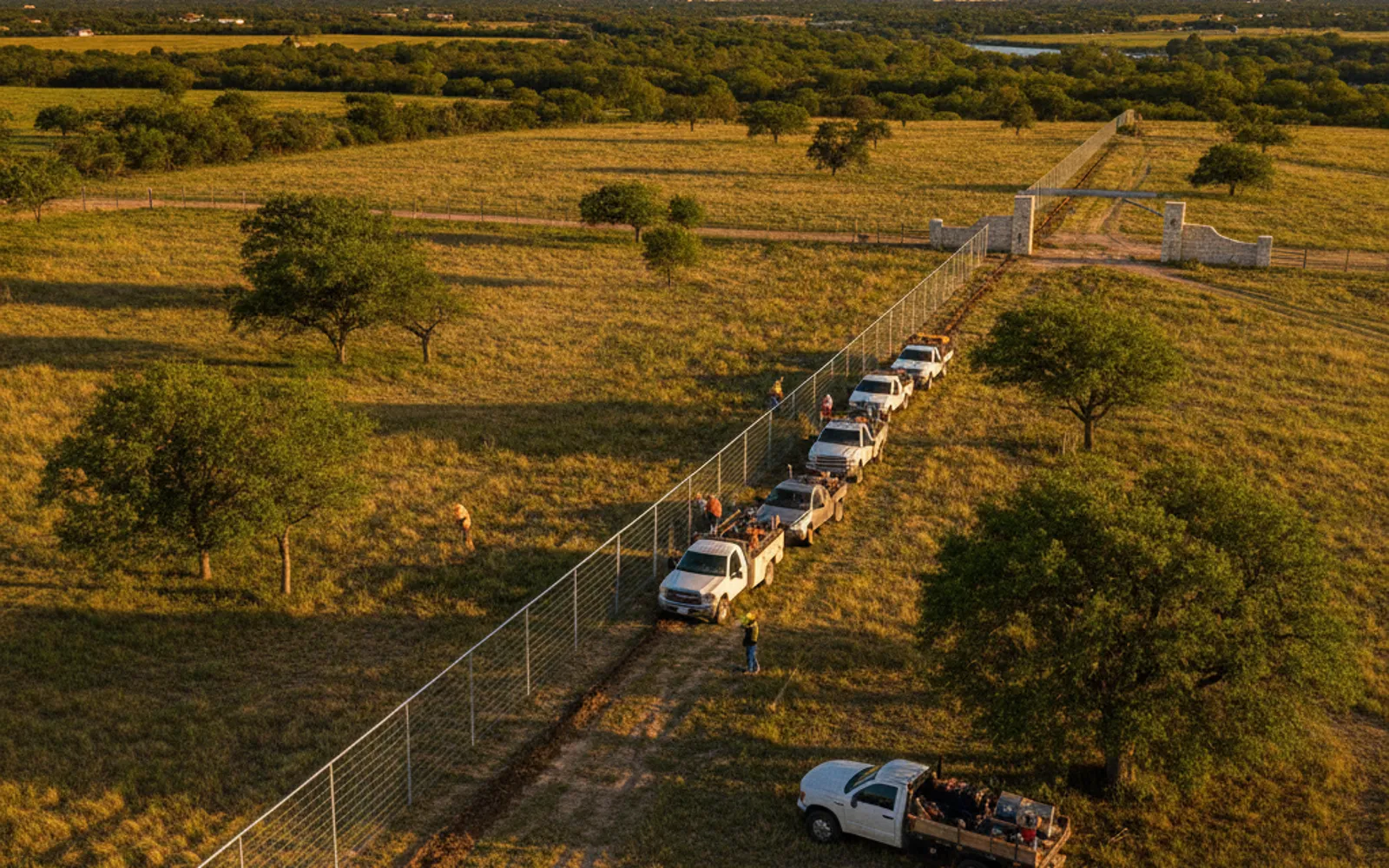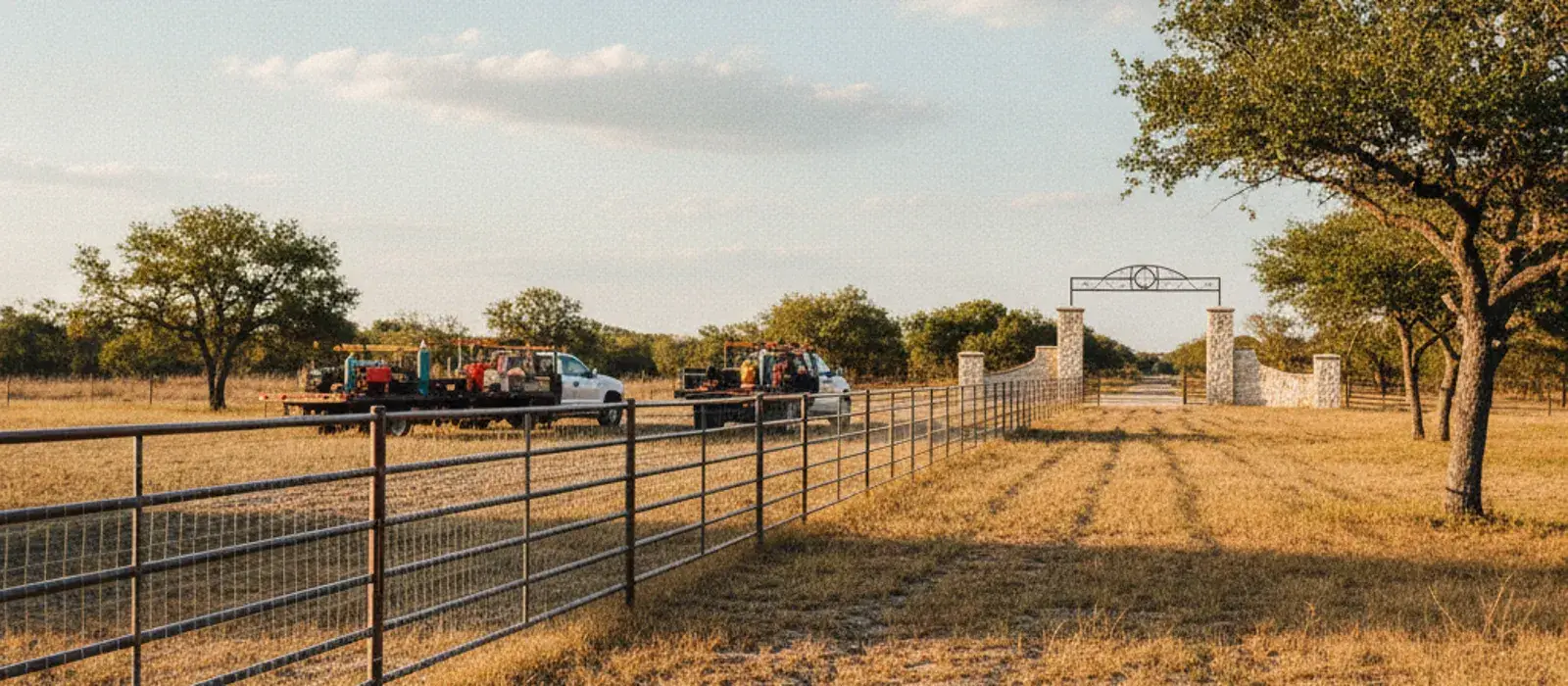
Texas has more high-fenced acreage than any other state in the country, and here’s the part that surprises most landowners: the state never inspects the fence itself. There’s no high fence permit, no state inspector, and no minimum legal height written into the game code.
So why do so many high fence projects around Waco end up tangled in paperwork, dead deer, or lawsuits with the neighbors? Because Texas high fence regulations aren’t really about the fence. They’re about what’s inside it. The wire is your business. The animals behind the wire are a whole different story, and that’s where folks get burned.
We build game fence all over McLennan, Bosque, and Falls counties, and we’ve watched smart people make expensive mistakes because nobody explained the rules in plain English. This article fixes that.
What Texas High Fence Regulations Actually Cover
Let’s clear up the biggest misunderstanding first. In Texas, you can build an 8 foot fence around your property tomorrow without asking anyone’s permission, as long as it’s on your own land and outside any road right of way or utility easement. No state agency signs off on the fence.
What the state does regulate, and regulates hard, is deer. Native white-tailed deer and mule deer are property of the State of Texas, even when they’re standing inside your high fence. Building the fence doesn’t make them yours. You can’t sell them, you can’t trap them and haul them to your buddy’s place, and you can’t buy “some deer” off Craigslist to stock your new pen.
Texas Parks and Wildlife Department (TPWD) controls everything involving native deer through a permit system:
- Deer Breeder Permit: lets you hold and sell captive-bred whitetails from a registered facility. These are the only whitetails that can legally be bought and sold.
- Triple T Permit (Trap, Transport, Transplant): lets qualified landowners move wild deer between approved properties. It’s not a purchase program, and TPWD has tightened it in recent years because of chronic wasting disease.
- Deer Management Permit (DMP): lets you temporarily pen wild deer for breeding purposes on your own place.
- Managed Lands Deer Program (MLDP): not required for a high fence, but most serious high-fenced operations enroll because it gives you extended seasons and custom harvest quotas tied to a management plan.
Current rules and season details live in TPWD’s Outdoor Annual, and they change often enough that you should check before every project and every season.
If you’re planning a high fence and want real numbers before you talk permits, call us at (254) 870-8898. Estimates are free and written, and we’ll tell you straight what your ground needs.
High Fence Rules for Native Whitetail: Where Landowners Get Burned
Here’s a story we tell every new high fence customer. Rachel Dunn bought 90 acres outside Valley Mills in 2024 and had us quote a high fence so she could “buy a dozen good does and a nice buck” and build her own herd. She’d budgeted about $5,000 for deer.
Then she learned the rules. Wild whitetails can’t be purchased at any price. The only legal route was buying breeder deer from a permitted facility, and pen-raised bred does were running $2,500 to $4,000 each, with quality bucks a lot higher. Her $5,000 stocking budget turned into a $30,000 line item, plus release requirements and disease testing paperwork on every animal that came through the gate.
She still did the project, but she did it two years slower than planned. That’s the pattern with native deer: the fence is the easy part.
A few more rules that catch people off guard:
- Hunting inside a high fence is still hunting. Seasons, bag limits, and license requirements all apply to native deer unless you’re enrolled in MLDP with its own tag system.
- Chronic wasting disease (CWD) rules follow the deer, not the fence. If you bring in breeder deer, the source facility’s testing status matters, and a CWD trace can freeze movement on and off your property.
- A high fence can change your neighbors’ hunting too. Deer that used to cross four properties now live on one. That’s legal, but it’s the number one source of hard feelings, so talk to the folks next door before the first post goes in.
Texas High Fence Laws for Exotics: Axis, Blackbuck, and Friends
Exotics play by a completely different rulebook, and it mostly works in your favor. Axis deer, blackbuck antelope, fallow deer, aoudad, and other non-native hoofstock are legally livestock in Texas. They’re your private property, there’s no closed season, and no bag limit. You still need a valid hunting license to hunt them, but that’s about it from the state’s side.
The catch is the flip side of ownership: exotics are only yours while they’re on your land.
Marcus Teague learned that one the hard way near Crawford. He stocked 14 axis does at about $800 a head before his fence was fully finished. One stretch along the creek was still old 6 foot net wire from the previous owner. Axis are strong jumpers, and within a month, 11 of those does had cleared that low section and scattered. Two got taken legally by a neighboring hunter, because a free-ranging exotic on someone else’s land is fair game for anyone with a license and permission to hunt there. Marcus was out roughly $9,000 in animals plus the cost of fixing the fence he should’ve finished first.
Two more things to know on exotics:
- The Texas Animal Health Commission (TAHC), not TPWD, handles disease rules for exotic livestock. CWD-susceptible exotics like elk, red deer, and sika have their own movement and testing requirements. Check tahc.texas.gov before you buy or move those species.
- Escaped exotics can create liability. If your aoudad ends up causing a wreck on a county road, you’ll want to show you maintained a fence adequate to contain them. That’s the same standard logic we cover in our post on who’s responsible when livestock hit the road, and it applies double to animals that can clear a cattle fence without breaking stride.
Fence Specs That Actually Hold Deer and Exotics
Since the law doesn’t set a height, the animals do. The industry standard in Central Texas is 8 feet, built with 96 inch fixed knot wire on line posts, with taller pipe posts at corners and gates. A healthy whitetail can clear 7 feet from a standing start when it’s motivated. Axis are worse. Nilgai and elk push the strength requirements more than the height.
Here’s how a true game fence compares to the other fencing on a typical ranch:
| Fence type | Typical height | Installed cost per foot (Central TX) | What it holds |
|---|---|---|---|
| 5-strand barbed wire | 48 to 54 in | $3 to $5 | Cattle |
| Net wire (field fence) | 48 in | $5 to $8 | Cattle, goats, sheep |
| 8 ft fixed knot game fence | 96 in | $15 to $25 | Whitetail, axis, most exotics |
| Game fence with apron or hot wire | 96 in plus | $18 to $30 | Adds hog and dig-under protection |
A few spec points that matter more than most people think:
- Fixed knot beats hinge joint for high fence, period. The solid knot keeps vertical stays from shifting when a 200 pound animal hits the wire. We break down the difference in fixed knot vs hinge joint wire.
- Corners and gates carry the whole fence. An 8 foot fence puts serious leverage on corner assemblies. Skimp there and the whole run sags inside five years.
- Feral hogs will test the bottom. Hogs don’t jump, they root under. A buried apron or a low hot wire saves you from the constant repairs we describe in feral hog fence damage.
- Gates have to match the fence. A beautiful 8 foot fence with a 6 foot gate is a 6 foot fence. We build matching tall gates as part of our ranch entrance gate work in Waco.
Ready to get a real spec for your place? Request a free written estimate and we’ll walk the property lines with you.
Property Lines, Neighbors, and County Rules Around Waco
The state may not permit your fence, but geometry and neighbors still can wreck a project. Three local issues come up on almost every high fence job we quote in McLennan, Bosque, and Falls counties.
First, the property line itself. Texas law doesn’t force your neighbor to pay for any part of a fence, high or low, and it doesn’t give you the right to set posts on their side. Best practice is building 6 to 12 inches inside your own line so every post, brace, and inch of concrete is unquestionably yours. Get a survey if there’s any doubt. A fence built even slightly over the line is a problem that only gets more expensive with time. Our post on fence on the property line in Texas covers the details.
Second, right of way and easements. County road rights of way, pipeline easements, and utility easements all restrict where an 8 foot fence can go. Most easements allow fencing but require gates or specific clearances. Read your easement documents before you order 300 rolls of wire.
Third, water crossings and floodplains. High fence across a creek needs engineered water gaps that swing or break away in a flood. If you’re in a mapped floodplain, check with the county floodplain administrator before building a solid barrier across a drainage. A washed-out quarter mile of game fence is a five-figure repair.
What a High Fence Really Costs in Central Texas
Now the numbers, because everybody asks. At $15 to $25 per foot installed, a mile of 8 foot game fence runs roughly $80,000 to $130,000 depending on terrain, rock, brush clearing, and gate count. That’s not a typo. High fence is the most expensive wire fence you can build, and it’s priced like it.
Danny Kolar runs 210 acres a few miles west of West, and in 2025 we built him 1.3 miles of 8 foot fixed knot, two 16 foot tall-frame gates, and three water gaps. Rocky ground on the north line meant drilling instead of driving posts. His final invoice landed just under $140,000. He’d gotten a lowball bid at $95,000 from an outfit that planned to use hinge joint wire and T-post corners, and he was smart enough to ask why the bids were so far apart. The cheap version would’ve been a very expensive cattle fence, not a deer fence.
Budget honestly, and budget for the whole system: fence, gates, water gaps, clearing, and stocking if you’re going that route. Our game fence cost guide breaks the per-foot math down line by line.
One safety note before you grab an auger and a pallet of wire. Stretching high-tensile fixed knot wire stores enormous energy, and 8 foot fence work means heavy posts, tall ladders, and hydraulic equipment. A snapped stretch of high-tensile wire can cut you badly. Small repairs on existing fence are fine DIY territory. Building a mile of high fence is not. If any part of the job involves stretching full-height game wire or setting pipe corners in rock, call a professional crew.
That’s what we do all day. Our game fence installation team in Waco handles permits questions, surveys, specs, and the build itself, and our estimates are always free and in writing. Call (254) 870-8898 or reach us here, day or night. The emergency line runs 24/7, because deer don’t wait for business hours and neither do storm-flattened fences.
Frequently Asked Questions
Do I need a permit to build a high fence in Texas?
No state permit is required to build the fence itself on your own property. What requires permits is holding, moving, buying, or breeding native white-tailed deer, all of which run through TPWD. Check easements, road rights of way, and floodplain rules with your county before you build.
How tall does a Texas high fence have to be?
The law sets no minimum height, but 8 feet is the working standard because whitetails can clear 7 feet and axis deer jump even better. Most builds use 96 inch fixed knot wire with taller pipe posts at corners and gates. Going shorter to save money usually means paying for the fence twice.
Who owns the deer inside my high fence?
Native white-tailed and mule deer belong to the State of Texas no matter whose fence surrounds them, so seasons, licenses, and bag limits still apply. Exotics like axis and blackbuck are your private property while they’re on your land. Once an exotic escapes onto a neighbor’s place, anyone hunting there legally can take it.
Can I make my neighbor split the cost of a high fence on the property line?
No. Texas law doesn’t obligate a neighboring landowner to contribute to any fence, and you can’t set posts on their side of the line without permission. Build inside your own boundary, get a survey if the line is uncertain, and have the cost conversation before construction, not after.