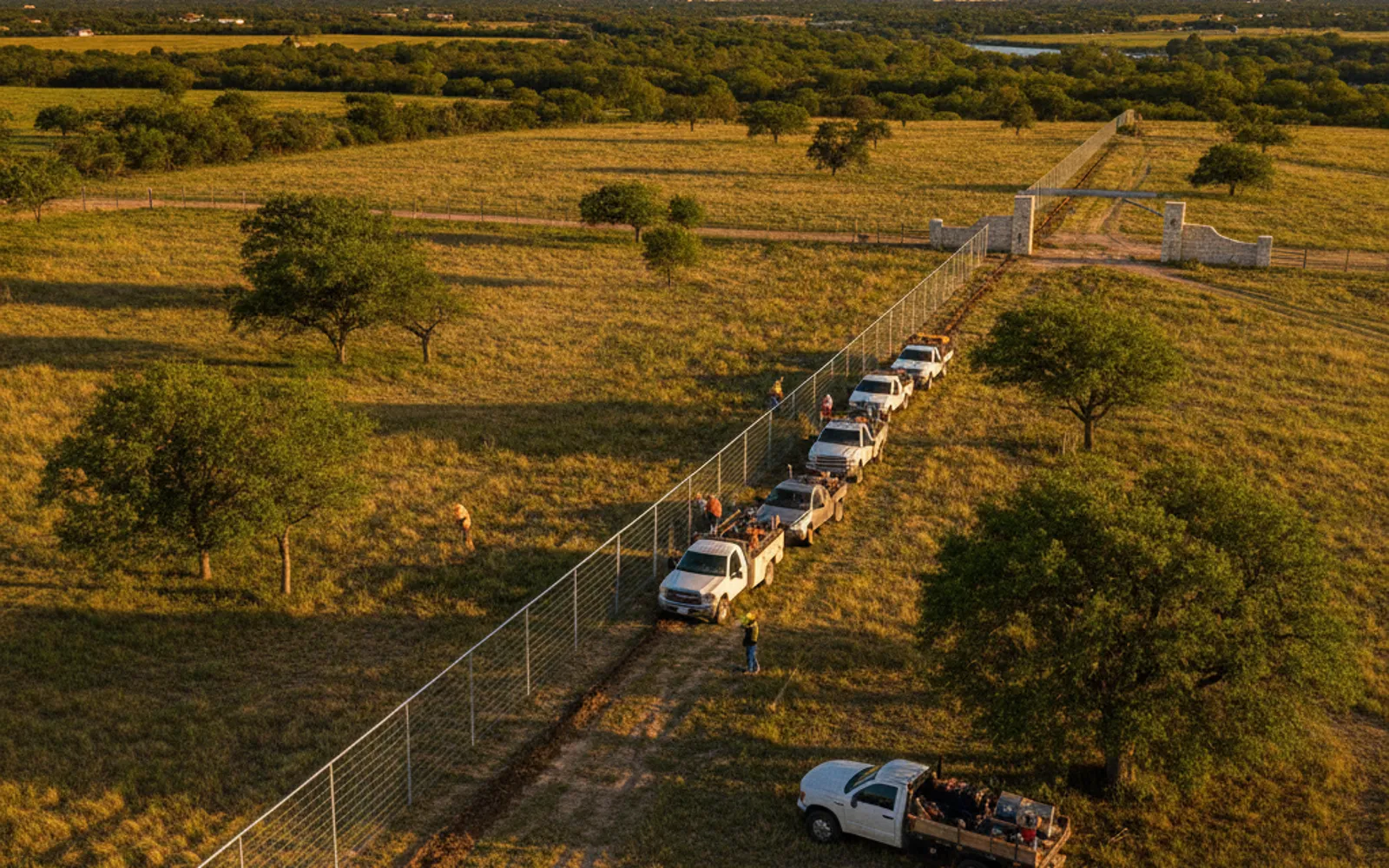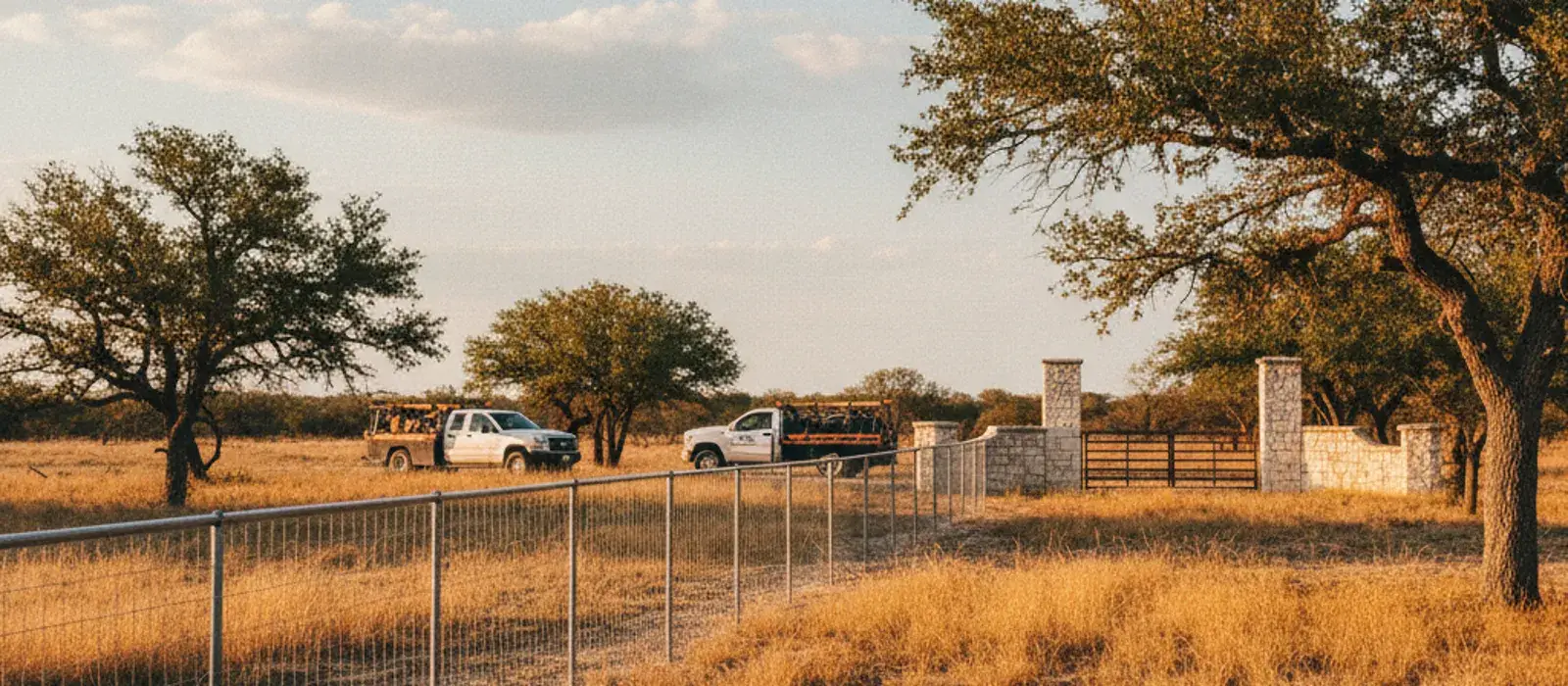
A fence built three feet over the line can end up costing more than the fence itself. We’ve seen it happen more than once around Waco, and it always starts the same way: a landowner points at an old cedar post or a rusted wire and says, “that’s the line, it’s always been the line.”
Sometimes it is. Plenty of times it isn’t. If you’re planning a fence on the property line in Texas, the smartest $400 to $700 you’ll ever spend is a boundary survey before the first post goes in the ground. This article walks through why that survey matters, what Texas law actually says about line fences, how to handle the neighbor conversation, and where the real dollar risks hide.
Why Every Fence on the Property Line in Texas Starts With a Survey
Here’s the uncomfortable truth about rural land in McLennan, Bosque, and Falls counties: a lot of the old fences out here were never on the line to begin with. Crews in the 1950s and 60s built where the ground was easiest, not where the deed said. They dodged rock, skipped creek crossings, and followed tree lines. Then sixty years passed and everybody just assumed the fence was the boundary.
When you replace one of those fences, you inherit the mistake. And unlike a sagging wire, a boundary mistake doesn’t get cheaper with time.
A rancher we’ll call Dale, out near Crawford, learned that the hard way in 2024. He replaced 1,400 feet of old net wire with new 5-strand barbed wire along what he figured was his east line. Total job ran about $9,200. Eight months later his neighbor sold, the buyer ordered a survey, and the new fence turned out to sit 15 feet inside the neighbor’s tract for most of its run. Dale ended up pulling posts, re-drilling holes, and rebuilding on the true line. The do-over added roughly $4,100 to a fence that was already paid for. A survey up front would’ve cost him about $600.
That’s the math in one story. The survey is a rounding error next to the fence. The mistake is not.
If you’re pricing a line fence right now and want real numbers before you commit, call us at (254) 870-8898. Estimates are free and in writing, and we’re happy to walk the line with you before anybody digs.
What Texas Property Line Fence Laws Actually Say
Texas fence law surprises people, mostly because of what it doesn’t say.
First, Texas has no statewide statute that forces your neighbor to split the cost of a boundary fence. If you build it, you pay for it, unless the two of you agree otherwise. That’s different from a lot of other states, and it’s the number one thing landowners get wrong. We covered the cost-sharing question in detail in our post on who pays for a fence between neighbors in Texas.
Second, most of rural Texas is still legally open range, meaning livestock owners aren’t automatically required to fence animals in. Counties and voters can flip that with local stock laws, and most Central Texas counties have. Where a stock law applies, you’re fencing cattle in, not fencing them out. Our breakdown of the Texas open range law explains which rules apply where, and why it matters if a cow ends up on FM 185.
Third, the state’s main fence statute, Texas Agriculture Code Chapter 143, deals mostly with what counts as a “sufficient fence” and with stock laws, not with who owns a boundary fence or where it must sit. That question comes down to your deed, your survey, and any written agreement with the neighbor.
One more wrinkle worth knowing: if a fence sits off the true line long enough and both sides treat it as the boundary, doctrines like adverse possession and acquiescence can come into play. That’s lawyer territory, not fence-builder territory, and it’s exactly the kind of mess a survey prevents.
Survey Cost vs. Mistake Cost: The Real Numbers
People balk at survey quotes until they see what the alternative runs. Here’s how the numbers typically stack up in our area. Survey prices vary with tract size, terrain, and how findable the original corner markers are.
| Item | Typical Cost in Central Texas | Notes |
|---|---|---|
| Boundary survey, 10 to 25 acres | $400 to $900 | More if corners are lost or brush is heavy |
| Boundary survey, 50 to 200 acres | $900 to $2,500 | Often priced per corner or per acre |
| New 5-strand barbed wire fence | $2.50 to $4.50 per foot | See our barbed wire fence cost guide |
| Tearing out and rebuilding a misplaced fence | $4 to $7 per foot | Removal plus rebuild, often in worse ground |
| Attorney fees in a boundary dispute | $3,000 to $15,000+ | Before anyone touches a fence |
| Losing a strip of land to adverse possession | Whatever that acreage is worth | Plus the neighbor relationship |
Read that table bottom to top and the survey starts looking like the cheapest line item on the whole project. On a mile of fence, even a small angle error compounds. Two degrees off at the starting corner puts you about 180 feet off the mark by the far end of a mile run.
Find a licensed surveyor through the Texas Board of Professional Engineers and Land Surveyors, which keeps a public license lookup. Ask for a boundary survey with corners marked and flagged, and tell them a fence crew will be building to those stakes.
Talk to Your Neighbor Before You Set the First Post
The legal side matters, but out here the neighbor side matters just as much. You’re going to share that line for decades. A ten-minute phone call before you build saves years of cold shoulders at the co-op.
Marcus, who runs cattle on about 60 acres outside China Spring, did this the right way in early 2025. His shared west line fence was shot: rotten posts, rusted wire, cattle testing it weekly. Instead of just building, he took our written estimate to his neighbor, and they agreed in writing to split a $7,800 rebuild straight down the middle. Each side paid $3,900, both herds stayed put, and both tracts got more valuable. No statute made that happen. A conversation did.
When you talk to your neighbor, cover four things and put them on paper:
- Where the fence will sit, referenced to the survey, on the line or inside it
- Who pays what, including future repairs
- What kind of fence it’ll be, since a shared fence should hold both owners’ livestock
- Who maintains which stretch going forward
Even a one-page signed agreement beats a handshake when one of the properties sells. And they all sell eventually.
If you’d like a written estimate you can hand your neighbor, request one here. It costs nothing and it turns a vague conversation into a real number.
On the Line or Inside It: Where Should the Fence Actually Go?
Once the survey stakes are in, you’ve got a genuine decision to make. There are three ways to place a boundary fence, and each has trade-offs.
Centered on the line. The classic shared fence. Posts straddle the boundary, both owners typically treat it as joint property. Best when both neighbors agree in writing on cost and upkeep. Risky when they don’t, because now you co-own a fence with someone who may not maintain their end.
Fully inside your line. You set the fence six inches to a couple feet inside your boundary. It’s 100 percent yours: your fence, your rules, your maintenance schedule, and nobody can touch it. The cost is a sliver of grazing you give up along the run, and you’ll still want to keep the strip on the far side from growing up in brush.
Well inside your line. On rough country, some owners pull the fence back 10 or 20 feet to dodge a creek bank, a rock ledge, or a stand of cedar. Practical, but mark the true corners anyway so the fence doesn’t get mistaken for the boundary by the next owner.
Consider this couple’s experience near Valley Mills. The Hendersons bought 25 acres in 2023 and assumed the old south fence was their line. Their $650 closing survey showed the fence sat almost 30 feet inside their deeded boundary for a quarter mile. That strip worked out to nearly three quarters of an acre they were about to fence themselves out of. They built the new fence on the surveyed line, with corners set as proper H-braces, and picked up land they’d already paid for.
Whatever placement you choose, build it once and build it stout. On property lines we usually recommend either a heavy 5 or 6 strand barbed wire fence for cattle country or a pipe fence where the line fronts a road or a headquarters area and you want something that shrugs off vehicles and time.
When to Stop Guessing and Call a Pro
There’s plenty of fence work a handy landowner can do. Stretching wire on a short, flat, surveyed run with a helper and a good stretcher is a fair weekend project.
But some situations call for stopping and picking up the phone:
- You can’t find your corner markers, or the deed calls don’t match what’s on the ground. That’s a surveyor first, then a fence crew.
- The neighbor disputes the line. Do not build anything until that’s settled. A fence built into a live dispute becomes evidence, and sometimes a demolition bill.
- The line crosses a creek, a county road right of way, or a utility easement. Water gaps and easement rules trip up even experienced hands.
- The run is long. At a half mile or more, small layout errors compound, and corner bracing has to be dead right or the whole fence sags inside five years.
- There’s any question about stock law status and your liability if cattle get out onto a road.
We build property line fences across McLennan, Bosque, and Falls counties, and we build to survey stakes, not to guesses. We’re licensed and insured, every estimate is free and in writing, and if a storm drops a tree across your line fence at 2 a.m. and the cattle are walking, our emergency line answers around the clock.
Get the survey. Have the neighbor conversation. Then let’s build a fence that’ll still be on the right line thirty years from now. Call (254) 870-8898 or request your free written estimate today.
Frequently Asked Questions
Can I build a fence directly on the property line in Texas?
Yes, if it’s truly on the line and your neighbor doesn’t object, though the smart move is a written agreement first. A fence centered on the boundary is generally treated as shared, which means shared decisions about repairs and replacement. If you want full control of the fence, build it a short distance inside your own line so it’s entirely on your property.
Does my neighbor have to pay for half the fence in Texas?
No. Texas has no statute requiring a neighbor to share the cost of a boundary fence, so whoever builds it pays for it unless both parties agree otherwise. Many neighbors do split costs voluntarily since both sides benefit. Get any split in writing, including who handles future repairs.
How much does a property line survey cost before building a fence?
For typical small acreage around Waco, expect roughly $400 to $900, with larger or brushier tracts running $900 to $2,500 or more. Price depends on tract size, terrain, and whether the original corner markers can be found. Compared to tearing out and rebuilding a misplaced fence at $4 to $7 per foot, the survey is cheap insurance.
What happens if my fence is over the property line?
Best case, the neighbor doesn’t mind and you sign an agreement acknowledging the fence isn’t the boundary. Worst case, you’re required to remove and rebuild it, and if the encroachment stands long enough, boundary doctrines like adverse possession can even shift ownership of the strip. If you discover an encroachment, talk to the neighbor early and get a real estate attorney involved before anyone pulls a post.