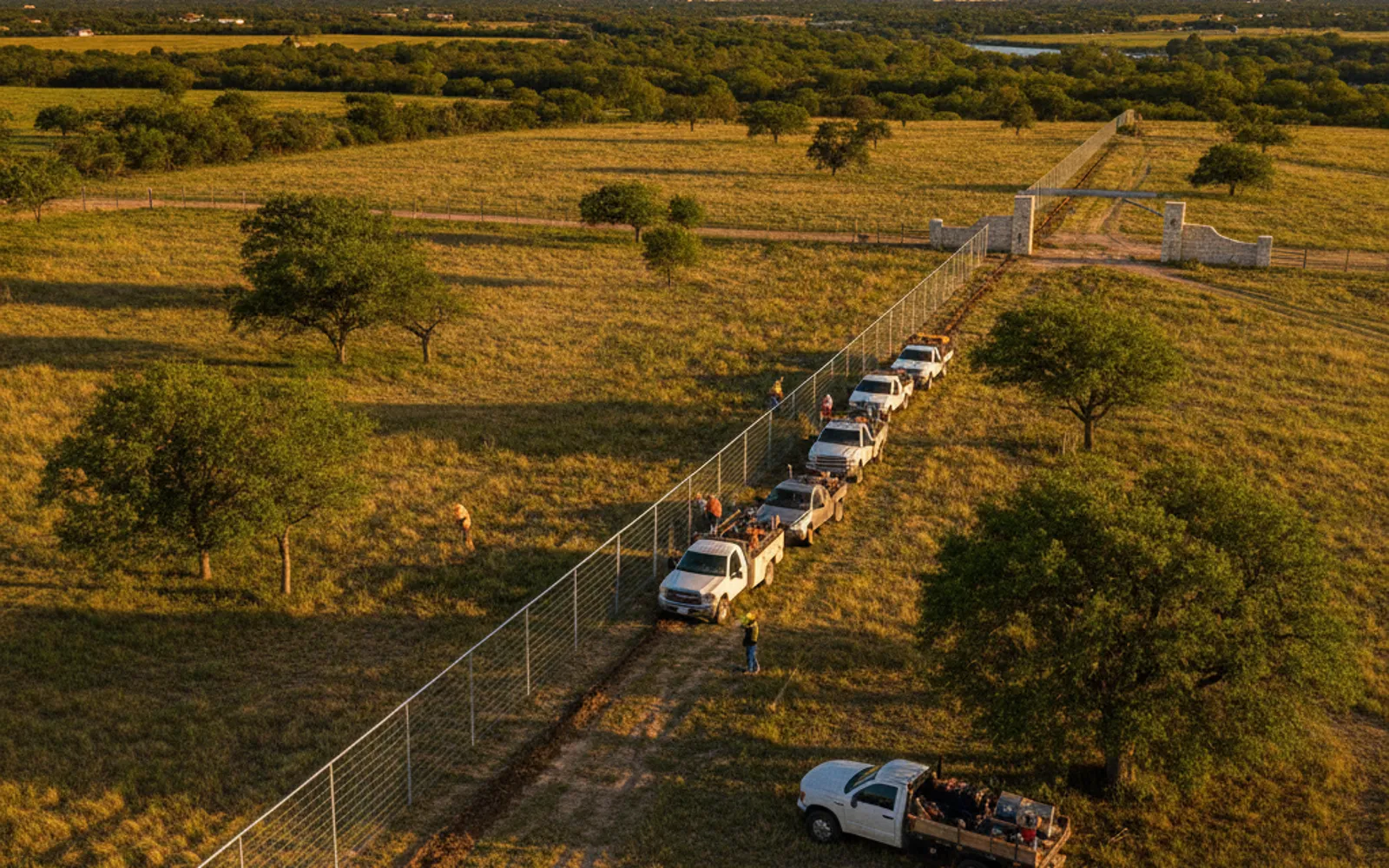
A horse can be grazing quietly at dusk and tangled in wire before full dark. The fence does not have to fail for that to happen. It only has to be the wrong fence for the animal standing behind it.
Picking the safest fence for horses is really a question about injury risk. Every fence type carries a different kind, and the difference between a bad night and a routine one usually comes down to what the fence is made of, whether the horse can see it, and whether a leg fits through it.
We build ranch fence around Waco, in McLennan, Bosque and Falls counties, and we build plenty of barbed wire for cattle people. We do not put horses behind it. What follows is how the common fence types rank on risk, what each costs per foot installed, and where the money is worth spending on a horse place.
If you already have horses standing behind old wire and it worries you, do not wait on an article. Call (254) 870-8898 and we will come walk the line with you. On-site estimates are free.
The Four Ways a Fence Injures a Horse
Almost every fence injury we get called out to look at falls into one of four buckets. Knowing which bucket a fence puts you in tells you more than anything printed on the wire tag.
Laceration is the one everybody pictures. Barbs and cut wire ends slice hide. A horse that hits barbed wire at speed does not bounce off it. The wire wraps, the horse fights it, and the barbs work like a saw against a moving leg. Serious wire cuts run into the thousands of dollars in vet work, and that is a general figure from the horse world, not anything we can quote.
Entrapment is the quiet one. A hoof goes through a 6 inch mesh opening, or under a slack bottom wire, or over a low top wire while the horse is reaching for grass on the neighbor’s side. The horse pulls back, the wire tightens, and most of the damage happens in the fight rather than the first contact. That is why cheap field fence hurts horses even though the wire on it is perfectly smooth.
Then there is impalement and blunt trauma. Uncapped T-post tops, broken wood rails and open pipe ends all punch instead of cutting. This is what turns an ordinary spook into a chest wound.
The fourth one is simple impact. Thin wire disappears at dusk, in rain and against tall grass, and a horse running from something it fears will go straight through a fence it never saw. Visibility is a safety feature. That is the whole argument for a top rail or a sight board on an otherwise ordinary wire fence.
Injury Risk by Fence Type: How the Common Options Rank
Here is how the fence types we see on Central Texas horse places compare. Cost columns are our installed price bands for this market, and they move with terrain, brush, and how much of the line is corner and gate work.
| Fence type | Worst injury risk | Visibility to a horse | Installed cost per foot |
|---|---|---|---|
| 5-strand barbed wire | Deep laceration, wire wrap | Poor | $2.50 to $5.50 |
| Hinge-joint field fence, 6x6 openings | Hoof and leg entrapment | Fair | $3.50 to $8 |
| No-climb 2x4 horse mesh with top rail | Bruising, little laceration risk | Good with a rail | $3.50 to $8, horse-grade mesh at the top of that band |
| Fixed-knot game fence, 8 ft | Entrapment where openings are large | Fair | $4.50 to $10 |
| Welded pipe | Blunt impact, scrapes | Very good | $12 to $28 |
| Electric poly tape or rope | Tangling if a line breaks | Good with wide tape | Added to another fence and priced with the job |
| Wood or vinyl rail | Splinters, broken rail edges | Very good | Not a line we build, so treat any figure you see as a general estimate |
Two things stand out on that table. The safest fences are not the cheapest ones, and the gap between a cattle fence and a horse fence is roughly the difference between $3 per foot and $8 per foot on the same run of line.
The other thing worth saying plainly: cost per foot on any of these depends on the ground. Blackland clay that a post driver walks through prices very differently from limestone that has to be drilled.
Why No-Climb Mesh Is the Safest Fence for Horses on Pasture
For most horse places under 50 acres around here, 2 inch by 4 inch woven mesh with a top rail is the honest answer. The openings are too small for a hoof to pass through, there is nothing sharp on it, and the top rail gives the horse something to see from a dead run.
The specification matters more than the brand. We build these at 48 to 60 inches tall, with the bottom of the mesh set close to the ground so a horse that rolls near the fence cannot get a leg under it. Class 3 galvanizing is worth the small upcharge in our humidity. Wood or pipe posts on the corners and a real H-brace at every pull, because a horse fence that sags is a horse fence with a gap in it.
A 12-acre horse place outside Lorena is a fair example. Roughly 3,000 feet of perimeter in tired 5-strand barbed wire, two mares, and an owner who had already paid for one wire cut. Horse-grade no-climb with a top rail put that job at the top of our net wire band, around $7 to $8 per foot, so about $21,000 to $24,000 for the whole perimeter.
That was more than the owner wanted to spend in one season, so we phased it. The horse trap and the paddock nearest the barn went first, about 900 feet at roughly $6,300 to $7,200, and the back line stayed barbed wire until the following year with the horses kept off it. Phasing a horse fence is normal and it beats doing the whole thing in the wrong material. More on the mesh itself is in our no-climb horse fence guide, and the service page for this work is horse fence in Waco.
Pipe Fence: The Safest Option Where Horses Get Crowded
Injury risk is not evenly spread across a property. Most horse wrecks happen where horses are gathered, sorted, fed, or worked, which is exactly where wire is least appropriate.
Welded pipe is the safest thing we build for pens, alleys, round pen walls, and stallion runs. A horse that hits pipe slides along it instead of tangling in it, there is nothing to cut with, and the fence does not deform when a 1,100 pound animal leans on it. It also does not care about a horse cribbing, pawing or kicking at it.
The price is the tradeoff. Welded pipe runs $12 to $28 per foot installed depending on pipe diameter, rail count and how much gate work is in it. That is real money on a perimeter, which is why the usual layout on a horse place is pipe where horses are handled and no-climb on the pasture line.
A small place near China Spring did exactly that. About 220 feet of pipe around the working pens and the alley to the trailer, then mesh on the pasture perimeter. The pipe section landed in the middle of that band, in the neighborhood of $4,000 for the pens, and it will outlive everything else on the property. Details are on our pipe fence and corrals and working pens pages.
If you are trying to decide where pipe earns its price on your place, that is a walk-the-fence-line conversation rather than a phone quote. Ask for a free on-site estimate and we will price it in sections so you can see what the safety is costing you per foot.
The Fences Behind Most of the Wrecks
Barbed wire is a good cattle fence. A 300-acre cattle lease west of Crawford is exactly where it belongs: five strands, T-posts on 12 foot spacing, wood corners, $2.50 to $5.50 per foot or roughly $13,200 to $29,000 per mile depending on the ground and the brush. Cattle are thick hided and slow to panic, and the barbs teach rather than injure.
Horses are the opposite animal. They run first, they run into things, and their skin tears. Penn State Extension says it plainly in its fence planning guide for horses, and University of Georgia Extension reaches the same conclusion in its bulletin Fences for Horses. This is not a fencing contractor’s opinion, it is the standing recommendation from the extension services.
The second common problem is cattle-grade hinge-joint field fence used on a horse pasture. It looks like the right idea, and it is smooth wire, but 6 inch by 6 inch openings in the upper part of the roll are big enough for a hoof and small enough to trap it. Cattle fence and horse fence come off different rolls for a reason, and the roll is where the safety difference lives.
Third is a single strand of hot wire on step-in posts used as a real fence rather than as a training aid. Electric is a psychological barrier, not a physical one. It works well on top of a solid fence to keep horses off it, and it fails badly as the only thing between a spooked horse and a county road. We cover the details, including grounding problems in dry ground, in electric fence for horses.
Fourth, and the cheapest to fix, is uncapped T-posts. Caps or post sleeves are a few dollars per post and they remove an impalement risk entirely. If nothing else on this page gets done this month, do that one.
Where Safe Fences Still Fail
A well-specified fence still hurts horses if the details are wrong, and the details are where corners get cut on a low bid.
Gates are the first place to look. A tube gate with wide horizontal spacing is a leg trap for a horse that paws at it, and the gap between the gate end and the post is where hooves get caught. On horse gates we either fill the gate with mesh or keep the frame tight to the post. Corners are the second place, because a horse that gets pushed into a sharp corner by a pasture mate has nowhere to go.
Ground conditions drive both cost and safety here. A limestone hill section near Valley Mills is a good example: about 1,400 feet where nearly every post had to be drilled rather than driven. Rock work put that run at the top of the net wire band at roughly $8 per foot, where the same fence on flat blackland clay would have come in nearer $5.50. Shortcutting post depth in rock is how you get a fence that leans in two years, and there is more on that in fence posts in rocky ground.
Our clay does its own damage. It shrinks in drought, opens cracks around posts, then swells when the rain comes back, and a fence that was tight in May can be loose in September. On horse fence that matters more than on cattle fence, because a sagging top rail or a slack mesh is exactly what a leg goes over or through.
Walk your fence line twice a year with a pair of fencing pliers and look for three things: slack in the mesh, wire ends that have worked loose, and posts that have started to lean. Anything you can move with one hand, a horse can move with its chest. Full price bands for every fence type we build are on the ranch fence cost page, and if you want a number for your own place, call (254) 870-8898 and we will come look at it.
Frequently Asked Questions
Is barbed wire ever safe for horses?
No, and the extension services have been consistent about this for decades. Barbed wire is a proper cattle fence and we build a lot of it, but on horses it causes wrapping lacerations that are expensive at best and career-ending at worst. If barbed wire is what you have, the practical step is to fence the horses off it with a safer interior line rather than trusting the horses to respect it.
How tall should a safe horse fence be?
For most riding horses, 54 to 60 inches at the top wire or rail. Ponies and minis can be kept in lower fences, but the risk is a horse getting a leg over a low top wire, so we would rather build to 60 inches on any line a horse can reach across at a neighbor’s pasture. Height matters less than the size of the openings and whether the horse can see the fence.
Can I make my existing fence safer without replacing it?
Often, yes. Capping T-posts, adding a visible top rail or a wide electric tape at chest height, tightening slack mesh, and filling gate openings all reduce risk for a fraction of a rebuild. Whether that is enough depends on what the fence is made of, so it is worth having someone walk the line with you before you spend money on either option.
What does the safest horse fencing cost per foot around Waco?
Horse-grade no-climb mesh with a top rail sits at the upper end of our net wire band, $3.50 to $8 per foot installed, with most horse jobs landing at the top of that range. Welded pipe runs $12 to $28 per foot and is usually reserved for pens and working areas. Final numbers depend on terrain, brush, corner and gate count, so we quote after walking the line, not before. If you are comparing options first, the best fence for horses guide sets them side by side.