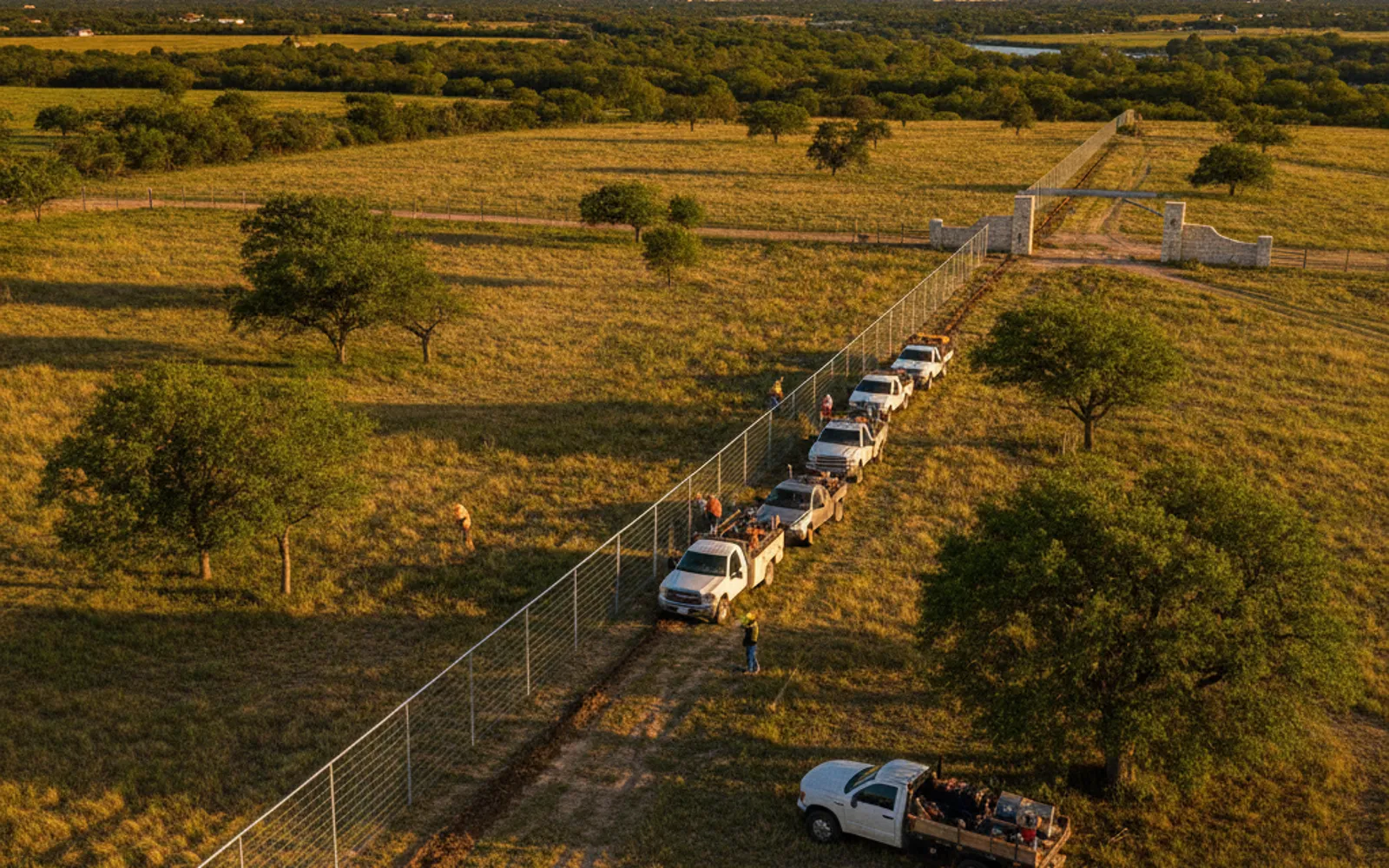
For most people working full-size horses, the right round pen size is 50 to 60 feet across. Fifty feet is plenty for lunging and groundwork. Sixty feet is the better all-round number if you plan to start colts or ride in it, because a young horse carrying a rider for the first time needs room to move out and find his balance. Go under 40 feet and a big horse cannot lope a circle without cramping. Go much past 70 and you lose the point of a round pen, which is keeping the horse close enough that your body position still means something to him.
Size is only half of it. Wall height, panel style, gate placement and footing matter just as much, and on Central Texas ground the footing is where most pens go wrong. Blackland clay turns to grease after a rain and to brick in August.
To have someone look at your ground and tell you what fits, call (254) 870-8898 for a free on-site estimate anywhere in McLennan, Bosque or Falls counties.
Round pen size by use
Most round pens for saddle horses fall between 50 and 60 feet in diameter. The horse needs a circle big enough to travel on without bending so hard he loses his balance, and the handler needs to stay close enough in the middle to drive and draw him.
| Diameter | Circumference | Area (approx.) | Best for |
|---|---|---|---|
| 35 to 40 ft | 110 to 126 ft | 960 to 1,260 sq ft | Minis, ponies, weanlings, a holding pen for one horse |
| 50 ft | 157 ft | 1,960 sq ft | Lunging, groundwork, liberty work with a finished horse |
| 60 ft | 189 ft | 2,830 sq ft | Starting colts, first rides, general use with a full-size horse |
| 66 to 80 ft | 207 to 251 ft | 3,420 to 5,030 sq ft | Riding and loping, big or long-strided horses |
Smaller is not safer for a green horse. A 40-foot circle forces a hard bend at the lope, and a nervous colt that cannot find his feet tends to cut in toward the handler or try to leave over the wall. Sixty feet gives him somewhere to go.
Bigger is not better for groundwork. Past about 70 feet you are walking a lot to stay in position, and the horse can get far enough away to tune you out.
Match it to the horse. A 17-hand warmblood needs more room than a 14.2 cow horse. Minis and ponies do fine at 35 to 40 feet.
How many round pen panels you need
Portable round pens are built from straight panels, so the “circle” is really a polygon, and the diameter depends on how many panels you use and how long they are. Twelve feet is the common panel length. Counting the gate panel as one, 12-foot panels give you roughly:
- 10 panels: about 37 to 39 feet across
- 13 panels: about 49 to 50 feet across
- 16 panels: about 60 to 61.5 feet across
- 20 panels: about 76 to 77 feet across
The first number is flat side to flat side, the second corner to corner. Ten-foot panels make a rounder pen for the same diameter, but you need more of them and there are more joints to work loose. Decide the final size before you buy; pens added onto a few panels at a time tend to end up lopsided.
How tall should round pen walls be
Penn State Extension’s fence planning guide for horses puts general horse fence at 54 to 60 inches, on the idea that the top of the fence should sit about at the withers. The University of Georgia’s Fences for Horses bulletin goes a little higher for small enclosures: for paddocks, corrals and stallion pens, the top of the fence should be at eye level with the horse’s head held naturally, usually 4 to 6 inches above the withers.
A round pen is a small enclosure where you are deliberately putting pressure on the horse, so build to the high end of that:
- 5 feet (60 inches): a common panel height, fine for broke horses doing groundwork.
- 6 feet: what we would build for starting colts, stallions, or any horse with a history of going over things. The extra foot is cheap next to a horse hung on a top rail.
Solid walls or open rails
Solid walls keep a horse’s attention inside the pen. He cannot see the herd across the fence or the dog running the drive, so he is more likely to stay on you, and there is no gap for a leg to go through. The tradeoff in Texas is heat. A fully solid pen in July holds still, hot air at horse height by mid-morning.
A common compromise is a solid band on the lower few feet with open rails above for airflow. Some colt-starting pens also slope the walls outward so a rider’s knee does not scrape on the first rides. That only pays if you start a lot of horses.
For open-rail pens, aim for 5 or 6 rails with no gap big enough for a hoof, and look hard at where panels meet. The joints are where a horse pawing at the wall catches a foot.
Permanent pipe round pen vs portable panels
This is the real decision for most people, and there is a good case for each.
Portable panels
Portable panels go up in an afternoon with two people and need no holes. You can move the pen, take it with you if you sell, or use the panels elsewhere. For groundwork with a sensible horse, a heavy set of panels is fine.
The weaknesses show up with a horse that leans, rears or hits the wall. Pin-and-sleeve or chain connectors loosen over time, the pen walks across the ground as horses push on it, and panel feet that stick inward can catch a hoof. If you go portable, pick panels with more rails and heavier tubing, check every connection before you work a horse, and anchor the pen so it cannot creep. Our post on the safest fence for horses covers why rigid pipe beats anything that flexes when a horse hits it.
Welded pipe
A welded pipe round pen on set posts is the one that stays put. Posts go in on a circle, rails are bent or segmented and welded on, and the whole thing becomes one rigid ring. A 1,200-pound colt leaning into it does not move it, and with paint it will outlast a set of panels by a long way.
On blackland clay the posts are the hard part. Expansive clay heaves shallow posts, and in a round pen every post has to hold its spot or the ring goes out of shape and the gate stops latching. Our guide to setting posts in clay soil covers depths and why. West of the Brazos and up into Bosque County the problem flips: thin soil over limestone and caliche, and holes that have to be drilled into rock. Both change the labor, which is why nobody should quote a round pen without seeing the ground. For post and rail sizing, see what size pipe for a pipe fence; the posts carrying a gate should be the heavier size.
What a permanent pen costs
Our welded pipe fence runs $12 to $28 per foot installed. A 60-foot round pen is about 189 feet around, so the ring alone at that band works out to roughly:
- 189 ft x $12 = about $2,270
- 189 ft x $28 = about $5,290
That is the fence line at standard pipe fence height. Six-foot walls, sheeting, a wide equipment gate, and the base and footing work below add to it, and we price those after walking the spot. A 50-foot pen is about 157 feet around and comes in proportionally lower. The full table is on our ranch fence cost page. We do not quote portable panel prices, because farm store prices move too fast for a number here to stay right.
Footing and drainage on blackland clay
A round pen concentrates hooves on a narrow track along the wall, so it wears footing faster than an arena and turns to mud faster when drainage is poor. On Central Texas clay, get this right before a panel goes up.
Pick the spot first. Use the highest, flattest ground you can spare, never a low spot or a slope that sheds water across the ring. If water runs toward the site from uphill, cut a shallow swale to turn it.
Build a base on clay. Sand dumped straight onto blackland clay works down into it within a season and leaves a sticky mess. Penn State Extension’s all-weather paddock guide lays out a method that suits a round pen on heavy ground: strip 6 to 12 inches of native soil and organic matter, lay non-woven geotextile fabric on the subgrade, then build at least 6 inches of compacted gravel (coarse stone underneath, 1-inch gravel on top), graded at a 1 to 2 percent slope so rain runs off instead of ponding.
Keep the top layer shallow. For the working surface, Penn State’s arena footing guide recommends medium to coarse, hard, sharp sand, starting at about 2 inches and adding half an inch at a time as needed. It warns that sand deeper than 6 inches is stressful to horse tendons. On a pen where the horse is always on a curve, err shallow.
Whatever the ground, plan to top up the sand and drag out the track horses dig along the wall.
Gate placement and size
Width. Penn State’s horse fence guide calls for horse-and-handler gates of at least 4 feet, 5 preferred, and 12 to 16 feet where vehicles and tractors need through. In a round pen, plan for both: a walk gate for daily use and a 12-foot gate (or a panel that swings out) so a tractor can get in to work the footing.
Flush on the inside. Hang the gate in line with the wall, with latch hardware outside or recessed, so nothing sticks into the pen. A rider’s knee runs right along that wall.
Heavy posts, no sag. A dragging gate in a round pen is more than a nuisance, because you cannot shut it fast when you need to.
Where on the circle. Many trainers keep the gate off the side facing the barn or the herd. Horses drift toward both, and stacking them in one spot gives the horse a place to hang.
A plan for a round pen that lasts
Say you have a few acres outside Lorena, a couple of saddle horses, and a colt coming up. A sound build looks like this:
- A 60-foot ring on the highest ground near the barn, graded to shed water.
- Clay stripped, fabric down, a compacted gravel base, and about 2 inches of sharp sand on top.
- Welded pipe at 6 feet, with the lower wall sheeted if you want solid sides, or 6 rails if you want airflow.
- A 5-foot walk gate plus a 12-foot equipment gate, both flush and hung on heavy posts.
If that is more than this year’s budget, 16 heavy portable panels on the same prepared base get you working now, and the base is not wasted if you go permanent later. For the rest of the place, horse pasture fencing layout covers paddocks and turnout.
We build horse fence and welded pipe pens across McLennan, Bosque and Falls counties. Call (254) 870-8898 and we will walk the spot, look at the soil and drainage, and give you a free on-site estimate for the ring, gates and base.
Frequently Asked Questions
What is the best size round pen for starting colts?
Sixty feet is a common choice for starting young horses. It is tight enough to keep the colt’s attention on you and big enough that he can lope a circle without cramping and carry a rider without feeling trapped. Some trainers go a little larger for riding. Very small pens make a green horse more likely to cut in or try to go over the wall.
How many 12-foot panels make a 50-foot round pen?
About 13 panels of 12 feet, counting the gate panel, give a pen roughly 49 to 50 feet across. Sixteen panels give about 60 feet, and ten panels about 37 to 39 feet. Because straight panels make a polygon rather than a true circle, the distance flat side to flat side is a little less than corner to corner.
How tall should a round pen be?
Five feet is a common panel height and works for broke horses. For colts, stallions, or a horse that has jumped out before, build at 6 feet. University of Georgia guidance puts corral and stallion pen fence at about eye level with the horse’s head, usually 4 to 6 inches above the withers, and a round pen is a pressure situation, so err taller.
What is the best footing for a round pen on clay?
Do not put sand straight onto blackland clay. Strip the topsoil, lay geotextile fabric, build a compacted gravel base graded to drain, then add about 2 inches of hard, sharp sand, topping up half an inch at a time. Penn State Extension warns that sand deeper than 6 inches stresses tendons, which matters more on a constant curve.
Is a pipe round pen worth it over portable panels?
If you are starting colts or working horses that lean on and hit walls, yes. Welded pipe on set posts does not walk, loosen at the joints or flex. Portable panels suit groundwork with quiet horses, renters, or a pen you may move. You can start with panels on a proper base and go to pipe later without wasting the groundwork.