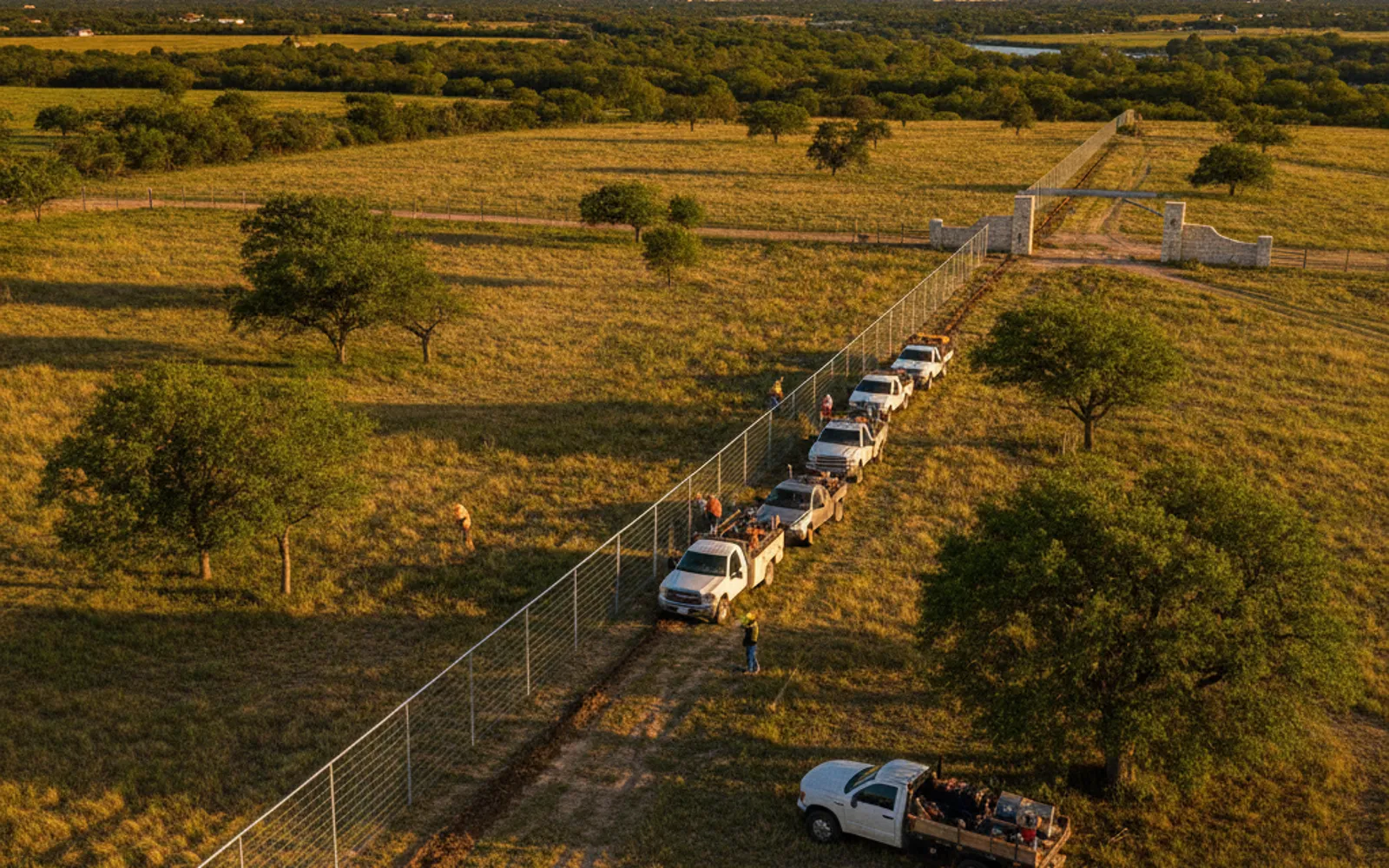
Most pipe fence around Waco comes down to six builds: full welded rail (3, 4 or 5 rails), a pipe top rail over no-climb or net wire, pipe posts strung with cable, capped posts with a clean finish, pipe corners holding a wire fence, and a mix of those along road frontage. Each one holds different stock and looks different from the road. Pick by what has to stay in first, then by looks.
This guide covers what each design is good at and where it falls short. For pricing, our pipe fence cost guide and the ranch fence cost page have the numbers.
If you already know what you want, call (254) 870-8898 and someone will walk the line for a free on-site estimate anywhere in McLennan, Bosque or Falls counties.
Start with the animal, then the look
Before you pick a design, three questions settle most of it.
What pushes on it? Cows lean and scratch. Bulls test. Horses run into things and reach over. Goats and sheep go through any gap. Calves slip between rails that hold their mothers.
How high? University of Tennessee Extension puts perimeter cattle fence at a minimum of 54 inches and cattle handling facilities at 60 inches minimum (UT Extension PB1541). For horses, Penn State Extension recommends 54 to 60 inches, about wither height (Penn State, Fence Planning for Horses).
Who sees it? A back pasture line only has to work. Road frontage and the drive get looked at every day, by you, your neighbors and whoever buys the place someday.
Pipe diameter and wall thickness are a separate question, covered in what size pipe for a pipe fence. This article is about layout and style.
1. Three, four and five rail welded pipe
The classic build: pipe posts set in concrete with pipe rails welded across, often all from used oilfield pipe.
Three rails is the common cattle build. Grown cows respect it because the steel does not give. Calves are another story. With nothing below the bottom rail, small calves walk right through.
Four or five rails close the gaps and suit horses. Do the arithmetic before you settle on a count. Penn State recommends keeping the open space between horse fence rails to 12 inches or less, with the bottom 8 to 12 inches off the ground so a hoof does not get trapped and foals cannot roll under. Say the top rail sits at 60 inches and the bottom rail at 12. That leaves 48 inches to split:
- 4 rails: 16 inches center to center, about 13.5 inches open with 2 3/8 inch pipe
- 5 rails: 12 inches center to center, about 9.5 inches open
A strict reading of the 12-inch guideline means five rails, or four with mesh or cable filling the lower part.
Where it fits: traps, pens, horse lots, arenas, and frontage near the house. Where it does not: long perimeter miles. Full rail across 3,000 feet of back pasture is money barbed wire or net wire would save you.
2. Pipe top rail over no-climb or net wire
This is what most people mean by pipe fence with mesh: pipe posts, one pipe top rail welded across, and woven wire stretched tight underneath and tied to the posts.
The wire does the containing. The top rail holds the posts in line, gives horses something solid to see, and stops animals leaning over and mashing the wire down. University of Georgia’s horse fence bulletin notes that a top rail on a square mesh fence keeps horses from stretching the wires (UGA Extension B1192).
No-climb under a pipe rail (horses)
No-climb is woven wire with 2 x 4 inch openings, too small for a hoof. Under a pipe top rail it is about as safe a horse fence as you can build, and it keeps dogs and small stock out too. Our horse fence page gives the general Central Texas market range for no-climb with a pipe top rail as $12 to $18 per foot, against $6 to $10 for no-climb alone. The no-climb horse fence guide covers when the rail is worth adding.
Net wire under a pipe rail (cattle, goats, sheep)
Net wire, or field fence, has graduated spacing: tight at the bottom, wider at the top. Under a pipe rail it holds calves, goats and sheep that walk through a rail fence, while the pipe carries the strength and the look. It suits small places running a mix of animals, and frontage that has to be goat-tight.
Two details show on a finished job. Hang the wire on the inside of the posts, so stock push it into the posts instead of off its ties. And stretch it before you tie it. Slack mesh under a straight pipe rail looks worse than a plain wire fence.
3. Pipe posts with cable
Cable fence runs heavy smooth cable through holes in pipe posts, with a spring at the end of each run. UT Extension’s bulletin describes cable fences as 3/8-inch smooth steel cables of seven twisted wires, with heavy-duty springs at one end to absorb the shock when animals press against them, used mostly for holding pens, feedlots and corrals.
Pipe and cable earns its place:
- It gives. A cow that hits cable gets pushed back instead of meeting a dead stop.
- It is open. Wind blows through and you can see across the lot.
- It uses less steel than full rail because cable replaces the fill rails.
It has limits too. Cable has to stay tensioned, and a slack run is a leg trap for a horse. Horses see a pipe rail more easily than cable, which is why many cable fences get a pipe top rail. And cable alone will not hold goats, sheep or small calves.
If you are thinking about sucker rod for the fill instead, read our used oilfield pipe fence guide before you buy at the pipe yard.
4. Capped posts and the finish details
Cap every post. An open pipe post takes in rainwater. The NRCS Texas fence specification (Conservation Practice Code 382) calls for steel pipe posts of at least Schedule 40, painted or galvanized, with the top permanently capped to keep rain out (NRCS Texas Fence Code 382). A welded plate or cap does the job and makes the fence look finished.
Decide how the rail meets the post. Two common looks:
- Posts cut flush, top rail welded across the tops. A clean continuous line, popular on frontage.
- Posts standing proud of the top rail, capped. Reads more like a traditional board fence, and the caps can match an entrance.
For most fences the choice is about looks. Pick one and keep it the whole length.
Keep the rails true. Across rolling ground you can step the rails level or follow the grade. Following the grade usually looks more natural here. A mix of both looks wrong.
Paint. The NRCS spec calls for welded steel assemblies to be painted for rust protection and repainted when rust shows. Black, dark green and white are the frontage colors you see most.
5. Pipe corners and braces on a wire fence
One of the best uses of pipe on a ranch is at the corners, ends and gates of a barbed wire or net wire fence, where the strain is.
The NRCS Texas spec calls for a corner brace wherever the line changes direction by 20 degrees or more, and end braces at fence ends and both sides of gate openings. Its steel minimum is 2 3/8 inch outside diameter pipe for uprights and braces, welded and painted, and it lets a steel assembly carry its horizontal brace at the top of the posts, which a wooden one may not.
In practice that means a welded pipe H-brace at every turn, gate and end, with T-posts or wood line posts between. You get a wire fence that stays tight for years because its corners do not move.
One NRCS detail matters on the black clay east of I-35. The spec notes that on Blackland soils a post hole may be filled with concrete up to 12 inches from the surface, with soil backfilled on top. It is a fair question to ask anyone setting pipe posts in that clay.
6. Mixing builds along the frontage
The most common layout on Central Texas places is not one design. It is pipe where it is seen and wire where it is not:
- Full rail or pipe over no-climb along the road and the drive
- The same fence around the house, barn and horse lot
- Pipe corners with barbed wire or net wire on the back and side lines
- A welded pipe entrance that matches the frontage
The trick is the transitions. Where frontage rail meets back-line wire, end the rail at a braced pipe corner and start the wire from it, instead of tacking wire onto a rail post. Build the gate posts from the same pipe as the frontage so the entrance looks planned. Our ranch entrance gates page shows what goes into those.
Pipe fence designs side by side
| Build | Holds well | Weak spot | Best spot | Price guide |
|---|---|---|---|---|
| 3 rail welded pipe | Grown cattle | Calves, goats, foals | Traps, frontage | Welded pipe band, $12 to $28/ft |
| 4 or 5 rail welded pipe | Horses, cattle | Cost over long runs | Horse lots, arenas | Welded pipe band, $12 to $28/ft |
| Pipe rail over no-climb | Horses, dogs, small stock | Mesh must stay tight | House and barn | Market range $12 to $18/ft |
| Pipe rail over net wire | Calves, goats, sheep | Horned goats hang up in wider mesh | Mixed small places | Depends on wire and footage |
| Pipe posts with cable | Cattle lots, pens | Slack cable, small stock | Working lots | Depends on runs and footage |
| Pipe corners on wire fence | Cattle perimeter | Line posts between | Back lines | Barbed $2.50 to $5.50/ft, net $3.50 to $8/ft |
These ranges are the ones published on our pipe fence, horse fence and cost pages. Footage, corners, gates and ground decide where you land, so treat the table as a starting point, not a quote.
Welding pipe fence yourself
Plenty of landowners here can weld, and pipe fence is a fair project for someone who welds often. A few things decide whether it holds up:
- Plumb and line first. Set posts, let the concrete cure, then string a line for the top rail. A rail welded to wandering posts looks wrong from the road forever.
- Fit the joints. A gap filled with weld is weaker and uglier than a joint cut to fit.
- Weld both sides. A rail tacked on one side is the first thing a rubbing cow pops loose.
- Clean the pipe. Used pipe carries scale, rust and sometimes oil. Paint over that and it lifts.
- Cap and paint as you go. Open posts and bare welds through a Texas summer put you behind.
- Plan for rock. West of the Brazos and in Bosque County, limestone and caliche sit close to the surface. Hand-digging there is a long week.
If your place has rock, slopes, a creek crossing or a lot of corners, it can pay to have a crew set the posts even if you weld the rails yourself.
Get a number for the design you picked
Once you know which build fits, someone needs to walk the actual line: corners, ground, gates, and where frontage meets back lines. That sets the real price inside the ranges above.
Call (254) 870-8898 for a free on-site estimate. We build pipe fence across McLennan, Bosque and Falls counties, and someone walks the line with you before any number is quoted.
Frequently Asked Questions
What is the most common pipe fence design in Central Texas?
Welded pipe posts with a pipe top rail and either more rails or wire underneath covers most of what gets built. Three-rail pipe is common for grown cattle. Four or five rails, or a pipe top rail over no-climb, suits horses. Many places mix builds: pipe along the road and around the barn, and wire with pipe corners on the back lines.
How many rails should a pipe fence have for horses?
Penn State Extension recommends a horse fence 54 to 60 inches tall with 12 inches or less of open space between rails. With a 60-inch top rail and a 12-inch bottom rail, five rails meets that guideline and four comes close. Three rails leaves gaps a horse can put a head or leg through, so it usually needs mesh or cable below.
Can you put no-climb or net wire on a pipe fence?
Yes, and it is one of the most useful pipe fence designs. The wire goes on the inside of the posts under a welded pipe top rail. No-climb suits horses and small animals, and net wire suits calves, goats and sheep. The top rail keeps the posts in line and stops animals leaning over the wire. See our horse fence page for market ranges.
Do pipe fence posts need caps?
They should have them. An open post collects rainwater, and the NRCS Texas fence specification calls for steel pipe posts to be permanently capped to keep rain out, as well as painted or galvanized. A welded plate or a cap does the job and gives the fence a finished look from the road.
Is pipe and cable fence good for cattle?
It works well for pens, lots and working areas. The cable gives a little when cattle hit it, and springs at the ends absorb the shock. It needs the tension kept up, it will not hold goats, sheep or small calves, and horses see a pipe rail more easily than cable. For long perimeter lines, barbed wire with pipe corners usually makes more sense.