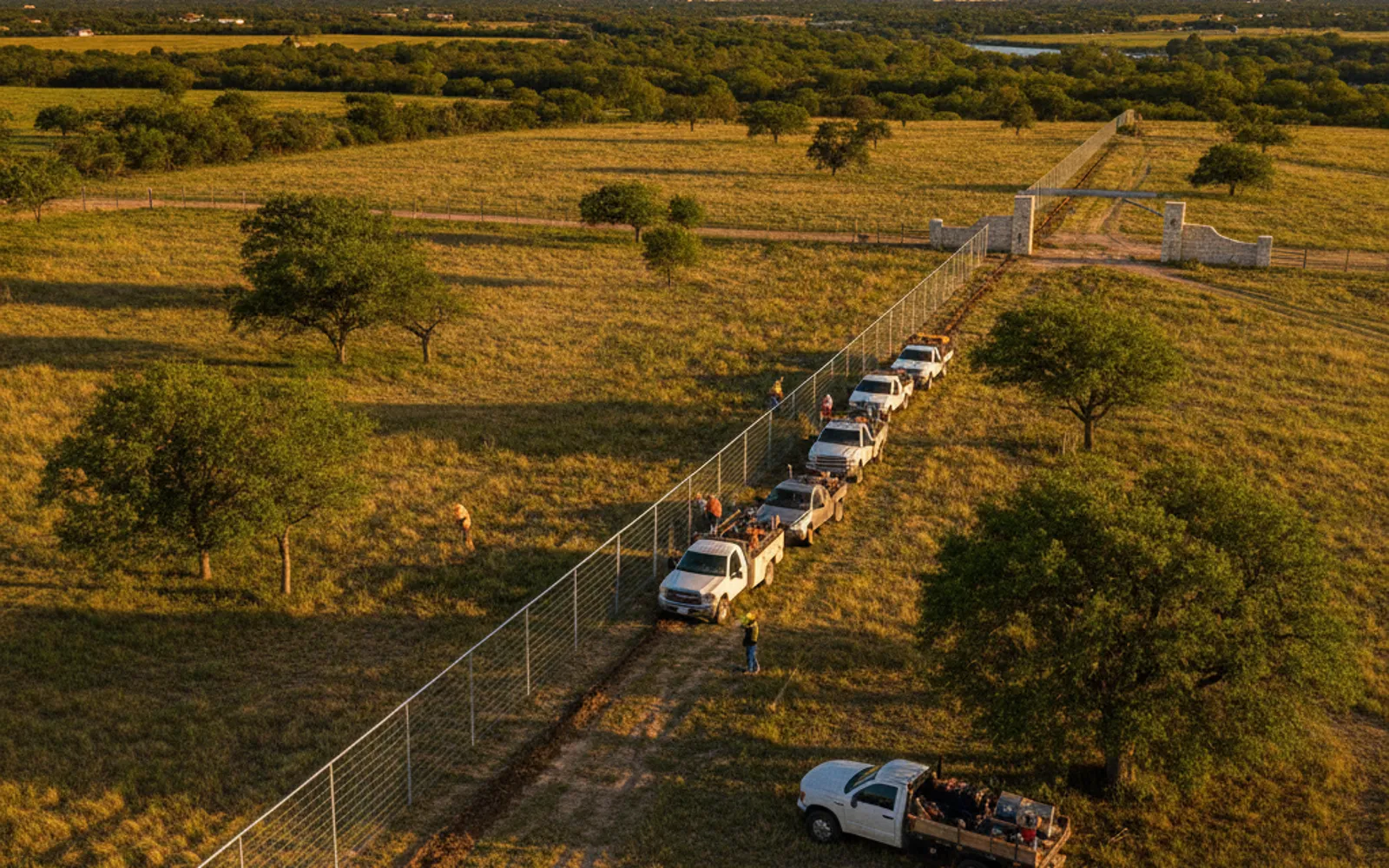
A barbed wire fence goes up in this order: settle where the line runs, clear it, build the corners and braces, set the line posts, run and stretch the strands, tie them off at the braces, then staple or clip them to the line posts and add stays. Get the order wrong and you end up pulling wire against a brace that has not set, or re-stapling half a mile because the posts wander.
What separates a fence that stands for decades from one that sags by the second summer is the braces, the tension, and the tie-offs.
Below is the whole sequence with the specs that matter. If you would rather have someone walk the line and price it, call (254) 870-8898 for a free on-site estimate.
Before you dig: settle the line and the plan
Know where the line actually is
On a boundary fence, the old fence is not proof of where the property line sits. If there is any doubt, get a survey before you set a post. See building a fence on the property line in Texas.
Call 811 before you dig post holes. The NRCS Texas fence specification (Code 382) makes a utility check a required step before any fence built to it goes in, and the 2015 edition names Texas811 outright. That spec is the closest thing to a published Texas fence standard, and it comes up a lot below. The current 2021 edition is shorter and changes a few numbers, so where the two differ, both are given.
Decide the fence before you buy the wire
Three decisions set your materials list:
- Strand count and heights. Five strands is the standard for cattle, four for interior cross fence with calm stock. Our post on how many strands of barbed wire you need covers heights for each wire and when four is enough.
- Wire. 12.5 gauge low-carbon or 15.5 gauge high-tensile. They stretch and splice differently. See barbed wire gauge: 12.5 vs 15.5 before you order.
- Post spacing. This drives your post count, which drives your budget. The ranges are in fence post spacing for barbed wire.
For a floor to build against, the 2015 NRCS Texas spec for a barbed cattle fence calls for at least 4 wires, the bottom wire at least 14 inches off the ground, the middle two at 10 inch intervals, and a top wire at no less than 44 inches. Most cattle fences go past that minimum, with a fifth strand and a top wire closer to 48 inches or more.
Walk it and mark every change
Walk the whole line with flags. Mark every corner, every gate, every creek crossing, and every place the ground changes grade sharply. Each of those becomes a brace. Both editions of the NRCS spec call for a corner brace anywhere the line turns 20 degrees or more and a braced anchor at every gate, and the 2015 edition adds an end brace where the slope changes by more than 8 percent. On a straight, flat run, pull assemblies go no more than 1,320 feet apart, the length of one spool. Rolling country along the Bosque or the Brazos breaks into shorter pulls, which stretch more evenly anyway.
Step 1: Clear the fence line
You cannot build straight through cedar and mesquite. Clear a lane wide enough for a truck, a post driver and a wire unroller, and cut stumps low so they do not hang the wire or the tires. On land nobody has worked in years, clearing is often the slowest part of the job. Our fence line clearing page has the per-foot range and what heavy brush does to it.
Step 2: Build the corners and braces first
Braces carry the whole fence. Line posts only hold wire up. All the tension on every strand ends at a brace, so braces go in first and get time to set.
The NRCS Texas minimums for a wood corner or end assembly:
| Part | Minimum spec |
|---|---|
| Corner or end post | 6 inch top diameter |
| Horizontal brace | 4 inch diameter, 6 feet between the uprights |
| Brace height | At least two-thirds of the top wire height |
| Post depth | 3 feet in the ground, unless driven |
| Brace wire | Two full loops of 9 gauge smooth wire (or 12.5 gauge high-tensile smooth), twisted tight; the 2015 edition specifies a metal twist rod at least 18 inches long |
| Brace wire position | 4 to 6 inches above the rail on the brace post, 4 inches above ground on the corner post |
That brace wire direction, high on the brace post and low on the corner post, is the part people get backwards. The current 2021 spec allows a single H brace (or a single-post welded brace) where the fence runs less than 660 feet between corners, ends or gates. Past 660 feet it calls for a double H or a three-post assembly, and runs longer than 1,320 feet get in-line pull assemblies to break them up. The 2015 edition was stricter and capped the single H at 330 feet. Welded pipe braces are the other option, and they do not rot.
Setting matters as much as size. When a brace post is backfilled with dirt, the 2015 spec calls for a hole at least 6 inches wider than the post, and both editions call for tamping in 4 to 6 inch lifts. On blackland soils the 2015 edition allows concrete up to 12 inches below the surface with soil backfilled on top. That clay shrinks and swells with every drought and rain, and a post set shallow in it will walk. West of the Brazos and into Bosque County you hit limestone and caliche instead, and a proper depth there means a rock auger, not a clam-shell digger.
Brace wire direction and common mistakes are in H brace fence basics.
Step 3: Set the line posts
Get a straight line
On flat ground, stretch a single guide wire or string between two braces and set posts to it. Over rolling ground, the Tennessee Extension guide PB1541 (written for high-tensile wire, but the layout method carries over) suggests setting sighting pegs you can see from each end and shifting them until they line up with both corners. It also suggests running the bottom wire out first with a little tension as a layout guide, and tying it to each line post as it is driven.
Posts, depth and spacing
For T-posts, the 2015 NRCS Texas spec wanted at least a 6 foot post set 24 inches deep, or a 5.5 foot post set 18 inches deep in rocky ground. The 2021 edition puts it more simply: drive the T-post until the top of the anchor plate is at least 2 inches underground. Wood line posts need at least a 3 inch top and go 2.5 feet deep in the 2021 edition (24 inches in the 2015 one). Driven wood posts hold better than dug and tamped ones: the Tennessee guide puts a driven post at 1.7 times the strength of a tamped post.
For barbed cattle fence, the spec sets a maximum line post spacing of 20 feet without stays, or 30 feet with two or more stays. Most working cattle fence runs tighter than that.
Hit the high and low spots
Put a post at the top of every rise and the bottom of every dip, whatever the spacing says. In a dip, wire tension pulls the post up, so the 2015 NRCS spec has posts in low areas weighted with rock or concrete. At a creek, plan a water gap rather than running the main strands across. A flash flood will take them.
Step 4: Run out the wire
Put the spool on a wire unroller (a spinning jenny, or a pipe through the spool on a truck bed or tractor) and pay it out as you drive the line. Do not let it loop or kink. A kink is a weak spot that breaks under tension later. Tie the wire off at the first brace (Step 6), then pay it out to the far brace.
Wear leather gloves and eye protection. The Tennessee guide says the same about tensioning wire, and a barbed strand that lets go under load whips back hard.
Which side of the post
On a boundary fence, the NRCS spec puts the wire on the side of the post facing the animals, so pressure pushes wire into the post instead of popping staples. On cross fence either side is allowed. On a curve, run the wire on the outside.
Step 5: Stretch the strands
Top down or bottom up?
Extension guides split on this. The 2015 NRCS Texas spec says wires are installed from the top wire down (the 2021 edition drops the rule). The University of Georgia’s Fences for the Farm (C 774) says to work from the bottom up and install the bottom wire first.
Both work. Top-first sets the height that matters most for containment and lets you check it across every dip. Bottom-first gives you a layout line while posts are still going in. What matters more is that every strand sits at its planned height and carries the same tension. A fence with one tight wire and four slack ones has one wire doing the work.
How to stretch
Hook a fence stretcher or come-along to the far brace (or a solid anchor just past it), grip the wire, and pull. Never pull from a line post, a T-post, or a truck bumper where you cannot feel what the wire is doing.
New barbed wire has some give in it. Take out the slack and most of that give, but not all of it. Overstretched wire has nothing left to absorb a cow leaning on it, a falling limb, or a cold snap. The NRCS spec warns that temperature has to be considered: wire tightens in cold weather and loosens in hot weather. A strand stretched drum-tight in August can snap in a January freeze.
On long runs, tie off at each in-line brace and start a new pull.
Step 6: Tie off at the braces
This is the detail that fails quietly. The NRCS Texas spec calls for each wire to take two complete wraps around the end post and have its tail twisted tightly around the stretched wire at least 6 times. The 2015 edition adds that the wraps get stapled on a wood post, or wired to a steel one.
Wrap the corner or end post itself, since that is what the brace is built to hold back. And tie off every strand at every brace: running a strand through a brace without wrapping it turns two pulls into one long one.
If you have to join two spools mid-run, the NRCS spec prefers a Western Union splice, tightly wound and closely spaced. The 2021 edition sets the minimum at 4 wraps on each side of center (the 2015 edition asked for 8, and extra wraps cost nothing). The other option is splice sleeves that hold at least 80 percent of the wire’s strength: two 3/8 inch sleeves or one 3/4 inch sleeve per splice.
Step 7: Fasten to line posts and add stays
Once all strands are stretched and tied, fasten them to the line posts: clips on T-posts, staples on wood posts.
The 2021 NRCS spec calls for 9 gauge staples at least 1.5 inches long (the 2015 edition allowed 1 inch in hardwoods like cedar and mesquite), driven diagonally to the grain so they do not split the post, at a slight downward angle, or upward where the wire pulls up. It also says to leave space between the staple and the post so the wire can move and the galvanizing is not crushed. The Tennessee guide adds that staples go at an upward angle on posts in dips and a downward angle on posts on rises, following the direction the wire pulls.
Then add stays. Twisted wire stays hold strand spacing between posts so a cow cannot spread two wires and walk through. The NRCS spec calls for stays that are fence height plus 2 inches and hang free of the ground, so the fence can flex when an animal hits it. A stay dug into the dirt rusts out and stops the fence from giving.
Then walk the finished line once more for a strand that sags differently, a staple driven flush, or a post lifting in a dip.
What a professional build costs
If you are pricing the job rather than building it, a 5-strand barbed wire fence runs $2.50 to $5.50 per foot on our ranch fence cost page, or $13,200 to $29,000 per mile. A quarter mile (1,320 feet) works out to roughly $3,300 to $7,260 on that range. Where a job lands depends on clearing, rock, post type and spacing, and how many braces the ground demands.
Say you have 40 acres outside McGregor with thin soil over rock on one side and a creek on the other. The braces at the creek and the rock drilling will move the number more than the wire will. That is why someone walks the line before any price is quoted. Our barbed wire fence service covers McLennan, Bosque and Falls counties. Call (254) 870-8898 and we will walk the line and give you a free on-site estimate.
Frequently Asked Questions
How high should a barbed wire fence be for cattle?
The 2015 NRCS Texas fence specification sets the top wire at no less than 44 inches for cattle, with the bottom wire at least 14 inches off the ground. Most cattle fence runs the top wire at 48 inches or higher, with a fifth strand to close the gaps at pushing height. Bulls and road frontage usually get the taller setup.
Do you string barbed wire from the top or the bottom first?
Guides disagree. The 2015 NRCS Texas spec installs wires from the top down, while University of Georgia Extension says to install the bottom wire first. Either works. What matters is that every strand is stretched to the same tension, tied off properly at the braces, and fastened at its planned height on every line post.
How tight should a new barbed wire fence be?
Tight enough to take out the slack and most of the give in new wire, but not all of it. Wire contracts in cold weather, so a strand stretched to the limit in summer can snap in a hard freeze. Stretch every strand to the same feel so one wire is not doing all the work.
Can I build a barbed wire fence with only T-posts?
You can use T-posts for line posts, but not for corners, ends, or gates. Those need braced assemblies of heavy wood or welded pipe set deep, because they carry all the tension. A lone T-post at a corner will lean the first time the wire is stretched. Many builders also mix wood line posts into a T-post run for stiffness.
How far apart should the braces be on a long barbed wire run?
The NRCS Texas spec allows pull assemblies up to 1,320 feet apart on straight, flat ground, and requires braces at every turn of 20 degrees or more and at gates. The 2015 edition also braces slope changes over 8 percent. The 2021 edition limits a single H brace to runs under 660 feet. On rolling Central Texas ground, pulls end up shorter, which makes even stretching easier.