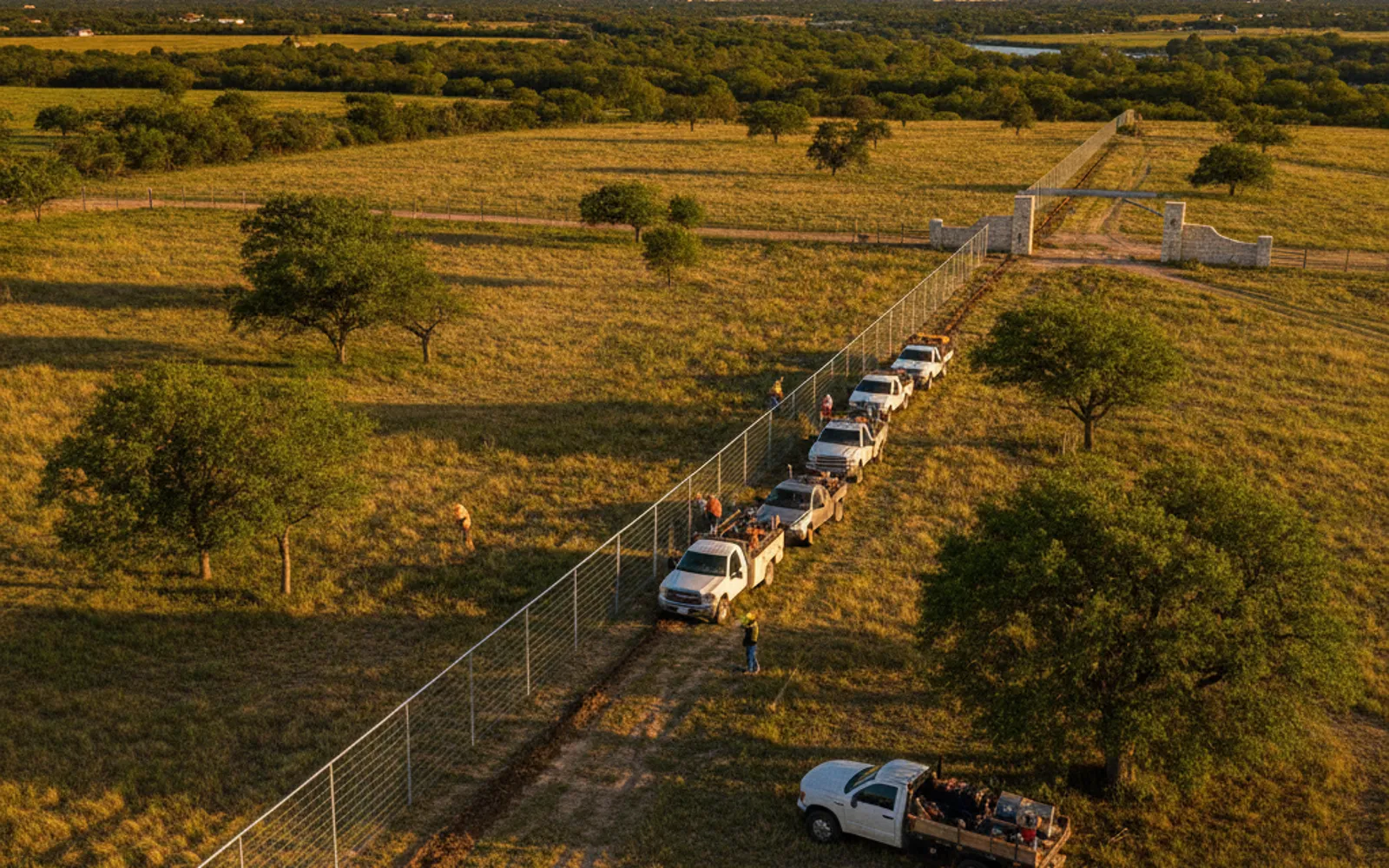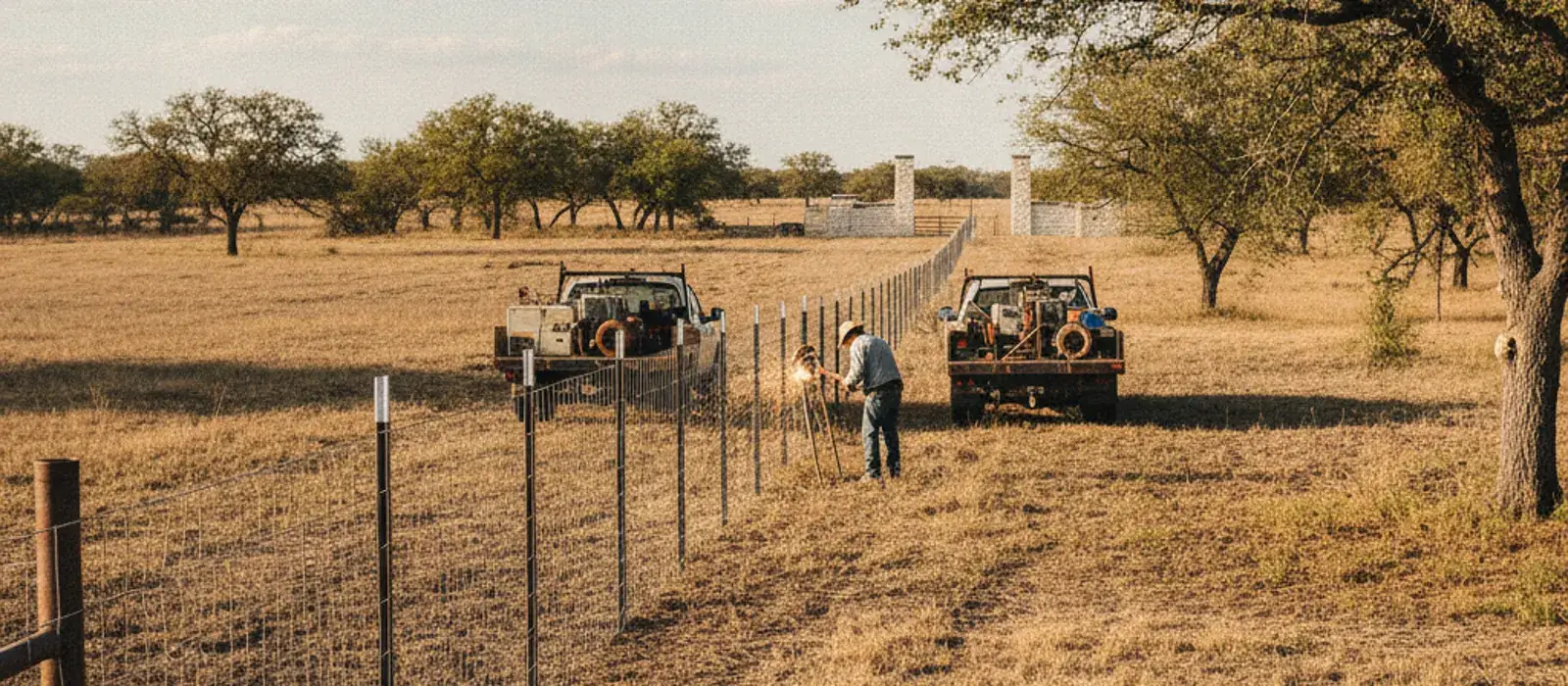
Three strands of barbed wire will hold a fat, happy cow on a good day. The trouble is, nobody builds fence for the good days. You build it for the February morning when the herd is hungry, the neighbor’s bull is bellowing across the line, and a cold front has every animal on the place pacing the wire.
So how many strands of barbed wire for cattle is actually enough? For most Central Texas operations, the answer is five. Four will do the job in some interior pastures. Three is asking for a phone call about your cows standing in the middle of a county road.
We build and repair barbed wire fence around Waco every week, across McLennan, Bosque, and Falls counties, and strand count is the first question almost every landowner asks. Here’s the straight answer, with real numbers behind it.
The Short Answer: 5 Strands Holds Most Cattle
A 5-strand barbed wire fence, built 48 to 54 inches tall on good posts with solid corner braces, will hold commercial cow-calf pairs, stockers, and most bulls in typical Central Texas conditions. That’s the standard we recommend for perimeter fence, and it’s what the big ranches around Crawford and Valley Mills have settled on for decades.
Why five? Cattle challenge a fence three ways. They reach over the top for grass, they push through the middle when they’re crowded or spooked, and calves scoot under the bottom. Five strands lets you defend all three zones at once: a stout top wire at 48 inches or better, three wires guarding the belly-height middle, and a bottom wire low enough that a calf thinks twice.
Texas law sets a much lower bar, by the way. The state’s definition of a “sufficient fence” in Texas Agriculture Code Chapter 143 is only three barbed wires on posts no more than 30 feet apart. That’s a legal minimum from another era, not a recommendation. A fence can meet the statute and still let your herd out every other weekend.
Here’s what the legal minimum costs in practice. Danny Kolar runs about 40 pairs outside West, on a place he bought with an old 3-strand perimeter. Last fall his bull went through the west line chasing a neighbor’s heifers, and Danny spent a Saturday getting him home. The tally: $350 to a hauler with a stock trailer, a $290 vet visit for wire cuts, and roughly $480 in patch materials and lost time. Call it $1,100 for one escape, and he got lucky it happened on a pasture road instead of the highway. He had us rebuild that line to five strands the next month.
If you’re staring at a tired 3-strand fence right now and wondering whether it’ll hold through fall, call us at (254) 870-8898. We’ll walk the line with you and give you a free written estimate, no pressure.
How Many Strands of Barbed Wire for Cattle in Each Situation
The right count depends on what’s leaning on the fence and what’s on the other side of it. Here’s how we spec jobs around Waco:
Perimeter fence along roads: 5 strands, no debate. If cattle get through this fence, they’re on pavement. A wreck involving your cow is a lawsuit risk on top of a dead animal, so this is the last place to save a few cents per foot.
Perimeter fence between neighbors: 5 strands. Especially if the neighbor runs bulls or has cows that cycle. A shared line fence takes pressure from both sides, twice the animals testing the same wire.
Interior cross fence: 4 strands is usually fine. If a cow slips through a cross fence, she’s still on your place. Four strands saves real money on long divisions, and you can always add a fifth wire later if a particular pasture gets tested.
Bulls, or a bull pasture: 5 strands minimum, 6 if he’s proven he’ll push. A 2,000 pound bull that wants through a fence needs more than wire to stop him. For chronic fence-walkers, a lot of our customers add a single offset hot wire instead of a sixth barbed strand. It’s cheaper and it works on the animal’s mind, not just his hide.
Cow-calf pairs: 5 strands with a low bottom wire. Calves go under, not through. A bottom wire at 12 inches or higher is an open door for a month-old calf, and mama will find her own way to follow.
Stockers and weaned calves: 5 strands, tight. Fresh-weaned calves are the hardest animals in the cattle business to fence. They’re light, they’re panicked, and they’ll hit wire at a run. Wire tension matters as much as count here.
If your fence problem is less about strand count and more about cattle already getting out, start with our guide on why cattle get out and how to stop it.
Strand Spacing: Where Each Wire Should Sit
Five strands hung in the wrong spots hold cattle worse than four strands hung right. Cattle put pressure on a fence between roughly 26 and 42 inches off the ground, which is chest and neck height on a mature cow. That middle zone is where your wires need to be stacked closest together.
Here’s the spacing we use on a standard 5-strand cattle fence, measured from the ground up: 14, 22, 30, 39, and 49 inches. For a 4-strand interior fence: 16, 26, 36, and 46 inches. University fencing guides, like the Fences for the Farm publication from UGA Extension, land in the same neighborhood, tighter spacing through the middle and a top wire at 48 inches or better.
Two spacing mistakes we fix constantly on older Central Texas fences:
Bottom wire too high. Anything over 15 or 16 inches lets calves duck under without touching wire. If you also fight feral hogs, there’s a trade-off, because a low bottom wire takes more hog damage. We cover that in our post on feral hog fence damage.
Even spacing top to bottom. Splitting five wires evenly across 50 inches leaves 10-inch gaps right at pushing height. Cattle find those gaps. Stack the middle tighter and let the gap ride higher, above where they push.
One more thing on height: 48 inches is the working minimum for the top wire. In brushy country around Bosque County where deer traffic is heavy, some folks run the top wire a touch lower, or use a smooth top wire, to cut down on deer-strike damage. That’s a judgment call we’re glad to talk through on site.
What More Strands of Barbed Wire Cost Per Foot and Per Mile
Adding strands is cheap insurance, because the expensive parts of a fence are the posts, the corner braces, and the labor to set them. Once the framework is in the ground, each extra wire is mostly just wire and clips.
Here’s what full builds typically run in our service area in 2026, using 12.5 gauge Class 3 galvanized wire on T-posts with wood line and corner posts:
| Fence Build | Cost Per Foot | Cost Per Mile | Best Use |
|---|---|---|---|
| 3-strand barbed | $1.60 to $2.00 | $8,400 to $10,600 | Legal minimum only, not recommended |
| 4-strand barbed | $1.85 to $2.40 | $9,800 to $12,700 | Interior cross fence |
| 5-strand barbed | $2.10 to $2.75 | $11,100 to $14,500 | Perimeter, pairs, most herds |
| 6-strand barbed | $2.40 to $3.10 | $12,700 to $16,400 | Bulls, high-pressure lines |
| 5-strand plus offset hot wire | $2.45 to $3.20 | $12,900 to $16,900 | Chronic pushers, bull pastures |
Look at the gap between 4 and 5 strands: roughly 25 to 35 cents a foot. On a quarter mile of fence, that fifth wire costs about $330 to $460. Danny’s one escape in West cost $1,100. The math isn’t close.
Retrofitting is even cheaper if your posts and braces are still sound. The Muellers in China Spring had us add a fourth and fifth strand to 2,600 feet of decent 3-strand cross fence last spring. At 95 cents a foot for two wires, stays, and labor, the job came to about $2,470, a fraction of the $6,000 plus a full rebuild would have run.
Full pricing breakdowns are in our barbed wire fence cost guide, and if you’re budgeting a bigger project, our ranch fence cost page covers every fence type we build. Want a number for your place instead of a range? Request a free written estimate and we’ll measure it off aerials before we ever set foot on the property.
Why Cattle Still Get Out With Enough Strands
Strand count gets the attention, but most escapes we’re called out on trace back to something else. Before you add wire, check these four things.
Loose wire. A slack strand is a suggestion, not a barrier. Cattle learn to lean into loose wire and walk it down. Barbed wire should be tight enough to sing a low note when you strike it. If yours sags, fixing tension is a half-day job, and our post on fixing sagging barbed wire walks through it.
Failing corners and braces. Every ounce of wire tension loads onto the corner assemblies. When an H-brace rots or racks, the whole stretch goes slack at once, and no strand count saves you. This is the number one structural failure we see on fences over 20 years old.
Post spacing that’s too wide. Posts every 30 feet meets the statute, but the wire between them flexes like a trampoline. We set T-posts at 10 to 12 feet on cattle fence. Tighter spacing stiffens every strand you’ve paid for. More on that in our fence post spacing guide.
Hunger and habit. A fence-crawler that’s learned the trick will teach the herd. Sometimes the honest fix is culling one cow, not rebuilding a mile of fence.
Here’s a real one: Ray Simcik near Crawford called us about heifers getting into his neighbor’s coastal patch. He assumed he needed a sixth wire on a quarter mile of line. When we walked it, the fence had five good strands, but the wire had gone slack against a leaning corner post. We rebuilt one H-brace and re-tensioned the stretch for about $680, instead of the $1,600 he’d budgeted for new wire he didn’t need. An honest walk-through before the work starts saves money more often than it costs.
A word on safety before you tackle any of this yourself. Re-tensioning barbed wire stores serious energy in the strand, and a snapped wire under tension can cut you badly. Wear leather gloves and eye protection, never stretch rusted or brittle wire, and if a stretch involves rebuilding corners or crossing a creek, stop and call a professional. That’s exactly the work we’re built for.
When Barbed Wire Isn’t the Right Answer at All
Strand count only matters if barbed wire is the right tool, and sometimes it isn’t.
If you’re running calves that slip any barbed fence, net wire with a barbed top wire holds everything from calves to goats. It costs more per foot, but on small acreage the difference is manageable. We compare the two honestly in barbed wire vs net wire.
If bulls are destroying your pens and working areas, wire of any count is the wrong material. Corrals, bull traps, and high-traffic lots need pipe fence, which shrugs off pressure that would flatten a wire fence weekly.
And if horses share the pasture, skip barbed wire entirely. Horses hit wire differently than cattle and the injuries are ugly and expensive.
For a standard cow herd on Central Texas pasture, though, 5-strand barbed wire remains the best value per foot of anything you can build. Get the strand count right, hang the wires at the right heights, and build it on corners that will still be standing when your kids run the place.
Ready to put real numbers on your fence line? Call Brazos Ridge Fence Co. at (254) 870-8898 or request your free written estimate online. We’re licensed and insured, we answer the phone, and we keep a 24/7 emergency line for storm damage and cattle-out calls, because fences never fail at a convenient hour.
Frequently Asked Questions
Will 3 strands of barbed wire hold cattle?
Sometimes, and that’s the problem. Three strands meets the Texas legal definition of a sufficient fence and may hold settled cows on good grass, but it fails under pressure from bulls, weaned calves, drought, or a neighbor’s herd. Nearly every escape call we run in McLennan County involves a 3-strand fence. Treat three strands as a temporary condition, not a plan.
Is 4 or 5 strand barbed wire better for cattle?
Five strands is better for any perimeter fence, any fence along a road, and any pasture with pairs or bulls. Four strands is a reasonable saver on interior cross fences where an escape just means a cow in the wrong pasture. The cost difference is usually 25 to 35 cents per foot, so we lean toward five anywhere the consequences of an escape are real.
How high should a barbed wire fence be for cattle?
Build the top wire at 48 to 54 inches. Shorter fences invite cattle to reach over and eventually lean the top wire down, and taller than 54 inches buys little for cattle alone. Just as important, stack your middle wires between about 22 and 39 inches, because that’s the zone where cattle actually push.
How many strands of barbed wire do I need for a bull?
Plan on five tight strands as the floor, and six for a bull that’s proven he’ll test fence. Even better than a sixth strand, in our experience, is a single offset electric wire at nose height on the bull’s side. It trains him to stay off the fence entirely, which protects the whole line instead of just adding one more wire for him to stretch.