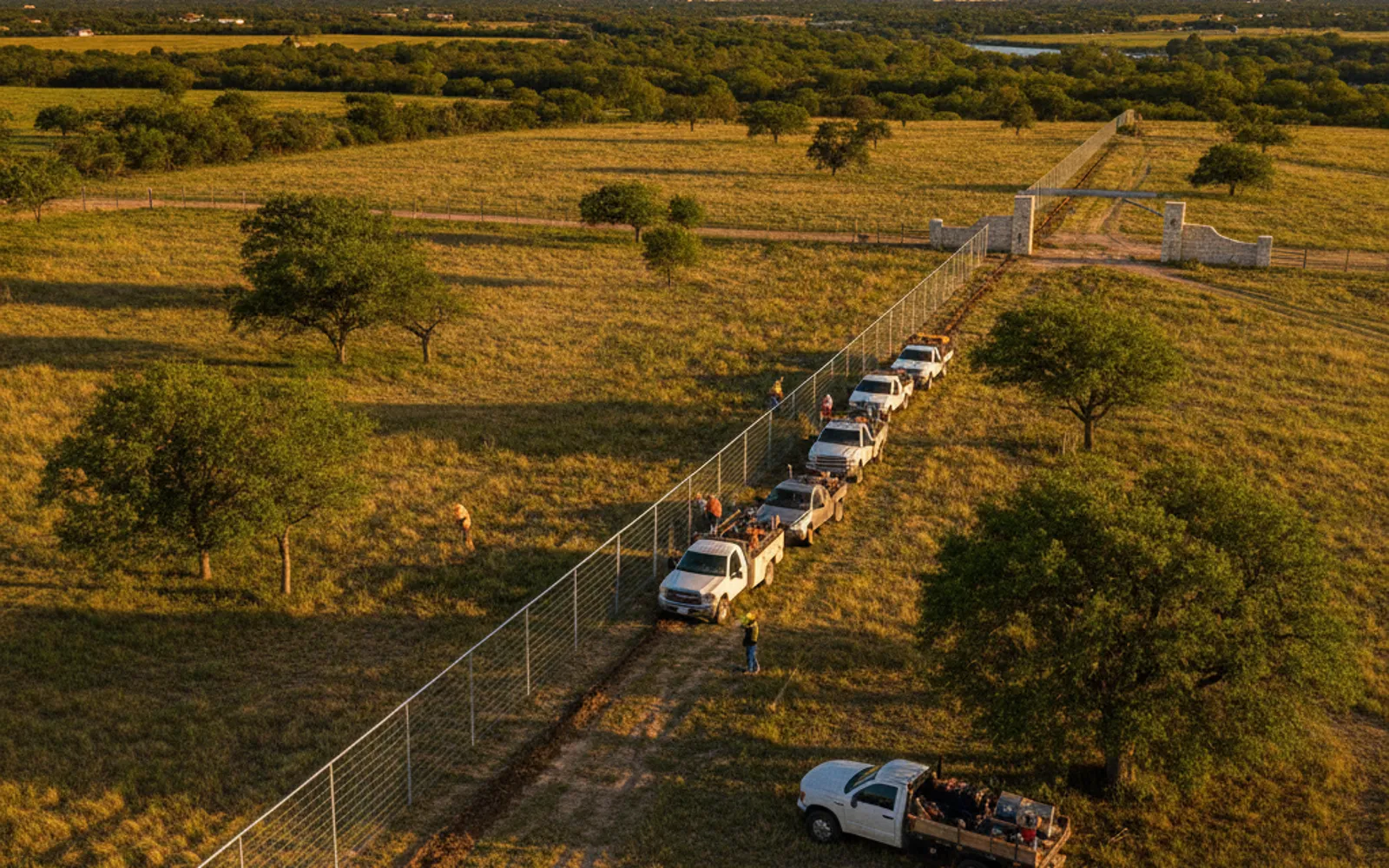
For most riding horses on pasture, a horse fence should stand 54 to 60 inches above the ground, with the top close to the height of the horse’s withers. The University of Georgia puts the minimum for a perimeter pasture fence at 60 inches and lets fences that split two pastures drop to 54. Small paddocks, corrals and stallion pens go higher, up to eye level on the horse, and a stallion can need 6 feet.
Height is only half the job. Foals roll under fences and grown horses paw under them, so extension guidance puts the bottom 6 to 8 inches off the ground, with a bottom rail no higher than 12 inches where foals run.
Below are the numbers by horse and by pen, how to check them against your own horse with a tape, and what height does to the cost. If you would rather have someone measure your horses and walk the line with you, call (254) 870-8898 for a free on-site estimate anywhere in McLennan, Bosque or Falls counties.
Horse fence height by where the fence sits
Each fence on a horse place has a different job, and the height follows the job.
| Fence | Recommended height | Source |
|---|---|---|
| Perimeter pasture fence | 60 inches minimum | UGA Extension |
| Fence dividing two pastures | 54 inches | UGA Extension |
| Pasture and paddock fence, general | 54 to 60 inches, top near wither height | Penn State Extension |
| Paddock under 2 acres, corral, stallion pen | Eye level with the horse’s head, usually 4 to 6 inches above the withers | UGA Extension |
| Stallion paddock | 6 feet may be necessary, usually double-fenced | Virginia Cooperative Extension |
| Bottom of the fence | 6 to 8 inches off the ground | UGA and Penn State Extension |
| Bottom rail where foals run | No higher than 12 inches | Penn State Extension |
Those figures come from the University of Georgia bulletin Fences for Horses, Penn State Extension’s fence planning guide for horses, and Virginia Cooperative Extension’s fencing options for horse farms.
The withers rule and how to check it on your horse
Penn State’s rule of thumb: in paddocks and pastures, put the top of the fence at wither height so a horse cannot flip over it. The withers are the high point at the base of the neck, where a horse is measured for height.
Horses are measured in hands, and a hand is 4 inches. Multiply the first number by 4 and add the second. A 15.2 hand horse is 15 x 4 = 60, plus 2, so 62 inches at the withers. A 14.2 is 58 inches. A 16.1 is 65 inches.
That arithmetic shows why 60 inches is a floor on a lot of places. A 60-inch fence sits right at the withers of a 15 hand horse, 2 inches under a 15.2, and 5 inches under a 16.1 warmblood. For most stock horses around here, 60 inches is at or near the withers, and on open pasture that is fine. If your horses are tall, measure one and build to it.
The paddock rule is stricter. UGA says the top of a paddock, corral or stallion pen fence should be at eye level with the horse’s head in a natural upright position, usually 4 to 6 inches above the withers. For that 15.2 horse, that is 66 to 68 inches, taller than the common 48- and 60-inch rolls of horse mesh. In practice that means a pipe top rail set above the mesh, or a pen built in welded pipe.
Why taller in small pens? In a big pasture a spooked horse has room to turn. In a small trap, horses bunch up and push each other into the fence. UGA notes that horses are more likely to jump a fence than go through or under it when spooked or herded.
Mares and geldings on pasture
Build the perimeter to 60 inches. That is the line between your horses and a county road or a neighbor’s stock, and the one fence you never want tested. On road frontage, or anywhere horses can see other horses across the wire, give the fence a visible top. Horses that can reach each other across a fence will lean on it, strike at it, and push it down over time.
Cross fence between your own pastures can come down to 54 inches under the UGA guidance. That is below the withers of most full-size horses, so it works when both sides are settled and have grass. Put a new horse next to the herd, or let the grass run out in August, and a 54-inch line gets tested.
If you are still choosing a fence type, the best fence for horses compares the options and the safest fence for horses ranks them by injury risk. This article is only about how tall to build whatever you pick.
Stallion fence height
A stallion needs more fence in two directions: up, and out.
Virginia Cooperative Extension says paddock fencing should be at least 4.5 feet, and that 6 feet may be necessary for stallions, because higher fences discourage fighting across the fence and attempts at jumping out. The same guide says stallion paddocks are usually double-fenced, with lanes to the other pastures wide enough for equipment and wide enough that horses cannot reach across and fight.
So a stallion setup is two fences. The pen itself, at or near 6 feet and stout enough that a rearing stud does not bend it, which on most places means welded pipe fence. Then a second fence across a lane, so no horse on the other side can get a nose or a leg over the top rail. The lane is the part people skip, and it is the part that stops the trouble.
Say you build a 100 by 100 foot stallion paddock in welded pipe. That is 400 feet of fence. At the published welded pipe range of $12 to $28 per foot, that is $4,800 to $11,200 for the pen before gates, and the fence across the lane adds its own footage. Pens are covered on our corrals and working pens page.
Foals and the bottom of the fence
Everything above is about horses going over. With foals, the risk is going under.
Penn State recommends 8 inches of clearance at the bottom: enough that a pawing hoof does not get trapped, not so much that a horse reaches under for grass. Where there are foals, it says to keep a bottom rail no higher than 12 inches so a foal cannot roll under. UGA puts the bottom 6 to 8 inches off the ground.
Openings matter as much as the gap underneath. Penn State says small safe openings are less than 3 inches square, and that space between rails or strands should stay at 12 inches or less, or up to 18 inches on electric fence. That is why 2 by 4 inch mesh is the standard fill on a mare and foal pasture. Our no-climb horse fence guide covers the mesh itself.
The Central Texas part: blackland clay shrinks and cracks in a dry summer and swells when the rain comes back, and posts heave with it. A bottom wire set at 8 inches in spring can be 12 inches off the ground in a swale by fall, or dragging on a high spot. Low spots, washouts and draw crossings are where a foal finds a way under. Walk the bottom of a foaling pasture after every big rain and every long dry spell.
Ponies and miniature horses
The extension bulletins used here are written for full-size horses and do not give separate numbers for ponies or minis, so scale the same rule to the animal: top near the withers, openings too small for a hoof, a bottom gap the animal cannot get under.
What changes is which part fails first. A pony will often go through or under a fence built for a 16 hand gelding. A mini is unlikely to go over a 48-inch fence at all. The risk with a mini is the bottom and the openings, and an 8-inch gap sized for a big horse’s hoof is a lot of room for a mini’s head.
For a mixed herd, build the height for the tallest horse and the bottom for the smallest. That usually means 2 by 4 mesh run closer to the ground, with a top rail where the big horses need it.
The top rail counts toward the height
A 60-inch fence of thin wire that disappears at dusk is not doing the same job as a 60-inch fence with a rail on top. UGA notes that painted rail fences are highly visible and look to a horse like a solid barrier it is less likely to challenge or run into. It also says gates should be level with the top of the fence. A 60-inch fence with a 50-inch tube gate in it has a low spot exactly where horses gather.
The rail also holds the mesh up when a horse leans on it, and it counts toward the height.
UGA also says that if horses are damaging a fence by reaching over it to graze, an electric strand across the top should stop it, mounted on insulators on the opposite side of the post from the mesh or rails. A hot strand on offset brackets is the cheapest way to add effective height to an old fence. Our electric fence for horses article covers chargers and grounding.
Raising a fence that is too short
Plenty of horse places here started as cattle country, fenced with 47 to 48 inches of field fence or barbed wire. First question: are the posts long enough? Posts set for a 48-inch fence rarely stand tall enough to carry a rail at 60 inches. The fix is taller posts set at intervals, an offset electric strand, or, on T-post lines, often all new posts. On rock west of the Brazos and in Bosque County, each new post may need drilling. Second: is it the right fence? Raising barbed wire does not make it a horse fence.
If a line only needs a few posts reset or replaced to carry a rail, our repair work on posts runs $45 to $120 per post.
What height does to the cost
Taller fence costs more mostly through the fence type height pushes you into. The published ranges on our horse fence page are general Central Texas market ranges: no-climb 2 by 4 mesh at $6 to $10 per foot, no-climb with a pipe top rail at $12 to $18, and full welded pipe, three or four rail, at $12 to $28.
A hypothetical: a square 5-acre pasture has about 1,870 feet of perimeter (217,800 square feet, about 467 feet a side, times four). With a pipe top rail at $12 to $18 per foot, that is about $22,400 to $33,700 before gates. Plain no-climb at $6 to $10 is about $11,200 to $18,700. Our other fence prices are on the ranch fence cost page.
Get the height right before the posts go in
Decide the height before the first post is set. Measure your tallest horse at the withers. Decide which lines are perimeter, which are cross fence and which are pens. Plan a stallion’s lane before his pen. Then check the bottom in the low spots, because in our clay the ground under a fence does not stay where you left it.
If you want a second set of eyes on it, we will come out, measure, and walk the line with you before quoting a number. Call (254) 870-8898 for a free on-site estimate in McLennan, Bosque or Falls counties.
Frequently Asked Questions
Is a 4 foot fence tall enough for horses?
Not for most full-size horses. A 48-inch fence is below the withers of nearly any riding horse, and extension guidance puts horse fence at 54 to 60 inches, with UGA calling 60 inches the minimum for a pasture perimeter. A 4-foot fence can hold miniature horses and some ponies, and it can serve as the mesh under a top rail that brings the whole fence up to about 60 inches.
How tall should a stallion fence be?
Virginia Cooperative Extension says 6 feet may be necessary for stallions, because taller fences discourage fighting across the fence and jumping out. UGA puts stallion pens at eye level with the horse’s head. Stallion paddocks are usually double-fenced with a lane between them and other horses, so no horse can reach across. Most stallion pens are built in welded pipe for strength.
How high off the ground should the bottom of a horse fence be?
UGA recommends 6 to 8 inches and Penn State about 8 inches. That leaves room for a pawing hoof without trapping it and discourages horses from reaching under for grass. Where foals run, Penn State says to keep the bottom rail no higher than 12 inches so a foal cannot roll under. In blackland clay, recheck that gap after heavy rain and after drought.
Does the top rail count toward the fence height?
Yes. The top rail is usually the highest point of a horse fence and the part the horse actually sees. A 48-inch roll of 2 by 4 mesh with a rail set just above it and 6 to 8 inches of clearance underneath comes out close to 60 inches. UGA also says gates should be level with the top of the fence, so carry that height through at the gates.
How tall should a fence be for miniature horses?
The extension bulletins used here give heights for full-size horses, not minis, so scale the same rule to the animal: top near the withers, openings too small for a hoof, and a small gap underneath. A mini rarely goes over a fence. It goes under or through, so small-opening mesh set close to the ground matters more than extra height. In a mixed herd, build the height for the tallest horse.