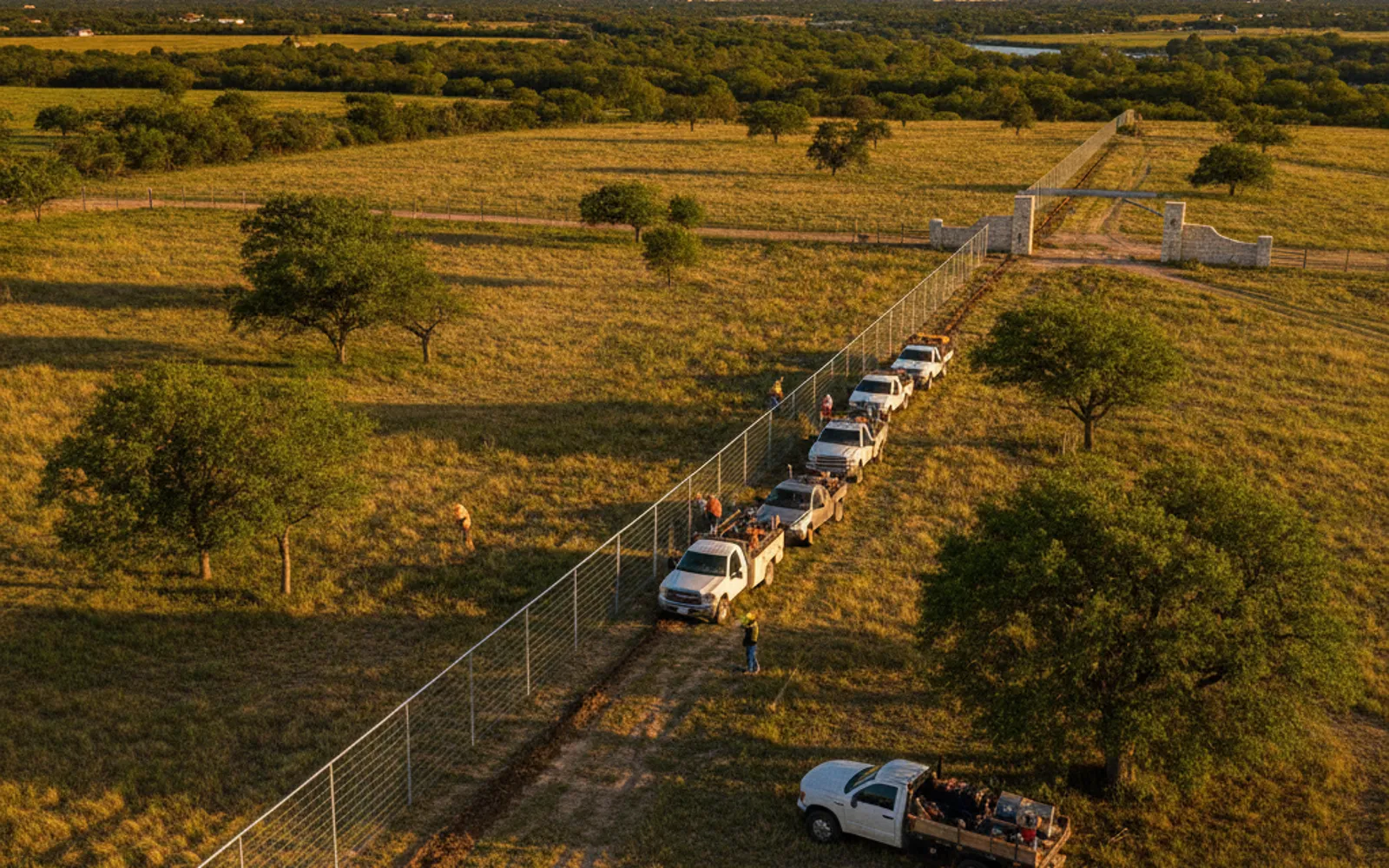
A square acre takes about 835 feet of fence to go all the way around. An acre is 43,560 square feet, the square root of that is 208.7 feet, and four sides of 208.7 feet comes to 834.8 feet.
The catch is that fence per acre is not a fixed number. It drops fast as the tract gets bigger, and it climbs the moment your land stops being a square. A square 40 acres needs exactly one mile of fence, which works out to 132 feet per acre, not 835. A long, skinny 10 acres along a county road can need 25 percent more fence than a square 10.
Below is the math for common tract sizes, why shape matters, and how to turn footage into rolls, T-posts and braces. To have someone walk and measure the line instead, call (254) 870-8898 for a free on-site estimate anywhere in McLennan, Bosque or Falls County.
How many feet around an acre
Start with the square. Area of a square is one side times itself, so to get the side you take the square root of the area.
- 1 acre = 43,560 square feet
- Square root of 43,560 = 208.7 feet per side
- 4 sides x 208.7 feet = 834.8 feet of perimeter
Round it to 835 feet. That is the shortest four-sided fence that can enclose one acre. A circle would be shorter (about 740 feet), but nobody builds a round fence around pasture, so the square is your real floor.
For any size, multiply the acres by 43,560, take the square root, and multiply by 4. The shortcut for fence per acre on a square tract: divide 835 by the square root of the acres. For 100 acres that is 835 / 10, about 83.5 feet per acre. Quadruple the land and the perimeter only doubles, which is why a big place costs far less per acre to fence.
Fence per acre for 1 to 160 acres (square tracts)
Here are the numbers for square tracts, with the per-foot range for 5-strand barbed wire from our ranch fence cost page ($2.50 to $5.50 per foot installed) multiplied out. The dollar column is simply perimeter times $2.50 and perimeter times $5.50, rounded to the nearest $10.
| Acres (square) | Length of one side | Perimeter | Feet of fence per acre | 5-strand barbed wire at $2.50 to $5.50/ft |
|---|---|---|---|---|
| 1 | 209 ft | 835 ft | 835 | $2,090 to $4,590 |
| 5 | 467 ft | 1,867 ft | 373 | $4,670 to $10,270 |
| 10 | 660 ft | 2,640 ft (half a mile) | 264 | $6,600 to $14,520 |
| 20 | 933 ft | 3,734 ft | 187 | $9,340 to $20,540 |
| 40 | 1,320 ft | 5,280 ft (1 mile) | 132 | $13,200 to $29,040 |
| 100 | 2,087 ft | 8,348 ft | 83 | $20,870 to $45,910 |
| 160 | 2,640 ft | 10,560 ft (2 miles) | 66 | $26,400 to $58,080 |
A few things jump out. One side of a square 40 is 1,320 feet, a quarter mile, which is the same length as a standard roll of barbed wire. A square 160 (a quarter section) is exactly two miles around. And the cost of fencing per acre falls from roughly $2,090 to $4,590 on a single acre to roughly $165 to $365 per acre on 160.
Net wire runs $3.50 to $8 per foot, so the same math on a square acre is 835 x $3.50 = about $2,920, up to 835 x $8 = $6,680. For pipe, game fence and the rest, use the per-foot bands on the cost page and multiply by your perimeter. What moves a real bid is covered in cost to fence 10 acres.
What does it cost to fence 1 acre?
On paper, 835 feet of 5-strand barbed wire lands between about $2,090 and $4,590. Small jobs tend to sit toward the top of the band, because four braced corners, a gate and a crew on site do not shrink with the footage. A one-acre horse or goat lot usually wants net wire fence instead.
Why rectangles and odd shapes need more fence
The square is the best case. Stretch the same acreage into a rectangle and the perimeter grows, even though the area has not changed. Here is what happens to 10 acres (2,640 feet as a square) as it gets longer and narrower:
- 2 to 1 rectangle (933 x 467 ft): 2,800 feet, about 6 percent more
- 3 to 1 rectangle (1,143 x 381 ft): 3,048 feet, about 15 percent more
- 4 to 1 rectangle (1,320 x 330 ft): 3,300 feet, 25 percent more
- 10 to 1 rectangle (2,087 x 209 ft): 4,592 feet, about 74 percent more
That last one is not far-fetched: plenty of Central Texas tracts are long strips with narrow road frontage. For any rectangle, add the long side and the short side, then double it.
Real tracts are worse than rectangles. Every jog in a property line is a corner, and a corner is not just more feet. The Texas NRCS fence standard calls for a corner brace assembly wherever the line changes direction by 20 degrees or more, and an end brace on both sides of every gate opening. A tract with nine corners and two gates carries 13 brace assemblies before you set a single line post.
Measure the real line, not the acreage
Acreage tells you little about footage. Better sources, best first:
- Your survey plat. The boundary calls give a distance for every leg of the line. Add them up. If you plan to fence on the boundary itself, read building a fence on the property line in Texas first.
- A measuring wheel, walked along the line you will actually build. Fences rarely sit exactly on the boundary where a creek or cedar brake is in the way.
- The measuring tool in a satellite map program. Good for a budget, not for ordering wire.
A 16-foot gate opening takes 16 feet out of the wire run but adds two end braces.
Turning feet into materials: a per-1,000-foot parts list
Materials follow from three decisions: how many strands, how far apart the line posts sit, and how often you brace. Work it per 1,000 feet and scale up.
Barbed wire: rolls
A standard roll of barbed wire is 1,320 feet, or 80 rods. The Texas NRCS spec even sets its maximum distance between pull assemblies on non-electric fence at the length of the spool, 1,320 feet, on straight pulls over flat ground.
Rolls needed = feet of fence x number of strands / 1,320, rounded up.
For 1,000 feet of 5-strand: 1,000 x 5 = 5,000 feet of wire. Divide by 1,320 and you get 3.8, so buy 4 rolls. The leftover goes into wraps at braces and gates. Running 4 strands instead of 5 cuts the wire by a fifth, but not the posts or the braces.
Net wire: rolls
Most woven field fence comes in 330-foot rolls (20 rods). For 1,000 feet, 1,000 / 330 = 3.03. Three rolls leaves you about 10 feet short, so you buy 4. Most cattle net wire also carries one or two barbed strands on top, so add 1 or 2 rolls of barbed wire per 1,320 feet of line.
How many T-posts do I need?
Line posts = feet of fence / post spacing. Spacing is the decision that moves the number most:
- 12-foot spacing: about 83 posts per 1,000 feet
- 15-foot spacing: about 67 posts per 1,000 feet
- 20-foot spacing: about 50 posts per 1,000 feet
For barbed wire, extension guides recommend tighter spacing than the NRCS maximum. The University of Tennessee’s Planning and Building Fences on the Farm (PB1541) recommends 12 to 14 feet for barbed wire and 14 to 16 for woven wire. UGA’s Fences for the Farm says about 10 to 12 feet for most fences, with narrower spacing over irregular ground. The Texas NRCS Fence (382) specification allows up to 20 feet for barbed wire without stays and 30 feet with two or more stays, and calls for steel T-posts at least 6 feet long set 24 inches in the ground (a 5 1/2-foot post set 18 inches is allowed in rocky soil). Where each spacing makes sense is covered in fence post spacing.
Hilly or broken ground adds posts. Every dip and rise needs a post to hold wire height, so a 15-foot plan ends up tighter on the ground. On blackland clay, many builders run the tight end of the range because posts work loose as the clay swells and shrinks.
Clips, staples and stays
- T-post clips: one per strand per post. 67 T-posts x 5 strands = 335 clips per 1,000 feet at 15-foot spacing.
- Staples: about one per strand per wood post, plus extra at braces.
- Stays: under the NRCS spec, barbed wire with line posts wider than 20 feet apart needs stays.
Braces: the part that decides whether the fence stays tight
Count these separately. They take a big share of the labor.
- Corners: one assembly at every corner. UT’s PB1541 notes a corner needs bracing for each fence leading into it, and recommends a double-span assembly when the fence run is longer than 200 feet.
- Gates and ends: an end brace on each side of every gate opening, and wherever the fence stops.
- In-line pull assemblies: UGA and UT both recommend a braced line assembly every 650 feet when a run between corners is longer than that. The Texas NRCS spec sets the outside limit at 1,320 feet on flat, straight ground, with additional pulls at sharp slope changes. On rolling Central Texas ground, plan on the 650-foot figure.
For 1,000 feet of straight fence, that means two end or corner assemblies plus one pull assembly near the middle. For how an H-brace is built and why corners fail, see H-brace fence basics.
A worked example: 20 acres, square, one gate
Say you have 20 acres outside Lorena, roughly square, and you want 5-strand barbed wire for cows with one 16-foot gate at the road.
- Perimeter: 3,734 feet (933 feet per side).
- Wire: 3,734 x 5 strands = 18,670 feet. Divide by 1,320 = 14.1, so 15 rolls.
- Line posts at 15-foot spacing: 3,734 / 15 = about 249, less the posts that are part of braces, so call it 245.
- Clips: 245 x 5 = about 1,225 if they are all T-posts.
- Braces: 4 corners, 2 gate braces, and one in-line pull on each 933-foot side if you follow the 650-foot guidance. That is 10 assemblies, and more if you build each corner with a brace for both fences leading into it, as the Tennessee guide advises.
- Installed price at our per-foot band: 3,734 x $2.50 = $9,335 up to 3,734 x $5.50 = $20,537. That is roughly $467 to $1,027 per acre.
If the old line is grown up in cedar and mesquite, clearing comes first. Fence line clearing runs $1 to $3 per foot, so clearing the whole 3,734 feet would add $3,734 to $11,202, and a heavy cedar brake can run past that. Want a cross fence down the middle for two pastures? That is one more 933-foot run with its own end braces.
When the calculator stops being useful
The math above gets you a budget and a parts list. It cannot tell you if your ground needs rock drilling, if the creek crossing needs a water gap, or if the neighbor’s old fence can stay. West of the Brazos and up into Bosque County, thin soil over limestone and caliche changes how every post goes in. In the blackland east of Waco, clay heave decides how deep the corners go.
If you want exact footage and a real number, have someone walk it. We build barbed wire fence, net wire, game fence and pipe across McLennan, Bosque and Falls counties, and the estimate is free and done on site. Call (254) 870-8898 and tell us the acreage and what you are running.
Frequently Asked Questions
How many feet of fence do I need for 1 acre?
A square acre takes about 835 feet of fence. That comes from 43,560 square feet per acre, a side of 208.7 feet, times four sides. A rectangular acre takes more: a 2 to 1 rectangle needs about 885 feet and a 4 to 1 rectangle about 1,044 feet.
How many feet of fence per acre on a larger tract?
It drops as the tract grows. Divide 835 by the square root of the acres. A square 10 acres needs 264 feet per acre, a square 40 needs 132 feet per acre (exactly one mile total), and a square 100 needs about 83 feet per acre. Irregular boundaries push those numbers up, sometimes a lot.
How many rolls of barbed wire do I need?
Multiply the fence length by the number of strands and divide by 1,320, the length of a standard roll. For a quarter mile of 5-strand fence, that is 5 rolls exactly, so buy 6 to cover wraps at the braces and gates. For 1,000 feet of 5-strand, 3.8 rolls rounds up to 4.
How many T-posts do I need per 1,000 feet?
Divide 1,000 by your line post spacing. At 12 feet that is about 83 posts, at 15 feet about 67, and at 20 feet about 50. Hilly ground adds posts at dips and rises. Corner, gate and pull brace posts are counted separately from the line posts.
What is the cost of fencing per acre?
For square tracts with 5-strand barbed wire at $2.50 to $5.50 a foot installed, it runs about $2,090 to $4,590 for 1 acre, about $660 to $1,450 per acre on 10 acres, and about $210 to $460 per acre on 100 acres. Shape, clearing, rock and gates move it. The per-foot bands for other fence types are on our ranch fence cost page.