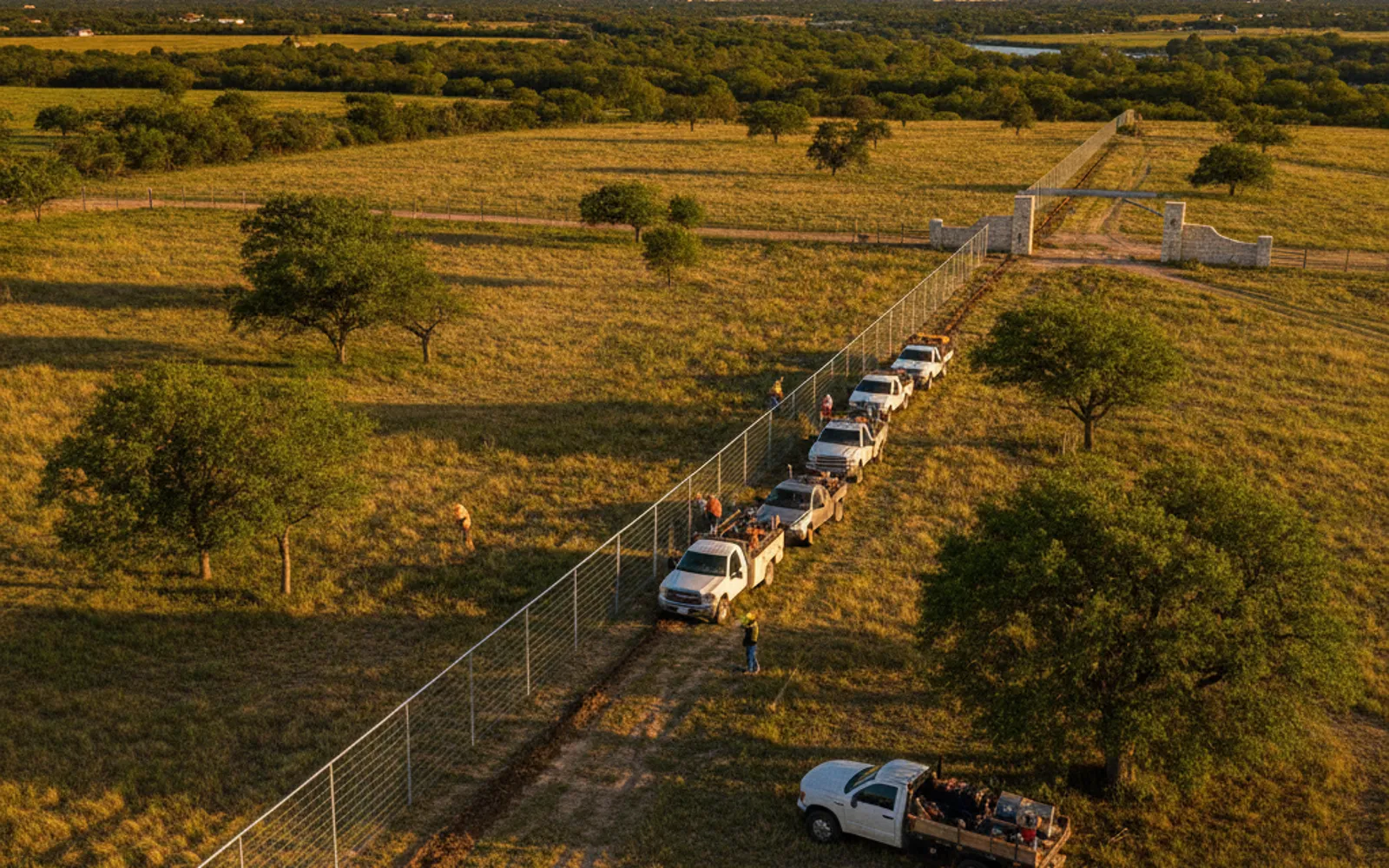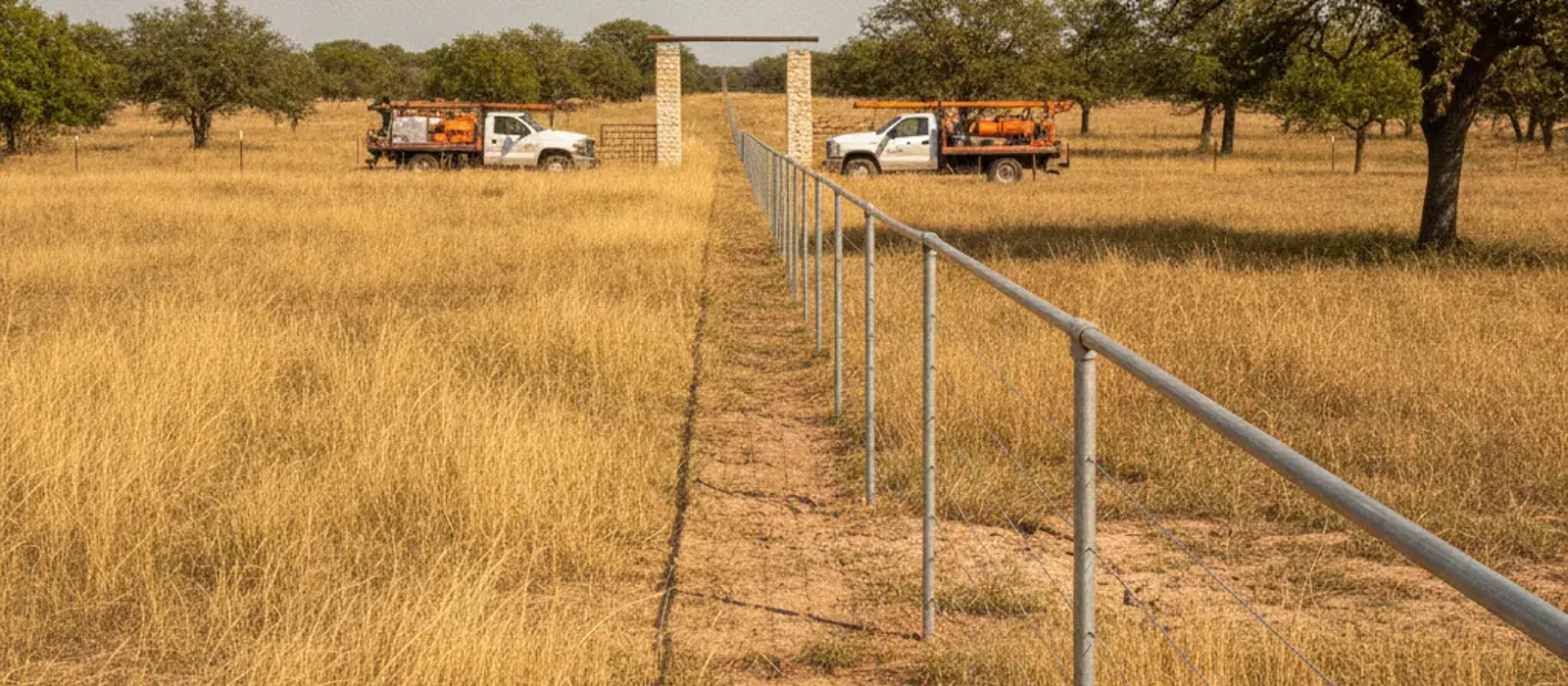
A mile of 5 strand barbed wire fence around Waco runs about $17,000 to $25,000 installed right now. That number surprises folks in both directions. Some landowners expect double that, and some are still working off prices their dad paid in the 90s.
Here’s the short answer on barbed wire fence cost per foot in Central Texas in 2026: most jobs land between $2.50 and $5.50 per foot installed, depending on strand count, post type, terrain, and how far your corners are apart. The rest of this article breaks down where you’ll fall in that range, what a full mile really costs, and where landowners in McLennan, Bosque, and Falls counties waste money without knowing it.
We build and repair this fence every week, so these are working numbers, not internet guesses.
Barbed Wire Fence Cost Per Foot: 2026 Central Texas Numbers
Barbed wire is still the cheapest way to hold cattle, and that’s why it covers most of the pasture line in Central Texas. Here’s what installed prices look like around Waco right now.
| Fence Type | Cost Per Foot (Installed) | Cost Per Mile (Installed) |
|---|---|---|
| 3 strand, T-posts | $2.50 - $3.25 | $13,200 - $17,200 |
| 4 strand, T-posts | $2.75 - $3.75 | $14,500 - $19,800 |
| 5 strand, T-posts with wood line posts mixed in | $3.25 - $4.25 | $17,200 - $22,400 |
| 5 strand, all wood posts | $3.75 - $4.75 | $19,800 - $25,100 |
| 6 strand, all wood posts (bulls, tight pens) | $4.25 - $5.50 | $22,400 - $29,000 |
Those prices include materials, labor, braced corners, and normal cleanup. They don’t include heavy brush clearing, rock drilling, old fence removal, or gates. Figure another $350 to $700 per 12 to 16 foot tube gate hung on a wood or pipe post, and more for a real ranch entrance.
Materials alone run roughly $0.90 to $1.60 per foot if you’re pricing a DIY job. Labor and equipment make up the rest, and on rocky Bosque County ground, labor is the part that grows.
Want a number for your actual fence line instead of a range? Call us at (254) 870-8898 and we’ll walk it with you. Written estimates are free and they don’t expire the minute you hang up.
Barbed Wire Fence Cost Per Mile: Budgeting a Big Stretch
Per-foot pricing makes sense for a 600 foot lot line. Once you’re fencing a quarter section, you need to think per mile.
A mile is 5,280 feet. At $3.25 per foot, that’s $17,160. At $4.25, it’s $22,440. Most full-mile jobs we build in Central Texas land between those two numbers for 5 strand fence.
Longer runs usually cost a little less per foot than short ones. The crew mobilizes once, the corners are farther apart, and we can stretch wire in long pulls. A 300 foot job might price at $4.75 per foot because the fixed costs get spread over almost nothing. A mile of clean, straight line might price at $3.35.
Corners and braces are the hidden line item on big jobs. Every corner, gate, and major grade change needs an H-brace, and a properly built H-brace runs $150 to $300 each in materials and labor. A square 160 acre tract has 4 corners minimum, plus braces at every gate. Skimp here and the whole fence sags inside five years. We covered why in our post on H-brace fence corners.
If you’re fencing smaller acreage, the math shifts again. Small tracts cost more per foot than big ones, because the corners and gates stay the same while the footage shrinks.
What Pushes Your Price Up or Down
Two neighbors on the same road can get quotes a dollar per foot apart and both quotes can be honest. Here’s what moves the number.
Strand count and wire quality. Each added strand costs roughly $0.25 to $0.40 per foot. Most cow-calf operations around here run 5 strands. Cheap 15.5 gauge high-tensile wire costs less up front than 12.5 gauge Class 3 galvanized, but it won’t last near as long in our weather. If you’re not sure how many strands you need, our guide on how many strands of barbed wire sorts it out by livestock type.
Post type and spacing. T-posts are cheapest. Wood line posts cost more but handle cattle pressure better. Most of our fences run wood posts every 50 to 100 feet with T-posts between, on 10 to 12 foot spacing.
Terrain and soil. Sandy loam east of Waco digs easy. The limestone ridges out toward Crawford and Valley Mills eat auger bits. Rock drilling can add $0.50 to $1.00 per foot on bad stretches. Creek crossings need water gaps, which are their own little project.
Brush and old fence. Clearing a grown-up fence line runs $1.00 to $3.00 per foot depending on how thick it is. Tearing out and hauling off old wire and posts usually adds $0.50 to $1.00 per foot.
Gates and entrances. Every opening adds hardware, bracing, and labor. A plain tube gate is a few hundred dollars. A cattle guard is a few thousand. Decide what each entrance actually needs before the crew shows up, because adding a gate mid-job costs more than planning it in.
Access and distance. A line the truck can drive builds fast. A line we have to pack materials into by hand or ATV builds slow, and slow is what you pay for. Fence lines along a bluff, through a bottom, or behind a locked neighbor gate all add hours that show up on the quote.
One more thing worth saying: wire and steel prices have bounced around a lot since 2020. A quote from two years ago is stale, and so is a price your neighbor got in 2019. If your budget is built on old numbers, get a fresh quote before you commit to a plan.
The USDA Natural Resources Conservation Service publishes cost data and specs for livestock fencing through its conservation practice standards, and it’s worth a look if you want a second reference point. You’ll find it at nrcs.usda.gov. Just remember national averages don’t price your rocky hillside.
Real Jobs, Real Numbers From Around Waco
Ranges are fine, but actual jobs tell you more. Here are three from the past year or so, names shortened for privacy.
Crawford: half mile of replacement fence. Dale runs about 60 cows on leased and owned ground outside Crawford. His west line was 1950s-era fence, rusted through and spliced a hundred times. We tore out 2,640 feet of old wire and built 5 strand with wood posts on the corners and pulls. Tear-out added $0.60 per foot. All in, he paid $8,450, right at $3.20 per foot including removal. His cows had been getting out onto FM 185 twice a month. That stopped the week we finished.
Valley Mills: rock changes the math. Marcy bought 42 acres northwest of Valley Mills and wanted the road frontage refenced, about 1,700 feet. Her quote started at $2.90 per foot. Then the auger hit solid limestone on the north third of the line. We drilled about 500 feet of that stretch, which added $520 to the job. Final bill was $5,450. We told her about the rock before we drilled a single hole, which is how that conversation should always go.
Lorena: small tract, honest premium. James and his wife keep a few heifers on 11 acres south of Lorena. They needed 950 feet of new 4 strand along a neighbor’s side plus one 16 foot gate. Short job, two corners, one gate brace. It priced at $3.60 per foot plus $480 for the gate, about $3,900 total. He’d gotten a $2.25 per foot number from a guy with a Facebook page and no insurance. That guy never showed. We did, and the fence is tight two summers later.
If your fence line looks like one of these, request a free written estimate and we’ll put a real number on it.
DIY or Hire a Crew? Where the Math Breaks
Plenty of ranchers around here can build fence, and we’ll never pretend otherwise. If you’ve got a tractor with an auger, a helper, and time, you can build barbed wire fence for materials cost plus your weekends.
Here’s the honest math though. Materials run $0.90 to $1.60 per foot. A quarter mile is 1,320 feet, so call it $1,300 to $2,100 in materials. Hiring it out at $3.00 per foot costs about $3,960. You’re saving roughly $2,000 to $2,600 for what’s realistically 4 to 6 full days of hard labor for two people, assuming nothing goes wrong.
Where DIY goes sideways is corners, stretching, and rock. A wire stretcher under tension stores serious energy, and a snapped strand of barbed wire will cut you before you see it move. Post holes in limestone will burn up a rented auger in an afternoon. And a fence with weak corners fails no matter how good the wire work is.
Our rule of thumb: DIY short repairs and small paddocks if you know what you’re doing. Hire out long runs, road frontage, rocky ground, and anything where a failure puts cattle on pavement. Texas A&M AgriLife Extension has solid livestock fencing guidance if you do go the DIY route, at agrilifeextension.tamu.edu.
And know when to stop. If a stretch fails and cattle are out near a road, that’s not a weekend project anymore. That’s a liability problem at 2 a.m. Our 24/7 emergency line exists for exactly that: (254) 870-8898.
How to Get a Quote You Can Trust
A good barbed wire quote should be written, itemized, and boring. Here’s what to look for.
Per-foot price with scope spelled out. Strand count, wire gauge and class, post type and spacing, number of braced corners, and gates listed separately. If a quote just says “fence, $2.75/ft,” you don’t know what you’re buying.
Site walk before the number. Nobody can price rock, brush, and grade from the road. We walk every line before we put a number in writing.
Removal and cleanup addressed. Old wire left rolled up in your pasture is a cow injury waiting to happen. Make sure haul-off is in the quote or priced as an option.
Proof of insurance. A crew working along your road frontage without liability coverage is your problem the day something goes wrong.
If barbed wire is only one option you’re weighing, our ranch fence cost guide compares it against net wire and pipe side by side, with the same kind of per-foot numbers you’ve seen here. For the full picture of what we build, start with our barbed wire fence installation page.
Fencing is a 30 year purchase on most places. A few hundred dollars of difference between quotes matters a lot less than whether the corners are still standing in 2045. Get two or three written numbers, compare what’s actually in them line by line, and pick the crew that walked your ground and answered your questions straight.
Frequently Asked Questions
How much does barbed wire fence cost per foot in Texas?
In Central Texas, installed barbed wire fence runs about $2.50 to $5.50 per foot in 2026. A basic 4 strand T-post fence sits at the low end, and a 5 or 6 strand fence on all wood posts sits at the top. Rock, brush, old fence removal, and gates add to that base number.
What does a mile of barbed wire fence cost?
Most 5 strand barbed wire fence in the Waco area costs $13,000 to $21,000 per mile installed. Long, straight runs on clean ground price toward the bottom of that range. Rocky ground, lots of corners, and creek crossings push it toward the top.
Is it cheaper to build a barbed wire fence myself?
Materials alone cost about $0.90 to $1.60 per foot, so DIY can save real money on short runs if you have the equipment and a helper. The savings shrink fast once you rent an auger, hit rock, or rebuild a corner that didn’t hold. For long runs and road frontage, most landowners come out ahead hiring a crew.
How long does a barbed wire fence last in Central Texas?
A well-built fence with Class 3 galvanized wire and solid corners will go 25 to 40 years here with basic upkeep. Cheap wire, weak corners, and constant cattle pressure can cut that to 10 or 15. Keeping brush off the line and fixing sags early is what stretches a fence’s life.