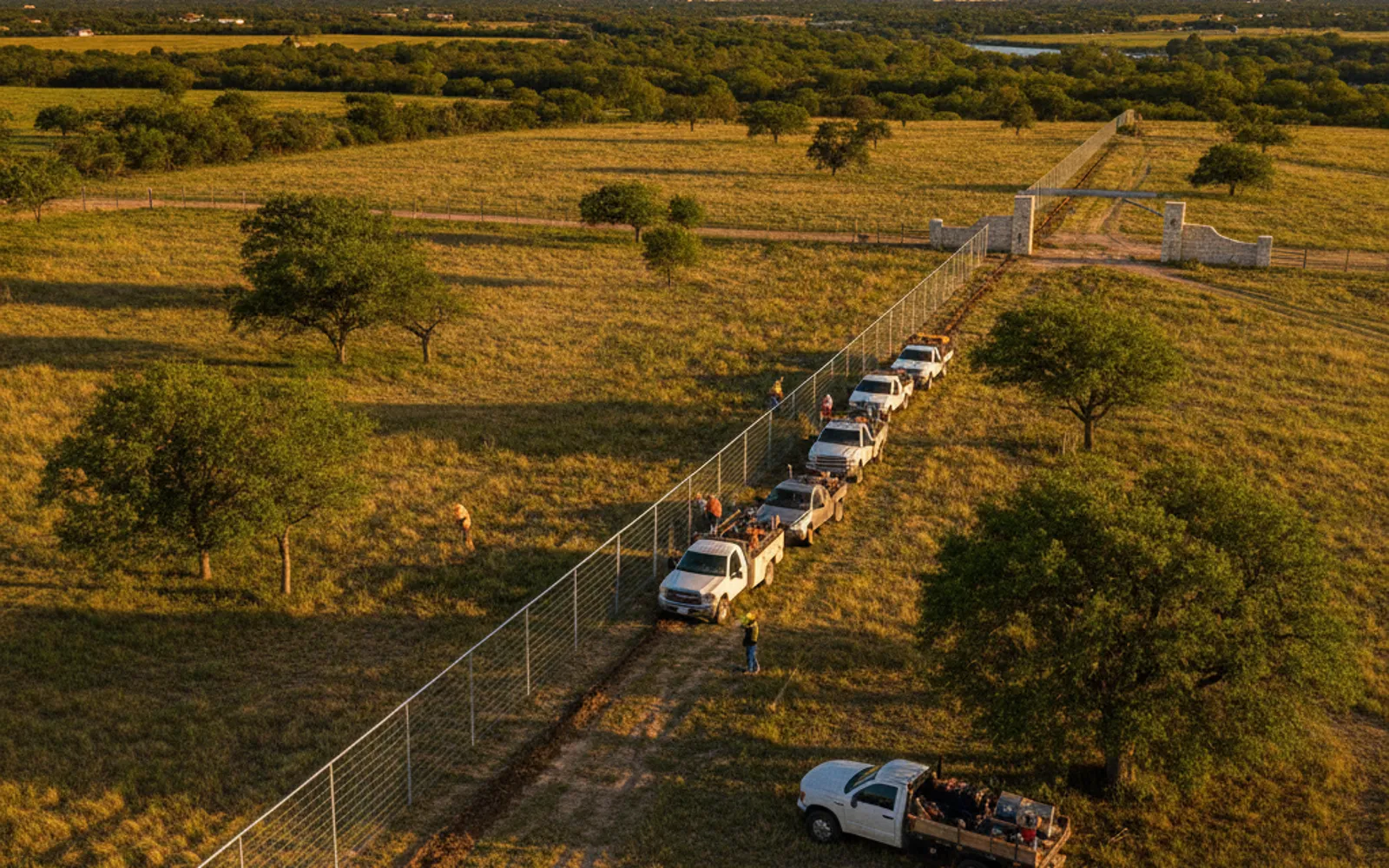
A hog panel and a cattle panel are the same product in two sizes. Both are 16-foot sheets of welded, galvanized rod with stays every 8 inches. The hog panel is 34 inches tall and packs its wires tight at the bottom so a pig cannot root under or squeeze through. The cattle panel is 50 inches tall with wider openings, because a cow pushes high and does not dig. Pick by the animal’s height and by what it does at ground level.
The farm store stacks them beside a combo panel and a goat panel, and the tags explain little. Below are the real specs, what each panel holds, how to post and tie them, and where a panel fence stops making sense and wire takes over.
If you would rather have someone walk your pens or fence line and tell you what goes where, call (254) 870-8898 for a free on-site estimate anywhere in McLennan, Bosque or Falls County.
The short version: height and bottom spacing
The differences are in three places: overall height, how many horizontal (line) wires there are, and how those wires are spaced from the ground up. Here is one manufacturer’s line, taken from the OKBRAND spec pages for its hog panels, cattle and combo panels and sheep and goat panels. Other brands run close to these numbers but not identical, so read the tag on the panel you are buying.
| Panel | Height | Line wires | Spacing, bottom to top | Stays |
|---|---|---|---|---|
| Hog | 34 in | 11 | four 2 in, two 3 in, one 4 in, two 5 in, one 6 in | 8 in |
| Sheep and goat | 42 in | 11 | four 3 in, two 4 in, two 5 in, two 6 in | 8 in |
| Cattle | 50 in | 10 | two 4 in, seven 6 in | 8 in |
| Combo | 50 in | 13 | three 2 in, two 3 in, two 4 in, five 6 in | 8 in |
All four are 16 feet long. Add the gaps and you get the height.
The detail that matters most is the bottom 8 inches. A hog panel has four 2-inch gaps down there, so the lowest openings are 2 by 8 inches. A cattle panel’s lowest openings are 4 by 8, then it jumps to 6 by 8 for the rest of the sheet. A baby pig or a young goat goes straight through a 4-inch gap. A cow does not care.
The combo panel is the one people overlook. It is cattle-panel height with hog-panel spacing at the bottom, which is why it sells for pens that hold more than one kind of stock.
Wire weight: why “4 gauge” on the tag is not the whole story
Retail listings tend to call every panel “4 gauge.” Look closer and most makers sell two weights of the same panel.
OKBRAND, for example, lists its heavy 10-line cattle panel at 44 pounds and the lighter “Select” version at 32 pounds, same 50 by 16 foot size. The heavy combo is 52 pounds against 37 for the Select, and the heavy hog panel is 42 pounds against 29. The heavy line is built from quarter-inch rod. That is roughly 30 percent less steel, and you feel it the first time a cow leans on one in an alley.
For a garden, a feeder ring or a goat pen under light pressure, the lighter panel is fine. For a crowding pen, an alley, a bull pen or anything a trailer might back into, buy the heavy panel and put stout posts behind it. The weight on the tag tells you more than the word gauge does.
What each panel holds, and what it does not
Cattle panels
A 50-inch cattle panel holds grown cattle in a pen or small trap. The 4-inch bottom spacing stops most calves once they have some size, though a small calf can still get a head or leg through. Cattle panels are the default for working pens, sorting pens, alley sides and small holding traps. They are not tall enough to stop a bull that wants over. The live post on cattle panels vs net wire covers how panels and woven wire compare under a hard hit.
Hog panels
A 34-inch hog panel holds domestic hogs because pigs push and root; they do not climb. The same panel works against feral hogs in small areas. Texas A&M AgriLife Extension tested hog panel fences around deer feeders and found that 28- and 34-inch fences kept feral hogs out completely while adult deer kept jumping in to feed. They set the small openings at the ground and tied the panels to T-posts.
What a hog panel will not do is hold cattle, horses or most goats. A cow reaches over 34 inches without trying, and a goat will hop or climb it. For hogs tearing up an existing perimeter, the live post on feral hog fence damage is the better read.
Combo panels
Combo panels earn their extra weight when one pen holds cattle one week and pigs, calves or sheep the next. The 2-inch bottom rows stop small stock and hogs; the 50-inch height holds cows.
Goat panels
A horned goat will push its head through a 6 by 8 inch opening after grass on the other side, then cannot pull back past the horns. Panels with small openings all the way up, like the 4 by 4 inch mesh some makers sell at 48 inches, take that away. A 42-inch goat panel holds most meat goats in a pen; a goat that jumps needs more height or a hot wire on top. For pasture fence, see our goat and sheep fence page.
Horses
None of the four is a good horse fence. A 50-inch panel is short for most horses, and Penn State Extension’s fence planning for horses puts horse fence at 54 to 60 inches and says small, safe mesh openings are under 3 inches square. A 6 by 8 inch opening lets a pawing hoof through and can catch it. Use purpose-built horse panels, no-climb mesh or pipe; our horse fence page covers those options.
Good jobs for panels on a place
Panels shine where animals crowd, where a fence has to move, or where the run is short:
- Working pens and alleys. Heavy cattle or combo panels on pipe or stout wood posts. Our corrals and working pens page covers how a full set of pens goes together.
- Feeder and bait-site rings. A circle of hog panels around a deer feeder, set tight to the ground, keeps hogs off the corn and lets adult deer jump in. The AgriLife study found the 34-inch height limited fawn access, so it suggests 28 inches, or notches cut in the top of 34-inch panels, where fawns need to feed.
- Garden fence and trellis. Hog panels make a solid low garden fence against hogs and dogs. A cattle panel bends into an arch between two raised beds and carries beans, squash or cucumbers for years.
- Temporary pens. Panels on T-posts come down and go back up somewhere else.
- Patching gaps. A panel over a washed-out low spot or a hog run under a woven wire fence is a quick fix while you plan the real repair.
- Creek and draw crossings. Panels hung from a cable or pipe across a draw can swing up with high water and drop back when it falls, instead of holding against the drift in a flash flood until the whole crossing tears out.
How to post and attach panels
Panels are rigid, so they skip the stretch-and-brace work a wire fence needs. That makes them simpler to put up and less forgiving of bad posts.
Post spacing. Set a post at each end of a panel and one in the middle, about every 8 feet. Overlap panel ends by one stay space (8 inches) and set the post at the overlap so both panels tie to it. The AgriLife feeder rings used the same layout: a T-post at each overlap and one halfway between.
Which post. T-posts are fine for garden fence, feeder rings, goat pens and hog pens. Working pens and alleys want pipe or heavy wood posts, because a panel is only as stiff as what it is tied to. On pipe, panels are usually welded on.
Tying on. On T-posts, use the clips made for them or wrap 9- to 12.5-gauge galvanized wire around the post and two line wires, and twist it tight. Tie at the top, middle and bottom at minimum. Baling wire works, but it rusts out fast in the open.
Graduated side down. Hog, combo and goat panels have a right way up. The tight rows go at the ground. Stand one upside down and a pig will find out in a day.
Ground contact. For hogs and small stock, set the bottom wire at the dirt. On uneven ground, rake or cut a level pad under each panel, or step the panels so the gaps under each one stay small. Panels do not follow dips the way woven wire does.
Posts in clay and rock. Blackland clay shrinks and swells between drought and a wet spring, and posts lean over a few seasons, dragging the panel with them. West of the Brazos and into Bosque County, thin soil over limestone means drilling for anything heavier than a T-post. Set pen posts for the ground they are in.
Sharp ends. Cutting a panel with bolt cutters or a grinder leaves a row of sharp stubs. Grind them or bend them back so they face away from stock.
When a panel fence costs more than wire
A panel fence is cheap per job and expensive per mile.
A mile of fence is 5,280 feet. At 16 feet a panel, that is 330 panels, a few more once you allow for overlaps. At 44 pounds each for a heavy cattle panel, it is about 14,500 pounds of steel to haul and handle, and at 8-foot post spacing it is 660 posts. The same mile in net wire is 16 rolls of 330-foot woven wire (5,280 divided by 330), on posts at your normal wire spacing (see fence post spacing) with braces at corners and gates.
Our installed range for net wire or field fence is $3.50 to $8 per foot, or $18,480 to $42,240 across a mile (5,280 times 3.50, and 5,280 times 8). Panels cover the same distance with about twenty times as many pieces to haul, set and tie, which is why panel fence stays around barns and pens. The strength and cost comparison against woven wire is covered in more depth in cattle panels vs net wire.
Pens flip it around. They are short, crowded and take a beating, and a stretched wire fence in a crowding pen gets pushed out of shape. Pen work is usually priced as a setup rather than by the foot. The general Central Texas market range for a 20 to 30 head setup is $6,000 to $12,000, and a full facility for 100 head or more runs $18,000 to $30,000 and up. The full list of bands is on the ranch fence cost page.
A rough rule that holds up: if the animals crowd against it, or the run is under a couple hundred feet, panels are worth it. If the run is long and the stock is spread out, use wire and spend the difference on better corners.
Getting the right panel in the right place
Most places end up with more than one panel type: cattle or combo panels in the pens, hog panels around a feeder or garden, goat panels where the kids are, and wire on the long runs. The mistakes that cost money are the wrong height for the animal, light panels in a heavy-use pen, and posts that will not stay straight in the ground they are in.
If you are laying out pens or deciding where panels stop and wire starts, have someone walk the line with you before you buy a trailer load. Call (254) 870-8898 for a free on-site estimate in McLennan, Bosque or Falls County.
Frequently Asked Questions
What is the difference between a hog panel and a cattle panel?
Height and bottom spacing. A hog panel is 34 inches tall with tight 2-inch gaps between the lowest wires so pigs cannot root under or squeeze through. A cattle panel is 50 inches tall with 4-inch gaps at the bottom and 6-inch gaps above. Both are usually 16 feet long with vertical stays every 8 inches. The hog panel holds pigs; the cattle panel holds cows.
What is a combo panel?
A combo panel is cattle-panel height, about 50 inches, with hog-panel style spacing at the bottom. One common version has 13 line wires with three 2-inch gaps at the ground. It holds cattle, hogs, calves and other small stock in the same pen. If you only ever hold grown cattle, a plain cattle panel does the job with less steel.
Can I use hog panels for goats?
Usually not as the only fence. At 34 inches, most goats will jump or climb a hog panel. The tight bottom rows help with kids, but the height is too low for adults. A 42 to 48 inch goat panel, ideally with small openings all the way up so horned goats do not get their heads stuck, is the better choice. See our goat and sheep fence guide for pasture options.
How many T-posts do I need per cattle panel?
Plan on a post every 8 feet: one at each overlap between panels and one in the middle of each 16-foot panel. That works out to about two posts per panel on a long run. In a working pen or alley where cattle push on the sides, use pipe or heavy wood posts at the same spacing rather than T-posts.
Are cattle panels safe for horses or a round pen?
They are not ideal. A 50-inch panel is shorter than the 54 to 60 inches Penn State Extension recommends for horses, and the 6 by 8 inch openings can catch a hoof. For a round pen, use purpose-built horse panels made of tubing, or pipe with no-climb mesh. Cattle panels are fine for a garden or a pen that never holds a horse.