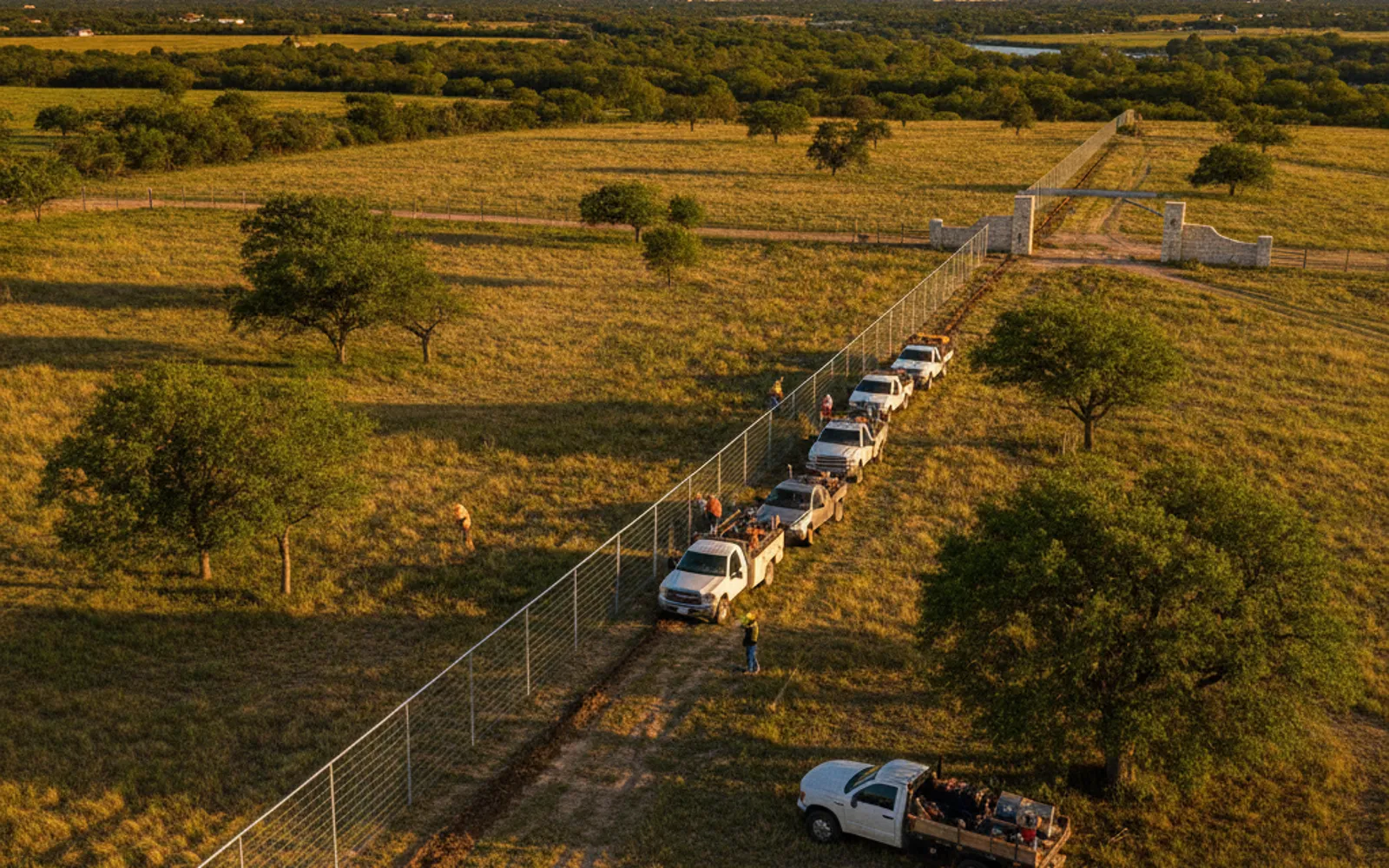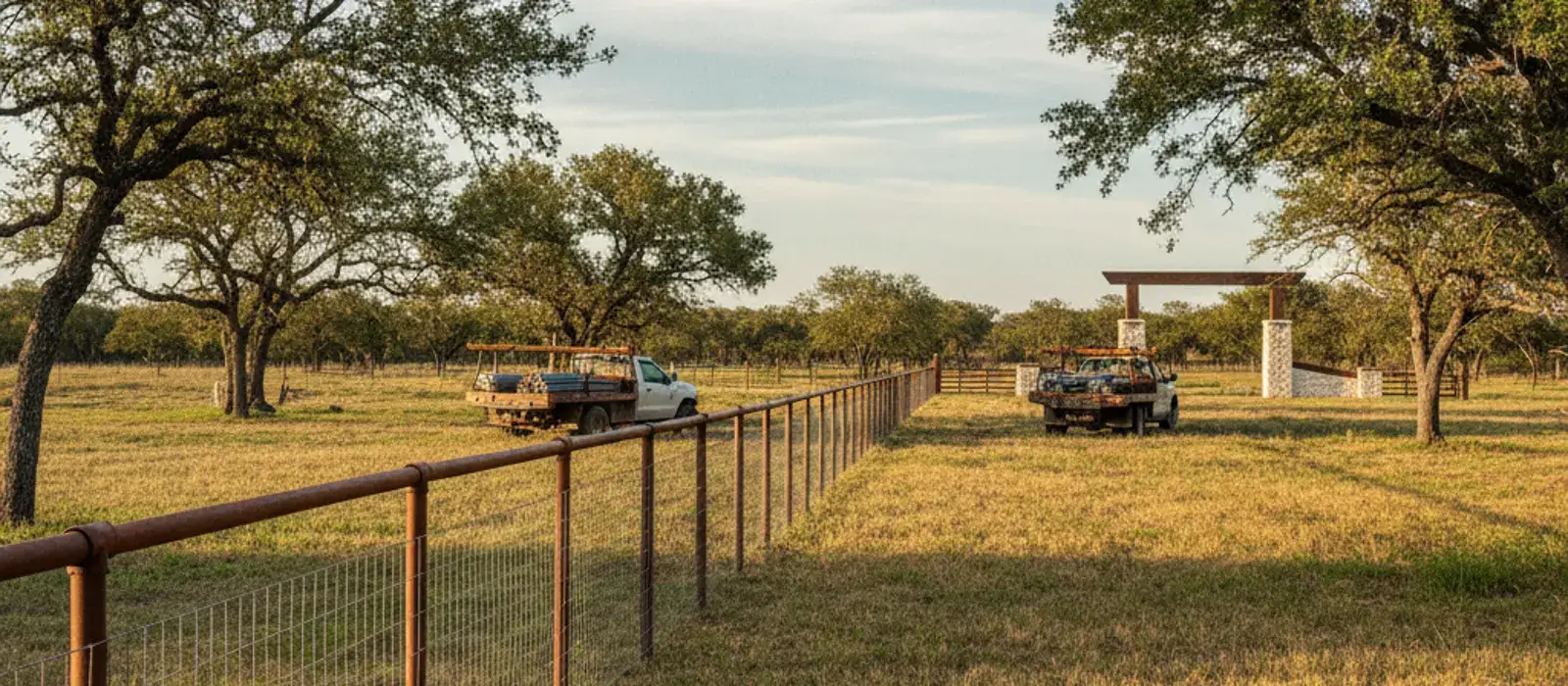
About half the fence repair calls we run in McLennan County trace back to one decision somebody made years ago: they put a t-post where a wood post belonged, or paid wood-post money where steel would’ve done the job. The t-post vs wood post question isn’t really a question of which one is better. It’s a question of where each one belongs, because a good barbed wire fence around Waco uses both, and the ranchers who get the mix right spend a lot less on repairs over the next 25 years.
We build and repair ranch fence all over McLennan, Bosque, and Falls counties, so we’ve seen every version of getting this wrong. All-steel fences with corners leaning into the pasture. All-wood fences that cost double what they needed to. This article lays out where each post type earns its keep, what they actually cost in 2026, and how to combine them so your fence stays tight.
If you’d rather skip the reading and just get a straight answer for your place, call us at (254) 870-8898. Estimates are free and in writing.
What T-Posts Do Well (and Where They Fall Short)
A steel t-post is a line post. That’s its whole job. It holds wire at the right height and keeps strands spaced along the run. Driven 18 to 24 inches into decent soil, a 6.5-foot t-post does that job for decades at a fraction of the cost of wood.
Here’s what steel gives you:
- Speed. A two-man crew with a driver can set 150 to 250 t-posts a day. Wood posts in augered holes go in at maybe a third of that pace.
- Price. A 6.5-foot, 1.25 lb/ft t-post runs $6 to $9 at Central Texas farm stores. A comparable treated wood line post runs $15 to $25 before you dig a single hole.
- Rocky ground. In the chalky limestone west of Crawford and out toward Valley Mills, driving steel beats augering rock every time. We cover that fight in detail in our post on setting fence posts in rocky ground.
- Fire and rot. Steel doesn’t rot at the ground line and a grass fire won’t take out a mile of it.
Now the other side of the ledger. A t-post has almost no resistance to pull along the fence line. Stretch five strands of barbed wire to proper tension and anchor them to a t-post, and that post will lean, then pull, then fail. Steel also bends and stays bent. A cow that leans on a wood post gets bored and walks off. A cow that leans hard on a t-post can leave it kinked at 30 degrees, and it never stands straight again.
T-posts also make poor gate hangers, poor corner posts, and poor ends. Anywhere the fence changes direction or the wire terminates, steel line posts are the wrong tool.
Where Wood Posts Earn Their Keep
Wood posts handle the loads t-posts can’t. Every place your fence starts, stops, turns, or crosses something is a wood post location.
Corners and ends. A properly built corner is two or three 6-inch treated posts set 36 to 48 inches deep in concrete or tamped tight, tied together with a horizontal brace and a diagonal wire. That assembly is what actually holds your wire tension. Without it, the whole fence is loose no matter how many t-posts you drive. We walk through the build in our guide to H-brace fence corners, and it’s the single most important 20 feet of any fence.
Gates. A 12-foot tube gate weighs 90 to 120 pounds and swings on two hinges all day. Hang it on anything less than a deep-set 6-inch or 8-inch wood post (or pipe) and you’ll be lifting that gate to latch it within two years.
Stretch posts. On long runs, a wood post every 300 to 600 feet gives you a place to tie off and re-tension wire in sections. When a limb drops on the fence, you fix one section instead of re-stretching a half mile.
Dips, rises, and water gaps. Wherever the wire wants to pull up out of a low spot or down over a rise, the vertical load will lift a t-post right out of the ground. Wood holds.
Livestock pressure points. Working pens, alleyways, feed areas, anywhere cattle bunch up and push, wood posts (or better, pipe) take the abuse. For heavy-pressure areas a lot of our customers step up to a pipe fence, which outlasts everything.
The catch with wood is cost, labor, and rot. A treated pine post in the black clay east of Waco can last 20 to 30 years. A bargain post with thin treatment can rot at the ground line in 8. Post choice matters as much as post placement, and we compare the options in cedar vs treated pine posts.
T-Post vs Wood Post Cost: Real 2026 Numbers
Here’s what the two actually cost around Waco right now, materials and typical installed price. Prices move with steel and lumber markets, so treat these as planning numbers and get a written quote before you budget a whole project.
| Item | Material cost | Installed (typical) | Best use |
|---|---|---|---|
| T-post, 6.5 ft, 1.25 lb/ft | $6 to $9 | $12 to $18 | Line posts on straight runs |
| T-post, 8 ft heavy duty | $10 to $14 | $16 to $24 | Taller net wire, game fence lines |
| Treated pine line post, 4 in | $15 to $25 | $35 to $55 | Stretch posts, dips, pressure spots |
| Treated pine corner post, 6 in | $30 to $45 | $85 to $150 | Corners, ends, gate posts |
| Full H-brace corner assembly | $90 to $150 | $250 to $450 | Every corner and end |
Run the math on a quarter mile (1,320 feet) of five-strand barbed wire with posts every 12 feet. All wood, you’re looking at roughly 110 line posts at $35 to $55 installed each, which is $3,850 to $6,050 in posts alone. Swap the line posts to steel and keep wood only at the corners, ends, and a couple of stretch points, and the post budget drops to around $1,600 to $2,400. Same fence height, same wire, and honestly a straighter-looking fence, for less than half the post cost.
That’s why nearly every barbed wire fence we build follows the same recipe: wood where the fence works hard, steel where it just stands there. You can see how posts fit into total project pricing on our ranch fence cost page.
Last fall we rebuilt a fence for Dale Kubacak, who runs about 40 cows outside Crawford. The previous owner had fenced the whole place with t-posts, corners included, sometime in the 2000s. Every corner had crept inward 8 to 14 inches, the wire sat slack enough to step over in places, and his cows had figured that out twice that summer. We didn’t replace the fence. We built him nine new H-brace corners and ends at about $340 apiece, re-stretched the existing wire, and replaced 60-odd bent t-posts. Total came in just under $4,100. A full rebuild would’ve run him north of $16,000. The lesson: the steel was fine. The missing wood is what failed.
Mixing Wood Posts and T-Posts: The Layout That Works
Here’s the standard layout we use on barbed wire and field fence across Central Texas. It’s not fancy, and that’s the point.
- Wood H-braces at every corner, end, and gate. No exceptions. This is the skeleton.
- Wood stretch assemblies every 300 to 600 feet on long runs, and at the bottom of every significant dip.
- Steel t-posts on 10 to 12 foot centers between them for cattle on barbed wire. Tighten to 8 feet for goats, sheep, or heavy hog pressure. Our fence post spacing guide covers the spacing question by animal and wire type.
- Wood or pipe at water gaps and creek crossings, because that’s where floodwater loads hit.
Some folks ask about the old-school pattern of one wood post every fourth or fifth post down the line. It looks stout, and on show-front fencing along a county road it does dress things up. Structurally, though, a 4-inch wood line post driven or tamped 24 inches deep doesn’t add much that a good t-post doesn’t, and it triples your line post budget. Put that money into deeper, bigger corner posts instead. Corners are what keep wire tight, and tight wire is what keeps cattle home.
Texas A&M and other land-grant extension programs publish the same basic guidance if you want a second opinion. The University of Georgia’s extension bulletin Fences for the Farm is one of the better free references on brace construction and post depth, and USDA NRCS publishes fence standards used in cost-share fencing programs if you’re fencing under an EQIP contract.
One more real-world example. In March, Marcy Villanueva near Valley Mills called our emergency line at 6 a.m. with cattle on FM 56. A dead post oak had dropped across her fence overnight, and because the old fence had no stretch posts, the falling tree slacked the wire for a full quarter mile in both directions. We got the cattle penned and the gap closed that morning for $650, then came back the next week to add four wood stretch assemblies down that line for another $1,400. The next limb that falls will slack one 400-foot section, not 1,300 feet. If you’re getting those dawn phone calls yourself, our post on cattle getting out of the fence walks through finding the weak point fast.
If you’re staring at a fence line right now trying to figure out which posts failed and why, send us a couple of photos through the contact form and we’ll give you an honest read on repair versus rebuild.
Central Texas Soil Changes the Answer
The t-post vs wood post math shifts with what’s under your boots, and around here that changes fast.
Blackland clay east of I-35, around Lorena and out toward West, swells when wet and shrinks hard in drought. That movement heaves shallow posts and opens gaps around them. In clay we set wood corners deeper, 42 to 48 inches, and we expect some t-post straightening after a wet winter. Deep-set wood is cheap insurance in that ground.
Limestone and caliche west of Waco, out through Crawford, McGregor, and Valley Mills, is the opposite problem. You can’t drive deep, and augering means rock bits and patience. Steel pilot points and rock drills earn their keep, and sometimes the right answer for a corner is drilling and setting pipe in concrete instead of fighting a 48-inch hole for wood.
Sandy river bottoms along the Brazos and Bosque hold posts loosely. T-posts wobble, so we tighten spacing to 8 or 10 feet and upsize wood posts.
Drought years are their own problem. In cracked, dried clay a t-post that drove tight in April can rattle loose by September. That’s part of why fences that stood fine for a decade suddenly start leaning during a dry stretch.
Frank Mynar, who runs stockers on leased ground outside West, learned the sandy-soil lesson the expensive way in 2025. He’d fenced a 30-acre bottom trap himself with t-posts on 15-foot centers to save money. Feral hogs went through it like it was string, and he lost roughly $2,200 in a busted fence, an escaped-cattle gathering fee, and a neighbor’s flattened oat patch before he called us. We rebuilt the pressure side with net wire, 8-foot t-post spacing, and wood posts every 100 feet for about $5,800. He’s had zero breakouts since.
When to Stop DIYing and Call a Pro
Plenty of fence work is fair game for a capable landowner. Driving t-posts, splicing wire, swapping a bent post, stapling loose strands. If you’ve got a post driver and a good pair of gloves, have at it.
But know where the line is. Call a professional when:
- Corners or braces need rebuilding. A corner that’s set wrong fails slowly and takes the whole fence’s tension with it. This is the highest-skill part of the job.
- You’re stretching long runs of wire. Barbed wire under tension stores real energy. A snapped strand or a slipped stretcher can cut you badly. Wear eye protection and never stretch wire alone.
- The fence is on a property line. Texas fence law has quirks worth understanding before you build, and a misplaced fence is an expensive argument.
- There’s a water gap, road frontage, or utility easement involved. Call 811 before any post holes near buried lines. It’s free and it’s the law.
- The project is more than you can finish before livestock test it. A half-built fence is an invitation.
We’re licensed and insured, our estimates are free and written, and our emergency line answers 24/7 for storm damage and cattle-out calls. Call (254) 870-8898 or reach us at brazosridgefence.com and we’ll walk your line with you, whether you need the whole job done or just the corners set so you can run the wire yourself.
Frequently Asked Questions
Can I build a barbed wire fence with only t-posts?
You can, but it won’t stay tight. T-posts can’t anchor wire tension, so an all-steel fence goes slack as the corners lean, usually within a few seasons. At minimum, put wood H-braces at every corner, end, and gate, then run steel between them.
How many t-posts should go between wood posts?
On a typical Central Texas cattle fence, we run t-posts on 10 to 12 foot centers with wood stretch posts every 300 to 600 feet, plus wood at every corner, end, gate, and major dip. For goats, sheep, or hog pressure, tighten steel spacing to about 8 feet. There’s no structural need for a wood post every fourth or fifth post unless you want the look.
How long do wood fence posts last in Central Texas?
A quality treated pine post rated for ground contact typically lasts 20 to 30 years here, and good steel t-posts often outlast them. Cheap, lightly treated posts can rot at the ground line in under 10 years, especially in wet bottomland. Buy posts with a .40 CCA (or equivalent) ground-contact treatment rating and you’ll only do this job once.
Which is cheaper, t-posts or wood posts?
Per post, steel wins big: $12 to $18 installed for a t-post versus $35 to $55 for a wood line post and $85 to $150 for a corner post. On a quarter mile of fence, using steel for line posts and wood only where the fence needs anchoring usually cuts the post budget by more than half. Get a written quote though, since steel and lumber prices both move around.