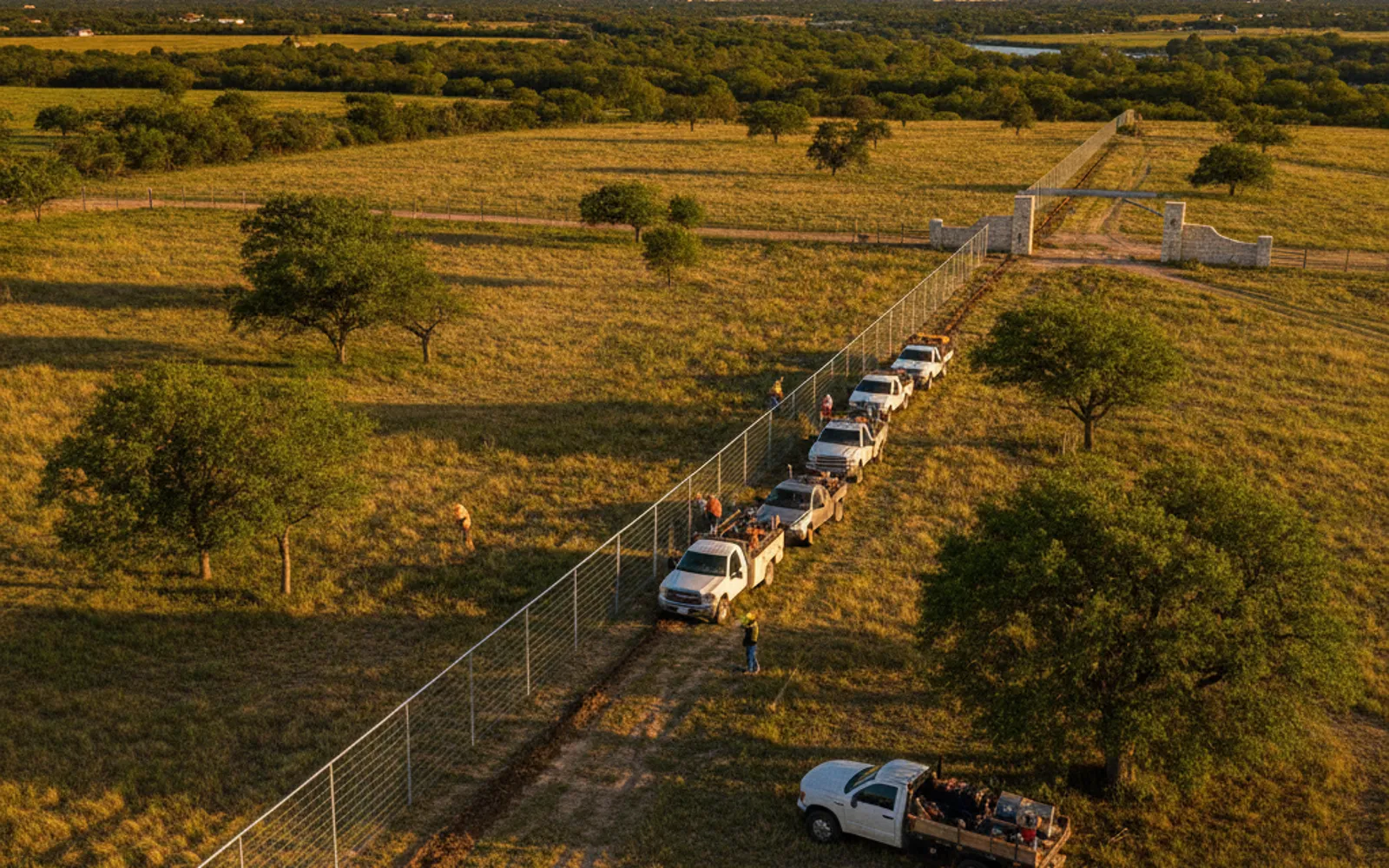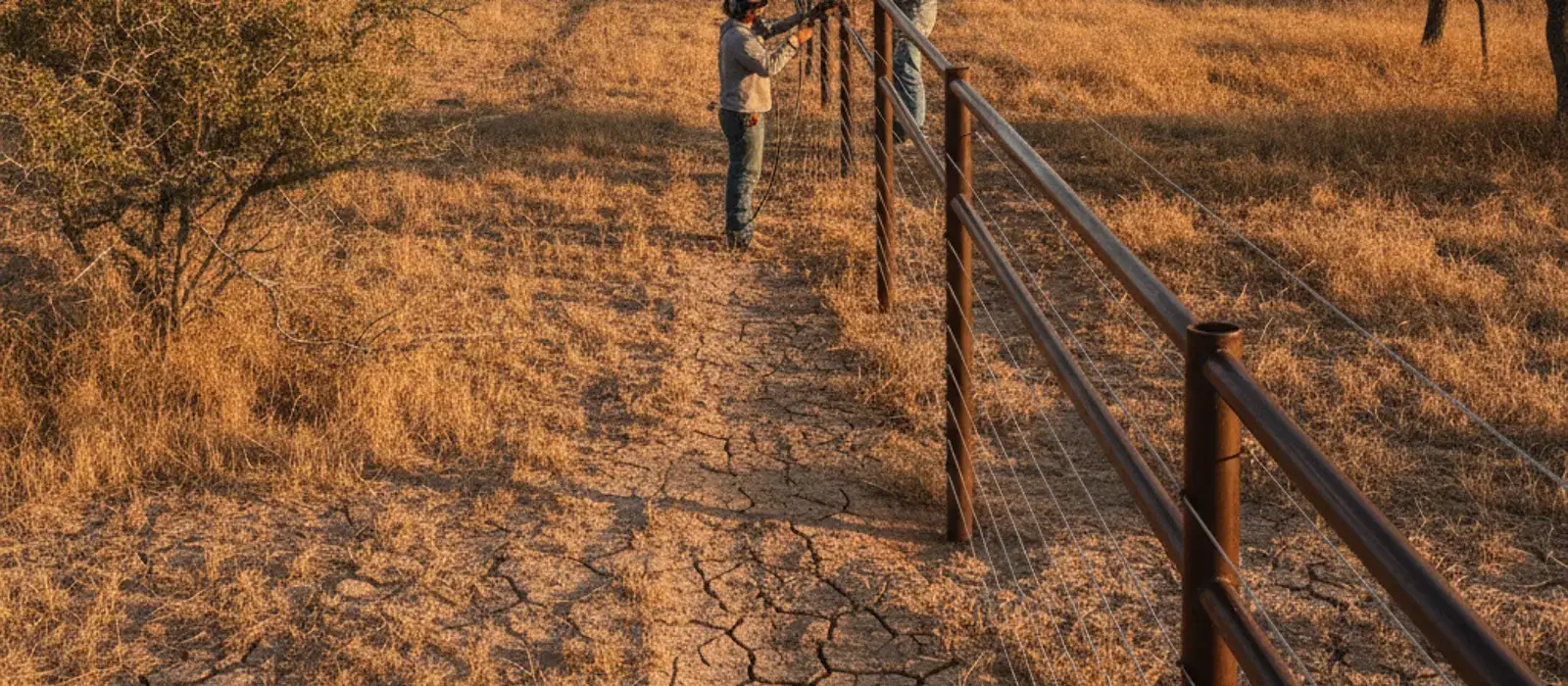
A mile of five strand barbed wire around Waco runs $15,000 to $24,000 installed. A mile of two strand electric fence can go in for less than half that. So why does barbed wire still line almost every county road in McLennan, Bosque, and Falls counties?
Because cheap up front isn’t the whole story. The electric fence vs barbed wire question comes down to three things: what it costs to build, what it costs to keep working, and whether it actually holds your cattle when a storm rolls through or a bull decides the neighbor’s grass looks better. We build both kinds all over Central Texas, and the honest answer is that each one wins in different spots on the same ranch.
Here’s how they stack up, with real numbers from real jobs.
Electric Fence vs Barbed Wire Cost: The Real Numbers
Let’s start where everybody starts, the price per foot. These are typical installed ranges we see around Waco in 2026, materials and labor together, on ground that isn’t solid rock.
| Electric (1-2 strand hot wire) | Barbed Wire (5 strand) | |
|---|---|---|
| Installed cost per foot | $1.25 to $2.50 | $2.50 to $4.50 |
| Cost per mile | $6,500 to $13,000 | $15,000 to $24,000 |
| Energizer and grounding | $300 to $900 one time | None |
| Typical lifespan | 15 to 25 years (wire), 5 to 10 (energizer) | 25 to 40 years with upkeep |
| Works during power or battery failure | No | Yes |
| Annual upkeep | Check charge weekly, mow or spray fence line | Restretch, restaple, replace the odd post |
| Best use | Cross fencing, leases, rotational grazing | Perimeter and road frontage |
Two things jump out. Electric is the clear winner on upfront cost, mostly because you’re driving fewer posts. Hot wire carries almost no physical load, so posts can sit 30 to 50 feet apart instead of the 10 to 12 foot spacing barbed wire needs. Fewer posts, fewer holes, less labor.
But barbed wire is a physical barrier that works 24 hours a day whether or not a battery is charged. That difference matters more than any number on this table, and we’ll get to why.
Danny Vaculin, who runs stockers on leased coastal ground outside West, is a good example of electric done right. He picked up an 80 acre lease last spring and needed about a mile and a half of cross fence fast. A five strand barbed job would’ve run him around $22,000, which makes no sense on a three year lease. We built him two strand high tensile electric with a solar energizer for about $9,600. His steers respected it within a week, and when the lease ends he can pull most of it and take it with him.
If you’re trying to figure out which side of that table your project lands on, call us at (254) 870-8898 or request a free written estimate. We’ll walk the line with you and give you numbers for both options, in writing.
How Each One Controls Cattle
Barbed wire is a physical barrier. Electric is a psychological one. That’s the whole comparison in two sentences, and everything else follows from it.
A properly built five strand barbed fence stops cattle because they physically can’t get through it without pain and effort. Even a hungry cow testing a fence line hits the barbs and backs off. It doesn’t need electricity, doesn’t care about weeds, and works exactly the same at 3 a.m. in a thunderstorm as it does on a clear afternoon. If you want the details on strand counts, our post on how many strands of barbed wire you need breaks it down by livestock type.
Electric fence stops cattle because they’ve been trained to fear it. A cow touches a hot wire once, gets a sharp 5,000 to 8,000 volt reminder, and gives that wire a wide berth from then on. Trained cattle will respect a single strand of hot wire that a calf could walk through if it wanted to.
The key word is trained. Cattle new to electric fence need to learn it, ideally in a small trap where they can test the wire without ending up on a farm to market road. And here’s the catch nobody likes to talk about: when the fence goes dead, cattle figure it out faster than you’d think. Some cows will start testing a fence within a day or two of the charge dropping. A dead electric fence is barely a fence at all.
Then there’s pressure. A hot wire handles casual pressure fine, a cow reaching for grass or scratching an itch. It does not handle panic. A deer strike, a pack of dogs, or a Fourth of July fireworks show can send cattle straight through electric fence like it’s not there. Barbed wire usually turns that same panicked cow, or at least slows her down and leaves you evidence of where she went through.
Upkeep: What Each Fence Asks of You Every Year
No fence is maintenance free, but the two types ask for very different kinds of attention.
Electric fence needs regular, frequent, small attention. You need to check voltage at least weekly with a fence tester, because the fence only works when it’s carrying a charge. Grass and weeds growing into the wire bleed voltage into the ground, so you’re mowing or spraying the fence line two or three times a year in a wet spring. Solar panels need cleaning, batteries die every few years, and lightning loves energizers. If your charger is clicking but the fence reads low, our guide on why your electric fence isn’t working covers the usual suspects, bad grounding being the big one. Around here, dry summer soil is a terrible conductor, and a fence that snapped hard in April can feel like a static tickle by August.
Barbed wire needs occasional, heavier attention. You’re walking the line a couple times a year, restretching slack wire, replacing a rotted post here and there, and fixing whatever the last storm dropped on it. The work is more physical but far less frequent, and the fence keeps doing its job between visits. Budget roughly $100 to $300 per mile per year for materials on a barbed fence in decent shape, more as it ages past 25 or 30 years.
Gene Pruitt’s place in Valley Mills shows how the two can cover each other’s weaknesses. His barbed perimeter was 30 years old and his bulls had learned to lean through it to reach the neighbor’s oats. Rebuilding the whole line would’ve cost him north of $20,000. Instead we ran a single offset hot wire down 2,600 feet of the worst stretch, about $1,800 all in. The bulls quit leaning, the old wire quit stretching, and he bought himself years before a full rebuild.
Oklahoma State University’s extension service publishes a solid economic comparison of livestock fencing options if you want to see lifetime cost math laid out per foot per year. Their numbers line up with what we see in the field: electric wins on total cost, barbed wins on reliability, and the gap narrows the longer you own the land.
Hot Wire vs Barbed Wire in Central Texas Conditions
Fence charts made for Missouri pasture don’t always survive contact with Central Texas. A few local realities push the hot wire vs barbed wire decision one way or the other.
Drought and dry soil. Electric fence needs moist soil to complete the circuit through the cow’s hooves. In a Central Texas July, blackland clay bakes hard and cracks, and fence voltage that reads fine at the energizer delivers a weak shock at the animal. Extra ground rods and a pos-neg wire setup help, but this is a real weakness here that it doesn’t have in wetter country.
Storms and lightning. One good spring storm can kill an energizer and drop limbs on any fence. The difference is what happens next. A barbed fence with a limb on it usually still turns cattle. An electric fence with a dead charger turns nothing.
Feral hogs. Hogs go under fences, not through them, and they’ll root out the bottom of either type. A low hot wire at snout height is actually one of the better hog deterrents going, which is a point for electric or for adding a hot strand to barbed.
Liability on roads. Texas is technically open range, but stock laws in McLennan and most surrounding counties, plus Chapter 143 of the Texas Agriculture Code on highways, mean cattle on the pavement can become your problem fast. That’s why we almost never recommend electric alone on road frontage. One dead battery between you and a wreck on Highway 6 is a bad bet.
Marcy Holt learned that one the hard way near Crawford. She’d fenced her whole 120 acres in electric to save money, and it worked fine for two years. Then a May lightning strike cooked her energizer while she was out of town, and by the next evening eight steers were grazing the right of way on a farm to market road. A neighbor got them penned before anything worse happened. She called us that week, and we rebuilt her mile and a quarter of road frontage in five strand barbed for about $21,000. She kept the electric for interior cross fencing, where a failure means cows in the wrong paddock instead of cows on the road. If your cattle have been finding their way out, our post on why cattle get out of fences is worth ten minutes.
The Setup That Wins on Most Ranches
After enough of these jobs, a pattern shows up. The ranches with the fewest escapes and the lowest lifetime fence bills almost never pick one or the other. They use both, each where it’s strongest.
Barbed wire on the perimeter. Especially road frontage and property lines. It’s the fence that works when nothing else does, it satisfies the “sufficient fence” standard your county stock law expects, and a well built one is a 30 year asset. Our barbed wire fence crews in Waco build these to a spec that includes h-braced corners and Class 3 galvanized wire, because the cheap version costs more in the long run.
Electric for cross fencing. Interior paddocks, rotational grazing, temporary leases, and protecting hay ground. It’s cheap, fast, and easy to move. A failure inside the perimeter is an inconvenience, not an emergency.
A hot offset wire to protect aging barbed fence. Often the highest return fencing dollar you can spend. One strand on offset insulators stops the rubbing and leaning that destroys older fence.
Budget-wise, that combo means spending the real money once, on the perimeter, then covering the interior for a fraction of the cost. For the full picture on what perimeter fence runs, see our ranch fence cost guide or the deeper dive on barbed wire fence cost.
One safety note before you run wire yourself: never power any fence with a homemade or plug-in charger that isn’t a listed, low-impedance fence energizer. People have been killed by improvised fence chargers. And if a storm drops a tree across your fence and cattle are already out, that’s not a DIY afternoon. Our emergency line at (254) 870-8898 answers 24/7 for exactly that situation, and we’re licensed and insured for the work.
If you’re weighing electric against barbed for a specific pasture, the cheapest mistake to avoid is building the wrong fence in the wrong spot. Reach out for a free written estimate and we’ll price both options side by side for your ground, your cattle, and your budget.
Frequently Asked Questions
Is electric fence cheaper than barbed wire?
Yes, usually by half or more up front. Around Waco, a two strand electric fence runs $1.25 to $2.50 per foot installed, while five strand barbed wire runs $2.50 to $4.50 per foot. Electric also carries ongoing costs barbed doesn’t, like energizers, batteries, and weed control on the fence line, so the lifetime gap is smaller than the upfront gap.
Will a single hot wire really hold cattle?
Trained cattle, yes, most of the time. Cattle that have learned to respect electric fence will honor a single strand at about nose height. It won’t hold untrained cattle, panicked cattle, or cattle standing at a dead fence, which is why we don’t recommend hot wire alone along roads or property lines.
Can I add electric to my existing barbed wire fence?
Yes, and it’s often the best money you can spend on an older fence. A single hot wire on offset insulators keeps cattle from leaning, rubbing, and reaching through, which is what wears out barbed fence early. Expect roughly $0.60 to $1.00 per foot for an offset hot wire added to sound existing fence.
How long does each type of fence last in Central Texas?
A well built five strand barbed fence with quality galvanized wire and good bracing lasts 25 to 40 years here. High tensile electric wire lasts 15 to 25 years, but energizers typically need replacement every 5 to 10 years, sooner if lightning finds them. Heat, drought cracked clay, and feral hogs shorten both, so an annual walk of the line pays for itself.