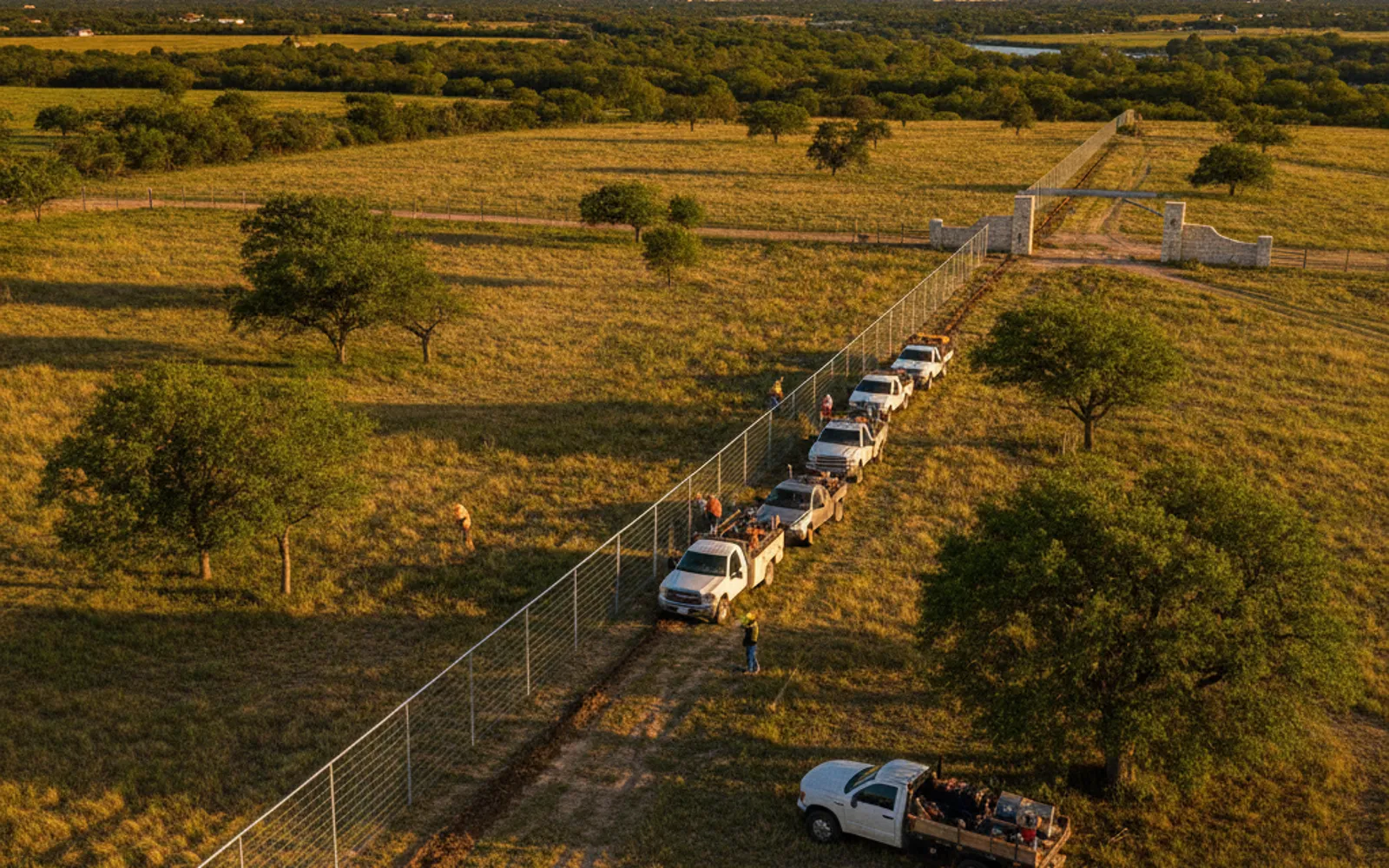
The short answer: a fence meant to hold or exclude whitetails on open ground should stand 8 feet at the top wire, measured at every point along the line, not just where it looks good from the road. In controlled trials, most deer cleared a 6-foot fence, a few cleared 7 feet, and none cleared 8 feet. That last foot is where the fence stops leaking.
The longer answer is that height covers only one way a deer beats a fence. Deer also go under a high bottom wire, through a gap or loose mesh, and over a spot where the ground rises next to the wire. A fence that is 8 feet on the flat and 6 feet on the uphill side of a cutbank is a 6-foot fence as far as the deer are concerned.
Most deer fence advice online is written for gardens and HOA backyards. This is the ranch and lease version. If you would rather have someone walk your line and point out the weak spots, call (254) 870-8898 for a free on-site estimate.
How high can a deer jump? What the trials actually measured
For building a fence you need something better than a best-ever jump story, and there is a good measurement.
Researchers with the USDA’s National Wildlife Research Center and the Wisconsin DNR put wild-caught whitetails in a test pen split by a woven wire fence, then raised that fence about a foot a week and drove the deer at it. The results were published in 2010 as Assessment of Abilities of White-Tailed Deer to Jump Fences. The deer were the northern subspecies, the largest whitetail subspecies, so these were not small animals.
| Test fence height | What happened |
|---|---|
| About 3, 4 and 5 ft | All 22 deer jumped it |
| About 6 ft (1.8 m) | 19 of 22 jumped it |
| About 7 ft (2.1 m) | 3 deer jumped it (2 during drives, 1 on its own between drives) |
| About 8 ft (2.4 m) | No deer jumped it, in the first trial or five more with new deer |
A few details from that paper matter more than the headline:
- Left alone, the group hopped the fence 10 or more times a day at 3 to 5 feet. At 6 feet that fell to about once a day, and at 8 feet it was zero.
- At 8 feet, deer being pushed often ran into the fence instead of trying to jump it. That is what you want your fence to do: look impossible.
- The authors surveyed more than 150 wildlife biologists afterward and found six who had seen a deer clear a fence of 8 feet or more. So 8 feet holds most deer, not every deer, every time.
The practical read: a 6-foot fence is a speed bump. A 7-foot fence stops most deer but leaks a few, and the few that learn a spot will keep using it. An 8-foot fence, built well, holds.
Why 8 feet is the working number in Texas
The 8-foot number comes from the animals and from the agencies that work with them, and the agencies land within a foot of each other.
Texas Parks and Wildlife’s guide to local deer control methods says blocks larger than about 50 acres usually need 8-foot woven wire or high-tensile fencing to reliably keep deer out when feeding pressure is high, and calls game fence at least 8 feet tall the only fully deer-proof design. It also says the mesh should be 6 inches or less.
The NRCS Texas fence specification (Conservation Practice 382, hosted by AgriLife Extension) lists deer fence with a 96-inch average top wire height. Its drawing shows a fence 8 feet tall overall on posts 20 feet apart: two widths of net wire joined with hog rings, two strands of 12.5-gauge barbed wire across the top, and an optional barbed wire at the bottom.
Oklahoma State Extension’s fact sheet on minimizing impacts to wildlife from livestock infrastructure (NREM-9028) puts exclusion fence for deer and elk at 7 to 8 feet with a highly visible top wire or rail.
So why do you still see 7-foot and 7.5-foot fences? Usually to save on wire and post length. But between 7 and 8 feet is exactly where the Wisconsin deer went from sometimes clearing the fence to never clearing it. Shaving the top foot saves money in the one band of height that does the work, and much of the labor is the same either way.
For what the state regulates about the deer themselves, see Texas high fence regulations. This article sticks to the fence.
Deer go under and through before they go over
Height gets the attention, but plenty of deer never try to jump. A gap at the bottom is cheaper than a leap.
A University of Montana study, To Jump or Not to Jump: Mule Deer and White-Tailed Deer Fence Crossing Decisions, put cameras on pasture fence crossings in Montana and Alberta. Nearly half of all successful deer crossings went under the fence rather than over it, and the higher the bottom wire, the more deer went under. At the whitetails’ known crossing spots, about two crossings in three went under. When the researchers lowered the bottom wire at those spots, the share crawling under dropped to 18 percent and the whitetails jumped instead. That was a low cattle fence, but the lesson carries over: if the bottom gives deer a way, they take it.
On an 8-foot game fence, the usual ways under and through:
- Daylight under the bottom wire. Any gap a deer can get its head and shoulders into is a doorway. Fawns get through much less. The bottom of the fence should touch the ground everywhere, including across dips.
- Mesh too open at the bottom. Game fence wire uses tighter spacing low down for a reason. TPWD’s 6-inch figure is the ceiling, not the goal, for the bottom rows.
- Hog damage. Feral hogs lift and root under the bottom of a fence, and once they open a hole, deer and coyotes use it too. A tight bottom wire, a buried or pinned apron, or a low offset hot wire all help. The repair side is covered in feral hog fence damage.
- Wire that has stretched or shifted. Loose wire can be pushed apart. Fixed knot wire holds its spacing better under an animal’s weight than hinge joint; see fixed knot vs hinge joint.
- Gates. A gate that is shorter than the fence, or hangs with a foot of air under it, sets the height of the whole fence. Gates on a high fence line need to match it top and bottom.
Terrain changes the height a deer actually sees
This is where a lot of “8-foot” fences quietly become 6-foot fences. The wire is 96 inches tall on the roll. What counts is the distance from the ground on the deer’s side to the top wire, where the deer is standing.
Slopes and cutbanks
Run a fence across a hillside and a deer on the uphill side faces a shorter jump wherever the ground rises close to the wire. Road ditch banks, stock tank dams and terraces do the same thing. Where you cannot move the fence off the high ground, you raise the fence there with taller posts and an extra strand or two on top.
Draws, creeks and low spots
Where the fence crosses a dip, the wire wants to span it straight and lift off the ground. That leaves a gap underneath exactly where deer already travel, since draws are natural crossings. The NRCS spec notes that posts set in low areas or gullies need to be weighted or set in concrete so they do not pull out of the ground. Creek crossings need their own water gap built to the fence’s height and to handle floods; see water gap fences.
Things piled against the fence
A fallen cedar or mesquite leaning on the wire, a brush pile, round bales stacked against it, or flood drift all make a step. One ice storm can drop limbs on a lot of fence in a night. A clear lane on both sides keeps these from becoming ramps, which is why fence line clearing comes up on most high fence lines in cedar and mesquite country.
Blackland heave and rocky ground
In blackland clay, posts heave and lean as the soil shrinks and swells, and a leaning post drops the top wire. West of the Brazos and into Bosque County, thin soil over limestone tempts people to set posts shallow instead of drilling, and a short post leans the same way. Either one takes inches off the top of the fence within a few years.
What 8 feet should mean on your fence line
When you compare bids or build it yourself, “8-foot game fence” should mean:
- Top wire at 8 feet on the deer’s side, everywhere. Measure it at high spots, beside ditches and on slopes, not just on the flat.
- Bottom wire in contact with the ground. Across dips, add posts or weight so the wire follows the ground.
- Wire with tight spacing low down. A single 96-inch roll, or two shorter rolls stacked and joined with hog rings (the layout the NRCS drawing shows). Either works if the joint is tight and the lower rows are close enough to stop fawns.
- Corners and braces that hold tension. An 8-foot wall of wire loads a corner far harder than a 4-foot cattle fence. When a corner gives, the run sags and the bottom lifts.
- Posts long enough for the height plus the depth. In rock that means drilling, not cutting the post short.
- Gates the same height as the fence, with no gap under them.
Keeping deer in versus keeping deer out
Holding deer on a lease or ranch (high fence). Build to 8 feet with no gaps. Deer inside a fence learn every inch of it, and one weak spot will be found. For exotics, 8 feet is the floor, not the ceiling; the game fence installation page covers what changes for axis, blackbuck and aoudad.
Keeping deer out of a food plot, orchard or garden. TPWD’s guide lists 8-foot woven wire as the sure option. For small areas it also describes a 3-wire offset electric fence: two wires 18 inches off the ground and 3 to 4 feet apart, with a third wire 4 to 5 feet high between them. Deer balk at its width, not its height. TPWD also notes electric designs usually fail over large areas, and startled deer tend to slip through.
A cattle fence you want deer to cross. Here low is the goal. The NRCS spec suggests spacing the top two wires 10 inches apart on fences under 48 inches so jumping deer are less likely to get caught.
What a deer fence costs, and getting the height right the first time
Our range for 8-foot high game fence is $4.50 to $10 per foot installed, about $25,000 to $50,000 per mile. For a quarter mile (1,320 feet), that is 1,320 x $4.50 = $5,940 at the low end and 1,320 x $10 = $13,200 at the high end. Rock, brush, creek crossings and gates are what move a job within that range, and clearing a lane, where the line needs it, is priced separately. The full breakdown by acreage is in game fence cost, and the other fence types are compared on the ranch fence cost page.
The expensive mistake is not the extra foot of height. It is a fence that is 8 feet on paper and 6 feet at the draws, fixed later after the deer have found every low spot.
If you want someone to walk your line before any number is quoted, and point out the slopes, draws and cedar that will cost you height, call (254) 870-8898. Estimates are free and on-site across McLennan, Bosque and Falls counties.
Frequently Asked Questions
How high can a whitetail deer jump?
In controlled trials with wild-caught whitetails, 19 of 22 deer cleared about 6 feet, three cleared about 7 feet, and none cleared 8 feet across six separate experiments. A few wildlife biologists have seen deer clear 8 feet or more, so 8 feet holds most deer rather than every deer. Where ground rises beside the fence, the jump a deer faces is shorter than the fence’s height.
Is a 6-foot fence tall enough to keep deer out?
No, not for a pasture, lease or anything larger than a small yard. In the Wisconsin trials 19 of 22 deer jumped a 6-foot fence when pushed. A 6-foot fence may slow deer where they have an easier route elsewhere, but TPWD says fence at least 8 feet tall is the only design that fully excludes deer.
Do deer jump fences or go under them?
Both, and they pick whichever is easier. In a Montana and Alberta camera study, nearly half of successful deer crossings of a pasture fence went under it, and more went under as the bottom wire got higher. On high fence, a gap under the bottom wire, a hog hole or a washed-out draw is often how deer get through.
What is the best height for a deer fence on sloped ground?
Still 8 feet, but measured from the ground on the deer’s side to the top wire at every point. On hillsides, next to road ditches and beside terraces or tank dams, the uphill side can sit much closer to the top wire. Those spots need taller posts and extra wire on top, and the bottom has to follow the dips so it stays on the ground.
Can I add height to an existing fence for deer?
Often, yes. Taller posts or extensions can carry extra strands above an existing net wire fence, but the existing posts and corners have to be sound enough to take the added load and wind. A fence that is already leaning or loose at the bottom will leak no matter how tall it gets, so fix corners and the bottom line first.