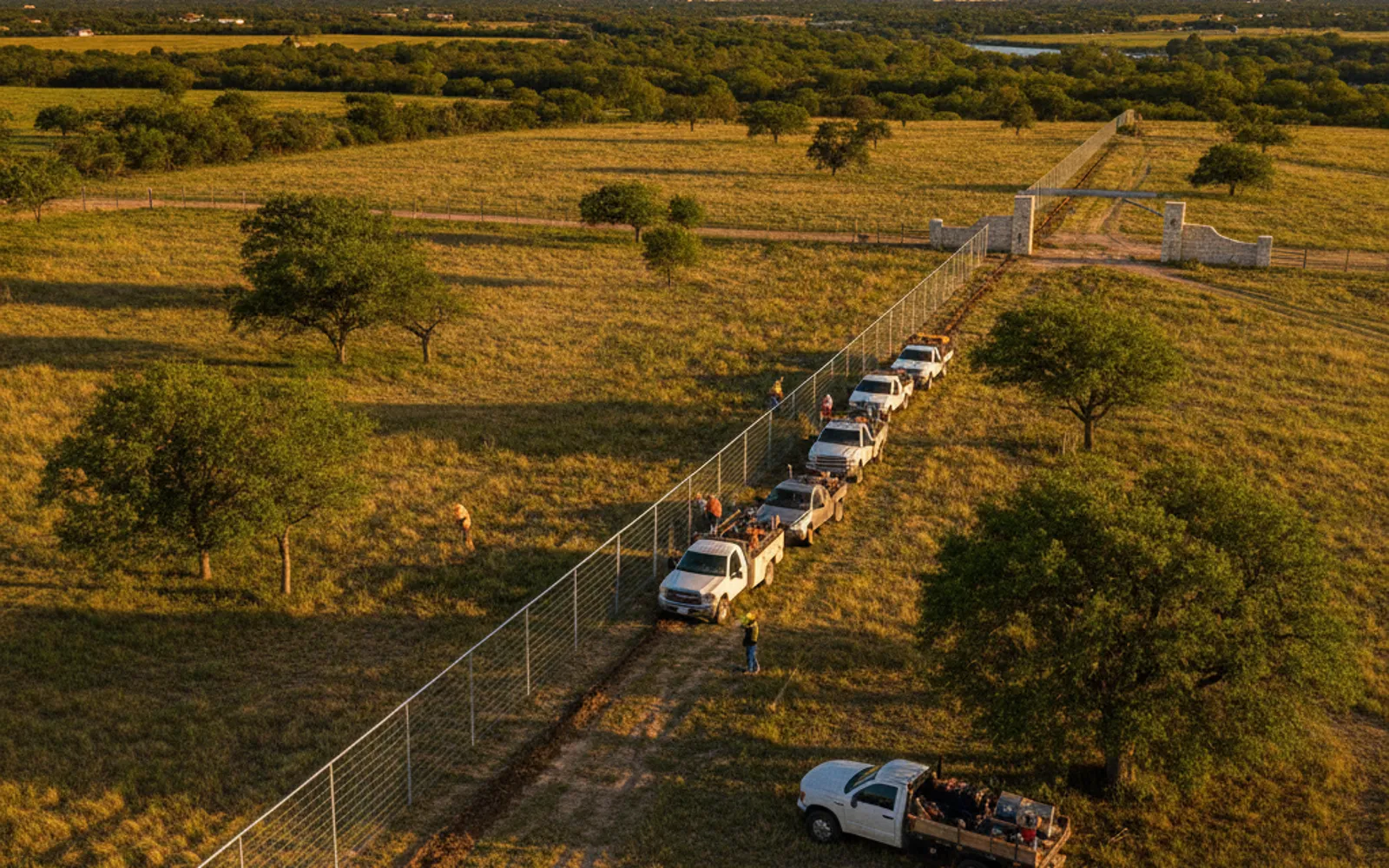
A coyote proof fence, in practice, is net wire with 4-inch mesh at least 47 inches tall, a bottom that sits tight to the ground or carries a wire apron, a hot “trip” wire just outside the fence near ground level, another strand on top to stop climbers, and no gaps at gates, low spots or creek crossings. Add a guardian animal and you have a setup that holds up in coyote country.
What you will not find is a fence that is 100 percent coyote proof at a price a working place can carry. Texas A&M AgriLife’s publication Coping with Coyotes says there is probably no such thing as an economically feasible coyote-proof fence. The realistic goal is a fence that turns most coyotes and keeps loose dogs out.
If you want someone to walk your line and say which of the layers below it needs, call (254) 870-8898 for a free on-site estimate.
How coyotes and dogs get through a fence
AgriLife notes coyotes can climb or even jump some fences, but the usual route is under. Coyotes use “slides,” low spots where the bottom wire rides a few inches off the dirt, and crawl through. Look for a smooth scrape under the mesh with hair caught in the wire above it.
The routes, roughly in the order you will find them:
- Under at a dip, a draw, a washout, or where hogs have rooted and lifted the mesh.
- Through a hole in old wire, or the gap where a gate meets its post.
- Around at a water crossing or a gate hung high.
- Over, usually by climbing. A 1977 Oregon State University Extension circular, Fencing Against Coyotes, noted that some coyotes use corner braces to climb and advised keeping braces as low to the ground as possible.
Loose dogs are an easier problem. AgriLife’s guide says the traditional sheep and goat fence, net wire with two strands of barbed wire on top kept in good repair, will keep most dogs out of a pasture. So a dog proof fence is mostly a well-kept net wire fence. A coyote proof one takes more.
The spec, layer by layer
Net wire is the base. Each layer on top closes one of the routes above.
| Layer | Typical spec | What it stops |
|---|---|---|
| Net wire | 47 to 48 inch, 4-inch mesh, fixed knot on a perimeter | Walking through, kids and lambs getting out, most dogs |
| Bottom | Wire tight to the ground, a barbed strand at ground level, or a wire apron | Crawling under and digging |
| Outside trip wire | Hot wire about 6 to 8 inches high, 8 to 10 inches out from the fence | Coyotes working the bottom before they dig |
| Top | One or two barbed or hot strands, taking total height to about 5 feet | Climbing and jumping |
| Gates and gaps | Gates hung low with mesh, water gaps built to the same standard | The easy way around all of the above |
Mesh size and height
AgriLife’s coyote guide sets the target at net wire at least 5 feet high with mesh no larger than 6 inches. For goats and sheep, go tighter. Six-inch field fence lets a horned goat get its head through and get stuck, and a stuck goat is exactly what a coyote is looking for. Four-inch mesh closes that off.
Sheep and goat wire usually comes around 47 or 48 inches, short of 5 feet, so the common fix is one or two strands above the mesh. Barbed is enough for dogs. For coyotes, AgriLife recommends an electrified wire on top to prevent climbing. On a perimeter, put the money into fixed knot wire, which holds its shape when goats stand on it. Our net wire fence page covers the wire choices.
The bottom: apron, ground wire, or both
This is where most predator fences win or lose. AgriLife calls for a buried wire apron to stop digging. The Oregon State designs used a woven wire apron fixed to the bottom of the fence and laid outward, 24 inches wide in their cost figures, and noted that a wider or buried apron improves it.
On blackland clay you can trench an apron in, but that clay shrinks and swells, and a bottom tight in March can show daylight by August. On much of the ground west of the river and through Bosque County you are on limestone and caliche under thin soil, where burying is off the table. There the apron is laid flat on the outside and pinned down. A coyote digging at the fence line hits wire instead of dirt.
The cheaper option is a barbed strand run right at ground level under the mesh. It will not stop a determined digger alone, but it closes the slides a loose bottom leaves.
The outside trip wire
If you add only one thing to an existing net wire fence, make it this. AgriLife calls a single electric trip wire outside the fence probably the single best investment you can make to reduce coyote passage, and cites work where a hot wire 8 to 10 inches out from the fence at 6 to 8 inches high made the fence more effective. The coyote walks up to look for a way under, and its nose finds the wire first.
The catch is upkeep. The same publication cites a nationwide survey in which 95 percent of ranchers said shorted-out fences were a recurring problem. A wire 6 inches up lives in the grass, so plan on mowing under it. If yours keeps going dead, see our guide to an electric fence not working.
AgriLife also describes all-electric fences of seven to twelve alternating charged and ground wires, 4 to 6 inches apart, that have excluded coyotes in some situations. They are a psychological barrier that only works while hot, and the guide suggests pairing electric with a physical barrier such as a ground-level barbed strand. For goats, which test a hot fence the day the charger quits, we would not build an all-electric perimeter.
Where predator fences fail
Coyotes find the weak spot. Walk these first.
Gates. A tube gate hung 8 inches off the ground is an open door. Hang gates low, cover the lower half with mesh, and close the gap on the hinge side.
Water crossings. Every creek and draw that cuts your fence becomes a hole after a flash flood. Our post on water gap fences covers the builds. On a predator fence, check them after every rise.
Dips and draws. On rolling ground the mesh bridges across low spots. Add posts through the dip so the wire follows the ground, or pin wire across the gap.
Hog damage. Feral hogs root along fence lines and lift the mesh as they go, and coyotes use what they leave. A hog-tight bottom and a coyote-tight bottom are close to the same thing, so read our post on feral hog fence damage if you have both.
Brush and braces. Cedar and mesquite growing into the wire short the hot strands, give climbers a step and hide slides from you. The Oregon State circular found some coyotes climb corner braces, so keep the brace rail as low as the design allows, and keep the line clear enough to walk. We do fence line clearing as its own job or as part of a new build.
Poultry needs its own fence inside the big one
A pasture fence built to hold goats will not protect chickens, ducks or guineas. Raccoons, skunks and snakes climb or squeeze through 4-inch mesh, hawks and owls come from above, and a coyote only has to get in once. Poultry protection is a smaller, tighter job:
- A coop the birds are shut in every night.
- A run in welded wire or hardware cloth. Chicken wire keeps birds in, but it will not keep a dog or a raccoon out.
- A covered top on the run if hawks are working your place.
- An apron around the base of the run, for the same reason as on the pasture fence.
Loose dogs and Texas law
AgriLife notes dog and coyote kills look different: coyotes usually go for the throat, dogs tend to attack the hindquarters, flanks and head.
Under Texas Health and Safety Code Section 822.013, a dog or coyote that is attacking, about to attack, or has recently attacked livestock, domestic animals or fowls may be killed by a person who witnesses the attack, or by the attacked animal’s owner (or someone acting for the owner) who knows of it, without liability to the dog’s owner. The section also lets you detain or impound a dog found on your property that is known or suspected of killing stock, then return it to its owner or hand it to local animal control, and it makes the dog’s owner liable for the capture costs and the damage. Read the section yourself before acting on it. A fence that keeps the dog out is the better outcome.
Guardian animals: a complement, not a substitute
AgriLife’s guide says researchers and producers agree guard dogs can prevent livestock losses to coyotes. In the 1986 survey it cites, 71 percent of producers rated their dogs very effective and 21 percent somewhat effective. Guard dogs tend to work best in pastures under 1,000 acres and alongside other methods, electric fencing included, and do better when raised with the stock from about 2 months old. There is testimonial evidence for donkeys and mules as well.
The fence slows a coyote and funnels it, and the dog deals with the one that gets through. A tight perimeter also keeps a roaming guardian dog at home.
You do not have to fence the whole place to this spec
Building a whole 200-acre perimeter to full predator spec is rarely the best use of money. The Oregon State circular suggested a smaller predator-fenced pasture used for night holding and lambing. AgriLife points out that sheep and goats are vulnerable to coyotes at every age, so a secure place to hold them at night earns its keep year round.
A practical layout for a lot of goat and sheep places around Waco:
- A standard net wire perimeter, kept tight, with the bottom closed and water gaps maintained.
- A smaller night pen or kidding trap near the house or barn, built to the full stack.
- A guardian dog or donkey with the herd.
Here is the math on our published net wire range of $3.50 to $8 per foot. A 5-acre square night trap is 217,800 square feet, about 467 feet a side and roughly 1,870 feet around. At 1,870 ft x $3.50 to 1,870 ft x $8, that is about $6,545 to $14,960 for the net wire. The apron, hot wires, energizer and any clearing get priced once someone has walked the ground, because rock, cedar and low spots change them. Our ranch fence cost page puts net wire next to the other fence types.
Retrofit or rebuild?
If your net wire is in reasonable shape, you probably do not need a new fence. AgriLife says adding one or more electric wires to an existing net wire fence has been effective, provided the fence is in reasonably good condition. Tighten it, close the bottom, add the trip wire and a top wire, and fix the gates and water gaps.
Rusted wire, 6-inch field fence or leaning corners mean a rebuild. Our goat and sheep fence page covers what we build for small stock, and the best fence for goats and sheep goes deeper on containment.
We build across McLennan, Bosque and Falls counties, and someone walks the line before any number gets quoted. Call (254) 870-8898 for a free on-site estimate on a new predator fence or an upgrade to the one you have.
Frequently Asked Questions
How tall does a coyote proof fence need to be?
Texas A&M AgriLife’s coyote guide puts the target at about 5 feet of net wire with an electrified wire on top to stop climbing. Most sheep and goat wire is 47 or 48 inches, so the usual build is the mesh plus one or two strands above it. Height matters less than the bottom, because most coyotes go under rather than over.
Will barbed wire keep coyotes out?
No. A barbed wire fence alone will not stop a coyote, and it will not hold goats either. Barbed wire does have a role on a predator fence: a strand at ground level under net wire to close slides, and a strand or two on top to add height. The main barrier has to be small-mesh net wire.
Can coyotes dig under a fence?
Yes, and it is their most common way in. AgriLife recommends a buried wire apron. On rocky ground where burying is not practical, an apron laid flat on the outside and pinned down does the same job. A hot trip wire 6 to 8 inches high and 8 to 10 inches out from the fence turns many coyotes before they start digging.
Does electric fence stop coyotes?
It helps a great deal when it is maintained. A single outside trip wire on a sound net wire fence is one of the cheapest upgrades there is. All-electric fences with seven to twelve wires have kept coyotes out in some situations, but coyotes have to learn them, and a wire shorted in tall grass stops nothing. Pair electric with a physical barrier.
Is a livestock guardian dog enough without a good fence?
Usually not. Most producers in the survey AgriLife cites rated their guard dogs effective, but the same guide says dogs work best in smaller pastures and alongside other methods such as electric fencing. The fence slows coyotes and funnels them, the dog handles what gets through, and a tight fence keeps the dog home.
What does a predator fence cost per foot around Waco?
Our net wire, the base of any predator fence, runs $3.50 to $8 per foot installed. The apron, hot wires, energizer and clearing are priced separately after someone walks the line, since terrain, rock and brush change them. See ranch fence cost for the full range, or call for a free on-site estimate.