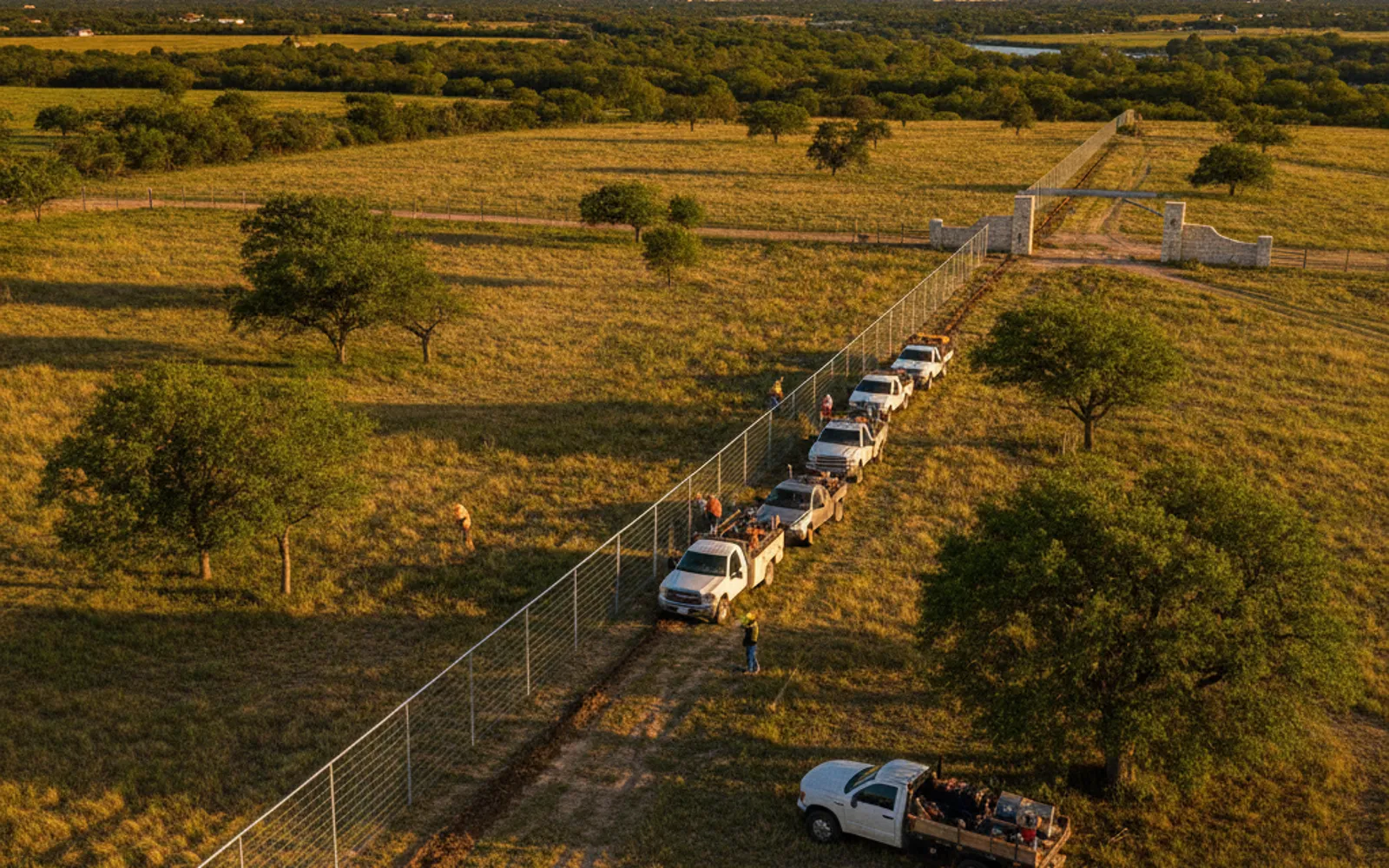
There is no single best fence for cattle. There is a best fence for each line on the place. On road frontage and boundaries, a tight 5-strand barbed wire fence on proper braces is the standard. In a calving or weaning pasture, net wire to the ground with barbed wire on top keeps calves from ducking under. On interior cross fences, high-tensile electric holds trained cattle for far less money. In pens, alleys and bull lots, welded pipe or heavy panels take pressure nothing else will.
Most working cattle places end up with three or four of those on the same property. The mistake is picking one fence and running it everywhere, which means you either overbuild the cross fences or underbuild the road line.
If you want someone to walk your lines and say which fence fits each one, call (254) 870-8898 for a free on-site estimate.
Start with the line, not the wire
Ask two questions about every stretch of fence. What is leaning on it? And what happens if it fails?
A cow through a cross fence ends up in the wrong pasture. A cow through the road fence ends up on a farm-to-market road at dusk. Those two failures do not deserve the same fence or the same budget.
Cattle also test fences differently. Mature cows reach over and lean. Calves go under. Fresh-weaned calves hit wire at a run. Bulls push with their whole weight when there are cows on the other side. So sort your fence into four jobs and match each one.
| Line | Fence that fits | Key specs | Published price band |
|---|---|---|---|
| Road frontage and boundary | 5-strand barbed wire | 12.5 ga barbed, top wire about 50 to 54 in., bottom wire near 14 in. | $2.50 to $5.50 per ft |
| Boundary with calves, goats or hogs | Net wire plus 1 or 2 barbed strands on top | 32 to 35 in. or taller woven wire at ground level | $3.50 to $8 per ft |
| Interior cross fence | 4-strand barbed or high-tensile electric | HT smooth 12.5 ga, energizer sized for the run | 4-strand at or under the 5-strand band; electric priced after the walk |
| Pens, alleys, bull lots | Welded pipe or heavy panels | 60 in. minimum, pipe posts 2 3/8 in. OD or larger | $12 to $28 per ft |
The full table of what we charge is on the ranch fence cost page.
Road frontage and boundary lines
The boundary is where a cheap fence can cost far more than the fence. Who pays when cattle get on a road depends on the county’s stock law and the facts, which is covered in cattle on road liability in Texas. This is the line where you spend the money.
The legal minimum is not the target
The Texas Agriculture Code defines a “sufficient fence”: at least four feet high, and for barbed wire, three wires on posts no more than 30 feet apart, with one or more stays between every two posts. But as the Texas A&M AgriLife guide A Landowner’s Guide to Fence Law in Texas explains, that standard applies only in open-range areas, where the fence keeps other people’s livestock out. It does not apply in a closed-range county, and it cannot be used to decide negligence in a roadway accident.
The spec that holds cattle
Five strands of 12.5 gauge barbed wire is the common boundary build in Central Texas. The NRCS Texas Fence (382) specification, the floor for cost-share fences, calls for at least four strands for cattle, a bottom wire at least 14 inches up and a top wire at no less than 44 inches. The University of Tennessee’s Planning and Building Fences on the Farm goes higher: perimeter cattle fence should be at least 54 inches. A top wire around 50 to 54 inches, with strands stacked tighter through the middle where cattle push, covers both. Exact spacing is in how many strands of barbed wire for cattle.
The wire is the cheap part. The framework is what holds. The NRCS spec requires corner braces wherever the line turns 20 degrees or more and pulls from two directions, end braces on both sides of every gate, in-line pull assemblies no more than 1,320 feet apart on straight flat runs, and brace posts buried at least 3 feet unless driven.
On our published table, 5-strand barbed runs $2.50 to $5.50 per foot, or $13,200 to $29,000 a mile. A quarter mile (1,320 feet) comes to $3,300 to $7,260. Our barbed wire fence page covers the build.
If a neighbor runs goats, if you calve along that line, or if hogs are working the bottom, a barbed boundary will leak. Move that line up to net wire with barbed on top, covered below.
Why electric alone is a poor boundary
The NRCS spec does include 4 and 5 wire high-tensile electric designs for boundary use. But it says one and two wire electric fences are for cross fencing and not recommended for exterior fences. And any electric fence is one ice storm, dead battery or wet spring of weeds on the wire away from being unpowered. On a road line, use electric as an addition to a physical fence, not the whole fence.
Interior cross fences: where you can save
A failed cross fence costs a few hours of sorting. That makes it the right place to save.
A 4-strand barbed fence meets the NRCS cattle minimum and uses less wire than a boundary. High-tensile smooth electric saves more, and it is where rotational grazing setups usually land. The NRCS spec gives these heights for 12.5 gauge high-tensile electric on cattle:
- 1 wire: one hot wire at 24 to 40 inches, depending on the size of the cattle
- 2 wires: top at 30 to 42 inches, second at 14 to 24
- 3 wires: top at 34 to 48 inches, middle at 24 to 36, bottom at 12 to 24
The saving is in posts. The NRCS table allows line posts on high-tensile electric up to 100 feet apart without stays, against 20 feet for barbed wire without stays.
The catch is the charger and the cattle. NRCS Texas asks for an energizer with at least 4,000 volts output under load and at least 1,600 volts at the farthest point of the fence for cattle. UT Extension puts the minimum to control short-haired cattle at around 700 volts, so the NRCS figure builds in margin. Cattle also have to learn the wire first, ideally in a small pen. For upkeep and lifespan compared, see electric fence vs barbed wire.
An old barbed cross fence that is sound but loose may not need replacing. Both the UT guide and the NRCS spec describe offset brackets that hold a hot wire off the existing fence at about two-thirds the height of the animal. Cattle quit leaning on it and the fence buys years. It will not fix rotten posts or failed braces.
Calving and weaning pastures
A bottom wire at 14 inches keeps a cow in. A two-week-old calf walks under it, and the cow will find a way to follow.
For a calving trap or a pasture next to the pens, net wire set at ground level is the answer. The NRCS spec gives two cattle builds: at least 32 inches of woven wire with one barbed strand 3 inches above it and a second 10 inches above that, or 35 inches of woven wire with one barbed strand 10 inches above. The mesh needs at least 11 gauge top and bottom wires, 14 1/2 gauge fillers and stays 12 inches apart or closer. Taller woven wire with a barbed strand on top gets you nearer UT’s 54 inches.
The barbed wire on top matters because cattle reach over bare net wire and lean on it until the top bows. The trade-offs are in barbed wire vs net wire, and our net wire fence page covers the build. Net wire runs $3.50 to $8 per foot on our published table. Mesh to the ground also holds up far better than open space under a barbed strand where feral hogs work the creek bottoms.
Wean in a pen or small trap of pipe, panels or tight net wire. Fresh-weaned calves hit fence at speed, and a big barbed pasture is the wrong place for them that first week.
Pens, alleys, traps and bull lots
A working pen takes more abuse in a morning than a boundary takes in a year. UT Extension says fences around handling facilities should be at least 60 inches tall, strong and clearly visible, with treated wood or heavy wire panels preferred, and lists corral posts at 6 feet apart.
Around here, permanent pens are usually welded pipe. The NRCS spec calls for pipe posts of at least 2 3/8 inch outside diameter, Schedule 40 or heavier, painted or galvanized, and capped so rain does not collect inside and rust them out. Blackland clay swells wet and shrinks dry, and for brace posts on Blackland soils the NRCS spec allows the hole to be filled with concrete to within 12 inches of the surface and topped with soil. West of the Brazos and into Bosque County, thin soil over limestone means drilling rock.
Welded pipe fence runs $12 to $28 per foot. A pen setup for 20 to 30 head runs $6,000 to $12,000, and a full facility for 100 or more head $18,000 to $30,000 and up, as general market ranges. See corrals and working pens.
Bulls get the same treatment. UT’s guide says a bull penned away from cows needs heavy posts with thick wire or cable, or electric fence. A pipe or heavy panel bull lot with an offset hot wire inside is hard to beat.
Wire and posts for any cattle fence
Wire. NRCS requires new galvanized wire meeting ASTM A121 (barbed) or A116 (woven), with at least a Class 1 coating, and notes that regular and utility grade wire do not carry enough zinc. Class 3 carries a heavier coat and outlasts Class 1 in wet ground and at creek crossings.
Line posts. Steel T-posts must weigh at least 1.25 pounds per foot (1.33 preferred), be 6 feet long and set 24 inches deep; in rocky ground a 5 1/2 foot post set 18 inches is allowed. Untreated cedar, bois d’arc or mesquite needs a 3 inch top and the same 24 inch depth.
Clearing. Cedar and mesquite grow into fence lines and drop limbs on the wire. Clearing before you build is cheaper than working around trees for the life of the fence.
A rough budget for a hypothetical place
Say you have 80 acres outside McGregor, roughly square. That is about 1,867 feet a side, or about 7,470 feet of perimeter.
- Perimeter in 5-strand barbed at $2.50 to $5.50 per foot: about $18,675 to $41,085
- One cross fence splitting it in half (1,867 feet) in 5-strand barbed: about $4,670 to $10,270. A 4-strand or high-tensile electric cross fence is priced after the walk.
- A pen setup for 20 to 30 head: $6,000 to $12,000
Brush on the line, rock or clay, and the number of gates and braces move those numbers.
Have someone walk your lines
The fastest way to get this right is to walk every line with someone who builds fence and decide what each stretch needs before you buy a roll of wire. We cover McLennan, Bosque and Falls counties, and the estimate is free and done on site. Call (254) 870-8898 and we will walk your road frontage, boundaries, cross fences and pens and price each one on its own terms.
Frequently Asked Questions
What is the best fence for cattle?
It depends on the line. For boundaries and road frontage, 5-strand 12.5 gauge barbed wire on good braces. For calving pastures or lines shared with goats or hogs, net wire with barbed wire on top. For interior cross fences, 4-strand barbed or high-tensile electric. For pens and bull lots, welded pipe or heavy panels at least 60 inches tall.
How tall should a cattle fence be?
The NRCS Texas spec sets the top wire at no less than 44 inches for cattle. UT Extension recommends at least 54 inches for perimeter cattle fence and 60 inches for handling facilities. On a boundary, a top wire around 50 to 54 inches covers both. Interior electric cross fences can run lower because the shock does the work.
What wire should I use for a cattle fence?
Use 12.5 gauge galvanized barbed wire for barbed fences, and woven wire with at least 11 gauge top and bottom wires and 14 1/2 gauge fillers for net wire. For electric, 12.5 gauge smooth high-tensile wire. Class 3 galvanizing outlasts Class 1 in wet ground and along creeks.
Will an electric fence hold cattle by itself?
On interior cross fences, with trained cattle and a strong energizer, yes. NRCS Texas designs for at least 1,600 volts at the far end of the fence for cattle. The same spec does not recommend one or two wire electric as a boundary, and any electric fence stops working when the charger does. Use it for cross fences or as an offset wire on a solid fence.
How far apart should cattle fence posts be?
Under the NRCS Texas spec, line posts on barbed or net wire can be up to 30 feet apart with two or more stays, or 20 feet without stays. UT Extension recommends 12 to 14 feet for barbed wire and 14 to 16 feet for woven wire. High-tensile electric can run posts much farther apart, and pens need posts about every 6 feet.
What is a legal cattle fence in Texas?
The Agriculture Code defines a sufficient fence as at least four feet high, and for barbed wire, three wires on posts no more than 30 feet apart with stays. According to the AgriLife fence law guide, that standard applies only in open-range areas and does not decide liability in a roadway accident, so it is not a good target for holding cattle.