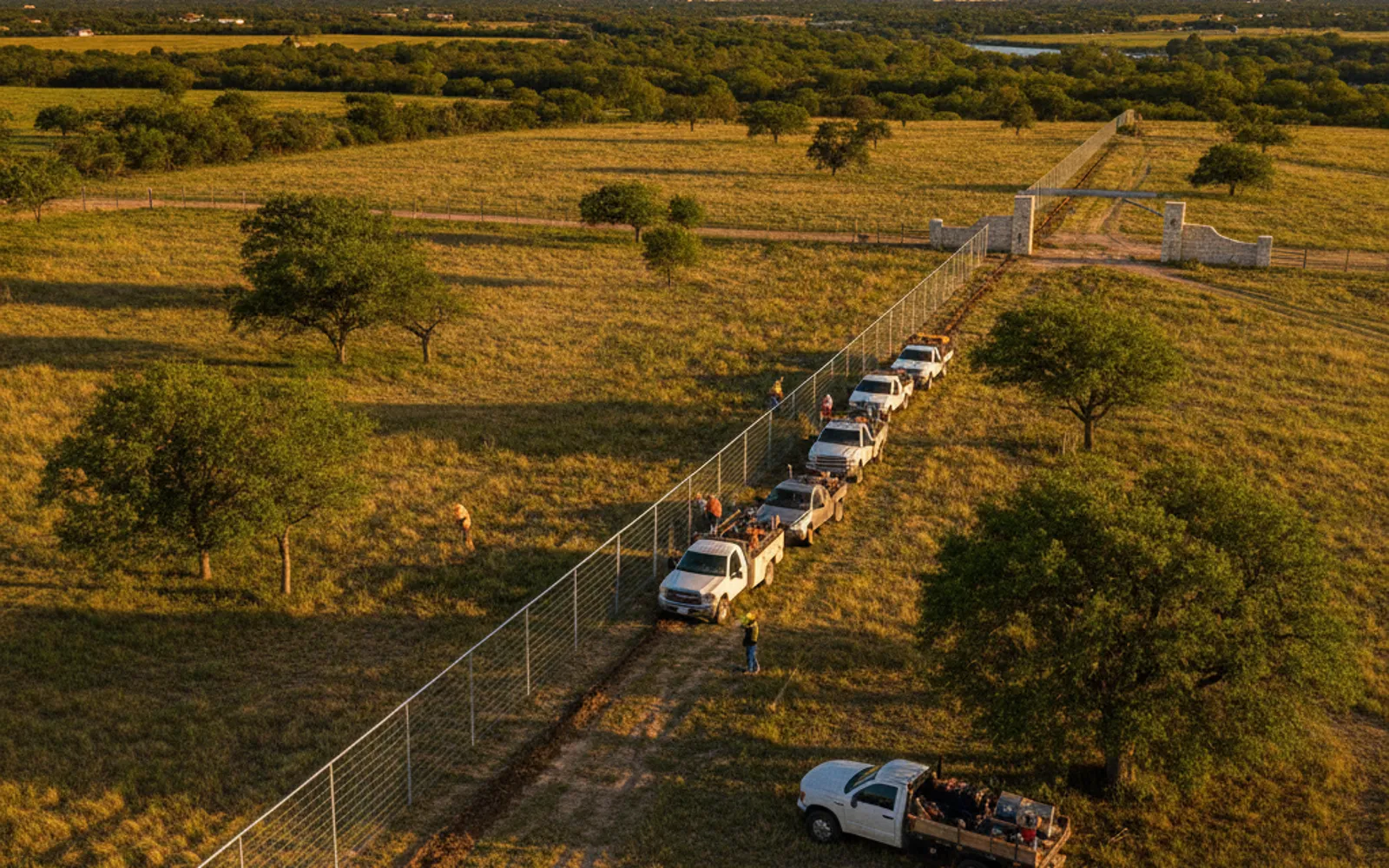
An axis deer fence is an 8-foot high fence built with fixed-knot net wire, tight to the ground, braced hard at every corner and gate, and kept whole at every creek crossing. Anything shorter or looser is a fence the axis will leave through sooner or later. Blackbuck are easier over the top and harder at the bottom, so the same fence works for both if the bottom wire is right.
Exotics do not test a fence the way whitetail do, and in Texas an exotic that gets out is not a simple thing to get back. If you are planning a place for axis or blackbuck in McLennan, Bosque or Falls County and want someone to walk the line before you buy animals, call (254) 870-8898 for a free on-site estimate.
This article covers the fence itself. The permit side of high fencing for native deer is in Texas high fence regulations.
Why exotics are a different fence problem than whitetail
A whitetail is a browser that moves in small groups. It walks the fence, finds the low spot or the gap under the bottom wire, and usually tries under or through before it tries over.
Axis are grazers, and they live in herds, anywhere from a handful of animals to more than a hundred, usually led by an old doe. That changes the pressure on a fence. When a whitetail spooks, one deer hits the wire. When an axis herd spooks, the whole bunch moves together, and the ones in back push the ones in front. A fence that would turn one animal can get hit by twenty at once in the same ten feet.
Axis also jump well, and they do not need much reason to try. A 6-foot net wire fence that has held cattle for thirty years is not an axis fence. Neither is a 5-strand barbed wire fence with a hot wire on top.
Blackbuck are a different animal again. They are small antelope built for open grass and speed. You will hear that blackbuck can be held behind a shorter fence than axis, and on a quiet day with nothing chasing them, that may be true. The trouble is that blackbuck rarely live alone on a place, and a small, fast animal in a panic finds the gap at the bottom. A blackbuck fence fails low, not high.
| Animal | How it usually beats a fence | What the fence needs most |
|---|---|---|
| Whitetail | Under or through a gap, over when pushed | Tight bottom, full height |
| Axis | Over low spots, often as a whole herd | Full 8 ft everywhere, strong corners |
| Blackbuck | Under or through at the bottom | Tight bottom, small openings low |
There is a reason beyond your own herd to keep them in. TPWD pen studies at the Kerr Wildlife Management Area, which included axis and blackbuck, found that exotic hoofstock out-compete whitetail on native range, because exotics eat grass as well as forbs and browse. The work is summarized on TPWD’s white-tailed deer vs. exotics page. Escaped axis become your neighbor’s whitetail problem.
Height: 8 feet, and why not less
The working height for a Texas high fence is 8 feet of wire, usually a 96-inch roll. A TPWD management publication on the Hill Country, hosted by Texas A&M AgriLife, describes the deer-proof fences there as net wire, 7½ feet high or higher, built to hold deer, exotics and livestock. Treat that as the floor, not the target.
Height is measured from the ground, not from the bottom of the roll. Where the wire bridges a dip, it hangs clear of the ground at the low point and leaves a gap underneath. Where it runs straight over a hump or rise between posts, the ground comes up under it and the top wire at the crown sits lower than 8 feet. Terrain is where most “8-foot” fences turn into 7-foot fences. Watch these spots:
- Slopes and terrace edges. An animal on the uphill side of a fence built across a slope sees a shorter fence. Where the grade is steep, add height or move the line.
- Next to brush piles, rock ledges or stacked cedar. Anything an animal can stand on next to the fence lowers it. Keep a clean lane on both sides.
- Where wire is spliced or patched. Old splices sag. Sagging wire is lower wire.
Wire: fixed knot, graduated, heavy enough
A typical Texas game fence uses 12.5-gauge high-tensile fixed-knot wire in a 96-inch roll. A common style is written as 2096-6: 20 horizontal wires, 96 inches tall, vertical stays every 6 inches. Wider stay spacing is cheaper; on an exotic fence we lean toward the tighter one.
The horizontal wires are graduated. They sit close together near the ground and spread out toward the top, which is what you want: fawns and small antelope go through whatever a grown animal cannot, so the tightest openings belong at the bottom.
Fixed knot is the right call for exotics. The knot locks the vertical stay to each horizontal wire, so when an axis doe hits the fence at speed, the stays stay put and the wire springs back instead of spreading into a hole. Hinge-joint wire costs less and has its place, but it can open up under repeated hits. The difference is covered in fixed knot vs hinge joint fence.
Class 3 galvanizing outlasts Class 1 on the same wire, which is worth paying for on a fence you plan to keep for decades.
The bottom: where blackbuck, fawns and hogs get out
Old high fence around here fails at the bottom in the same few ways:
- Gaps at dips and draws where the wire never touched the ground.
- Hog holes where feral hogs rooted under and pushed the wire up. A hole a hog made is a hole a blackbuck can use.
- Washouts after a hard rain, where a small creek or ditch cut under the fence.
Build the bottom right the first time. Keep the bottom wire tight to the ground across the whole run, stake it down at dips, and fill or wire the low spots now, not later. On hog-heavy ground, and there is plenty along the Brazos and its creeks, many owners add an apron: wire laid flat on the outside and tied to the bottom of the fence, so a rooting hog hits wire instead of dirt. Hog damage and its repair are covered in feral hog fence damage.
Posts, corners and braces
An 8-foot fence carries far more wire than a cattle fence, so everything holding it has to be bigger.
- Corners and ends are pipe, braced both ways, and set deep. A weak corner leans, the whole run goes slack, and slack wire is a fence animals push through or under.
- Line posts have to stand 8 feet out of the ground and still have enough post below grade to stay put. On most high fence that means 10 to 12 foot line posts, with spacing set by the ground and the wire maker’s spec (commonly somewhere around 15 to 25 feet).
- Ground conditions change the method. In blackland clay east of Waco, posts heave and lean with the shrink and swell of wet and dry years, so depth and bracing matter more. West of the Brazos and into Bosque County, thin soil over limestone and caliche often means drilling rock for every post.
Gates, cattle guards and water gaps
A high fence is only as tall as its lowest opening.
Gates. A tall fence with a standard 50-inch pipe gate is a 4-foot fence at the gate. Gates on an exotic place need to match the fence height, and the taller, heavier gate needs heavier, braced hinge and latch posts. Tall gates and entrances are on our ranch entrance and gate page.
Cattle guards. A cattle guard in a high fence line is an opening at ground level with no height at all. It turns cattle because cattle will not walk the rails. We would not trust one to hold axis or blackbuck. A tall gate at every entrance is the safer setup.
Water gaps. Central Texas creeks can go from dry to bank-full in an afternoon and pile brush into the fence. The same TPWD publication notes that washed-out water gaps must be replaced quickly to hold deer. On an exotic place, “quickly” means before the herd finds it, which can be the same day. Build the gap to swing or give in a flood and go back up fast; the options are in water gap fences.
Why containment decides whether the animals stay yours
Axis and blackbuck are not game animals under Texas law the way whitetail are. The estray chapter of the Agriculture Code, Chapter 142, defines exotic livestock as plant-eating, hoofed mammals not native to Texas, including the deer and antelope families, and the Parks and Wildlife Code regulates them as exotic animals. That has real consequences, and most of them put the burden on you.
On the hunting side, TPWD’s rules for exotic animals set no closed season, no state bag limit and no required means and methods on private land. A hunting license and the landowner’s permission are required.
The Parks and Wildlife Code gives owners some protection. Under Section 62.015, nobody may hunt an exotic from a public road or its right-of-way, nobody may hunt exotics on another person’s land without that landowner’s express consent to hunt exotics, and possessing an exotic or its carcass is an offense except for the owner and a few others, or with the owner’s consent.
Now go back to the estray law. Chapter 142 covers stray livestock, and stray exotic livestock are included. Section 142.0021 says a person may claim to own exotic livestock under that chapter only if the animal is tagged, branded, banded or marked in a conspicuous way that can be read from a long distance and identifies it as the claimant’s property. Very few axis herds carry marks like that.
Put those together. An unmarked axis doe that goes over a low spot and ends up two ranches away is hard to prove as yours, and even harder to get back. How the law sorts out a specific case is a question for a lawyer, not a fence builder. What we can tell you is that the fence is the thing that keeps you from needing one.
What an exotic fence costs
Our published range for 8-foot high game fence is $4.50 to $10 per foot, or about $25,000 to $50,000 a mile. Where a job lands in that range depends on wire class and stay spacing, how much rock the posts go into, how many corners, gates and water gaps the layout has, and whether the line needs clearing first. Clearing is priced separately, at $1 to $3 per foot on most lines, and heavy cedar brake can run past that.
Say you have 100 acres outside Clifton, roughly square. That is 4,356,000 square feet, about 2,087 feet a side and 8,348 feet around. At $4.50 to $10 a foot, the fence comes to about $37,566 to $83,480, before any clearing. Odd shapes, creek frontage and extra gates push the footage and brace count up. The full per-foot, per-acre and per-mile breakdown is in the game fence cost guide, and all of our fence types side by side are on the ranch fence cost page.
Before you buy the animals
The most expensive order of operations is animals first, fence second. Finish and walk the whole perimeter before anything goes in: every draw, gate, water gap and tie-in to old fence. If you already have exotics behind an old fence, walk it with a tape. Anywhere the top of the wire is under about 7½ feet from the ground, or the bottom wire is off the ground, is a spot the herd will find.
We build 8-foot game fence for axis, blackbuck and whitetail across McLennan, Bosque and Falls counties. Details are on our game fence installation page. Call (254) 870-8898 and someone will walk the line with you and give you a free on-site estimate before any number is quoted.
Frequently Asked Questions
How high does a fence need to be to hold axis deer?
Plan on 8 feet of net wire measured from the ground, which in practice means a 96-inch roll kept tight to the ground along the whole run. A TPWD Hill Country management publication describes deer-proof fences as 7½ feet or higher. Watch dips, slopes and anything an animal can stand on next to the fence, because those spots turn an 8-foot fence into a shorter one.
Will a regular cattle fence hold blackbuck?
Do not count on it. Blackbuck are small, fast antelope, and they tend to find gaps at the bottom of a fence rather than go over the top. A barbed wire or loose net wire fence has too many openings low down. An 8-foot fixed-knot fence with graduated wire and a tight bottom holds blackbuck and axis both, which matters on a place that runs more than one species.
What wire is best for an exotic game fence?
A typical Texas game fence uses 12.5-gauge high-tensile fixed-knot wire, 96 inches tall, with closely spaced wires near the ground. A common pattern is 20 horizontal wires with vertical stays every 6 inches. Fixed knot keeps the stays locked in place when an animal hits the fence. Class 3 galvanizing lasts longer than Class 1 on the same wire.
Are axis deer livestock or wildlife in Texas?
They are not native game animals. The Agriculture Code’s estray chapter counts non-native hoofed animals like axis and blackbuck as exotic livestock, and TPWD regulates them as exotics. TPWD sets no closed season or bag limit on exotics on private land, though a hunting license and landowner permission are required. Under the estray law, you can claim a stray exotic under that chapter only if it carries a mark readable from a long distance, so a good fence matters.
How much does an axis deer fence cost?
Our range for 8-foot high game fence is $4.50 to $10 per foot, about $25,000 to $50,000 a mile. Rock drilling, corners, tall gates, water gaps and brush clearing move a job within that range. Clearing, when a line needs it, runs $1 to $3 per foot on most ground. See the ranch fence cost page for every fence type we build.