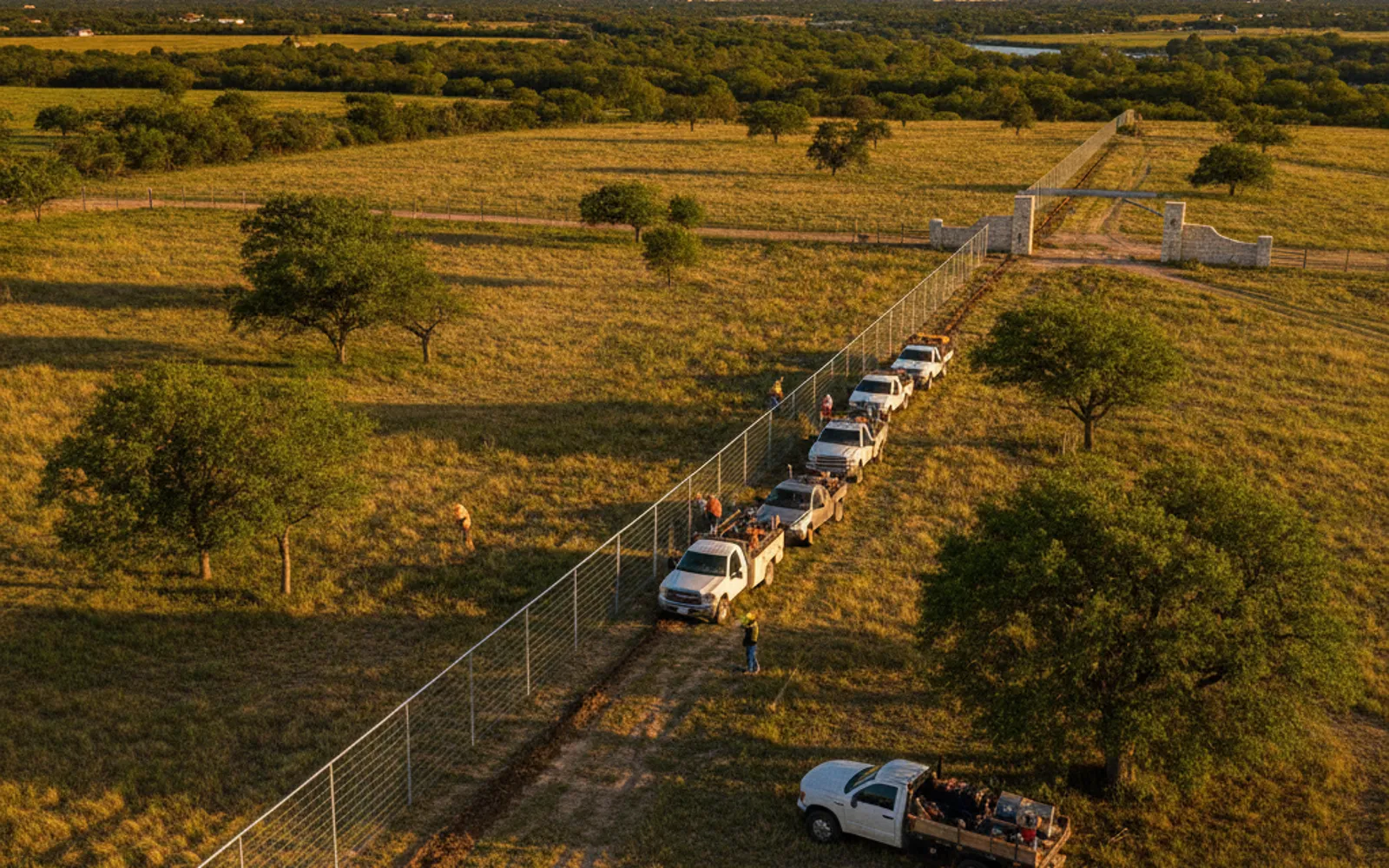
A fence that holds aoudad has to be taller than the ground around it lets it be, tight at the bottom, and built so nothing along the line works as a step. A standard 8-ft game fence is the starting point, not the finished answer. Aoudad climb as well as they jump, so they leave where the fence gets shorter in practice: at a cutbank, a rock ledge, a brace rail, a gate, or a washed-out creek crossing.
That is why aoudad are the hardest exotic to hold. Axis and blackbuck mostly test a fence by height and by gaps at the bottom. Aoudad test it like a rock face, looking for the foothold.
Below: why they are hard to hold, the height and construction they call for, where they get out, and what Texas Parks and Wildlife says about free-ranging aoudad. If you would rather have someone walk your line and show you the weak spots in person, call (254) 870-8898 for a free on-site estimate.
Why aoudad are the hardest exotic to hold
Aoudad, also called Barbary sheep, are wild sheep from the dry mountains of North Africa. The Texas Tech Mammals of Texas account for the aoudad describes them as adapted to dry, rough, barren country and calls them expert climbers that go up and down slopes a person can barely manage. Rams are heavy, thick-horned animals, and ewes carry horns too.
Put those traits against a fence and you get three problems.
They climb. A deer that wants out has to clear the fence in one move. An aoudad can use a boulder, a bank, a brace rail or a gate frame to get part of the way up first. Every foothold within reach of the wire takes height off your fence.
They jump. Fossil Rim Wildlife Center in Glen Rose, which keeps aoudad, calls them powerful jumpers and says a captive aoudad needs a fence about 10 feet tall to be sure it cannot clear it. That is 2 feet more than the 8-ft standard most Texas high fence is built to.
They live in rough country. Aoudad are at home in the kind of broken limestone, caliche and cutbank ground that makes fence building hardest. That is where posts are hardest to set, banks and ledges sit close to the line, and flash floods cut gaps under the wire.
They also live in small groups, so a weak spot rarely costs you one animal. When a hole opens, plan on it costing you the group.
What TPWD says about aoudad in Texas
Aoudad are not native to Texas. The Texas Tech account records 31 released southwest of Claude in Armstrong County in 1957, with 13 more near Quitaque in Briscoe County the same year. Texas Parks and Wildlife’s own magazine, in Is It a Bighorn or an Aoudad?, puts the Texas population at around 20,000 and says their range now runs from far West Texas into the Panhandle and parts of Central Texas. The same article notes that researchers worry aoudad may eventually outcompete the state’s native desert bighorn sheep.
For hunting, the state treats aoudad as an exotic. TPWD’s Outdoor Annual page on exotic animals names aoudad sheep in its list of examples and says that on private property there are no state bag or possession limits, no closed seasons, and no required means and methods of take. You still need a valid hunting license and the landowner’s permission, you cannot hunt an exotic on a public road or right-of-way, and it is unlawful to possess an exotic or its carcass without the owner’s consent.
The clearest signal of how the state sees free-ranging aoudad came in 2025. Senate Bill 1245 amended Parks and Wildlife Code section 43.1075 so a qualified landowner or the landowner’s agent can contract to take depredating aoudad sheep from a helicopter under a TPWD permit, effective September 1, 2025. The Parks and Wildlife Commission took up the rules to carry that out at its January 22, 2026 meeting. The proposed rule changes add aoudad to the aerial management rules alongside feral hogs and coyotes.
For a fence owner the meaning is simple. Aoudad that leave your place join a free-ranging population that Texas now lets landowners contract to take from a helicopter, under a TPWD permit, when the sheep are causing damage, and your neighbors will not thank you for adding to it.
Who owns an escaped exotic once it is on someone else’s land is a legal question for a Texas agricultural attorney, not a fence builder. For the wider permit picture on high fence, see our post on Texas high fence rules.
Fence height and wire for aoudad
An 8-ft game fence usually means 96-inch fixed knot wire, and that is what we mean on our game fence installation page. For aoudad, treat 8 ft as the minimum on flat, open ground and plan to go higher wherever the ground or the construction gives them a lift.
Effective height is what counts
Height on a fence drawing is measured from the ground at the post. The aoudad measures from wherever it is standing. If the ground inside the fence rises 3 ft toward the wire, your 8-ft fence is a 5-ft fence from the top of that rise. The same goes for a limestone ledge, a big rock, a dirt spoil pile or a stock tank dam near the line.
There are three ways to handle a spot like that:
- Move the fence line away from the rise so the animal cannot use it.
- Take the rise away: cut the bank, move the rock, level the spoil.
- Add height on that stretch with taller posts and a second course of wire or extra smooth high-tensile strands above the mesh.
The wire itself
Fixed knot is the right mesh for high fence because the knot keeps the vertical stays from sliding when a heavy animal hits the wire. We cover why in fixed knot vs hinge joint. For aoudad, pick a pattern with tight spacing near the ground, so lambs and young stock cannot push through the bottom openings, and keep the whole fence under real tension. A slack top wire bends down under a climbing animal and gives it the last foot it needed.
Some owners add an offset hot wire on the inside near the top. It can help, but only if someone keeps the charger, the ground rods and the line clear of brush. A dead hot wire does nothing.
A quick guide by situation
| Spot on the line | What it does to the fence | What to build |
|---|---|---|
| Flat, open ground | Full height works | 8-ft fixed knot, tight bottom |
| Ground rising toward the fence | Cuts effective height | Move the line, cut the bank, or add height |
| Rock ledge or boulder near the wire | Gives a launch point | Clear it or go taller on that stretch |
| Corner or H-brace | Horizontal rail is a step | Brace on the outside or cover it with mesh |
| Gate | Often shorter than the fence | Gate and frame to full fence height |
| Creek crossing or draw | Floods cut gaps underneath | Water gap built for your creek, checked after rain |
Where aoudad get out
Most escapes do not happen over the middle of a good, tight run. They happen at a handful of predictable places. Walk your line looking at it from inside, standing where the animal stands.
Corners and braces
An H-brace has a horizontal rail partway up the posts. To a climbing animal that rail is a ladder rung. On a fence meant to hold aoudad, build braces on the outside of the wire, or wrap mesh over the inside of the brace so there is nothing to stand on. The same thinking applies to pipe corners with welded crosspieces.
Terrain breaks
Cutbanks, bluffs, ledges and rock outcrops close to the fence are the classic aoudad exit. West of the Brazos and into Bosque County, limestone often sits right at the surface, and a fence that follows a property line through that ground will cross ledges and steep draws. Every one of them deserves a hard look.
Washouts and water gaps
Central Texas creeks flood fast, and one hard rain can open a gap under the bottom wire where a draw crosses the line. Aoudad do not need to go over a fence that has a hole under it. Water gaps have to be built to the creek, not to a standard drawing, and they have to be checked after every real rain. Our post on water gap fences covers the designs.
Gates
A tall fence with a short gate has the height of the gate. Gate frames also give a climbing animal a foothold. Hang gates that match the fence height, keep the gap under them small, and do not leave them sagging.
Things that show up later
A fence that held for years can start leaking when something new lands next to it: a hay ring, a feeder, a pile of cleared brush, stacked pipe, a trailer parked along the line, a tree that leans in after an ice storm, a limb that drops across the top wire. None of these are fence failures. All of them are ways out.
Building in aoudad country: rock, posts and clearing
The ground aoudad like is the ground where fence building costs the most. In thin soil over limestone or caliche, posts often have to be drilled, not driven, and corners in rock usually end up as pipe set in drilled holes. Our post on setting fence posts in rocky ground goes through the methods.
The line also has to be clear before any wire goes up. Cedar and mesquite along a fence line give animals cover and a way to lean on the wire, and they drop limbs on it. Fence line clearing runs $1 to $3 per foot, and heavy cedar brake can run past that.
For the fence itself, our published range for 8-ft high game fence is $4.50 to $10 per foot, or $25,000 to $50,000 per mile. Rough, rocky aoudad ground tends to push a job toward the top of that range because of drilling, and clearing and any stretch built taller than 8 ft come on top of it.
Say you have 160 acres in a rough square. Each side is about 2,640 ft (the square root of 160 x 43,560 square ft), so the perimeter is about 10,560 ft, or 2 miles. At $4.50 to $10 per foot, that is $47,520 to $105,600 for the fence before any added height, gates or clearing. The full price table is on our ranch fence cost page, and the game fence cost guide walks through per-acre math.
Keeping an aoudad fence tight
A high fence that holds aoudad on the day it is finished can stop holding them within a season if nobody walks it. Build a routine:
- Walk or drive the whole line after every flood, ice storm and high wind.
- Check every water gap after a real rain, not just the big ones.
- Look at corners and braces for lean. A corner that tips a few inches loosens every wire tied to it.
- Look for new launch points: rocks rolled down a slope, a fallen tree, a spoil pile from a pond or road job.
- Fix hog holes under the bottom wire the same week you find them.
When repairs are needed, most calls run $400 to $2,500. Resetting or replacing posts runs $45 to $120 per post, rebuilding a corner or H-brace $600 to $1,400, and rebuilding a washed-out water gap $700 to $1,800. Our fence repair page has the rest.
If you are planning a new aoudad fence, or you are losing animals through the one you have, the fastest answer is to have someone walk the line with you and mark every place the fence is shorter than it looks. Call (254) 870-8898 for a free on-site estimate anywhere in McLennan, Bosque and Falls counties.
Frequently Asked Questions
Can aoudad jump an 8 foot fence?
They can get over one if the fence gives them any help. Aoudad are strong jumpers and expert climbers, and Fossil Rim Wildlife Center says a fence of about 10 feet is what it takes to be sure a captive aoudad cannot clear it. An 8-ft fence on flat, clear ground leaves little margin, and a bank, rock or brace rail near the wire takes that margin away.
How tall should a fence be for aoudad?
Treat 8 ft of fixed knot wire as the floor on flat, open ground. Anywhere the ground rises toward the fence, or a ledge, rock or structure sits near it, either remove the lift or add height with taller posts and extra wire on that stretch. Measure from where the animal would stand, not from the base of the post.
Is there a closed season or bag limit on aoudad in Texas?
Not on private property. TPWD’s Outdoor Annual lists aoudad sheep as an exotic and says there are no state bag or possession limits, closed seasons, or required means and methods on private land. You still need a valid Texas hunting license and the landowner’s permission, and you cannot hunt an exotic on a public road or right-of-way.
Can aoudad be hunted from a helicopter in Texas?
Depredating aoudad can, under a permit. Senate Bill 1245 amended Parks and Wildlife Code section 43.1075, effective September 1, 2025, so a qualified landowner or the landowner’s agent can contract to take depredating aoudad sheep from a helicopter under a TPWD permit. It puts aoudad alongside feral hogs and coyotes in the state’s aerial management rules.
Where do aoudad usually escape a high fence?
At the places where the fence is shorter than it looks: corners and H-braces with a horizontal rail inside, cutbanks and rock ledges near the wire, gates that are lower than the fence, and creek crossings where a flood has opened a gap underneath. Walk the line from the inside after every hard rain or storm and look for anything an animal could stand on.