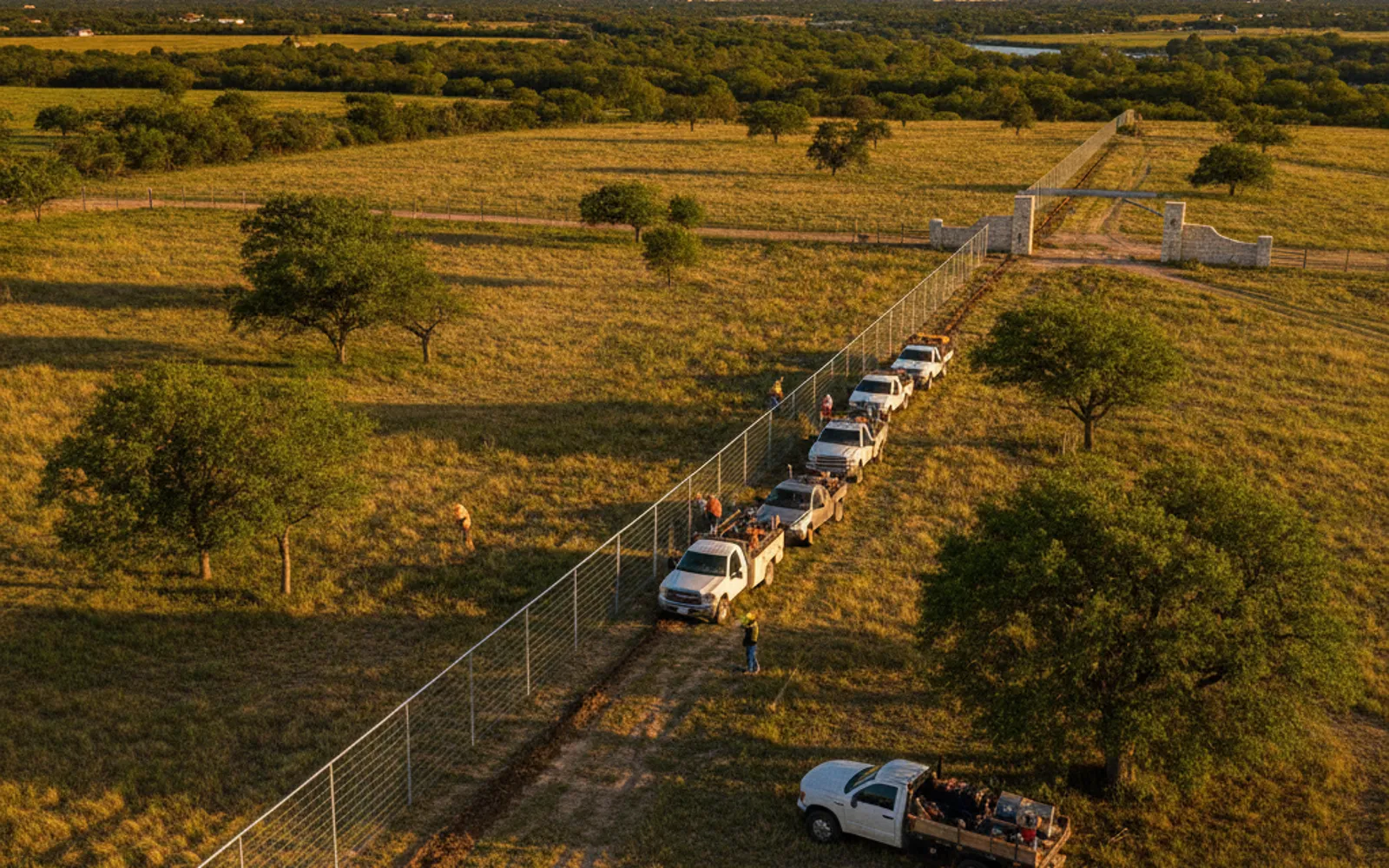
A three-rail fence looks finished the day the last board goes up. What it looks like in year seven is the part the brochure leaves out. If you are pricing a 3 rail horse fence around Waco right now, the decision that matters is not which one photographs better on install day. It is which one you are still happy with after eight Texas summers, a couple of ice storms, and a gelding who has decided the top rail is a scratching post.
We get asked about wood and vinyl rail fence most weeks, usually by somebody who just bought 10 or 20 acres and wants the front pasture to look like the places along the FM road. That is a fair thing to want. It is also the fence type where the gap between the bid and the twenty-year cost is widest, so it is worth understanding before you sign anything.
This article compares the two honestly, including where each one fails in blackland clay and limestone, and what we actually build for horse people in McLennan, Bosque, and Falls counties. If you would rather skip to real numbers on your own place, call (254) 870-8898 and we will walk the line with you. On-site estimates are free.
The Real Numbers Behind a Three-Rail Horse Fence
Start with the honest disclaimer, because this matters. Wood and vinyl rail are not the fences we price off our own cost sheet. Our published bands cover ranch fence cost for wire, mesh, pipe, entrances and cattle guards. So the wood and vinyl figures below are general market estimates for Central Texas, not a Brazos Ridge Fence quote, and you should treat them that way.
As a general estimate, installed wood three-rail with treated pine boards and set posts runs somewhere in the $9 to $18 per foot range in this market. Vinyl three-rail with a reputable extruded rail and routed posts generally runs $14 to $28 per foot installed. Materials only, before anybody sets a post, a vinyl three-rail kit commonly lands around $9 to $16 per foot and treated wood rail around $4 to $8 per foot. Those spreads are wide for a reason. Corner count, gate count, and what is under your topsoil move the number more than the rail material does.
For comparison, here is what we do quote from our own cost sheet. Horse-grade no-climb mesh prices against our net wire band of $3.50 to $8 per foot, and horse mesh sits at the upper end of that band because 2 inch by 4 inch woven wire costs more than field fence. Welded pipe fence runs $12 to $28 per foot. Those are firm ranges from real jobs, not averages pulled off the internet.
Wood Three-Rail: Cheap to Buy, Never Quite Finished
Wood is the cheaper fence to build and the more expensive fence to own. That is the whole story in one sentence, and everything below is detail.
The good part is real. A wood rail fence is visible from a dead run, which is the single most important safety property a horse fence has. A horse sees three solid boards. It does not always see wire. Both Penn State Extension and the University of Georgia Extension rank board fence highly for horses on visibility alone.
Wood also fails gracefully. A board that gets hit breaks, and a broken board is a $30 part and twenty minutes with a cordless drill. Compare that with a bent steel panel or a torn mesh section.
The costs show up later. Treated pine boards in Central Texas sun will need stain or paint on a three to five year cycle if you want them to keep looking like the day they went in. On a 1,500 foot run that is a real weekend, or a real invoice, every few years. Posts are the other clock. Ground contact rot at the soil line is what eventually takes a wood fence down, not the rails, and our shrink-swell clay pumps water in and out of that zone twice a year.
Then there are horses. Cribbers chew rails. Pasture-mates lean on them. A horse that has learned it can push a board off will keep testing it. Wood handles all of that better than vinyl does, but it does not handle it for free.
Vinyl Three-Rail: No Painting, Different Problems
Vinyl solves the paint problem completely. That is not a small thing when you are looking at 2,000 feet of white fence along a county road. There is no stain cycle, no rot at the rail, and it looks the same in year ten as year one if the product was any good.
Be careful about that last condition. Quality varies a lot between vinyl products, and the difference is mostly UV package and wall thickness. Rail that is thin or short on UV inhibitor will chalk, yellow, and get brittle in this climate faster than the warranty language suggests. Ask what the rail wall thickness is and read the warranty for what it actually covers, because most cover the material and not the labor to swap it.
Cold is the other thing people underestimate in Texas. Vinyl gets more brittle as temperature drops, and our winter is not mild every year. A rail that would flex in July can crack in a February freeze when a horse hits it. Heat runs the other direction: vinyl expands and contracts through the year, so it has to be installed with room to move or it will bow between posts.
The safety picture is genuinely mixed. Most vinyl rail systems are designed so the rail pops out of the routed post under impact rather than shattering. That is good for the horse. It also means a horse that leans hard enough will pop a rail out and walk through, which is why vinyl rail on a horse pasture is usually run with a hot wire or backed with mesh. Vinyl alone is a boundary. It is not a containment fence for a horse that has decided to leave, and any vinyl salesman who tells you otherwise has not stood in a pasture at 6 a.m. looking for a mare.
Vinyl also does not fix your post problem. Most vinyl posts are hollow, and the fence still depends on how deep and how well those posts are set. In blackland clay, that is the whole ballgame.
Ready for a number on your own place? Call (254) 870-8898 or get in touch here and we will come look at the ground before we quote anything.
Wood vs Vinyl 3 Rail Horse Fence Side by Side
| Factor | Wood three-rail | Vinyl three-rail | No-climb mesh + top rail | Welded pipe |
|---|---|---|---|---|
| Installed cost per foot | $9 to $18 (general estimate) | $14 to $28 (general estimate) | $3.50 to $8, horse mesh at the top of that band | $12 to $28 |
| Who quotes it | Market estimate, not our cost sheet | Market estimate, not our cost sheet | Our published range | Our published range |
| Recurring upkeep | Stain or paint every 3 to 5 years, replace broken boards | Wash off mildew, replace cracked rails | Retension wire, check clips | Touch up paint on cut ends |
| Typical service life | 15 to 25 years with upkeep, posts fail first | 20 to 30 years for good product, brittle failures possible | 20 to 30 years | 40 years plus |
| Contains a determined horse | Fair | Poor without hot wire or mesh | Good | Excellent |
| Stops a foal or a dog | No | No | Yes | No, unless meshed |
| Repair after a wreck | Cheap and fast | Rail replacement, color match can be an issue | Patch or restretch section | Cut and weld, needs a torch and a welder |
| Behavior in blackland clay | Post heave shows as leaning posts | Post heave shows as leaning posts and bowed rails | Wire absorbs some movement | Set in concrete, moves least |
The row that decides most jobs is the containment row. If your only fence is rail, you are relying on the horse respecting it. That works for a lot of horses and fails badly for a few. Our page on the safest fence for horses works through that trade in more detail.
Three Central Texas Jobs and What Decided Them
A 12-acre horse place outside Lorena wanted white vinyl three-rail on 1,850 feet of perimeter, and priced it out at roughly $22 a foot as a general market estimate, call it $40,000. Two mares and a pony, one of them a known fence-tester. We built 1,850 feet of horse-grade no-climb with a treated wood top rail instead, and it came in inside our net wire band at the upper end. Same clean look from the road, a fence a hoof cannot go through, and the money left over paid for the gates and a run-in shed pad.
A limestone hill section near Valley Mills is the opposite lesson. On 600 feet of that line, every post had to be drilled rather than augered, and rock drilling is specialist equipment with an operator, not something you rent for a Saturday. Post setting on that run cost more than the rails would have, whichever material we used. When the ground is rock, the rail material stops being the main variable, and anybody quoting a flat per-foot price over the phone for a line they have not walked is guessing.
A 40-acre place west of Crawford already had 900 feet of 20-year-old wood three-rail along the drive. The owner assumed the whole thing needed replacing. It did not. The rails were sound. Eleven posts had rotted at grade and were leaning, which made the entire fence look finished. Reset the posts, replace nine boards, restain, and that fence has another decade in it. That is the argument for wood in one story: the failure was cheap to find and cheap to fix.
What We Usually Build for Horses Around Waco
Here is the straight answer, and it is not the answer a rail fence salesman gives.
On small acreage with horses, the fence that does the most work per dollar in this part of Texas is 2 inch by 4 inch no-climb woven wire with a wood or pipe top rail. The mesh keeps hooves out and foals in. The rail gives the horse something to see and keeps the top of the fence from getting mashed down. It prices against our net wire band of $3.50 to $8 per foot, with horse-grade mesh sitting at the upper end, and it reads clean from the road. We cover the build in detail on our horse fence page and in our guide to no-climb horse fence.
Where somebody wants the fence to be permanent and the budget allows, welded pipe at $12 to $28 per foot is the last fence you will build on that line. Pipe is what we run on road frontage, around corrals and working pens, and anywhere horses crowd a gate.
Rail alone still has its place. Around a house, along a drive, on a dry lot where the horses are handled daily, wood three-rail is a good-looking, safe, repairable fence. Just budget for the paint cycle and set the posts properly, because in blackland clay the posts are what fails. Our notes on fence posts in clay soil cover depth and backfill.
What we will not do is tell you the material choice matters more than the ground it sits in. It does not. Two identical fences, one on flat clay pasture and one on a limestone slope, will not cost the same and will not age the same.
If you are weighing wood against vinyl on your own place, the useful next step is not another article. Call (254) 870-8898 and we will walk the line with you, look at the soil, count the corners and gates, and put a number in writing. No charge for the visit.
Frequently Asked Questions
How much does a 3 rail horse fence cost per foot in Central Texas?
As a general market estimate, installed wood three-rail runs about $9 to $18 per foot and vinyl three-rail about $14 to $28 per foot in this area. Those are not our quoted prices, and the spread depends almost entirely on your ground, your corner count and your gates. The fences we do price from our own cost sheet are horse-grade no-climb mesh at $3.50 to $8 per foot, top of that band for horse mesh, and welded pipe at $12 to $28 per foot.
Is vinyl horse fence safer than wood?
It depends on the failure you are worried about. Vinyl rails are designed to pop out of the post under impact rather than splinter, which is easier on a horse than a broken board. But vinyl gets more brittle in a freeze, and a horse leaning on it can push a rail out and walk off, so it is usually run with a hot wire or backed with mesh. Neither rail fence on its own stops a foal or a dog.
Will a three-rail fence hold up in blackland clay?
The rails will. The posts are the question. Shrink-swell clay around Waco moves through the year and works posts loose over time, which shows up as leaning posts and bowed rail lines. Set depth, backfill and bracing decide how long that takes, which is why we look at the soil on site before we quote a rail fence.
Can you repair an old wood three-rail fence instead of replacing it?
Often, yes. On rail fences we look at 20 years old, the boards are frequently still sound and the failure is a handful of posts rotted at grade. Resetting the bad posts, swapping the broken boards and restaining is a fraction of the cost of a rebuild. We will tell you honestly on site if the fence is worth saving or if you are better off starting over.