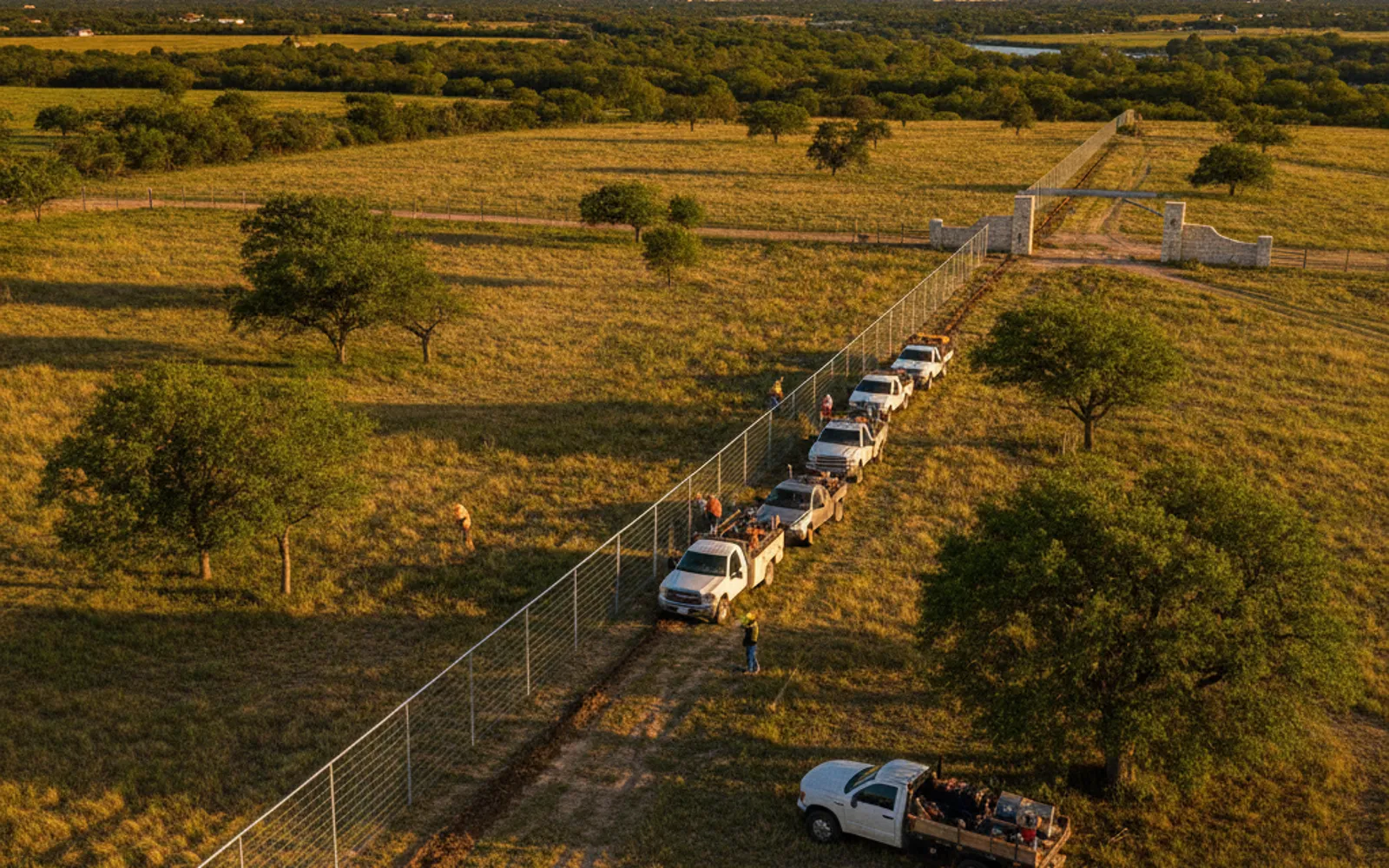
A fellow west of Crawford called us one March after his neighbor’s cows spent three nights in his winter pasture. He wanted to know who owed him a fence. The answer started with a question he had never once thought about in twenty years of owning that place: does the stock law where his land sits cover cattle, or does it not?
That is the whole game with Texas stock laws by county. Texas starts from open range, where the burden is on you to fence animals out. A county stock law flips that and makes the animal’s owner keep them in. Which rule applies to your dirt depends on an election that probably happened before your grandfather was born.
We build fence in McLennan, Bosque, and Falls counties, not law. Nothing here is legal advice. Talk to an attorney about your specific tract before you rely on any of it, because these records are old and they are local.
Open Range Is the Default and a Stock Law Is the Exception
Texas never adopted the fence-in rule that most states use. Under Texas common law, a livestock owner has no general duty to keep animals from wandering off. If you want your neighbor’s cattle out of your hay meadow, the default rule says build a fence that keeps them out.
Then the Legislature gave local voters a way out of that. Under Chapter 143 of the Texas Agriculture Code, a county or a subdivision of a county could hold an election to make it unlawful for certain animals to run at large. Where one of those passed, the range is closed and the burden moves to the animal’s owner.
Most of the settled counties in Central Texas closed the range on cattle generations ago. That does not mean yours did, and it does not mean it covers every animal. You can read the statute yourself on the Texas Legislature’s site, which is a short read and worth twenty minutes if you run stock.
If your perimeter would not stop a determined cow today, the legal question is secondary. Call (254) 870-8898 and we will walk the line with you and put a free written estimate in your hand.
Texas Stock Laws by County Are Not Something You Can Download
Landowners ask us for a map. There isn’t one, at least not one you should bet a lawsuit on. What exists is a pile of county-level records going back to the 1890s, some of them handwritten in a clerk’s minute book.
Three things make the county-by-county picture messier than people expect.
The elections were animal specific. One vote might cover cattle and horses and say nothing about hogs, sheep, or goats. Plenty of counties held separate elections years apart for different animals.
They were not always countywide. The law allowed subdivisions, so a stock law can apply to one commissioner precinct, or to an area described by old survey lines and roads that no longer exist by that name.
And they stayed on the books. A stock law adopted in 1912 is still the rule unless a later election repealed it, so age tells you nothing about whether it applies.
Every online list of closed-range counties we have seen carries a disclaimer, and it should. Treat those lists as a starting point and nothing more.
How to Check the Stock Law in Your County and Precinct
This is a phone call and a courthouse visit, not a research project. Here is the order that works.
Start with the county clerk. Ask for the commissioners court minutes and any recorded stock law elections for your precinct, and ask which animals each one covered. Some clerks have this indexed and will read it to you over the phone.
Call the sheriff’s office next. Deputies handle loose-stock calls every week and they generally know how the county treats them, which is useful even though it is not a legal opinion.
Then check your deed and survey against the precinct boundaries. If your tract straddles a line, you can genuinely have two answers on one piece of property.
If money or liability is on the table, pay an attorney or a title company to pull the records and give you a written answer. Texas A&M AgriLife’s Texas Agriculture Law blog is the best free plain-English resource on this subject, and it will save you time before you ever call a lawyer.
We cover this same ground from the other direction in our post on Texas open range law, which explains the fence-out rule itself.
Highways Have Their Own Rule, Stock Law or Not
Here is the part that catches people. Separate from any county stock law, the Agriculture Code makes it an offense to knowingly permit livestock to run at large on a highway. That applies whether the range around you is open or closed.
The catch is the definition. For that section, the code defines highway narrowly, as U.S. and state highways. Numbered farm-to-market roads and county roads are treated differently, and Texas courts have declined to read a general duty to fence into those roads for open-range areas.
So the honest summary is this. Frontage on a U.S. or state highway carries a duty that does not depend on your county’s stock law. Frontage on an FM road or a county road depends on the local stock law and on the facts of the wreck. Either way, a jury looking at a night-time collision will hear about the condition of your fence.
That is a fence conversation more than a legal one. We go deeper on the wreck side in our post on cattle on road liability in Texas.
What a County Stock Law Changes About the Fence You Build
A stock law does not build fence and it does not decide who pays for a boundary fence. That is a separate question with its own rules, covered in who pays for the fence between neighbors in Texas.
What the stock law changes is your exposure. In closed range, an animal of yours out on the road or in a neighbor’s crop is your problem from the first minute. That moves the fence from a grazing tool to a liability line, and it changes what we recommend on the frontage side of a place.
Here is what those choices cost in McLennan, Bosque, and Falls counties in 2026.
| Fence type | What it holds | Installed cost | Where it earns its keep |
|---|---|---|---|
| 5-strand barbed wire | Cattle on open pasture | $2.50 - $5.50 per foot | Back and side perimeter, cross fencing |
| Net wire / field fence | Goats, sheep, calves, mixed stock | $3.50 - $8 per foot | Small acreage, roadside, horse mesh at the top of the range |
| 8-ft game fence | Deer and exotics | $4.50 - $10 per foot | High-fence operations, whole-tract perimeter |
| Welded pipe fence | Anything, permanently | $12 - $28 per foot | Road frontage, corrals, entrances |
| Cattle guard, installed | Keeps stock in at an open gate | $3,500 - $8,000 | Drives and interior crossings |
On big tracts, think in miles. Barbed wire runs roughly $13,200 to $29,000 per mile and game fence $25,000 to $50,000 per mile, with rock and brush driving the spread. Our ranch fence cost page breaks down what moves a bid up or down.
Three jobs from this year show how the answer plays out on the ground.
That 300-acre cattle lease west of Crawford squares out to about 2.7 miles of perimeter, which is real money to rebuild all at once. We priced the half mile along the county road first, five-strand barbed wire with pipe corners, which lands around $6,600 to $14,500 at the per-mile range above. The back side stayed as it was for another season. If the range is closed on cattle where he sits, the road half is exactly where the first dollar should go, and if it is open, it still is, because nobody wins a fight over a dead cow on the pavement.
A 12-acre horse place outside Lorena runs about 2,900 feet of perimeter. The owner’s plan was three strands of barbed wire, on the theory that the county’s stock law would keep the neighbor’s cattle where they belonged. Stock law has never kept a horse from putting a leg through barbed wire. We built no-climb mesh at the top of the net wire band, $6 to $8 a foot, so call it $17,000 to $23,000 for the perimeter, with the strongest section on the road side. There is more on that choice in our post on no-climb horse fence and on our horse fence page.
Then there is the limestone north of Valley Mills. On a hill section where every post has to be drilled instead of augered, the same five-strand barbed wire that prices near the bottom of the band on blackland pasture moves toward the top of it, five dollars a foot and up. On one 1,400-foot ridge line that difference was several thousand dollars, and no legal answer about the stock law made the rock any softer. Our barbed wire fence page covers spacing and bracing for that kind of ground.
Want a real number for your place instead of a range? Call (254) 870-8898 or reach us through the contact form and we will come walk it. The estimate is free and we do not quote before we have seen the line.
What We Tell People to Do About It
Find out which rule applies before you need to know. It costs a phone call, and the answer usually arrives the same week.
Then fence to the risk, not to the statute. Open range is a defense in a lawsuit, not a fence, and it does nothing for the calf that is already on the highway. Put your money on the frontage and the corners first, then work back. Loose stock nearly always comes out of the same weak spots, which we listed in why cattle keep getting out of the fence.
Write down what you find. If a wreck or a crop claim ever happens, being able to show which stock law applies and when your fence was last inspected puts you in a much better position than a hazy memory of what somebody at the feed store said.
Frequently Asked Questions
How do I find out if my county has a stock law?
Call the county clerk and ask for recorded stock law elections covering your precinct, and ask which animals each one named. The sheriff’s office can tell you how loose-stock calls are handled in practice. For anything with money on it, have an attorney or title company pull the records and put the answer in writing.
Does a stock law mean my neighbor has to pay for the boundary fence?
No. A stock law governs whether animals may run at large. Who pays for a shared fence is a separate matter that usually comes down to agreements, prior use, and what the two of you work out. Get any cost-sharing arrangement in writing before the first post goes in.
Is Texas open range or closed range?
Both, depending on where you stand. The statewide default is open range, and counties or precincts that passed stock laws are closed for the animals those elections named. That is why there is no single reliable map for the whole state.
What fence do I need if my county is closed range?
The law does not specify a fence type. It says keep your animals in, so build what your stock actually respects: five-strand barbed wire at $2.50 to $5.50 a foot for cattle on pasture, net wire at $3.50 to $8 for small stock and horses, pipe at $12 to $28 where the pressure is highest. Call us at (254) 870-8898 for a free on-site estimate and we will tell you which sections need it first.