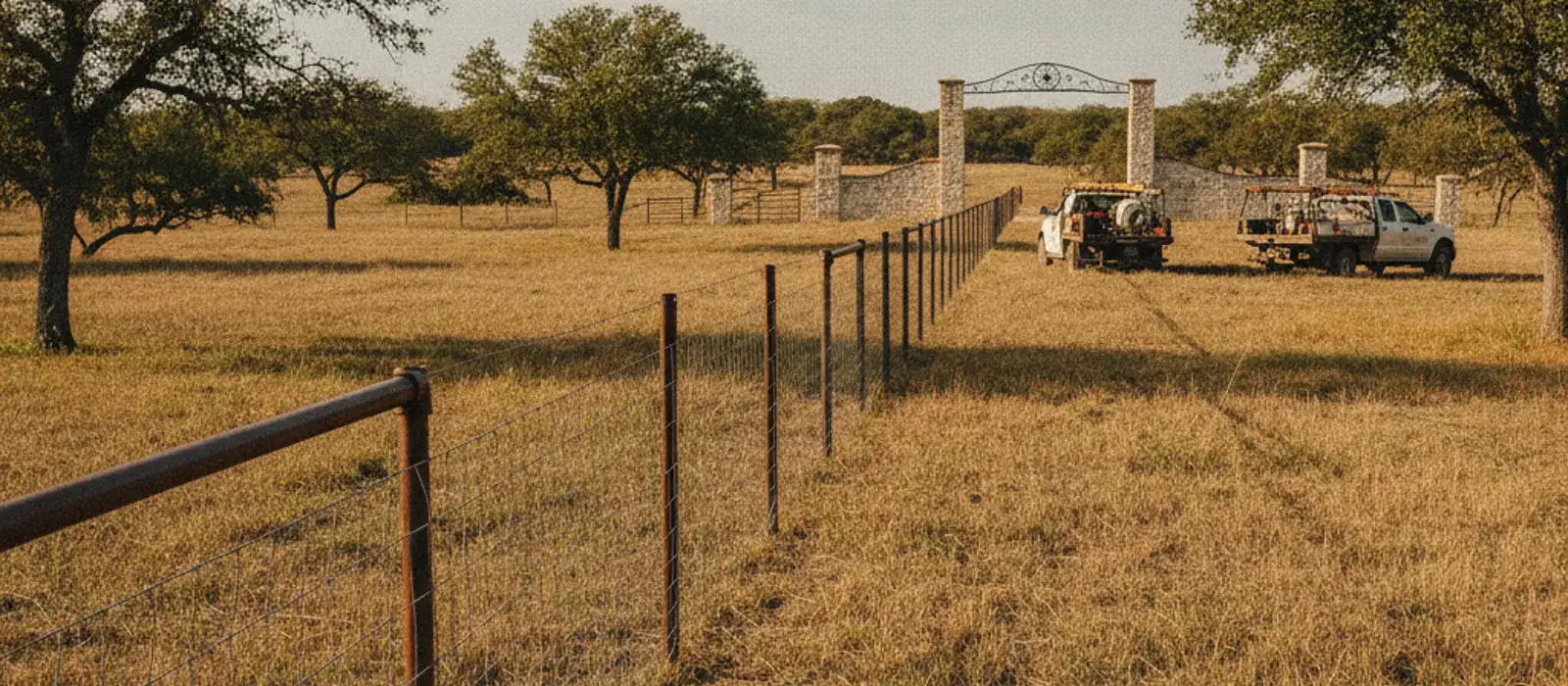
Most of the fence repair calls we run in McLennan County trace back to a failed post, not failed wire. The wire gets the blame, but the post did the quitting. That’s why the cedar vs treated pine fence posts question deserves a straight answer, because picking the wrong post is the most expensive small decision you’ll make on a ranch fence.
Get it right and your fence stands 25 to 40 years. Get it wrong and you’re pulling rotten stubs out of black clay in year six, paying twice for the same quarter mile.
We build fence every week across Waco, China Spring, Crawford, McGregor, Valley Mills, Lorena, and West. We’ve set thousands of both kinds of posts and dug out thousands more that failed. Here’s what we’ve learned, with real numbers.
Why the Post Decision Matters More Than the Wire
A five strand barbed wire fence is only as good as what’s holding it up. Wire almost never wears out first. Posts do.
Here’s the math that stings. Line posts run 10 to 20 feet apart on most ranch fences. On a quarter mile of fence, that’s 65 to 130 posts. If your posts fail at year 8 instead of year 30, you don’t just buy new posts. You pay for pulling the old ones, hauling them off, re-drilling holes, resetting, and restretching wire. Replacement almost always costs more than the original build.
Dale, who runs cows northwest of Crawford, learned that the hard way before he called us. A previous crew set his line posts with cheap untreated pine timbers in 2019. By 2023 he could push them over by hand. Redoing a quarter mile of line posts and restretching the wire ran him about $3,800. The right posts up front would’ve added maybe $400 to the original job.
So before you compare wire types or strand counts, get the post question settled. If you’d rather talk it through with somebody who sets posts for a living, request a free written estimate or call us at (254) 870-8898. We’ll shoot you straight on what your soil and stock actually need.
Cedar Fence Posts: What the Old Timers Got Right and Wrong
Drive any county road in Bosque County and you’ll see cedar posts that have stood since before most of us were born. That’s not a myth. It’s also not the whole story.
The cedar on those old fences is heartwood, the dense reddish center of a mature tree. Heartwood is loaded with natural oils that resist rot and insects. A true heartwood cedar post, the kind with almost no white wood on it, can last 20 to 25 years in Central Texas ground, sometimes longer in dry, well drained spots.
The problem is what’s sold as “cedar posts” today. A lot of it is young, fast cut Ashe juniper with a thin core of heartwood wrapped in two inches of white sapwood. Sapwood has none of that natural protection. It can rot off at the ground line in 5 to 7 years, and the skinny heartwood core left behind won’t hold a fence tight.
Marcy runs goats and a few horses outside Valley Mills, and her granddad’s cedar corner posts from the 1990s are still solid. When she added new cross fencing in 2021, she bought a trailer load of bargain cedar at $9 a post. By last spring, 14 of them had rotted through at the dirt. Replacing them, plus fixing the sagging wire they let loose, cost her right at $1,100.
Cedar’s other weak spot is brittleness. Old dry cedar snaps under impact. A 1,300 pound bull leaning on a cedar line post is one thing. That same bull hitting it at a run is another, and cedar loses that fight more often than treated pine does.
What cedar still does well:
- Looks right. That silver gray weathered post is the classic Texas ranch look, and nothing else matches it.
- No chemicals. Some folks want untreated wood near gardens, wells, or organic operations.
- Corner and gate posts in big diameters. A fat 8 inch heartwood cedar corner is a genuinely good post.
Treated Pine Fence Posts: What That Green Tint Actually Buys You
Treated pine posts are plantation grown southern yellow pine, pressure treated with preservative that’s forced deep into the wood. Pine takes treatment better than almost any other species because its sapwood is thick and absorbent. That’s the whole trick. The part of the tree that rots fastest in cedar is the part that carries the protection in pine.
Done right, a treated pine post is the most rot resistant wood post you can buy. The USDA Forest Products Laboratory has run ground contact stake tests for decades, and properly treated pine routinely outlasts naturally durable species in ground contact. You can dig into their wood durability research at the Forest Products Laboratory.
The catch is those two words: done right. Treatment quality varies a lot, and this is where most treated post horror stories come from.
Look for these three things:
- Retention level. For fence posts, you want CCA treated posts rated for ground contact, generally 0.40 pcf retention or better. Landscape timbers and “ground contact” deck lumber at 0.15 to 0.23 are not fence posts, no matter what the pallet sign says.
- A quality stamp or tag. Reputable posts carry a tag showing the preservative, retention, and inspection agency.
- Full penetration. Cut ends and dry centers on poorly treated posts rot from the inside out.
A fellow named Kurt near West found this out in 2022. He bought a bargain pallet of untagged “treated” posts at an estate sale for a new hay trap. Within three years the ground line on most of them had gone punky, and he paid us about $2,100 to pull and replace 60 of them with properly rated posts. The tagged posts would’ve cost him roughly $250 more the first time.
If you’re wondering about the chemicals, CCA is restricted for most residential lumber but still approved for agricultural fence posts. The EPA keeps a plain language rundown of wood preservatives and where each is allowed at epa.gov.
Cedar vs Treated Pine Fence Posts: Cost and Lifespan Side by Side
Here’s how the two stack up on the jobs we build around Waco. Prices are typical retail ranges as of this year and will swing with diameter and supplier.
| Factor | Cedar (true heartwood) | Treated pine (CCA 0.40+) |
|---|---|---|
| Line post, 4 in x 6.5 ft | $12 to $22 | $8 to $14 |
| Corner or brace post, 6 to 8 in | $30 to $60 | $22 to $40 |
| Expected life in Central Texas soil | 15 to 25 years, less if sapwood heavy | 25 to 35 years |
| Ground line rot risk | Low for heartwood, high for sapwood | Low when properly treated |
| Impact strength | Fair, brittle when old and dry | Good, flexes before it breaks |
| Holds staples | Fair, can split | Good |
| Insect resistance | Natural, heartwood only | Chemical, full post |
| Consistency post to post | Varies a lot | Very consistent |
| Looks | Classic silver gray ranch look | Green fading to gray brown |
On a full quarter mile with around 90 line posts, the post material difference between good cedar and good treated pine usually lands between $300 and $700. That’s real money, but it’s small next to the cost of rebuilding early. Lifespan and treatment quality matter far more than the sticker price per post.
For the full picture of what a complete fence runs, our ranch fence cost guide breaks down materials and labor per foot.
What Central Texas Clay, Heat, and Drought Do to Both
Soil is the referee in this fight, and around here the referee plays rough.
Most of McLennan and Falls County sits on blackland clay. That clay swells when it rains and shrinks hard in drought, opening cracks along every post. Those cracks funnel water straight down the post face, then seal up and hold that moisture against the wood for weeks. It’s a near perfect rot chamber, and it’s why the ground line, not the buried tip, is where posts fail. We cover the mechanics in our post on setting fence posts in clay soil.
Treated pine handles this cycle better because the protection goes where the rot happens. Sapwood heavy cedar fails fastest in exactly these conditions.
West of the Bosque River, around Crawford, Valley Mills, and parts of McGregor, you run into shallower, rockier, better drained ground. Cedar performs noticeably better there. Less standing moisture at the ground line means heartwood cedar can genuinely reach that 25 year mark.
Heat and drought punish cedar in one more way. Extended dry spells check and split dry cedar, and checked posts shed staples and snap easier. Texas A&M AgriLife Extension publishes solid fencing guidance for exactly our conditions, and it’s worth a read before any big build.
One thing no post choice fixes: bad bracing. A 35 year post won’t save a corner that wasn’t built right. If your corners lean, the post species was never the problem. See our guide on H-brace fence corners for how a corner should actually be built.
What We Actually Set on Jobs Around Waco
After all the back and forth, here’s the honest answer we give customers at the kitchen table.
For most working barbed wire fences in our area, we set properly treated pine for corners, braces, and wood line posts, usually mixed with steel T-posts between them. It’s the most predictable post you can buy. Every post on the trailer has the same protection, which isn’t something you can say about a load of cedar. If you’re weighing wood against steel for your line posts, our T-post vs wood post comparison walks through that call.
We reach for cedar when it fits: entrance fences and yard fences where looks matter, well drained rocky ground, and customers who want no treated wood on the place. When we do, we’re picky. Big diameter, heavy heartwood, minimal white wood. We’ll reject half a supplier’s stack to get it.
And for corners and gates that take serious abuse, or anywhere horses and heavy cattle crowd a fence line, welded pipe fence beats both woods and never rots at all.
A word on DIY. Swapping a handful of line posts is a fine weekend job if you can match the set depth and get the tamping right. But if you’re seeing rot across a whole stretch, if corners or gate posts are moving, or if cattle are already testing weak spots, stop and get help before a small problem becomes a loose herd on FM 185. Bracing and stretching under tension can hurt you, and a poorly rebuilt corner fails the whole fence.
Want a straight recommendation for your soil and your stock? Ask for a free written estimate or call (254) 870-8898. We’re licensed and insured, and if a storm or a cattle-out emergency can’t wait, that line answers 24/7.
Frequently Asked Questions
How long do cedar fence posts last in Texas?
True heartwood cedar posts typically last 15 to 25 years in Central Texas, and longer in dry, rocky, well drained ground. Sapwood heavy cedar can rot off at the ground line in as little as 5 to 7 years, especially in blackland clay. The quality of the individual post matters more than the species name on the invoice.
What treatment rating should treated pine fence posts have?
For fence posts, look for CCA treated posts with a retention of 0.40 pcf or higher, tagged for ground contact by an inspection agency. Landscape timbers and light duty treated lumber around 0.15 to 0.23 retention will rot in a few years when buried. If a post has no tag and no stamp, treat it as untested and price it accordingly.
Is treated pine safe to use around livestock?
Yes, properly treated and dried posts are widely used on cattle, horse, and goat operations, and CCA remains approved for agricultural fence posts. The preservative is bonded into the wood, so normal contact and occasional chewing aren’t considered a meaningful risk. Don’t burn old treated posts, and keep sawdust from cutting them out of feed areas.
Can I mix cedar and treated pine posts in the same fence?
You can, and plenty of ranches do. A common setup is treated pine or pipe at the corners and gates, where strength and lifespan matter most, with cedar or T-posts on the line. Just remember the fence ages at the speed of its weakest posts, so keep the quality consistent within each stretch.